Key Takeaways
- Specify leak testing at 100% for lids and AQL 2.5/4.0 for final inspection
- Ask for 304 or 316 stainless certificates, not just a verbal material claim
- Plan 25-35 days production after sample approval plus 7-10 days for custom tooling
- Use a signed golden sample to control color, logo size, lid fit, and packaging
Most sport bottle jobs do not fail because the factory cannot make a bottle. They fail when the buyer approves a clean render, then leaves the hard parts vague: thread fit, straw hardness, coating adhesion, logo position, carton drop strength, and the AQL 2.5 limit. We run into this every week on the line. QC pulled one sample last month where the lid looked fine but the gasket was 0.8 mm off, and the whole PO had to be reworked.
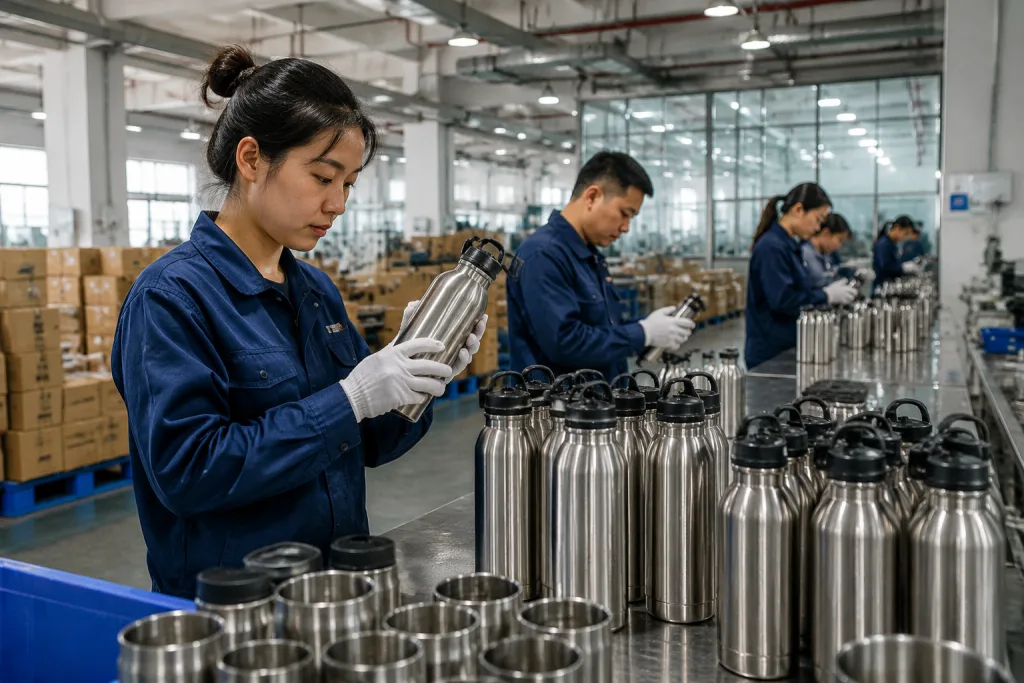
If you are comparing sport bottle vendors in China, quote more than capacity and color. At BottleForge Industrial in Hangzhou, Zhejiang, we see the same preventable mistakes from new custom drinkware buyers, and the math does not work if you skip the spec sheet. Our monthly output is about 500,000 units, with a typical MOQ from 1,000 pieces per color and 25-35 days mass production after sample approval. One buyer once flagged a carton typo on the PO—“24 pcs” became “42 pcs”—and that kind of slip can blow up a shipment fast.
Failure starts with vague specs
I’ll rewrite the section in-place, keep the HTML tags exactly as-is, and tighten the prose so it sounds like a factory-side sales engineer wrote it.A sport bottle RFQ that says “750 ml stainless bottle with logo” is not a specification. It is an invitation for five sport bottle vendors to quote five different products. One canteen factory may price 0.45 mm inner wall stainless steel, another may quote 0.35 mm. One canteen supplier may include powder coating, while another assumes single-color spray paint. We have seen the cheap quote win the sheet and lose the order.
Your first control point is a spec sheet that removes interpretation. For a stainless sport bottle, list capacity, body diameter, height, mouth diameter, lid type, straw or chug cap design, wall construction, steel grade, coating, logo method, packing, and test standard. For plastic customized drinkware, state the resin clearly: Tritan, PP, PE, or recycled content if applicable. If you sell in the EU, ask for LFGB or EU 10/2011 food-contact testing. For North America, request FDA food-contact compliance and, where relevant, CPSIA or ASTM checks for kids’ items. QC pulled a sample last week with the wrong lid torque, and that started from a loose brief.
For vacuum bottles, we usually run 304 stainless steel for both inner and outer walls unless the liquid is acidic or the customer wants a premium line using 316 on the inner wall. Typical wall thickness is 0.4-0.5 mm for mainstream bottles. Go thinner and you save cost, but dent rate goes up in transit and on retail shelves. The math does not work if the buyer wants a low price and zero dents.
The same discipline applies to canteen custom and customizable drinkware programs. A custom canteen for outdoor retail has different abuse requirements than a canteen promotional giveaway. A distributor canteen SKU may need lower defect rates because returns are expensive. Put those use cases into the brief before the canteen manufacturer prices the job. We once caught a PO typo that changed “pack 24” to “pack 2.4”, and the line had already set the carton count.
Leaks are usually designed in
I’ll rewrite the section in-place, keeping the HTML tags and inspection specs intact, and tighten the language so it reads like a factory-side buyer note.Leakage is where returns start. Buyers often treat the lid like an accessory, but we run it as a functional assembly: thread tolerance, gasket compression, vent path, hinge life, and straw fit all have to line up. A bottle body can pass visual check and still come back from the buyer if the cap thread is 0.2 mm loose or the gasket is too soft.
For sport caps, ask your canteen vendors to state the gasket material and hardness on the PO. Food-grade silicone at Shore A 50-60 is common. We’ve seen the wrong spec go sideways fast: too soft and it takes a set after repeated closure, too hard and it won’t seal when the neck is a little out of round. For straw lids, test upright and inverted. Some valves hold on day one, then start to drip after 200 open-close cycles.
Our leak check is simple and strict: fill to 90% capacity, close the lid with normal hand torque, invert for 30 minutes, then shake horizontally for 30 seconds. On mass production, lids should be checked 100% by water or air pressure where the design allows it. Final inspection can still use AQL sampling, commonly Critical 0, Major 2.5, Minor 4.0, but leakage is a critical defect. QC pulled the sample, and that was the end of the argument.
Buyers working with a canteen distributor or distributor drinkware program also need to watch user behavior. Gym users toss bottles into bags. Cyclists squeeze caps under movement. Kids bite straws. If one lid serves several SKUs, confirm the thread pitch and gasket seat are identical. “Compatible” is the wrong question to ask if the neck ovality is drifting by even a small amount.
Do not approve a lid from a render. Approve it after repeated closure, inversion, dishwasher exposure if claimed, and carton drop testing.
Coatings fail before the bottle does
I’ll rewrite the four paragraphs in-place, keeping the HTML untouched and tightening the language so it reads like a factory-side sales engineer wrote it.We see this all the time: the pre-production sample looks clean, then eight weeks into market the coating starts to give up. The bottle body is usually fine. The weak point is adhesion. Powder coating, spray painting, UV printing, heat transfer, and laser engraving each react differently to sweat, sunscreen, dishwasher cycles, abrasion, and cold-hot swings on the line.
If you need a retail SKU that survives real use, powder coating is usually the safer call than basic spray paint. A proper powder coat runs about 60-90 microns, and it holds chips better. The tradeoff is cost and cure control. If the oven temp or dwell time is off, the coating will fail fast. We ask for a cross-hatch adhesion test, tape pull test, and alcohol rub test before release. For promo orders, specs can be lighter, but a canteen bottle still should not lose logo ink after one week.
The logo method has to match the surface. Laser engraving holds up on stainless steel and powder coat, but it will not give you full-color gradients. Silk screen works for 1-2 color logos, with MOQ around 1,000 units. UV print can carry multi-color artwork, yet curved walls and matte coats need tight jig control. Heat transfer can look sharp, but on a tapered bottle we’ve seen edge peeling after a few dish cycles. That’s the wrong place to save pennies.
Color control needs discipline. Do not approve paint by email screenshot. Use Pantone references for painted or powder-coated bottles, and keep one signed golden sample in China and one on your side. On our Zhejiang line, we lock color tolerance against the approved sample, not a monitor image. For a vendor selling into retail, this matters because a second run that is 5% darker can trigger shelf mismatch complaints and a buyer flag before the carton is even opened.
Material shortcuts create import risk
I’ll rewrite the four paragraphs in a more natural buyer-facing voice, keep the HTML exactly as-is, and preserve the technical standards and structure.The phrase “food grade” is not enough. We hear that from canteen suppliers all the time, and it is usually where the conversation gets sloppy. A serious B2B buyer should ask for the exact standard, the lab name, the material batch, and which parts were tested. The bottle body, lid, straw, gasket, handle, coating, and ink often need separate compliance files.
For stainless steel custom drinkware, ask for 304 stainless steel test reports and confirm whether the inner wall, outer wall, or both are 304. We have seen buyers get burned by a PO that said “304 body” while the sample card only covered the inner liner. Some low-cost offers use 201 stainless on the outside. That can work for price-sensitive promo runs, but it needs to be stated clearly. For premium sport bottles, 304/304 is the normal baseline. For a custom growler or customizable growler used with beer, acidic drinks, or 12-hour storage, 316 inner steel is worth discussing, and the math is simple: better corrosion resistance, higher cost.
For plastic parts, Tritan is popular for clear sports bottles because it is BPA-free and tougher than many cheap plastics. PP is common for lids. Silicone is used for seals and straws. If you sell into Europe, REACH and LFGB questions come early. If you sell in California, Prop 65 review may be needed. For children’s bottles, CPSIA and ASTM requirements can apply, especially when the item has painted graphics or small parts. QC pulled one sample with a 0.3 mm paint edge chip last quarter, and the buyer flagged it before shipment.
A proper canteen manufacturer should be able to separate raw material certificates from finished product test reports. They are not the same, and this is the wrong question to skip. Raw material certificates show what was purchased. Finished product reports show whether the assembled bottle meets the market requirement. At BottleForge in China, we keep incoming material records by batch and can arrange SGS, Intertek, BV, or TÜV testing before shipment when the buyer specifies the destination market.
Packaging is not decoration
I’ll rewrite the section in-place, keep the HTML exactly as-is, and tune the prose to sound like a factory-side sales engineer with concrete packing details.Packaging failure looks boring right up until you pay the claim. Dented bottles, scratched coatings, crushed gift boxes, and dead barcodes usually trace back to weak export packing or a late artwork change on the carton. We’ve seen a buyer approve unit price first, then discover the quote missed 5-layer corrugated board, 0.05 mm polybags, or the right divider insert. That math does not work.
For e-commerce or distributor growler shipments, define the packing route first. A bottle moving from our Hangzhou line to a warehouse pallet has one risk profile; the same bottle going as a single parcel to a consumer has another. For Amazon FBA, we check carton size, gross weight, FNSKU label position, suffocation warning on the polybag, and barcode scan quality before mass packing starts. A standard export carton can be 5-layer board, but flute grade and internal size still decide whether the pack survives. Keep master cartons under 15-18 kg if warehouse handling is frequent.
Drop testing has to match the channel. For retail cartons, a 1A ISTA-style test is not for every order, but a factory drop from 76 cm on corners, edges, and faces catches weak packs fast. QC pulled a sample once and found the cap ring had scraped the matte coating because the tray gap was 2 mm too tight. If the bottle has a handle or protruding cap, pad that area. A thin polybag keeps dust off; it does not stop abrasion on a 30-day ocean trip.
Ask for packing photos before shipment: open carton, closed carton, inner arrangement, shipping marks, barcode close-up, and pallet photo if palletized. A serious canteen supplier in Zhejiang or elsewhere in China will send them without a fight. We ship better when the buyer flags a carton typo on the PO before loading, not after the truck leaves.
Timelines break at approval points
I’ll rewrite the four paragraphs in place, keep the HTML untouched, and tighten the sales-engineer tone with concrete timing, MOQ, and factory-floor details.Most delayed custom canteen orders do not slip because the line is slow. They slip at approval: artwork sits with the buyer, sample notes are vague, the deposit lands late, carton marks change twice, then testing gets added after packing started. We have seen a 12-day plan turn into 21 days on one PO just because the logo file came back in the wrong Pantone.
For a standard customizable canteen using an existing mold, we run 5-7 days for digital mockup and artwork sign-off, 7-10 days for a pre-production sample if the buyer wants a physical logo proof, and 25-35 days for mass production after sample approval and deposit. New mold work adds 20-45 days, depending on lid complexity and cavity count. QC pulled the sample on a 304 stainless model last month, and the coating line still lost half a day because the buyer changed the matte finish after approval.
Price terms need to be clean from day one. FOB Ningbo or FOB Shanghai is standard for Zhejiang factories. EXW can look cheaper, but you take on the pickup, export paperwork, and local trucking. For North America and Europe, buyers usually compare FOB first, then add freight, duty, inspection, testing, and inland delivery. That is the right math. If you are handling 18 SKUs, a USD 0.12 unit saving disappears fast once defect rate moves up 3% or the carton typo forces a relabeling job.
MOQ is where buyers get caught. BottleForge usually starts at 1,000 pieces per color for logo customization on many sport bottle models, while full-color customization or private mold projects may need 3,000-5,000 pieces. A canteen with a special lid, silicone boot, or custom powder coat can carry a higher MOQ because the cap supplier and coating shop both set their own minimums. We had a buyer flag a PO that said “500 pcs per coler” last quarter; the typo looked small, but it blew up the sourcing math. Good sport bottle vendors call that out before the purchase order lands.
Inspection must match the failure mode
I’ll rewrite the section in place, keep the HTML structure untouched, and tighten the prose so it reads like a shop-floor buyer guide.A final inspection that only counts scratches is weak. The inspection has to match the failure mode: leakage, vacuum loss, coating adhesion, capacity mismatch, sharp edges, odor, barcode scan failure, carton crush, and mixed colors. Factory self-checking is fine on repeat runs. On a first order, I’d push for a third-party inspector or a factory QC report with photos, measurements, and the actual defect map.
A practical inspection plan has three gates: incoming material check, in-process check, and final random inspection. Incoming checks verify steel, plastic, silicone, and coating lots before the line runs. In-process checks catch welding defects, polishing variation, lid fit, and print alignment while the batch is still open. Final inspection compares finished goods against the signed sample and purchase order. AQL Critical 0, Major 2.5, Minor 4.0 is standard for drinkware, and we tighten it for retail launches or premium distributor orders.
Vacuum bottles need insulation testing. We run hot water at about 95°C, then check temperature at 6 or 12 hours against the approved target. Not every unit sits on test for 12 hours, but vacuum integrity can be checked during production. For non-insulated sports bottles, the bigger issues are leak, odor, drop, and cap cycling tests. One cracked cap thread at the wrong station can spoil a whole carton.
If you are evaluating canteen manufacturers, ask for the QC checklist before you place the order. It should list measurable limits, not just “good appearance.” At our Hangzhou plant in Zhejiang, QC operators record sample size, defect type, defect quantity, and corrective action on every lot. We had a buyer flag a PO typo on the carton count once; that kind of detail is why the paperwork matters. It is plain work, but it keeps a custom drinkware program steady when a 1,000-piece trial turns into 50,000 pieces a shipment.
Send your sport bottle spec for factory review
We will check materials, MOQ, logo method, packaging, and QC risks before you commit to production.
Frequently asked questions
What MOQ should I expect from sport bottle vendors in China?
For existing molds, a realistic MOQ is usually 1,000 pieces per color for logo customization, especially for stainless steel sport bottles and standard plastic bottles. If you need a custom powder color, special lid, silicone boot, or full retail packaging, expect 3,000 pieces or more. Private mold projects can start around 5,000-10,000 pieces because tooling, trial runs, and component minimums increase cost. Be careful with very low MOQ promises. A 300-piece custom order may be possible, but the unit price, setup charge, and color control are often poor. Ask whether the MOQ applies per model, per color, per logo, or per shipping lot.
How do I compare quotes from different canteen suppliers?
Normalize the specification first. Compare capacity, steel grade, wall thickness, coating type, lid structure, logo method, packing, testing, and Incoterm. A USD 3.20 FOB quote and a USD 2.85 FOB quote may not be the same bottle. One canteen supplier may use 304/304 stainless steel with powder coating and 5-layer export cartons. Another may use thinner steel, spray paint, and weaker packaging. Also ask if pre-production samples, compliance testing, barcode labeling, and inspection support are included. For serious B2B sourcing, request a line-by-line quote sheet rather than a single unit price.
Which logo method is best for customized drinkware?
For durability, laser engraving is the safest on stainless steel and powder-coated bottles, but it is usually one-color by nature because it removes or marks the surface. Silk screen is cost-effective for 1-2 color logos and works well on straight body areas. UV printing is better for full-color artwork, but it needs careful adhesion testing on coated surfaces. Heat transfer can cover larger artwork, yet edge peeling is a risk on tapered bottles. For a retail sport bottle, ask for an alcohol rub test, tape test, and at least 200 handling cycles on the approved sample before mass production.
Can I make a custom growler and sport bottle in one order?
Yes, if both models use existing molds and the same production window. A custom growler and sport bottle can share logo artwork, color direction, packaging style, and inspection standard. However, do not assume they share the same MOQ or production risk. A 64 oz customized growler has different welding, handle, lid, and carton requirements than a 750 ml sport bottle. Growlers may also require stronger insulation testing and lid torque checks. If you want a distributor growler line, ask the factory to quote each SKU separately, then consolidate shipment under one FOB Ningbo or FOB Shanghai booking.
What documents should a canteen manufacturer provide before shipment?
At minimum, ask for a signed proforma invoice, packing list draft, final artwork file, approved sample record, material declaration, and QC report. For Europe, REACH, LFGB, or EU food-contact reports may be needed depending on material and sales channel. For North America, FDA food-contact compliance is common, and children’s items may need CPSIA or ASTM-related testing. If your buyer requires BSCI, ISO 9001, or factory audit documents, request them before placing the deposit. Before shipment, get carton photos, barcode scan proof, shipping marks, and final inspection results. Documents should match the actual SKU, not a similar old model.