Key Takeaways
- A basic 600 ml Tritan sport bottle usually lands at USD 1.45-2.10 FOB China at 1,000 pcs.
- For custom drinkware, MOQ often starts at 500 pcs for stock shapes and 3,000 pcs for deeper customization.
- Expect 7-10 days for samples, 25-35 days for production, and 25-40 days for ocean freight to Europe or North America.
- Ask for REACH, LFGB, FDA, ISO 9001, BSCI, and an AQL 2.5/4.0 inspection plan before you approve a quote.
If you are buying from a sport bottle vendor, the quote looks clean until you put three suppliers side by side. One sends a low unit price, one adds tooling on page 2, and one buries packaging, testing, and carton charges until the last line. That is where margin leaks out.
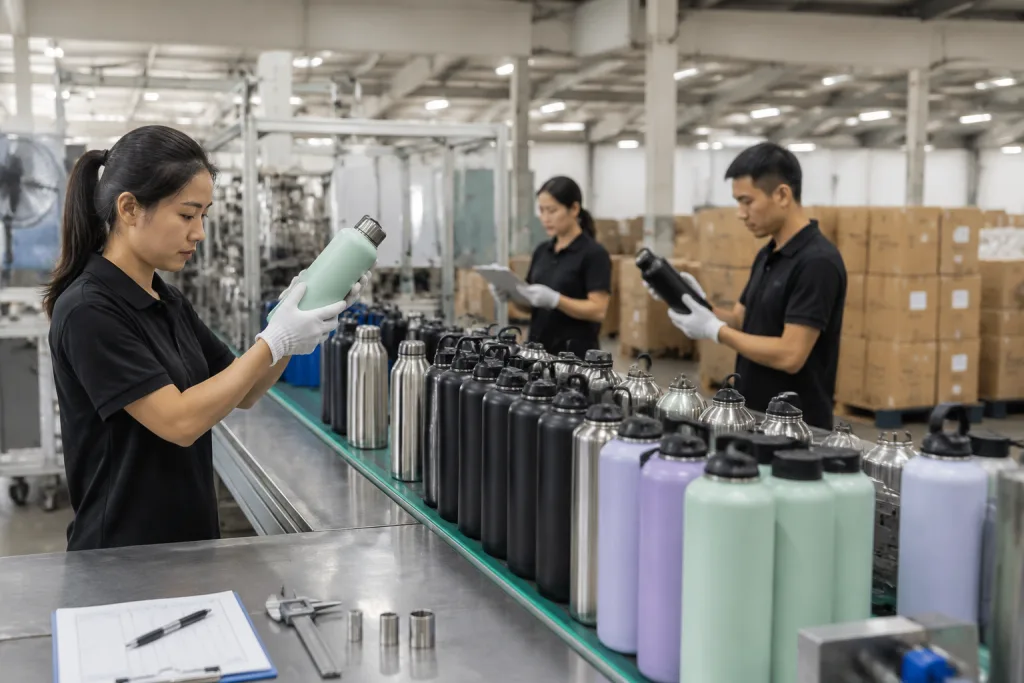
The better way to buy custom drinkware is to split the order into cost drivers and lead-time blocks before you ask for samples. A serious canteen factory in Zhejiang should give you material grade, decoration method, MOQ, sample days, and ship window without drama. Our Hangzhou plant runs 320,000 units per month, and we see the same thing on the line every week: the cheapest quote is usually not the cheapest landed cost.
What really drives unit price
I’ll rewrite the section in-place, keep the HTML unchanged, and tune the prose to sound like a factory-side sales engineer with concrete price and process detail.The unit price of a sport bottle is not set by the bottle body alone. We run it by body, lid system, decoration, packaging, and how many times the line has to touch the part. A plain 600 ml Tritan bottle with a screw cap and one-color silkscreen usually lands around USD 1.45-2.10 FOB at 1,000 pcs. A double-wall 18/8 stainless insulated model with powder coating moves to about USD 4.20-6.80 at 3,000 pcs. Those are normal numbers.
If a canteen supplier throws out a quote far below that, check resin grade, wall thickness, and cap build first. For Tritan, 1.0-1.2 mm wall thickness is the range we see hold up on the QC bench. For stainless steel, 0.4-0.5 mm gauge is a sensible shell spec for an insulated bottle. A cheap lid may add only USD 0.08, but an auto-seal lid, carry loop, or silicone straw can add USD 0.18-0.55 each. Packaging is its own cost: a simple white box can be USD 0.12-0.20, while a printed retail carton may run USD 0.25-0.60. We had a buyer flag a PO that cut box cost by half but kept retail artwork, and the math did not work.
For canteen custom programs, the same rule holds. A custom canteen, customized canteen, or custom growler is priced by process, not by wishful thinking. More engraving, more assembly, more leak checks. That is where the cost moves. A canteen manufacturer in Zhejiang looks at the order the same way we do on the line: material first, then tooling, then labor, then defect risk. If you want a cleaner unit price, simplify the spec sheet before you squeeze the factory.
MOQ tiers that buyers should expect
I’ll rewrite just the prose inside the existing HTML, keep every tag and list structure intact, and tune the wording to sound like an export sales engineer.MOQ is where first-time buyers get it wrong. A serious sport bottle vendor usually splits stock shapes from full customization. If the bottle, lid, and color already sit in the catalog, 500 pcs is a normal start. Change the color, add a custom cap, or move the logo to a new spot, and 1,000 pcs becomes the real floor. For a stainless insulated bottle or a custom growler with three processes, 3,000 pcs is common. A brand-new mold starts at 5,000 pcs or more. QC pulled the sample on a 500 ml run last week, and the buyer still asked for a 200 pc target. The math does not work.
This is not a China problem. It is how a canteen factory keeps tooling paid and the line moving. In Zhejiang, export-ready factories keep enough mold slots and machine hours to handle this split. A canteen promotional order with one logo and one carton style can run at lower volume. A canteen customized program with Pantone body color, printed sleeve, and special cap needs a higher MOQ because the line stops for extra changeovers. We run 12 days for a simple stock item and 18 days once the cap tooling changes; that gap shows up fast on the floor.
- Stock bottle + simple logo: 500-1,000 pcs
- Custom color + logo: 1,000-3,000 pcs
- New lid or new mold: 3,000-5,000 pcs
- Mixed SKUs for a canteen distributor: often 300 pcs per SKU, but a higher total order value
If a canteen vendor offers 200 pcs for a full custom shape, ask how they are doing it. Usually they are reselling stock or loading the price so high that the low MOQ is a trap. We’ve seen this go sideways on a 304 stainless order where the buyer flagged a PO typo, then found the sample was just a catalog bottle with a new print. A good canteen supplier will tell you straight where the threshold sits.
Lead time has two separate clocks
I’ll rewrite the section in place, keep the HTML intact, and tighten the sales-engineer voice with concrete timing and factory-floor detail.Buyers ask for one delivery date. We run two clocks: making and moving. Sample development for custom drinkware usually takes 7-10 days if the tooling is already on the shelf. A pre-production sample with your logo, carton, and color control should be booked at 7-12 days. Once you approve it, mass production on a standard sport bottle often lands at 25-35 days. In peak season, 40-50 days is the safer number, especially when the order needs special caps or printed packaging.
Shipping is the second clock. Ocean freight from China to the US or Europe usually takes 25-40 days port to port, plus clearance and trucking. Air freight can be 5-8 days, and you pay for that speed. For Amazon FBA, add 2-3 days for carton labeling, FNSKU application, and warehouse prep. QC pulled one carton for a wrong barcode once, and the buyer flagged it the day before booking, which pushed the launch. That is where schedules slip.
Good planning rule: order samples 45-60 days before final approval, and place production 60-90 days before shelf date.
A canteen distributor selling from stock can move faster, but once you want a customized canteen, customized drinkware, or customized growler program, the calendar sets the pace. The wrong question is “Can you make it fast?” The real question is “How many days do we need for approval, artwork correction, and one round of PO cleanup?” We’ve seen a PO with “12oz” typed as “120z” stop the line for half a day. Every change after sample approval usually costs 3-5 extra days.
Decoration choices change both cost and risk
I’ll rewrite the section in-place, keep the HTML structure intact, and tighten the sales-engineering tone with concrete shop-floor details and fewer generic phrases.Logo method is where buyers overspend or underbuy. On our line, silkscreen is still the cheapest and most repeatable for a one-color mark. At 1,000 pcs, it usually adds USD 0.12-0.28 per unit, depending on logo size and color count. Laser engraving on stainless lands around USD 0.18-0.35 and gives a permanent mark. UV printing or full-wrap graphics can sit at USD 0.35-0.90, but that extra spend makes sense when you need a retail shelf look or a canteen promo run with strong visual punch.
For Europe, ask for REACH and, when the bottle is food-contact stainless or plastic, LFGB paperwork where it applies. For North America, request FDA food-contact statements. We had a buyer flag a PO typo on the artwork side last month, and it pushed the sample back 3 days. A solid custom canteen or custom growler quote should also spell out the inspection plan: AQL 2.5 for critical defects and 4.0 for major or minor defects is a normal baseline. If the factory cannot tell you the defect limits, they are quoting a number, not quality.
- Silkscreen: low cost, best for simple logos
- Laser engraving: durable, no ink wear
- UV print: better for full color, higher cost
- Heat transfer or sleeve: useful for distributor drinkware with retail appeal
For canteen custom work, the logo is one line in the spec sheet. Tell the canteen manufacturer the logo position, the Pantone code, and whether you need dishwasher resistance. QC pulled the sample on a 65°C wash test once, and the ink held on one side but failed at the edge. That kind of miss is why we pin down the print zone and wash requirement before the line starts, not after.
Manufacturer or distributor: choose on purpose
I’ll rewrite the section in-place, keep the HTML intact, and tighten the sales-engineer tone with concrete factory details and cleaner buyer guidance.You do not buy from a canteen manufacturer and a canteen distributor for the same reason. Go factory-side when you need mold control, 20,000-plus units, and clear cost breakdowns. Go distributor-side when the order is small, the calendar is tight, or the basket mixes different SKUs. A distributor canteen order may save time, but the markup usually lands around USD 0.30-1.20 per unit, and we’ve seen it climb when stock is thin or the print file has a weird Pantone note.
A direct sport bottle vendor with factory control should answer four things fast: monthly output, tooling ownership, sample lead time, and the in-line QC method. We run the Hangzhou line in Zhejiang for export work, so the quote sheet is split cleanly into raw material, processing, decoration, and carton cost. That matters. A real canteen factory will tell you the 0.6 mm wall spec, the MOQ, and which jig the lid uses; a trading shop often sends one lump sum and hopes the buyer does not push back.
That does not make every distributor a bad call. For distributor growler or distributor drinkware programs with 8 to 12 SKUs and urgent replenishment, the channel can fit. But if you want canteen manufacturers to build your own colorway, your own lid, or a custom growler format, go direct. The same applies to a canteen supplier handling a branded water bottle line for Europe or North America: control beats a fast promise, and the buyer flagged it right away when the PO said “blu” instead of “blue.”
Read the quote like a landed-cost sheet
I’ll rewrite the section in place, keep the HTML unchanged, and make the wording sound like a real factory-side quote review.A quote only matters if you can turn it into landed cost. We ask for each line by itself: unit FOB price, logo charge, packaging charge, tooling, testing. New lid tooling usually lands at USD 180-650. A new bottle mold sits around USD 2,500-8,000, depending on cavity count and finish. Third-party inspection from China usually costs USD 180-300 per man-day. Sample courier to Europe or North America often runs USD 35-80.
Then add transport, duty, and inland fees on your side. Sea freight for a full container can move a lot; for planning, budget for an 8-15% swing in landed cost. Cheap EXW looks good on paper, then the math breaks once you add pickup and export handling. Ask straight away whether the quote is FOB Ningbo, FOB Shanghai, or EXW Zhejiang. One Incoterm changes the whole number.
A clean quote for custom drinkware should show carton count, master carton size, gross weight, unit weight, and pieces per carton. If you are buying canteen custom, canteen customizable, or canteen customized SKUs, ask for spare-parts allocation too, usually 1-2% extra lids or seals. QC pulled the sample on a 12 mm cap gap before, and that tiny buffer saved the order. We have seen this go sideways when the buyer flags a missing carton spec, so compare three quotes on the same basis and cut anything that hides a process step.
What to ask before you approve
I’ll rewrite the section in place, keeping the HTML structure and the exact heading, while tightening the prose to sound like a factory-side sales engineer.Before you approve a sport bottle vendor, ask for five things in writing: material grade, decoration method, MOQ, lead time, and compliance documents. If the answer is vague, the risk is usually in the missing detail. A serious canteen supplier should confirm 18/8 stainless, Tritan without BPA, or the exact resin spec for a custom drinkware project. For Europe, ask for REACH support on inks and contact materials. For North America, ask for FDA food-contact statements. For corporate buyers, BSCI and ISO 9001 are still useful checks.
If your program includes canteen promotional giveaways, ask how they hold print consistency across 5,000 to 20,000 pcs. If the program is a custom growler or customizable growler line, ask about weld quality, leak testing, and drop testing. QC pulled a 1.2 m drop test on our line last month, and the buyer flagged a cap torque miss of 0.3 N·m before shipment. That is the right level of detail.
In practice, the best buyers keep the spec sheet short and exact. Six or seven lines are enough. We run better when the PO says the finish, artwork size, and carton count without extra fluff. The factories in Zhejiang that keep repeat programs are the ones that quote cleanly and ship what they promised.
Request a quote with your exact spec
Send body material, logo method, target MOQ, and delivery country. We will turn it into a clear FOB quote, sample plan, and lead-time schedule.
Frequently asked questions
What MOQ should I expect from a sport bottle vendor?
For stock shapes, 500 pcs is a workable starting point if you only need a simple logo and standard packaging. Once you change color, lid, or carton, 1,000 pcs is more realistic. For stainless insulated bottles, custom canteen programs, or custom growler orders, 3,000 pcs is common because setup time and line changeovers are higher. If you want a new mold, expect 5,000 pcs or a tooling charge that makes low volume unattractive. A good vendor will tell you which part is driving the MOQ instead of hiding it.
How much does logo printing add per unit?
A one-color silkscreen logo usually adds USD 0.12-0.28 per unit at 1,000 pcs, depending on size and placement. Laser engraving on stainless often sits around USD 0.18-0.35. UV print or full-wrap graphics can add USD 0.35-0.90 because the process is slower and needs more curing or finishing time. If you are buying canteen promotional items for a campaign, the logo method should match the sales channel. Do not pick the cheapest print if the bottle will be washed hard or sold in retail.
How long does a custom order usually take?
Plan on 7-10 days for samples if the factory already has the basic mold, then 25-35 days for production after sample approval. If you request a new cap, special Pantone color, or a customized canteen with more than one decoration method, the schedule can stretch to 40-50 days. Sea freight to the US or Europe adds another 25-40 days. If you need Amazon FBA prep, add 2-3 days for carton labeling and warehouse prep. The lead time is manageable if you freeze the spec early and stop making changes after approval.
Is a canteen manufacturer better than a canteen distributor?
If you need better cost control, custom tooling, or repeat production, yes, the manufacturer is usually the better choice. A distributor can move faster on stock and lower-volume orders, but their markup is often USD 0.30-1.20 per unit, sometimes more. If you need a distributor canteen program with mixed SKUs, a distributor can help. If you need a custom drinkware line, customized growler, or special lid system, go direct to the canteen factory. You will get clearer lead times, fewer surprises, and better control over QC and compliance.
What compliance documents should I ask for in Europe and North America?
For Europe, ask for REACH support and, where relevant, LFGB for food-contact surfaces. For North America, request FDA food-contact statements. If the product is stainless or insulated, ask for material grade confirmation such as 18/8 stainless. A serious supplier should also offer ISO 9001 or BSCI if you need a factory audit trail. For inspection, AQL 2.5 for critical defects and 4.0 for major or minor defects is a sensible baseline. If a vendor cannot provide these documents, they are not ready for mainstream export.