Key Takeaways
- For a 750 ml stainless sport bottle, a practical MOQ is 3,000-5,000 pcs per color with 30-45 day production after sample approval
- Specify steel grade, wall thickness, coating, cap material, and logo method before asking for FOB pricing
- Use AQL 2.5 for major defects and AQL 4.0 for minor defects on most B2B drinkware orders
- Carton drop tests, barcode checks, and cap leak tests are as important as the logo approval
You do not need a glossy catalog first. You need to know whether sport bottle suppliers can turn your brief into 5,000 sellable units without leaking caps, weak printing, late cartons, or a tooling fee that shows up on page 3 of the quote. That is where a lot of custom drinkware orders go sideways.
Here is a real order: a 750 ml stainless sport bottle for a European fitness distributor, shipped FOB Ningbo from Zhejiang, China. Same playbook if you are buying a custom canteen, distributor drinkware, or a customized growler. We start with the bottle spec, lock the sample, check production on the line, and ship cartons your warehouse can scan without drama. QC pulled the sample twice before sign-off. That saved a headache.
Start with the sales case
I’ll keep the HTML structure intact and rewrite the prose to sound like a real sales engineer, with concrete factory details and cleaner commercial language.Assume you are a canteen distributor serving gyms, outdoor retailers, and corporate wellness programs. Your customer wants a 750 ml metal bottle with a carry loop, matte black powder coating, and a one-color logo. They say it should feel premium and still land under USD 5.20 FOB Ningbo. That target is tight. The math only works if you make the right trade-offs.
At BottleForge Industrial in Hangzhou, Zhejiang, we would split the sales case from the decoration wish list. Is this bottle for retail resale, a one-off promotion, or a distributor canteen program where the buyer reorders every quarter? Retail needs cleaner individual packing and a better surface check. Promo orders usually take simpler cartons and fewer print hits. A repeat program needs stable tooling, locked color chips, and spare lid parts we can ship without drama.
The first brief should cover capacity, material, lid style, finish, logo position, packing, destination market, target quantity, and compliance. Send only a photo and ask for “best price,” and the buyer will get a cheap lookalike, not the bottle they can actually sell. We run this case at 5,000 pcs, one body color, one logo, individual kraft box, 24 pcs per export carton, FOB Ningbo. QC pulled the sample against the 38 mm mouth opening, and our current line output for stainless sport bottles and tumblers runs about 420,000 units per month with a 35-day lead time after PP sample approval.
Translate the idea into specs
I’ll keep the HTML structure intact and rewrite the prose to sound like a real export sales engineer. First pass is a direct spec-focused rewrite with concrete factory details and cleaner buyer language.The spec sheet is where a loose custom canteen turns into a build we can actually run. For a 750 ml single-wall sport bottle, we usually lock in a 304 stainless steel body, 0.55-0.60 mm wall thickness, PP or Tritan cap insert, food-grade silicone gasket, and powder coating at 60-80 microns. On the line, that setup is stable. If you switch to double-wall vacuum construction, the bottle gets a different cost base and a different shipment timeline, and the retail value moves up fast.
Do not leave “customizable” vague. A canteen customized with logo only is a different order from one that needs a new mold, special cap, custom color, and retail packaging. Logo-only orders usually start from 1,000-3,000 pcs on existing stock colors. Pantone powder coating often needs 3,000-5,000 pcs per color, and QC pulled the sample twice when the shade was off by half a step. A new cap mold can run USD 1,200-3,500 in tooling and add 18-25 days before sampling. The buyer flagged a PO typo once because the cap finish was not written down.
For this order, the build is 304 stainless steel, 750 ml, 72 mm diameter, 255 mm height, screw cap with silicone gasket, matte black powder coating, and laser-engraved logo. Laser takes longer than one-color silkscreen, but it holds up better against scratches and avoids ink migration issues for buyers selling into the EU. If you are comparing sport bottle suppliers, ask for a quote against this exact spec, not a general “750 ml bottle.” That shortcut never works.
Price the order without guessing
I’ll rewrite the section in-place, keep the HTML tags untouched, and tune the prose to sound like a factory-side sales engineer.Once the spec is locked, the price stops drifting. A workable FOB China number for this 750 ml single-wall stainless sport bottle usually lands around USD 3.10-4.30, depending on cap structure, coating thickness, logo method, carton spec, and the week’s exchange rate. A double-wall insulated version usually moves to USD 5.20-7.80. If a quote comes in 18% under the pack, ask what got cut. We have seen that turn into thinner steel, a lighter spray coat, a plain cap, a cheaper gasket, or a soft QC check.
For a canteen supplier or canteen manufacturer, the cost stack is material, forming, polishing, coating, decoration, packing, labor, inland freight, and margin. On our line, a 0.5 mm steel sheet and a 5,000 pcs MOQ can change the math fast. For you, landed cost also pulls in ocean freight, duty, customs brokerage, warehouse handling, and sometimes EPR or packaging fees in Europe. One buyer once pushed a FOB Ningbo quote against an EXW quote from another China supplier; the PO was comparing two different jobs, not two prices.
Payment terms matter too. For a new customized drinkware order, we usually run 30% deposit and 70% balance before shipment after inspection. QC pulled the sample against AQL 2.5, and that is the checkpoint that decides the last payment. For established buyers, we can talk about balance against copy BL or credit insurance-backed terms. If you are a canteen vendor buying for a retail promotion with a fixed launch date, use a tight calendar: artwork approval by day 3, pre-production sample by day 10-14, mass production start by day 16, inline inspection around day 25, final inspection around day 34, vessel booking before day 38. The wrong question is “what is the cheapest quote?” Ask how much risk sits behind it.
Approve samples like a buyer
I’ll rewrite the section in-place, keep the HTML tags exactly as-is, and make the copy sound like it came from a buyer-facing sales engineer.The approval sample is not a souvenir. It is the production yardstick and the QC reference. For a sport bottle order, approve at least two physical samples: one stays with you, one gets sealed at the factory. The sealed sample should show coating color, logo size, cap fit, gasket position, weld line quality, inside finish, and retail box layout. If the order is for a canteen promotion program, approve the master carton mark too. We have seen cartons misread at the warehouse because a PO typo dropped one digit from the carton count.
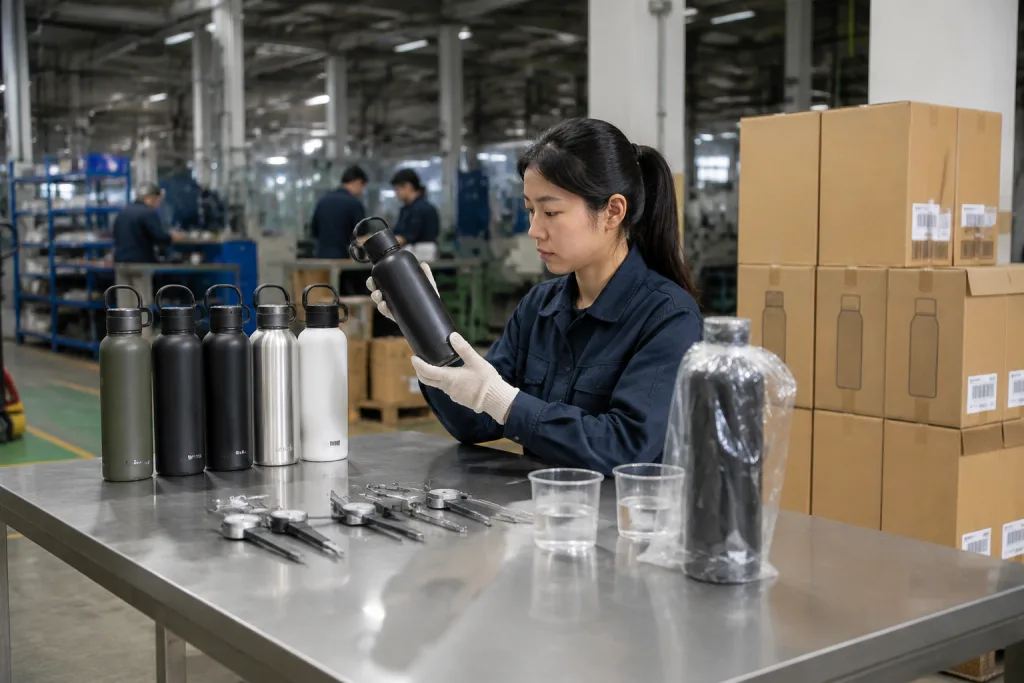
Check the bottle with basic tools. Put it on a digital scale. Measure height and diameter with calipers. Fill it with water, invert it for 30 minutes, then shake it 20 times. Wipe the logo with a dry cloth, then a damp cloth. Open and close the cap 20 cycles. This is not lab testing, and that is the point. QC pulled a sample last month that looked fine until the cap started binding after the 18th cycle, so the math does not work if you skip this step.
If you need REACH, LFGB, FDA, or California Proposition 65 support, say it before sampling. A canteen manufacturer’s existing material report may cover stainless steel, silicone, and coating, but your logo ink or special finish may need a separate test. For children’s bottles, ASTM and CPSIA rules can apply. Do not approve a sample with “color to be improved in bulk” written on it. Bulk production repeats what you sign off. If the black coating is too glossy, reject it now. We run the line to your approved standard, not to a guess.
Control production before cartons close
I’ll rewrite the section in-place, keep the HTML tags and structure untouched, and tighten the sales-engineer tone while preserving the technical checks and numbers.Good QC starts before the cartons close. By the time bottles are packed, the line is already under the gun to ship. For 5,000 pcs, we usually run an inline check at 20-30% finished. QC should check coating adhesion, dents, sharp edges, cap threading, gasket fit, logo position, odor, and color match. On powder-coated bottles, the base edge and shoulder curve need extra eyes. That is where thin coating shows first.
For final inspection, we use ANSI/ASQ Z1.4 sampling with AQL 2.5 for major defects and 4.0 for minor defects unless the buyer sets tighter limits. Major defects cover leakage, rust marks, unsafe burrs, missing gasket, wrong capacity, unreadable barcode, or the wrong logo. Minor defects cover small dust points, slight color shift within tolerance, or tiny carton scuffs. Critical defects stay at zero. We had a PO last month with a logo typo on the carton mark; the buyer flagged it before loading, and that saved a headache.
For this order, a normal inspection may pull 200 pcs from 5,000 pcs, depending on inspection level. Test at least 32 pcs for leakage, 20 pcs for cap torque feel, and several cartons for packing accuracy. If you are buying customizable drinkware for multiple end clients, keep QC records separate by PO, SKU, logo, and carton mark. The math does not work any other way. A distributor growler or customizable growler program carries the same risks, but larger vessels need more checks on handle strength and dent resistance. We once saw a handle crack at 1.2 kg pull even though the body passed visual inspection. A customized growler with a weak handle will fail in the field, not on the shelf.
Pack for your warehouse
I’ll rewrite the HTML in place, keep the tags untouched, and tighten the copy so it reads like a buyer-side factory note.Packing is where plenty of solid sport bottle suppliers create expensive headaches. The warehouse does not care that the bottle looks good if the carton caves in, the FNSKU is missing, or the inner box barcode pulls the wrong SKU. For Amazon FBA, club retail, or distributor drinkware programs, packing needs to sit on the purchase order from day one.
For a 750 ml order, we run one bottle in a polybag or paper wrap, one kraft inner box, 24 pcs per five-layer export carton, carton gross weight under 15 kg, and carton size around 48 x 33 x 54 cm, depending on bottle shape. If you want to skip polybags on sustainability grounds, ask for tissue wrap or molded pulp and check whether the coating survives a 1.2 m vibration run. Matte finishes mark faster than most buyers expect.
Run carton drop testing on at least one packed export carton: one corner, three edges, and six faces from 76 cm is the practical standard for drinkware cartons under 15 kg. Confirm carton marks, PO number, SKU, country of origin, quantity, gross weight, net weight, and barcode before the line starts. If you are a canteen distributor consolidating several SKUs in China, ask for loading photos and a carton count sheet. We ship through Ningbo or Shanghai, and the right port is the one that matches your forwarder’s sailing, not the one closest to the factory gate.
Choose suppliers you can manage
I’ll rewrite the three paragraphs in-place, keep the HTML exactly as-is, and strip the AI-ish phrasing while adding a few factory-floor details and sharper buyer language.The best canteen suppliers are not the ones with the biggest showroom. You want a supplier who can explain trade-offs, write down every change, and tell you no when your target price breaks the spec. Ask for BSCI status, ISO 9001 process controls, recent material test reports, and photos from the current line. If they cannot state the normal MOQ, sample time, and defect-handling steps without checking with sales, they are not ready for your program. We run into this all the time.
There is a real gap between a trading office, a canteen vendor, and a factory that actually makes the bottles. Trading offices work for mixed small orders, but technical changes slow down fast. A factory or integrated canteen manufacturer can control tooling, coating, assembly, and inspection on the same floor. At BottleForge Industrial in Hangzhou, China, we handle stainless thermos bottles, sports bottles, travel tumblers, kids bottles, glass bottles, infuser bottles, custom growler projects, and canteen customizable programs under one export team, so your drawings, samples, and QC notes do not get lost between departments. QC pulled the sample on a 0.3 mm logo shift last week. We fixed it before shipping.
Before you place the PO, ask one final question: “What can go wrong on this order?” A serious supplier will name coating scratches, cap gasket loss, logo alignment, carton compression, and vessel space. That honesty matters more than a polished brochure. The wrong question is whether they can promise zero risk; the math does not work. Choose sport bottle suppliers who catch the issue early, quote it plainly, and sort it out before your customer opens the carton.
Send your sport bottle brief for a factory quote
Share capacity, quantity, logo method, destination market, and target FOB price. We will return a practical spec and production timeline.
Frequently asked questions
What MOQ should I expect from sport bottle suppliers in China?
For existing stainless sport bottle models, expect 1,000-3,000 pcs for a simple one-color logo if the body color is available. For Pantone powder coating, most factories in Zhejiang or other China production hubs will ask for 3,000-5,000 pcs per color. New mold projects normally start around 5,000-10,000 pcs, plus tooling. If you need mixed colors under one PO, ask whether the MOQ is per order or per color. That detail changes your inventory risk. For first-time buyers, 5,000 pcs is often the cleanest balance between factory efficiency, unit cost, and manageable stock.
Is laser engraving better than silkscreen for a custom canteen?
Laser engraving is better when you want durability and a premium look on stainless steel or powder-coated bottles. It does not use ink, so there is less concern about ink adhesion or chemical migration. Silkscreen is better for larger logos, solid colors, and lower cost. On a 5,000 pc order, silkscreen may be USD 0.05-0.12 per position, while laser can be USD 0.12-0.35 depending on size and speed. For a canteen promotional order, silkscreen is often enough. For retail custom drinkware with long shelf life, laser usually creates fewer after-sales complaints.
How long does a customized drinkware order take from artwork to shipment?
A normal timeline is 3-5 days for artwork confirmation, 7-14 days for a pre-production sample, and 30-45 days for mass production after sample approval and deposit. Add 3-7 days for final inspection, booking, and customs documents. Ocean freight to Europe or North America can add 25-45 days depending on port and season. If you need a new mold, add 18-35 days before production sampling. Do not count production lead time from the first email. Count it from deposit, approved artwork, approved sample, and confirmed packing instructions.
What QC standard should I use for distributor drinkware?
For most distributor drinkware orders, use ANSI/ASQ Z1.4 with AQL 2.5 for major defects and AQL 4.0 for minor defects. Critical defects, such as sharp metal edges, unsafe contamination, or severe leakage, should be zero. Your inspection checklist should include capacity, leakage, cap fit, coating defects, logo position, barcode scanning, carton marks, and packing quantity. For a 5,000 pc order, the inspector may sample around 200 pcs depending on inspection level. If the goods are for a strict retail chain, confirm their required AQL before production starts.
Can one supplier handle sport bottles, canteens, and growlers?
Yes, if the supplier has the right production base and QC system. Sport bottles, custom canteen programs, and custom growler orders share materials such as 304 stainless steel, silicone gaskets, powder coating, and logo processes. The risks are different: sport bottles focus on cap leakage and coating scratches, while growlers need stronger handles, better dent resistance, and sometimes pressure-related checks. Ask for product-specific samples, not just general catalog photos. A capable supplier should provide MOQ, lead time, test reports, and defect examples for each category before you issue one combined PO.