Key Takeaways
- Compare sport bottle suppliers by spec, not by brochure: 0.6 mm stainless steel, 2.0–3.5 mm Tritan walls, and leak tests matter more than slogans
- A realistic MOQ for custom drinkware from a China factory is often 1,000–3,000 units per SKU, with 18–25 day lead times after confirmation
- For Europe and North America, ask for REACH, LFGB, FDA, and AQL 2.5 inspection records before you place a PO
- The best supplier list includes one canteen factory, one canteen manufacturer, and one distributor drinkware partner so you can cover branded, promotional, and fast-turn orders
If you are building a sport bottle supplier list, price is the wrong first filter. Spec fit comes first. A $0.82 bottle that leaks in transit, misses your lid color, or fails REACH is not cheap; it turns into chargebacks fast. We see this on the line: one weak cap gasket can sink a whole PO. Smart buyers in Europe and North America check wall thickness, closure type, test standards, and real production capacity before they ask for samples.
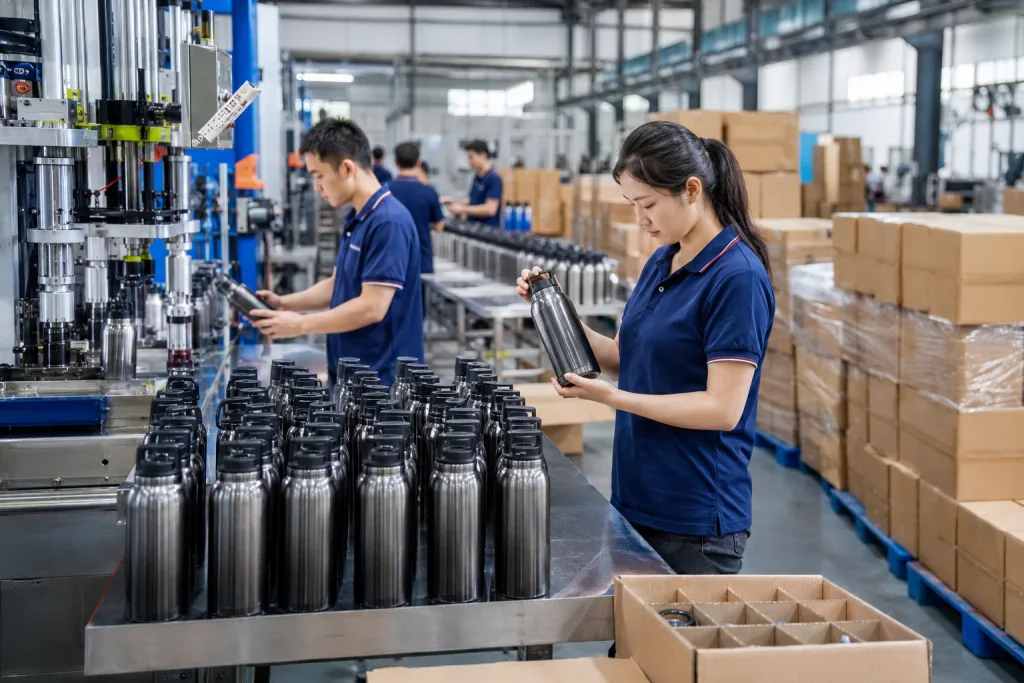
That matters even more if you source canteen custom programs, customized drinkware, or a custom growler line from the same factory. In Zhejiang, China, plenty of factories claim they are canteen manufacturers. Fewer can hold MOQ, keep lead times tight, and pass QC with traceable records. At BottleForge in Hangzhou, one production line runs 120,000 units per month, with standard lead times of 18 to 25 days after sample approval. Use that kind of number. Marketing copy does not ship cartons.
Start With The Spec Table
I’ll rewrite the prose in-place, keep the HTML structure unchanged, and tune it to sound like a real factory-side sales engineer.Build your sport bottle supplier list around one comparison table. If you cannot line up the bottle body, lid, coating, and compliance on the same sheet, you are not sourcing—you are guessing. We run this check on the line before sample approval, because a canteen factory that makes stainless vacuum bottles, a canteen manufacturer built for molded plastic, and a canteen supplier reselling mixed stock are not playing the same game.
Use these columns:
- Material: 18/8 stainless steel, Tritan, aluminum, or glass
- Wall thickness: 0.5 mm, 0.6 mm, 0.7 mm stainless; 2.0 mm to 3.5 mm plastic wall targets
- Closure: screw cap, sport cap, flip lid, straw lid, bamboo cap
- Test standard: leak test, thermal retention, dishwasher cycles, drop test
- MOQ: 500, 1,000, 3,000, or 5,000 units
- Lead time: sample days and bulk days
Once the table is on paper, the buyer talk gets cleaner. A canteen customizable line for retail is not the same order as a canteen promotional run for a trade show. A customized canteen for a supermarket chain needs repeatability and carton efficiency; we once had a buyer flag a 2 mm carton gap that broke pallet count. A customizable growler for a distributor can carry more margin if the finish and packaging are right. This is the wrong question to ask: “Who is cheapest?” The math doesn’t work if the spec is off by 0.1 mm or the MOQ sits at 5,000 when you only need 800.
Practical rule: if a supplier cannot state wall thickness, MOQ, and test method in one email, they are not ready for a serious B2B order.
Compare Supplier Types Head To Head
I’ll keep the HTML intact and rewrite only the prose so it reads like an experienced sales engineer, with tighter supplier comparisons and a few concrete factory-floor details.Not every name on a sport bottle supplier list deserves the same slot. Risk changes fast once you know who you are dealing with: a canteen distributor, a canteen vendor, or a direct canteen manufacturer. The factory gives you tighter control on decoration and packaging. The distributor gives you faster stock access and smaller opening orders. The vendor sits between them, but the engineering depth is usually thinner than what we see from a real canteen factory in Zhejiang or another export-heavy region in China. We run these comparisons all the time, and the wrong pick shows up later in QC.
Head to head, this is how the common supplier types stack up:
- Canteen manufacturer: best for custom canteen, customized drinkware, and repeat production; MOQ often 1,000 to 3,000 units
- Canteen factory: best for engineering control and process traceability; ask for ISO 9001, BSCI, and AQL records
- Canteen supplier: best for mixed catalogs and fast sourcing; weaker on exact spec lock
- Canteen distributor: best for local stock and smaller MOQs; less flexibility on molds and lid tooling
- Canteen vendors: useful when you need broad selection, but inspect the actual production source carefully
For North American retail, a direct factory in Zhejiang, China usually wins if the job needs private label print, Pantone matching, or a custom logo on a 500 ml sport bottle. We had a buyer flag a 0.8 mm artwork shift on a 24 oz sample last month; a distributor could not fix that on the spot. For Europe, a distributor can still make sense when you need a 2,000-unit reorder and the line is booked. But if you want a canteen customized with a new cap shape or a customized growler with embossed branding, you need the factory, not the middleman. The math does not work any other way.
The buyer mistake is treating all canteen suppliers as the same. They are not. The spread between a promo item and a branded retail item often lands at 15% to 35%, and that gap usually comes from the supplier type you choose. We have seen this go sideways on a PO typo too: one missing `s` on “matte black” turned into a week of rework.
Material Choice Changes Everything
I’ll rewrite the prose in-place, keep the HTML structure intact, and make it sound like a factory-side sales engineer wrote it.The fastest way to cut a supplier list is material. For a gym bottle that gets tossed in a 5 kg bag, 18/8 stainless and Tritan are the two we quote first. For a light promo run, aluminum or single-wall stainless usually wins on landed cost. If the buyer wants a premium shelf look, a customized canteen with powder coat and laser engraving can take the FOB up without feeling overdone.
Typical factory pricing from China at 1,000 units looks like this:
- 18/8 stainless sport bottle: USD 2.10 to 3.80 FOB, depending on lid and coating
- Tritan sport bottle: USD 1.45 to 2.60 FOB
- Aluminum canteen: USD 1.20 to 2.10 FOB
- Stainless growler: USD 4.20 to 7.50 FOB for larger insulated formats
That is where use-case fit decides the order. A canteen promo item for a stadium giveaway does not need the same finish as a customizable growler for craft retail. A canteen customizable program for an outdoor chain may need a 0.6 mm shell and a matte powder coat, and we have had buyers flag that exact spec after QC pulled the sample. A custom growler for distributors needs a better closure and a tighter leak limit than a basic sport cap bottle. This is the wrong question to ask if you start from color first. Start from how it gets used: bike commuting, gym carry, hiking, office desk, or beverage resale.
In Zhejiang, China, factories can quote all of these in one week. That does not mean they belong on the same shortlist. Pick the material that fits your target price, carton weight, and decoration method. We run into trouble when a buyer asks for a coating spec but has not checked the tooling sheet; a canteen manufacturer that cannot explain why the coating thickness is 40 to 60 microns should not be leading your project.
Use Case Fit Beats Feature Count
I’ll rewrite the HTML prose in a more field-tested sales voice, keep the tags intact, and thread in concrete factory details without changing the structure.Buyers often stack features and call it strategy. It isn’t. Match the bottle to the channel. A retailer wants shelf punch and low return risk. A distributor wants repeatable SKUs and carton ratios that don’t blow up on pallet count. A corporate buyer wants clean branding and a canteen promotional price that still covers freight, print, and margin—we’ve seen that math fail at MOQ 3,000 before the sample even cleared QC.
Best fit by channel
- Retail: customized drinkware with premium finishes, stable color batches, and barcode-ready packaging; the line checks color against a Pantone chip before packing
- Promotional: canteen promotional runs with simple decoration, fast lead time, and a price that stays low enough for mass giveaways
- Outdoor and sports: customizable canteen or sport bottle with a secure lid, carry loop, and 500 ml to 750 ml sizes; buyers keep asking for “more features,” but the lid leak test matters more
- Craft beverage: custom growler or customizable growler with a heavy-duty closure and a consistent neck finish; a 0.2 mm neck shift will trigger complaints at filling
- Wholesale distribution: distributor drinkware programs that accept 1,000 to 5,000 unit reorders without spec drift; we ship these on the same carton spec every time
If your customer is a gym chain, a 750 ml Tritan bottle with a flip lid can beat a stainless bottle with a tricky vacuum wall on gross margin and breakage. If your customer is a heritage outdoor brand, a custom canteen in brushed steel can outpull a colorful plastic line because the buyer flagged it as “cheap-looking” in the first round. The wrong question is “which bottle is best?” Ask which bottle fits the margin model.
A better buyer test is simple: would you reorder the same SKU in 90 days? If the answer is no, the item is too trendy or too fragile. Good canteen suppliers in China know this and will push a simpler structure for repeat business, even when the decorated sample looks sharper. That is the kind of advice you want from a canteen supplier or canteen vendor. It shows they understand your channel, not just the catalog.
Compliance And Quality Checks
I’ll rewrite the prose only, keep the HTML intact, and tighten the compliance language so it sounds like a factory-side sales engineer.For Europe and North America, quality paperwork is not optional. A sport bottle supplier list should include only factories that can show real test records, not a logo page. Ask for REACH, LFGB, and FDA-related material declarations where relevant, plus internal QC records at AQL 2.5 or tighter on appearance and function. If the bottle claims insulated performance, request a thermal retention test with the setup written out: starting temperature, ambient temperature, and timing intervals. We have seen buyers skip that and get burned on spec drift.
Watch three points closely:
- Leakage: inverted 24-hour test, lid torque, and seal consistency across 3 sample lots
- Print durability: dishwashing, abrasion, and cross-hatch if the finish is coated
- Food contact: material declarations for silicone, PP, Tritan, stainless, and pigments
In China, especially Zhejiang, plenty of export factories already run this paperwork. Still, you need to verify each order, not just the factory certificate. QC pulled the sample on a 10,000-piece canteen run and the gasket fit was off by 0.6 mm; one approved sample does not mean the line can hold that tolerance. That is the wrong question to ask. For canteen customizable or customizable drinkware items with logos, ask whether the ink is UV-cured or laser-marked, because that changes scuffing and lead time.
One more practical note: if a supplier cannot explain color shift from one batch to the next, especially on powder-coated custom drinkware, you will see mismatched shades on repeat orders. We run into this on PANTONE matches every season. The buyer flagged it after the second shipment, and the math does not work if retail chains are waiting on replacements.
How To Shortlist A Factory
I’ll rewrite the section in-place, keeping the HTML structure and tightening the sales-engineer voice. Then I’ll do a quick pass to make sure the phrasing stays concrete and the tag order stays unchanged.Shortlisting is where buyers save or lose the project. We keep it blunt on our side. Ask each factory for the spec sheet, MOQ, lead time, and pack count. Then ask for photos of the press line and the QC bench. Compare the quote line by line: bottle body, lid, print method, carton, and any add-on charge. If a distributor cannot tell you the actual factory name, take it off the list. We have seen that go sideways more than once.
For a normal export run from Zhejiang, a solid filter looks like this:
- Capacity: at least 100,000 units per month
- MOQ: 1,000 units per SKU for standard custom drinkware
- Sample lead time: 5 to 10 days
- Bulk lead time: 18 to 25 days after sample sign-off
- Inspection: AQL-based final check before shipment
Then split suppliers by job. One shop may be strong on canteen custom work with laser engraving. Another may handle canteen promo orders better. Another may know customizable growler packaging inside out. If you push one supplier to do every job, the math does not work; you pay more or you get sloppy consistency. We run into this on the line when the buyer asks for a 2 mm logo depth on one SKU and a full-color wrap on the next. A good canteen supplier in China knows its own lane and will say no when the order is the wrong fit. That is a good sign.
If you sell through Amazon, distributor channels, or retail chains, ask for barcode labeling, FNSKU support, drop testing for master cartons, and pallet count per 40HQ. One typo on a PO can turn into a missed label scan, and QC pulled the sample for that exact reason last month. Those checks are not glamorous. They are what keep a drinkware program moving.
Send your spec sheet, get a real shortlist
We compare your target price, MOQ, and packaging against factory capability in Zhejiang, China, then quote the best-fit custom drinkware options.
Frequently asked questions
What should I ask first on a sport bottle supplier list?
Start with the hard numbers: material, wall thickness, MOQ, lead time, and FOB price. For example, a real custom drinkware factory in Zhejiang, China should tell you if a 500 ml stainless bottle is 0.5 mm or 0.6 mm, whether the MOQ is 1,000 or 3,000 units, and whether bulk lead time is 18 or 25 days. If they dodge those basics, they are not ready for export work.
Is a canteen manufacturer better than a canteen distributor?
For custom canteen projects, yes, usually. A canteen manufacturer or canteen factory gives you better control over tooling, logo placement, lid options, and repeat consistency. A canteen distributor can be useful for smaller, faster buys, but they often have less control over exact specs. If you need canteen customizable or customized canteen work, direct factory sourcing is normally safer and cheaper at 1,000+ units.
What MOQ is normal for customized drinkware?
For standard custom drinkware from China, 1,000 units per SKU is common, and 3,000 units is normal for more complex decoration or special lids. Some canteen suppliers offer 500 units, but the unit price usually rises sharply. If you want a custom growler, canteen promotional pack, or customized growler with special packaging, expect MOQ and setup cost to move together.
How do I check if a canteen factory is compliant?
Ask for REACH and LFGB material declarations if you sell into Europe, plus any FDA-related material paperwork for the U.S. Then request actual QC records: leak test results, AQL 2.5 inspection sheets, and thermal retention data if the bottle is insulated. A real canteen factory in Zhejiang, China should be able to show this quickly. Certificates without batch records are not enough.
Can one supplier handle custom canteen and custom growler programs?
Sometimes, but not always well. A factory that does both canteen custom and custom growler programs must handle different neck finishes, closures, packaging, and test specs. That can work if their monthly capacity is strong, for example 120,000 units per month, and they have separate lines. If not, split the order between a canteen manufacturer and a specialized growler partner to reduce risk.