Key Takeaways
- A typical sport bottle private labeling order starts at 3,000 pcs MOQ and 35–45 days lead time after sample approval.
- FOB China pricing for common Tritan and stainless sport bottles usually lands around USD 1.20–3.80 per unit, depending on capacity and decoration.
- A practical QC plan uses AQL 2.5 for major defects and AQL 4.0 for minor defects, plus leak tests on every lot.
- A Zhejiang canteen factory with 500,000 units/month capacity can still miss your ship date if artwork, carton specs, or cap compatibility are not frozen early.
You are not buying a bottle. You are buying a repeatable order: the right mold or stock shape, the right logo method, the right carton, and a shipment that clears QC without surprise delays. For sport bottle private labeling, you need to think like a buyer and like a production engineer at the same time. Skip one detail, and you pay later in leaks, shade drift, or cartons that miss Amazon FNSKU labels.
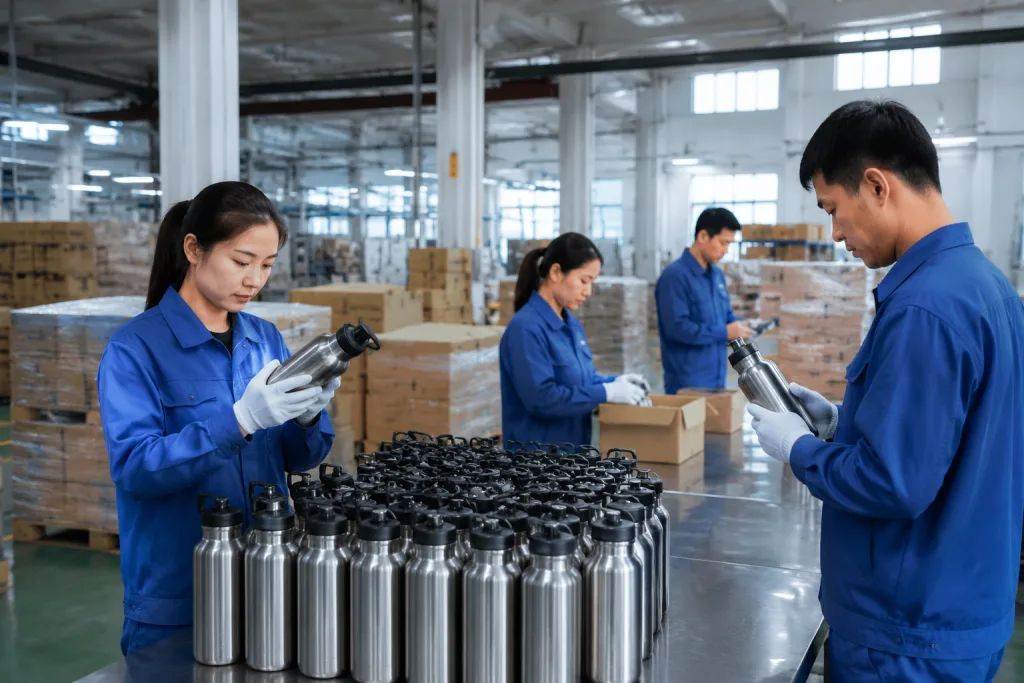
At BottleForge in Zhejiang, we see the same pattern every week: a brand owner sends a mood board, a distributor asks for FOB pricing, and then the real work starts—capacity, MOQ, material, print wear, and final packout. Last Tuesday, QC pulled a 12-piece sample set from the line and found a 1.2 mm gap on a cap fit, which saved a headache before mass production. China has strong factories and sloppy ones; the sample stage tells you which side you are on. So let’s walk one order end to end, the way a serious buyer should manage it.
Start With the Sellable Unit
I’ll rewrite the section in place, keep the HTML tags intact, and tighten the prose so it reads like a factory-side sales engineer.The cleanest way to buy sport bottle private labeling is to start from the sellable unit, not the factory’s default catalog spec. Ask what the customer will actually hold: 500 ml, 750 ml, 1 L, or a bigger 32 oz format. Then decide whether the buyer needs a Tritan body, 304 stainless steel, or a double-wall vacuum build. A canteen custom order for retail usually needs better graphics and packaging than a plain distributor canteen order for promotion.
For a first order, I would not go below 3,000 pcs unless you are testing a niche. In Zhejiang, a strong canteen manufacturer usually samples in 7–10 days and moves to production in 35–45 days after approval. We run the same check on every line: body color, lid color, logo size, matte or glossy or frosted finish. A buyer once sent a PO with “750ml” typed as “750 ml” in one place and “0.75L” in another; QC pulled the sample and the mismatch killed a week. Lock the spec early.
One mistake I see with canteen distributors is chasing too many SKUs at once. That is the wrong question to ask. If you need a canteen promotional line and a retail line, split them cleanly. The promo bottle can use simpler decoration and lower pack standards. The retail bottle should be treated as a customized drinkware item with proper carton strength, barcode placement, and a drop-test target. We’ve seen this go sideways when the buyer tried to combine both under one carton spec.
Freeze the Spec Before Sampling
I’m going to rewrite the three paragraphs in-place, keep the HTML unchanged, and tighten the sales-engineer tone with concrete factory details.Sampling is where you save money or create rework. A good canteen factory will ask for body material, cap style, logo method, Pantone color, and carton dimensions before it cuts the first sample. We run the same check sheet on the line. If you are ordering a customizable canteen, do not lean on a screenshot. Send a vector logo, exact Pantone references, and a target price. One vague brief can burn 7 days and force 2 extra rounds of air freight in China.
For decoration, silkscreen is still the cheapest for one- or two-color logos, while laser engraving makes sense for stainless steel if you want a mark that stays put. Heat-transfer and UV printing fit a canteen customizable design with gradients or multiple colors. On a custom growler, engraving on brushed 304 steel looks premium, but the buyer will flag the cap sealing and surface finish right away. We’ve seen this go sideways. That is why a canteen supplier should lock the decoration process before quoting, not after QC pulled the sample.
Ask for a pre-production sample, not just a hand sample. The difference is simple. A hand sample proves the shape works. A pre-production sample proves the line can hold the same wall thickness, logo placement, and lid torque. For a 750 ml stainless bottle with a 0.4 mm shell and PP lid, we check for wobble, flash, and uneven powder coat under the caliper and torque tester. If any of that shows up, you are not ready for bulk.
Price the Order Like a Buyer
I’ll rewrite the section in-place, keep the HTML exactly as-is, and make the copy sound like a real factory sales engineer with tighter pricing detail and a few grounded shop-floor specifics.FOB pricing for sport bottle private labeling comes down to material, capacity, tooling, decoration, and packaging. For a basic 500 ml Tritan bottle with one-color silkscreen, we usually quote USD 1.20–1.80 FOB China at 3,000 pcs. A 500 ml double-wall stainless bottle with laser logo and a retail box can land at USD 2.80–3.80. If you need a custom mold, tooling usually starts around USD 1,500–6,000, depending on cavity count and lid structure. That is normal in Zhejiang. We’ve seen buyers spend less on tooling than on fixing a lid that leaks at 45°C.
Do not look at unit price alone. Price the landed value. A canteen distributor buying for Europe should ask about cartons per master case, pallet pattern, outer carton burst strength, and whether we can label FNSKU or EAN at the line. If your canteen distributors need mixed-language packaging, put that in the quote from day one. The math does not work if the buyer flags 20,000 units for hand relabeling after PO. QC pulled a sample with a missing barcode once, and that small typo turned into a full rework.
If the factory says it is a canteen manufacturer with 500,000 units per month capacity, check what that number means for your material and decoration method. Plain bottles at scale are one thing; stable print on a customized growler or a brushed-metal custom canteen is another. Ask how many production lines run your exact item, and how many inspectors are at final packout. We run this check every day with the thickness gauge and the UV adhesion test, because some claims look good on paper and fall apart on the line.
QC The Bottle Before It Ships
I’ll rewrite the section in-place, keep the HTML tags untouched, and tighten the sales-engineer voice with concrete factory details. Then I’ll return only the rewritten HTML.QC is not a box-tick. We run acceptance before the line starts: AQL 2.5 for major defects, AQL 4.0 for minor appearance issues, plus 100% leak testing on caps and seal interfaces. If the cap is a straw lid or push-pull lid, add cycle testing and drop testing. A bottle can pass a quick visual and still fail after two drops from 1 meter. We’ve seen that go sideways.
For a customized canteen, check the first article and the final lot on the same points: logo alignment within 1.5 mm, coating adhesion, lid thread smoothness, silicone ring seating, and odor after a hot-water rinse. QC pulled the sample on the bench with a caliper and found a 0.8 mm logo shift once the heat-transfer film shrank. For the EU, ask for REACH-related material declarations and a clear BPA-free resin statement where it applies. If your channel is North America, ask for the reports you need, not a stack of paper nobody reads.
Check what can kill the order. That is the right question. A distributor drinkware order does not blow up because one inner carton has a scratch; it blows up because the first 3,000 units leak, the print rubs off, or the retail box crushes in transit. We ship enough cartons to know the difference, and a competent canteen supplier in China should build the inspection sheet around those failure points, not around cosmetic noise.
Package For Retail, Not Warehouse
I’ll rewrite the section in-place, keeping the HTML tags and structure unchanged while making the prose sound like a seasoned factory-side sales engineer.Packaging is where a lot of buyers burn margin without seeing it. A canteen promotional job can go out in a polybag and export carton, but a retail-ready custom canteen needs a different build. If the bottle is headed to Amazon or a club store, the outer carton has to hold up in transit, and the inner pack must keep the lid finish clean. For a 750 ml bottle, we usually spec a 3-layer carton for light units and move to 5-layer once the gross weight or stack height starts to climb.
Tell the canteen vendors straight: single retail box, master carton, or shelf-ready tray. If the unit is a customizable growler, the pack has to show capacity, stainless grade, and care notes without clutter. For canteen customized items sold in Europe, multilingual packaging is standard, and we quote that before the line starts. We’ve seen buyers try to save on print and end up with boxes that look fine on screen but fail at the shelf.
Use the carton spec to protect your margin. If the factory can load 24 pcs per carton instead of 20 without bruising the product, freight math improves fast. If the fit is too tight, scuffing starts. The right canteen factory will run a drop test and a vibration check before mass shipment; QC pulled the sample, and we look for lid rub, corner crush, and carton bulge before we sign off.
Ship The Order Like A Program
I’ll keep the HTML exactly as-is and rewrite only the prose, with a more hands-on factory tone and a few concrete shipping details.Once production is approved, run the shipment like a program, not a one-off. We confirm the ex-factory date, the FOB port, the carton count, and whether the buyer wants one 40HQ or a split booking. In Zhejiang, export teams can book fast, but the line still waits on your final marks and labels. Miss the cutoff by 2 days, and the vessel can roll 7 days.
For a first order, I like a tight control rhythm: sample approval, pre-production signoff, in-line check, final AQL 2.5 inspection, and packing list review. If you are working with a canteen distributor network, give each channel its own SKU and barcode. Do not mix a distributor canteen SKU with a retail SKU just because the bottle looks the same. We’ve seen that go sideways on a 12 oz bottle run, and the buyer flagged it at carton scan. The channel drives the pack logic, not the mold.
A good canteen manufacturer in China should also help you plan reorders. Keep the mold number, decoration file, carton spec, and approved sample on file, plus the PO typo we caught on carton marks. Then the next order of custom drinkware is a repeat run, not a fresh project. That is how brands scale in Zhejiang and how distributors keep margin without chasing every shipment.
Send your spec, get a workable quote
We’ll price your sport bottle private labeling order with real MOQ, lead time, and QC terms—not guesswork from a catalog.
Frequently asked questions
What MOQ should I expect for sport bottle private labeling?
For most standard sport bottle private labeling projects, expect 3,000 pcs MOQ for one design and one logo setup. If you need a custom mold, the MOQ may stay at 3,000 pcs but tooling adds upfront cost. For stock shapes with custom print, some Zhejiang factories can sample at 500–1,000 pcs, but the per-unit price is usually 15%–30% higher. If you want mixed colors, mixed lids, or retail packaging, confirm whether the MOQ applies per SKU or per total order.
How long does a first order usually take in China?
A realistic timeline is 7–10 days for samples, then 35–45 days for production after sample approval. If you add new tooling, expect another 10–20 days depending on mold complexity. For a busy canteen factory in Zhejiang, peak season can add a week. Freight booking, carton rework, or missing artwork can easily delay shipment by 3–5 days, so freeze your specs early.
What logo method should I choose for a custom canteen or growler?
For one- or two-color branding, silkscreen is usually the most economical. Laser engraving works well on stainless steel and holds up better for premium retail. UV printing is better for multicolor graphics, while heat transfer is useful when you need more image detail. On a custom growler, engraved branding often looks more durable, but you still need to verify surface prep and cleaning resistance. Ask for a rub test and a wash test before approving bulk.
How do I QC leaks and finish quality?
Use 100% leak testing for lids and seals, then apply AQL 2.5 for major defects and AQL 4.0 for minor defects on the lot. Check logo alignment, coating adhesion, and cap torque on the first article and final sample. For stainless bottles, ask for a hot-water odor check and a drop test from 1 meter. If the product is for Europe or North America, request REACH or relevant material declarations and any needed compliance reports before shipment.
Can I order custom drinkware for multiple channels at once?
Yes, but do not treat every channel the same. A canteen promotional SKU can use simpler packaging and lower decoration cost, while retail or Amazon units need barcodes, carton specs, and clean FNSKU placement. If you are selling through a canteen distributor or distributor drinkware channel, separate the SKUs so you can control pricing and replenishment. One order can share the same body and cap, but the packaging, label, and case pack should match the channel.