Key Takeaways
- A realistic MOQ for a custom canteen is often 1,000-3,000 units per SKU, with 35-45 day lead time after sample approval
- For drinkware, AQL 2.5 for critical defects and AQL 4.0 for minor defects is a common starting point, not a luxury
- A 18/8 stainless body with 0.4-0.5 mm wall thickness is usually safer than chasing the lowest USD price
- If you need customized drinkware for retail or promo, ask for REACH, food-contact, and carton drop-test records before PO
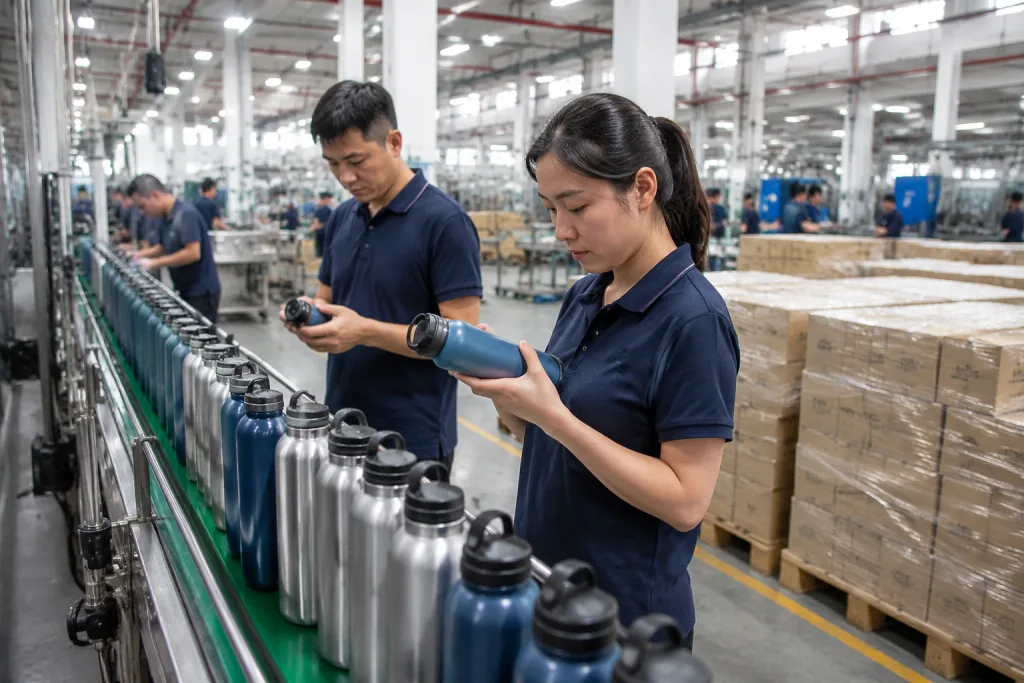
You are not buying a bottle. You are buying a line that repeats. If you source from sport bottle manufacturers, the sample on your desk is the easy part. The real test is the second run, carton labels, lid torque, and whether the print still lands clean after 2,000 pieces. That is where good canteen manufacturers separate from the rest.
For a buyer in Europe or North America, the job sounds simple: define the canteen custom brief, check factory capability, lock the decoration method, then inspect the first order like it matters. In Zhejiang, where a lot of serious canteen factory capacity sits, the gap between a smooth program and a mess is usually paperwork, sampling discipline, and a buyer who asks the right questions. We’ve seen a PO typo on lid color turn into a 12-day delay. The math does not lie.
Start With the Actual Use Case
I’ll rewrite just the prose, keep the HTML tags intact, and tighten it so it reads like a factory-side sales engineer wrote it.Picture a 12,000-unit order for a North American distributor canteen program. The end customer wants a 32 oz insulated bottle for gym bags, bike rides, and outdoor shelves. That still leaves the real decision on the table: straw lid, loop cap, or wide-mouth chug cap. We cannot quote straight until the use case, target retail, and decoration limit are fixed.
Good sport bottle manufacturers ask the plain questions first: hot or cold only, single-wall or vacuum, powder coat or painted finish, and whether the bottle is going to Amazon, wholesale, or a corporate canteen promo run. Give numbers, not adjectives. Say 18/8 stainless steel, 0.45 mm inner wall, 304 exterior, BPA-free lid, and 500 ml or 32 oz. If the canteen is for a gym chain, add a hard requirement: logo wear after 50 dishwasher cycles or 24-hour salt spray on coated parts. That cuts the list fast.
Do not let a canteen supplier steer you into a soft quote. If you are comparing canteen suppliers in China and Europe, send the same spec sheet to all of them. A real canteen manufacturer can tell you what is standard, what costs extra, and what changes the price by USD 0.20 versus USD 1.50. QC pulled samples on the line for this exact issue last month, and the buyer flagged a missing wall-thickness callout on the PO.
Build the Spec Sheet Buyers Trust
I’ll tighten the language, keep the HTML intact, and make the copy sound like a factory-side sales engineer wrote it. Then I’ll preserve the heading and list structure while swapping in sharper spec-sheet detail.Write the order like the person opening every carton will hold you to it. Buyers lose margin here all the time. They sign off on a clean sample, then the production run shows a thinner liner, a softer silicone ring, or a print that walks 1.5 mm on a curved body. A real spec sheet cuts that mess off early.
For a canteen custom project, we want the core fields on paper: capacity, material grade, wall thickness, lid material, coating type, logo method, packaging, and test standard. A clean example reads like this: 24 oz vacuum sport bottle, 304 stainless steel inner and outer, 0.45 mm wall, PP lid with silicone gasket, matte powder coat, one-color silk screen, individual white box, master carton 24 pcs, and carton drop test at 80 cm. We had a buyer flag a PO typo once—“24pcs” turned into “240 pcs”—and QC caught it before the line ran. If you are buying a custom growler or customizable growler for brewery retail, add pressure and seal notes. The closure carries more weight than the print.
Get the tolerances in writing. For the neck, ±0.5 mm on critical dimensions is a sane target; capacity is usually around ±3%. For decoration, ask for Pantone match, not a vague “close enough.” A Zhejiang factory with a real export line will put that into the PI and the sampling checklist without drama. If they hesitate, the math does not work in your favor.
Useful spec items
- Material grade: 304 or 316 stainless steel
- Wall thickness: 0.4-0.5 mm for standard insulated bottles
- Logo area: 40 x 40 mm, 1 color or 2 color max for silk screen
- Packaging: export master carton with 5-layer board
Check the Factory, Not the Sales Pitch
I’ll rewrite the three paragraphs in-place, keeping the HTML tags and structure unchanged while stripping the AI-ish phrasing and adding factory-floor specifics.There is a clear gap between a canteen factory and a trading desk with polished photos. You need proof the line is under control. Ask where the deep drawing, welding, vacuum sealing, coating, and packing happen. If the supplier says every process is in-house, ask for a factory tour video and a monthly output number. In Zhejiang, a serious drinkware plant often runs 200,000 to 500,000 units per month, depending on product mix, and that capacity has to fit your order size.
For a canteen distributor or drinkware buyer, the right question is not “Can you do this?” It is “How many SKUs can you hold steady?” If the answer sounds too broad, they are probably outsourcing too much. Good canteen manufacturers should show line QC checkpoints, incoming material inspection, and packaging control. We run batch checks on the caliper and the buyer usually spots the problem fast if the 0.2 mm tolerance slips. Look for BSCI if you care about social compliance, and ask whether the factory runs to ISO 9001 procedures even when the certificate is just hanging on the wall.
For canteen vendors selling into gift and promo channels, flexibility matters. Flexibility without process gets expensive fast. A canteen vendor that can handle custom canteen, customizable canteen, and customized canteen programs in the same plant is more useful than a middleman promising the moon. We once saw a PO typo turn “1,800 pcs” into “18,000 pcs”; QC pulled the sample, and the whole job stopped. If you need canteen promotional runs below 1,500 units, expect a higher unit cost and fewer decoration choices. That is normal. Pretending otherwise is the wrong move.
Samples Are a Test, Not a Trophy
I’ll rewrite the section in-place, keep the HTML exactly as-is, and tune the tone to sound like a buyer-side sales engineer.Buyers often treat the sample as the product. It is not. The sample is a question: can the factory repeat this 10,000 times? For custom drinkware, approve one sample for form, one for decoration, and one pre-production sample with final packaging. If you want a canteen customized for retail, make the sample carry the real label, barcode, and carton mark. Otherwise, you are testing metal, not the order.
Check the lid closure by hand. Look at thread engagement, gasket fit, and whether the bottle leaks when inverted for 24 hours. We once saw a 1 mm gasket mismatch turn a clean-looking custom growler into a refund headache. For vacuum products, ask the factory to record temperature retention at 95°C fill and compare the 12-hour and 24-hour numbers. If the claim has no test sheet, it is marketing.
When you buy from a canteen manufacturer in China, do not skip artwork proofing. A screen print that looks fine on a flat render can wrap badly around a curved 750 ml body. Laser engraving looks cleaner for premium drinkware, but it changes both cost and shelf appeal. If your brief includes customized drinkware for retail, ask the supplier for a side-by-side of silk screen, pad print, and laser engraving on the same substrate before you choose.
QC the First Order Like a Pro
I’ll rewrite the section in-place, keep the HTML structure intact, and make the prose sound like a factory-side sales engineer wrote it.The first shipment tells you if the program will reorder. Set the inspection plan before the line starts, not after. For a 3,000-unit order, we run pre-production sample signoff, in-line checks at 20%, and pre-shipment inspection at AQL 2.5 critical, 4.0 major, 6.5 minor. That is standard export work, not extra caution.
QC pulled the sample with a 0.2 mm feeler gauge, then checked dents, coating scratches, print offset, odor, leak failure, and carton crush marks. Pull 5-10 pieces from each carton stack, not only the top layer. If the buyer flagged Amazon FBA, confirm FNSKU label position, suffocation warning placement, and case pack count. For a distributor canteen program, print SKU, color, and lot number on the outer carton so the warehouse does not waste an hour fixing a PO typo.
One rule we use: if the bottle has a moving part, inspect the hinge, cap, and gasket. For a custom canteen with a straw lid, cycle it 30 times on the bench. For a customizable growler, check seal integrity after thermal shock. The math does not work if a $0.08 gasket slips and you eat 200 returns in North America or Europe. A solid China factory will take that report, not argue with it.
Price, Lead Time, and Shipping Reality
I’ll rewrite the three paragraphs in-place, keeping the HTML tags and the section structure intact while making the copy sound like a factory-side sales engineer.Do not shop on unit price alone. A stainless custom drinkware quote at USD 2.30 is not cheaper than one at USD 2.55 if the first one brings rework, late packing, or weak cartons. Ask for price by decoration method and packing level. On a 12,000-unit order, one-color silk screen usually adds USD 0.08 to USD 0.15, laser engraving adds USD 0.18 to USD 0.35, and gift box packing adds another USD 0.25 to USD 0.60 depending on print and insert. The math does not lie.
Lead time needs straight talk. Sampling usually takes 7-15 days. Production for a standard canteen supplier order runs 35-45 days after sample approval, then another 5-10 days for ocean booking and documents. QC pulled the sample on the line last week and found a cap torque issue, which is why we always build a buffer. If a canteen supplier promises 15 days for a fully customized stainless bottle, ask which step got skipped. That is the wrong question to ask the other way around.
For FOB China pricing, confirm the port, usually Ningbo or Shanghai, and ask whether the quote covers export cartons and standard inner boxes. If you need dropshipping or mixed-SKU pallets, the packing method changes the cost fast. We’ve seen this go sideways on a PO typo where the buyer wrote “1 pcs/box” but wanted bulk pack, and the rework burned a full shift. A reliable canteen factory should put these terms on one page, not hide them in a vague pro forma invoice. That makes true landed cost easier to compare for canteen distributors, canteen vendors, and distributor canteen buyers.
Send your spec, get a real factory quote
We handle sport bottle manufacturers, canteen custom programs, and export QC from Zhejiang. Share your target MOQ, finish, and delivery port for a fast quote.
Frequently asked questions
What MOQ should I expect from sport bottle manufacturers?
For standard stainless sport bottles, many sport bottle manufacturers set MOQ at 1,000-3,000 units per SKU and color. If you need a canteen custom order with multiple decoration methods, the MOQ may split by print color or lid type. For a simple one-color logo on one body color, 1,000 pieces is common in Zhejiang. If you want mixed-size packaging, gift boxes, or a special cap, expect the MOQ to rise by 500-1,000 units. Ask the factory to confirm whether the MOQ is for each design, each color, or each carton pack.
How do I judge whether a canteen factory is reliable?
Ask for three things: current monthly output, QC checkpoints, and export documents. A solid canteen factory in China should be able to share a monthly capacity figure, often 200,000+ units depending on the product mix, plus test records for leak, coating adhesion, and carton drop. Ask whether they have BSCI, ISO 9001, or at least a documented inspection flow. If the canteen manufacturer cannot explain material grade, wall thickness, and lead time in one call, they are probably not ready for a real B2B order.
What is a fair price for custom drinkware?
It depends on construction and finish. A basic single-wall custom drinkware bottle may land around USD 1.20-2.20 FOB China, while vacuum stainless models often sit around USD 2.20-5.50 depending on capacity, lid, and coating. A canteen promotional item with simpler packaging can stay low; a premium customized drinkware launch with laser engraving and gift box will cost more. For a custom growler or insulated bottle, compare price against wall thickness, seal quality, and packaging, not just the printed logo cost.
What QC standard should I request for bottle orders?
A practical baseline is AQL 2.5 for critical defects and AQL 4.0 or 6.5 for major and minor defects, depending on channel risk. For a canteen customized order, critical defects include leaks, cracked lids, missing parts, and wrong capacity. Ask the canteen supplier to document incoming material inspection, in-line checks, and final packing verification. If you are shipping to Amazon or a distributor drinkware warehouse, add carton drop tests, barcode checks, and count verification by pallet.
Can I order custom canteen or customized growler products for promotion only?
Yes, and that is common. Canteen promotional orders usually focus on logo visibility, fast lead time, and a strong price point rather than premium finish. For a custom canteen or customizable growler used in events, the factory may suggest one-color print, standard packaging, and one or two body colors to control cost. If you need a canteen vendor to handle 5,000 pieces quickly, choose a structure that is already tooled. A fully new mold adds time and raises the MOQ.