Key Takeaways
- A 5,000-unit sport bottle order usually needs 30-45 days after artwork and deposit approval
- 304 stainless steel at 0.5-0.6 mm wall thickness is a safer default than thin promotional metal
- Use AQL 2.5 for major defects and AQL 4.0 for minor defects on drinkware bulk orders
- Logo method, lid material, carton drop test, and spare parts should be locked before the PI
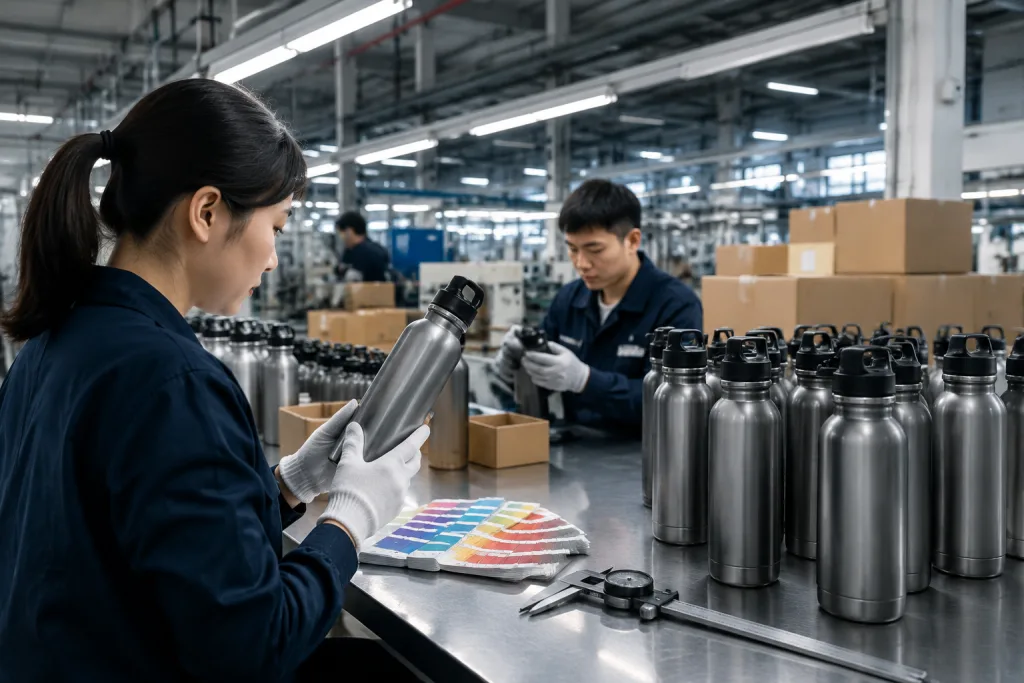
You are not buying a bottle. You are buying a sellable SKU that has to pass freight, retail shelf handling, dishwasher complaints, and the buyer who rejects 80 cartons because the logo sits 2 mm off center. We see this on the line: QC pulled the sample, put the caliper on the print position, and the whole discussion changed. That is why sourcing a sport bottle in bulk should start with the use case, not a catalog photo.
Take one real order shape: 5,000 stainless steel sport bottles for a fitness brand in Germany, shipped FOB Ningbo from Zhejiang, China. MOQ, cap leak rate, carton drop test, and barcode placement matter before the buyer asks for the final PI. Same logic applies if you are buying bulk drinkware, a bulk canteen range, or adding beer growler wholesale items later, but don’t start by asking for the cheapest bottle; we’ve seen that go sideways when the PO says matte black and the approved sample was powder-coated charcoal.
Start With The Actual Selling Channel
Before you ask any factory in China for a price, pin down the selling channel. A gym chain welcome-pack bottle usually needs fast logo approval and simple bulk cartons. An outdoor retail SKU needs shelf-ready packaging, barcode checks, and cleaner powder coating under the light box. An online marketplace item needs FNSKU labels, drop-test mailer boxes, and no loose silicone smell when QC opens the carton.
For our buyer scenario, the target is a mid-range fitness brand selling through its own website and distributors. The brief is a 750 ml double-wall stainless steel sport bottle, powder coated, leak-resistant, with a carry loop lid. Retail price target is EUR 24.90. That puts the FOB target around USD 4.20-5.80, depending on powder coat thickness, color box grade, and whether the buyer asks for FDA or LFGB testing. If the landed-cost sheet already breaks the margin, the math doesn't work. Do not spend 12 days arguing over logo placement while the EXW base cost is still wrong.
Decide early whether this is one hero product or the first SKU in a wholesale drinkware program. We see 6 out of 10 buyers start with sport bottles, then add wholesale canteen styles for outdoor accounts, beer tumbler wholesale items for summer promos, or bulk growler models for brewery distributors within six months. If that is your plan, keep the Pantone system, carton side marks, and spare lid codes consistent from day one. A small PO typo like “mat black” instead of “matte black” has sent cartons to the wrong distributor before.
At BottleForge Industrial in Hangzhou, Zhejiang, our regular MOQ for custom stainless sport bottles is 1,000 units per color, with monthly output around 480,000 drinkware units across sport bottles, tumblers, canteens, and growlers. Smaller trial orders are possible in some cases, but only with existing molds and stock colors already loaded on the line. If QC pulled the pre-production sample from a new mold, we would rather hold the order 3 days than ship a lid that feels loose after 20 open-close cycles.
Build The Specification Before Pricing
I’ll rewrite the section in place, keep the HTML untouched, and make the copy sound like a real factory-side sales engineer.The worst RFQ says, “Please quote sport bottle in bulk with logo.” Then we get five quotes that do not line up, because each supplier quietly picks a different steel grade, lid, coating, carton spec, and inspection level. A clean spec sheet cuts that noise before the price lands.
For a 5,000-unit order, the working spec should read like this: 750 ml capacity, 304 stainless steel inner and outer shell, 0.5 mm outer wall thickness, double-wall vacuum insulation, powder coating at 60-80 micron thickness, BPA-free PP lid, silicone gasket, leak test at 100 percent of production, and carton drop test before shipment. If the bottle contacts food or drink, ask for LFGB or FDA food-contact paperwork for your market. In Europe, REACH and LFGB come up all the time; for North America, buyers usually ask for FDA material declarations, and sometimes ASTM packaging checks or children’s product paperwork if the item is for minors. QC pulled a sample on the line and found a lid torque issue at 0.8 N·m, so this is not paperwork theater.
Capacity drives the quote more than a lot of first-time buyers expect. A 500 ml sport bottle feels undersized for gym use. A 1,000 ml bottle adds weight and pushes carton size up fast. We normally see 750 ml land in the middle for drinkware wholesale programs because it works for gym bags and office desks, even if it fits bottle cages only after a careful check. If bicycle use matters, set diameter under 74 mm and confirm it against common cage dimensions. The math does not work any other way.
If you also source canteen bulk or alcohol flask wholesale bulk items, do not copy the same test list across all three. A flat alcohol flask in bulk brings different weld risk, polishing marks, and leak behavior than a vacuum sport bottle. A beer growler in bulk needs thread strength and carbonation pressure checks that a fitness bottle never sees. We’ve had buyers flag a PO typo on one run because the same “leak test” note was reused for a flask and a vacuum bottle; that sort of shortcut goes sideways fast.
Choose Materials Without Overbuying
I’ll keep the HTML intact and rewrite the prose in a more field-tested B2B sales voice, with concrete numbers and factory-floor detail in each paragraph. Then I’ll return only the cleaned HTML.For most sport bottle programs, we run 304 stainless steel. It gives the right balance of corrosion resistance, cost, and supply. A buyer once pushed for 316 because it sounded premium; on the line, QC pulled the sample after a salt-spray check showed no real need for that upgrade for water, electrolyte drinks, or daily carry. Put the budget into a better lid, a cleaner coating, or tighter inspection before you spend on metal for marketing talk.
For this order, 201 stainless is the wrong question to ask. It can save USD 0.20-0.45 per unit, but the math does not work if customers leave acidic drinks inside overnight. We’ve seen that go sideways. One PO even came in with the inner wall spec typed as “210,” and the buyer flagged it before production; that kind of mix-up is exactly why we avoid thin-margin metal choices when the brand promise is durability. Zhejiang factories can make both grades, but Europe and North America usually regret chasing the lowest number on paper.
Plastic sport bottles still make sense for event giveaways and school campaigns, especially Tritan or PP. Tritan comes out clearer and looks closer to retail grade; PP is cheaper and has a softer look. Aluminum works for lightweight promo orders, but it needs an internal liner and dents fast if the carton gets handled rough. For a long-term retail SKU, stainless steel is the safer call, and we ship fewer complaints that way.
Wall thickness needs to be discussed in millimeters, not hopes. On a double-wall stainless bottle, 0.4 mm can pass sample approval but feel thin and pick up dents fast; 0.5-0.6 mm is the range we trust for retail. For a bulk canteen aimed at outdoor use, we often push a stronger body even if the unit cost rises by USD 0.30-0.70. A 600g carton drop test tells you more than a polished sample on your desk. The best wholesale drink bottle is the one that still looks right after 6 months in the field.
Lock Decoration And Packaging Early
I’ll rewrite the section in place, keep the HTML tags exactly as-is, and make the prose sound like it came from a hands-on sales engineer.Logo decoration is where bulk drinkware orders go sideways. We’ve seen a buyer approve a neat digital mockup, then the logo lands on a curve, the color shifts after curing, or the engraved mark disappears on a light powder coat. Lock the decoration method before the purchase order. Not after.
For a powder coated sport bottle, laser engraving is the cleanest call for one-position branding. The line burns through the coating and exposes the 304 stainless underneath. Silk screen printing gives you color, but it scratches easier and the oven cure has to be right; QC pulled one sample at 180°C because the ink edge blurred. Heat transfer works for gradients and larger artwork, though the MOQ is usually higher and the reject rate moves with artwork complexity. On 5,000 units, a one-color screen print often adds about USD 0.08-0.18 per unit, while laser engraving usually sits around USD 0.12-0.30 depending on size and placement.
Packaging depends on the channel. For distributor cartons, a white tuck box is enough. For ecommerce, we ship a stronger individual box or mailer with a 5-ply export carton. If the load goes to a marketplace warehouse, confirm FNSKU labels, carton content labels, suffocation warnings for polybags, and pallet height limits; we had one PO come in with a missing barcode file, and that cost a full day. The math does not work if you assume the factory already knows your platform rules.
If you plan future beer tumbler in bulk or beer growler wholesale bulk ranges, standardize the packaging language now: item number, color code, barcode placement, country of origin, and recycling marks. The warehouse crew does not care that the brand deck looks polished. They care whether they can spot 20 cartons in 2 minutes without opening a single box.
Price The Order Like A Buyer
I’ll rewrite the section in place, keep the HTML untouched, and tighten the pricing language so it reads like a buyer-side factory note.When a supplier quotes your sport bottle in bulk, ask what is in the number and what sits outside it. A clean quotation should state FOB port, material grade, capacity, lid type, coating, logo method, packaging, MOQ, sample cost, tooling cost if any, lead time, payment terms, and inspection standard. If three items are missing, the low price is not a price yet; it is just a guess. We’ve seen buyers get burned on a PO typo that left out “with straw lid,” and the line had to stop.
For a 5,000-unit Zhejiang order, the schedule we run is 7-10 days for a pre-production sample after artwork confirmation, 30-35 days for mass production after sample approval and deposit, and 3-5 days for final inspection and booking coordination. QC pulled the sample at 65mm mouth opening and found the lid torque off by 0.3 N·m, so the buyer flagged it before the run. Ocean freight to Europe or North America moves too much to quote cleanly, so compare FOB Ningbo or FOB Shanghai first. Then let your forwarder handle freight, duty, and local delivery.
Payment terms for new buyers are usually 30 percent deposit and 70 percent before shipment after inspection. Repeat buyers with steady volume may get better terms, but open account on a first custom drinkware bulk order is a weak bet. The math doesn’t work. If a supplier offers loose terms and a very low price, check whether they run the factory or are just feeding your order to a random workshop down the road.
Price related products separately. A beer tumbler wholesale order can look close to a sport bottle, yet it uses different lids and sometimes different coating fixtures. A wholesale growler or bulk growler order has larger capacity, heavier steel, and a carton that can add 1.8 kg per case. Alcohol flask wholesale items use smaller bodies but need tighter polishing control. Group them under “drinkware bulk” for sourcing only, not for final costing.
Inspect Before The Balance Payment
I’ll rewrite this section in place, keep the HTML intact, and tighten the language so it reads like a buyer-side QC note from the floor.Do not skip the final inspection just because the pre-production sample passed. Samples are made slow, one by one. Mass production runs on workers, fixtures, coating lines, assembly stations, and packers under clock pressure. A proper QC plan protects both sides, and the buyer gets the defect list before the goods leave China.
For this 5,000-unit order, use ANSI/ASQ Z1.4 sampling with AQL 2.5 for major defects and AQL 4.0 for minor defects. Critical defects stay at zero. We treat leakage, wrong material, sharp edges, failed vacuum insulation, a badly tilted logo, serious coating peel, incorrect capacity, and wrong carton labeling as major defects. Minor defects cover small dust spots, slight color variation inside the approved range, light carton scuffs, and tiny cosmetic marks outside the main viewing area. On the line, QC pulled the sample right after the cap torque check, and that is the right moment to catch a miss.
Key tests should include 100 percent factory leak test, random vacuum performance check, lid torque and gasket fit, coating adhesion cross-hatch test, barcode scan test if retail packaging is used, and carton drop test. For insulation, we fill bottles with hot water at around 95°C and measure the temperature drop after 6 or 12 hours on sampled units. Set the pass level before production starts. “Keeps hot all day” is marketing talk, not a QC standard. The buyer flagged it once on a PO with the wrong hold-time note, and we had to redo the spec sheet.
If you are also buying beer growler bulk, beer tumbler wholesale bulk, or canteen wholesale items, adjust the inspection points. Growlers need cap seal focus. Tumblers need lid fit and sip opening checks. Canteens need strap, cap chain, or coating abrasion checks. Your QC checklist should follow the product, not the invoice title. That is the wrong question to ask if you leave the same checklist on every line.
Plan Reorders And Line Extensions
I’ll rewrite the section in-place, keeping the HTML tags and structure exactly as-is while tightening the prose and adding the factory-floor detail you asked for.A good first order should make the second order easier. Keep the signed spec sheet, approved color chips, logo artwork, carton layout, test reports, and inspection report in one sourcing folder. On our side, we run the 24-hour sample archive by PO number, so a reorder in four months does not start from scattered emails and phone photos.
For a sport bottle program, reorder planning usually starts when 60-70 percent of inventory is committed, not when the warehouse is empty. If production takes 35 days and sea freight takes 30-45 days, your replenishment cycle sits at 75-95 days. Add 10 days if you need new colors or revised packaging. The math does not work any other way, and we have seen buyers miss that window and pay air freight that wipes out the margin.
Line extensions should be controlled. If the sport bottle sells well, you may add a 500 ml commuter size, a 1,000 ml gym size, or matching wholesale drinkware items such as beer tumbler bulk, beer growler wholesale, or a bulk canteen for outdoor retail. That part makes sense. QC pulled the sample on a 12 mm cap mismatch once, and that is the same headache you get when you push twelve SKUs before sell-through is clear. Each SKU adds MOQ, storage, spare parts, QC work, and cash locked in stock.
Working with a Zhejiang, China manufacturer helps when you need related stainless items under one quality system, but you still need discipline. Treat every new product as a new technical file. A beer growler in bulk is not just a bigger bottle, and an alcohol flask wholesale bulk order is not just a smaller one. We ship faster when the first order file is clean, and the buyers who scale without drama are the ones who keep the PO, the carton spec, and the test record aligned.
Send Your Sport Bottle Specification For Factory Review
Share capacity, material, logo, packaging, quantity, and target market. We will check feasibility, MOQ, lead time, and realistic FOB pricing.
Frequently asked questions
What MOQ should I expect for a custom sport bottle in bulk?
For stainless steel sport bottles, a realistic MOQ is 1,000 units per color when using an existing mold. If you need a custom shape, new lid, or private mold, expect 3,000-5,000 units and tooling charges. For powder coating, factories prefer stable color runs, so splitting 1,000 units into four colors often increases cost or gets rejected. At BottleForge Industrial in Zhejiang, standard custom logo orders usually start at 1,000 units per color, with better pricing at 3,000 and 5,000 units.
How long does a bulk sport bottle order take from China?
For a normal custom order from China, plan 7-10 days for a pre-production sample after artwork approval, then 30-45 days for mass production after deposit and sample sign-off. Final inspection, balance payment, and vessel booking can add 5-7 days. Ocean freight to Europe or North America commonly adds 25-45 days depending on port and season. If you need retail packaging, barcode labels, or FNSKU carton work, approve those files before sample stage to avoid losing another week.
Should I choose 304 or 316 stainless steel for sport bottles?
For most sport bottle in bulk projects, 304 stainless steel is the correct choice. It is food-safe, widely available, and cost-effective for water, electrolyte drinks, tea, and daily use. 316 stainless steel gives better chloride corrosion resistance, but it usually adds cost without much practical benefit for a standard fitness or retail bottle. Avoid 201 stainless steel for the inner wall if you are building a serious brand. The saving may be USD 0.20-0.45 per unit, but complaint risk is higher.
Can one supplier handle sport bottles, canteens, growlers, and flasks?
Yes, but you should still treat each item as a separate technical project. Sport bottles, wholesale canteen styles, beer growler wholesale items, and alcohol flask bulk orders use different welding, polishing, lid, and leak-test requirements. A factory that produces broad drinkware wholesale lines can simplify color matching, carton systems, and audits, but do not accept one generic QC checklist. Ask for product-specific samples, material declarations, and AQL inspection criteria for each SKU before combining them in one shipment.
What quality checks matter most before shipment?
For sport bottles, the key checks are leakage, vacuum insulation, coating adhesion, logo position, lid fit, odor, capacity, barcode accuracy, and carton strength. Use AQL 2.5 for major defects and AQL 4.0 for minor defects, with zero tolerance for critical safety issues such as sharp metal edges or contaminated interiors. Ask the factory to perform 100 percent leak testing during production, then arrange a final random inspection before paying the balance. A carton drop test is also important if goods ship by courier or ecommerce fulfillment.