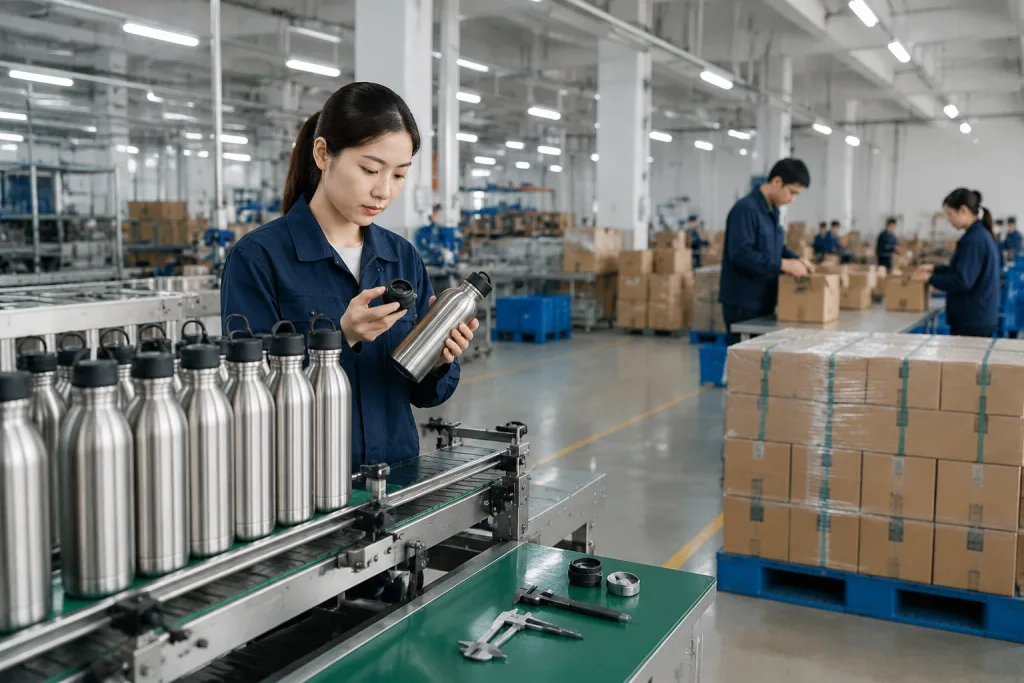
Key Takeaways
- Typical MOQ for custom sport bottles is 500 units, with 25-35 day lead time after sample approval
- A 0.6 mm 18/8 stainless body costs more than a thin 0.4 mm shell, but feels better and rejects dent claims
- Most factory-direct quotes change 8-15% based on lid type, decoration, and packaging
- Ask for AQL 2.5 major / 4.0 minor, REACH paperwork, and dishwasher or leak test data before PO
When you buy sport bottle factory direct, the real question is not “can you make it?” It is “can you make it to spec, on time, and without turning a simple bottle into a claim dispute?” We have seen EU buyers get burned on three checks: 1.2 mm wall thickness that feels flimsy in hand, lid sealing that fails after 30 open-close cycles on the bench, and print that looks clean on a mockup but chips after one dishwasher run. Those are line problems, not brochure problems.
At our Zhejiang factory, we treat a sport bottle like a spec sheet, not a lifestyle item. If you are comparing a canteen manufacturer, canteen supplier, or canteen vendor, read the line items like a buyer who has seen a PO typo turn into a week of back-and-forth: material grade, forming method, lid torque, coating adhesion, packaging compression, and inspection limits. That is how you get a clean FOB quote from China instead of a surprise, and the math has to work before we run the line.
Read the body spec first
I’ll rewrite the section in-place, keeping the HTML structure and the technical specs intact, while making the wording sound like a factory-side sales engineer.The body is where most buyers miss the real cost and the real failure points. For stainless steel, you usually see 18/8 or 304 on the spec sheet. That is the floor for a serious custom drinkware program, especially if you sell into Europe or North America and want fewer compliance back-and-forths. Wall thickness matters just as much. A 0.4 mm shell is cheaper and lighter, but it dents fast and feels thin in hand. A 0.6 mm body gives better hand feel and better survival in transit, and we see the difference on the line when cartons run through 3 or 4 warehouses before delivery.
For a plastic sport bottle, check the resin callout first. Tritan, PET, and PP do not behave the same on impact, odor retention, or hot-fill tolerance. If you want a custom canteen or customizable canteen program, ask the canteen factory to confirm whether the material is BPA-free and whether pigment load changes transparency from one batch to the next. We had a buyer flag a PO typo on wall thickness once—0.8 mm written as 0.08 mm—and QC pulled the sample before packing. A good factory in Zhejiang will give you the material grade, thickness tolerance, and shrink allowance before sampling. If they cannot, the math does not work; you are buying a guess.
- 18/8 stainless: stable, export-friendly, and common for premium SKUs
- 0.6 mm wall: better dent resistance than 0.4 mm
- BPA-free resin: standard expectation for North America
- Tolerance: ask for ±0.2 mm on wall and ±1.0 mm on overall height
Lid design changes the business
I’ll rewrite just the HTML prose, keep every tag and the existing strong tags, and tighten it into a more factory-floor voice with concrete detail.The lid is where returns start. We see good bottles fail on the line because the cap threads are rough, the gasket is 1 mm short, or the flip top drags after 200 open-close cycles. For a canteen customized order, the lid spec needs the same care as the body spec. Ask if the sealing ring is silicone or TPE, if it comes out for washing, and what compression force the factory uses during assembly. We run a torque check with a handheld gauge. If you are quoting a canteen promotional item, a lighter lid can work. For retail, it is the wrong call.
For buyers who toss bottles into bags, leak resistance beats a fancy shape. Our basic test set is simple: inverted for 24 hours at room temperature, 10 open-close cycles, then a 1.2 meter drop onto plywood. QC pulled the sample on a lid that passed water test but seeped at the hinge after the third drop. If you need a customizable growler or custom growler style with a wider mouth, cap torque matters more because wide-mouth threads cross-thread fast on a rushed fill line. A solid canteen manufacturer should give you thread pitch, gasket hardness, and spare-part lead time without making you chase them.
Buyer rule: if the factory cannot explain how the lid seals, do not approve the sample yet.
Decoration is not just branding
I’ll rewrite the section in place, keep the HTML structure intact, and strip out the AI-ish phrasing while adding a few factory-floor details and sharper buyer language.Decoration looks simple until you put the methods side by side. Silkscreen stays economical for one- or two-color logos. Laser engraving gives a clean, permanent mark on stainless. UV printing carries more color, but abrasion resistance depends on coating and surface prep. If you are buying customized drinkware or customizable drinkware, ask for samples on the same substrate and the same coating, not a random demo bottle from the display shelf. We run this check with the same jig every time, because a logo that holds on one powder coat can fail on another.
For canteen custom work, the rule is plain: pick the method that survives distribution, not the one that looks best on a render. On powder-coated steel, laser engraving is usually the safer long-term call. On glossy plastic, pad print can keep the unit cost down. Ask the canteen supplier for rub-test data, usually 50 to 100 double-rub cycles, and confirm whether the ink or laser mark changes after dishwasher exposure. QC pulled a sample last week with a 2 mm misaligned logo, and the buyer flagged it before packing. This is the wrong question to ask after shipment; the math does not work once chargebacks start.
- Silkscreen: low cost, best for simple logos on small runs
- Laser engraving: durable, clean, and stable on 304 stainless
- UV print: handles more color, but needs coating control
- Rub test: ask for 50-100 cycles minimum
Price follows process, not guesses
I’ll rewrite the prose in-place, keep the HTML untouched, and make the pricing copy sound like a factory-side sales engineer wrote it.Factory-direct pricing is easier to read than a buyer’s spreadsheet, as long as you ask for the right build. For a basic stainless sport bottle from China, FOB usually starts around USD 2.10-3.40 at 500 units, based on capacity, lid parts, and decoration method. A double-wall vacuum model usually lands closer to USD 3.80-6.20 at the same volume. Add a custom mold lid, a special coating, or retail packaging, and the price moves another 8-15%. Two quotes can sit close on paper and still miss the real cost by a mile.
MOQ matters just as much. A Zhejiang canteen factory may take 500 units for stock bodies with custom logos, but 1,000 to 3,000 units when you want a new lid or a color-matched body. Lead time is usually 25-35 days after sample approval and deposit for standard orders. New tooling pushes that out. We once saw a buyer flag a PO typo on carton count, and the math broke the pallet plan immediately. If you are a canteen distributor, ask for split shipment terms and carton pack-out counts. This is the wrong question to ask if you only chase unit price. The freight cube eats the margin.
Our factory in Hangzhou, Zhejiang runs up to 300,000 units per month across bottle lines, so we track output by line balance, not just mold cost. QC pulled the sample at 2 mm label offset and sent it back to the line. That is the level of detail you want from any canteen manufacturer or canteen vendors you audit.
Compliance is part of the spec
I’ll rewrite the prose in place, keep the HTML exactly as-is, and tighten the language so it reads like a factory-side sales engineer wrote it.Compliance goes into the PO, not into a chat after the container is booked. For Europe, we ship with REACH confirmation, food-contact declarations, and test reports matched to the exact material batch or at least the same resin family. For North America, buyers usually ask for ASTM-linked performance references, California Proposition 65 screening when it applies, and traceability on inks and coatings. If the bottle has a straw, gasket, or soft-touch part, do not let one certificate cover the whole build.
A serious canteen manufacturers list should treat QA the same way. Ask for incoming inspection, in-process checks, final AQL acceptance, and retention samples. We normally run AQL 2.5 for major defects and 4.0 for minor defects, though retail orders often get tightened to 1.5 and 2.5. If you need a customized canteen for a brand launch, ask for pre-production samples and a golden sample signed by both sides; we have seen a PO typo on lid color turn into a full rework. Add carton drop testing and barcode verification if the goods go straight to Amazon or a 3PL. The math does not work any other way.
Choose the right factory partner
I’ll rewrite the section in-place, keep the HTML exactly as-is, and tighten the sales language so it sounds like a factory-side buyer guide.Not every canteen factory fits the same buyer. Some are set up for quick canteen promotional runs and simple print jobs. Others run as a canteen distributor supply base, with stock lots and 7-day replenishment. The strongest group in Zhejiang and other parts of China works as a true canteen manufacturer: tooling, 316 stainless control, coating, decoration, and export packaging under one roof. You want that group if your order has any risk.
Ask direct questions. How many months of spare lids do they keep on the shelf? Do they test lid torque after 48-hour thermal cycling? How many operators stand on the final inspection line at 6 p.m.? Can they support a distributor growler program with replacement lids and matching gaskets? Can they ship one PO with 6 SKUs without holding the whole carton count? If they give numbers, you are talking to a supplier who knows export work. If they give adjectives, walk away. We’ve seen this go sideways on a 12,000-piece order because the buyer accepted “stable quality” and never asked for the gauge report. The better canteen supplier in China is not the one with the nicest showroom; it is the one that can repeat the same result on order 18, not just order 1.
Sample like a buyer, not a marketer
I’ll rewrite the two paragraphs in a sharper buyer voice, keep the HTML intact, and work in the factory-floor specifics without changing the heading or tags.Sampling is where you save money later. Do not approve a sample because the color looks close under office lighting. Check seam lines, lid fit, coating thickness, and logo placement under daylight and warehouse light. Measure the bottle height, body diameter, mouth opening, and weight against the approved sheet. For a standard sport bottle, weight variation should stay within 3 to 5 grams; if it jumps more than that, the process is not stable. If you are buying distributor canteen stock, ask for one plain sample, one decorated sample, and one packed-out carton sample. We once caught a 2.5 mm lid gap on the line with a caliper, and that was enough to stop a bad PO from moving forward.
We also tell buyers to run a simple field test with their own hands: fill with water, shake 20 times, invert for 24 hours, then open and inspect the gasket. If the order is for a customized growler or wide-mouth bottle, add a pour test to check splash control. This is basic work, and it catches the kind of defect QC pulls at the last minute. A good canteen vendors list should allow sample revisions without noise. One extra week on samples beats a chargeback from a retail chain every time. We had a buyer flag a typo on the carton mark once, and that small correction saved a full reprint.
Send your spec sheet for a factory quote
We will price the body, lid, decoration, and carton together so you see the real landed cost before you place the order.
Frequently asked questions
What is the usual MOQ for sport bottle factory direct orders?
For stock body and custom logo work, MOQ is often 500 units. If you want a new lid, special coating, or color-matched body, expect 1,000 to 3,000 units. A smaller run is possible, but unit price usually rises 15-30% because setup and labor do not scale down. For China sourcing, always confirm whether the MOQ applies per color or per SKU. One canteen supplier may group colors, another may not.
How long does a custom drinkware order take to ship?
Standard production is typically 25-35 days after sample approval and deposit. If the order needs new tooling, complex printing, or extra testing, build in 45-60 days. FOB lead time from Zhejiang can be faster on repeat runs because molds, cartons, and artwork files are already set. If you need Amazon prep, add 3-7 days for labeling, carton tests, and palletization.
Which material is better for a canteen custom project?
For premium steel bottles, 18/8 stainless is the safest choice because it is durable, food-contact friendly, and easy to export. For lighter or transparent products, Tritan or PP may fit better. If you want a canteen customized for retail, the right answer depends on price point, decoration method, and user environment. A school bottle and an outdoor growler do not need the same material spec.
What should I request in QC from a canteen manufacturer?
Ask for incoming material checks, in-process inspection, final AQL 2.5 major / 4.0 minor, leak testing, and retention samples. For decorated products, add adhesion or rub-test results. If you sell in North America or Europe, request REACH paperwork, food-contact declarations, and traceability by batch. A factory that cannot show these documents is not ready for serious distributor drinkware work.
Can I order customized drinkware with mixed SKUs in one shipment?
Yes, and it is common for distributor canteen orders. The factory can usually combine multiple colors, lid types, or logo versions if the body tooling is the same. The trade-off is packing complexity, and sometimes MOQ is calculated per variant. In China, the cleanest approach is to lock artwork first, then split cartons by SKU so your warehouse can receive and label faster.