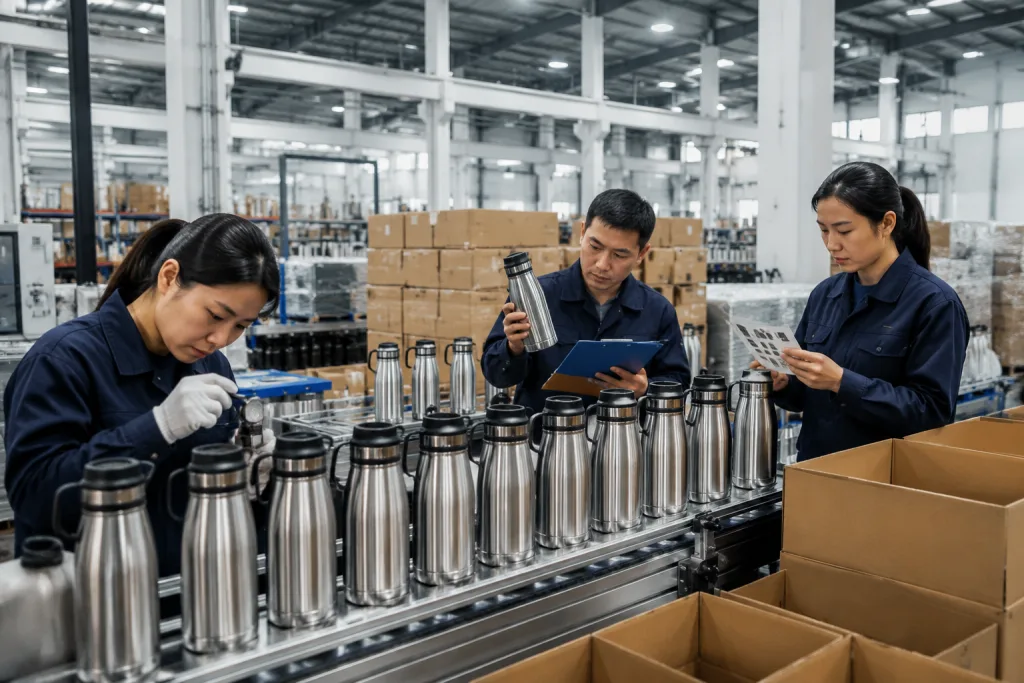
Key Takeaways
- A 0.5 mm wall-thickness drift can change squeeze feel, mold cooling, and leak risk on a 750 ml bottle.
- For printed custom drinkware, set an adhesion standard and wash test up front; 1 failed tape pull can become 5% returns.
- MOQ is not just a price issue: 3,000 pieces is often the point where tooling, decoration, and packaging become stable enough for distributor programs.
- Ask for AQL 2.5 major / 4.0 minor, torque specs, and carton drop tests before you approve any canteen distributor order.
If you buy for sport bottle distributors, you already know the hard part is not getting the PO signed. The headache starts when the batch looks clean on paper and then falls apart in use: lids crack in drop tests, print peels after one wash, bottles carry a resin smell, or a carton shortage turns a neat shipment into a claim. We have seen all four. Most of it shows up before production if you know where the line can drift.
In Zhejiang and the wider China drinkware supply base, the gap between a smooth program and a return-heavy one is usually not luck. It comes down to how tightly you spec the resin, wall thickness, closure torque, coating, and inspection plan. At BottleForge Industrial in Hangzhou, we run over 300,000 units per month with MOQ starting at 3,000 pieces and typical lead time of 25-35 days for custom drinkware, so the same mistakes keep surfacing across distributor orders. QC pulled a sample last week and found a 0.4 mm wall variance; that is the kind of miss that turns into a buyer complaint later. The better buyers ask the ugly questions before the line starts.
Where bottle programs usually fail
I’ll rewrite the section in-place, keeping the HTML structure intact and tightening the language to sound like an export sales engineer. Then I’ll give you only the revised HTML.The first failure is usually invisible: the buyer approves a hand-finished sample, then the production run comes from a different cavity, a different shift, or a different surface-prep cycle. That is why sample approval without a production spec sheet is weak. For sport bottle distributors, the usual weak points are closure fit, liner compression, print adhesion, and odor control. If the cap needs 0.8-1.2 N·m torque to seal in testing, write that number down. If the bottle is Tritan, PETG, or stainless steel, specify the exact resin or gauge, not the marketing name. We’ve seen a PO typo on `750 ml` turn into a freight headache.
Good China factories talk process windows; weak canteen manufacturers only talk about pictures. You want both. Ask for the mold count, cycle time, and target scrap rate. On a normal custom drinkware program, a 2-cavity bottle mold can hold tighter consistency than a rushed multi-cavity setup if the line is chasing volume. The math does not work if the first 100 pieces pass and the next 5,000 drift. That is not a sales issue. It is a claims issue. QC pulled the sample at `AQL 2.5`, and the wall thickness was `1.1 mm` on one side, `1.6 mm` on the other.
- Spec wall thickness: for many 750 ml plastic bottles, `1.2-1.8 mm` is a practical starting band.
- Ask for torque data: caps should not rely on “feels tight.”
- Demand process samples: pre-production sample, golden sample, and first-article photos.
That is the difference between a canteen factory that makes product and a partner that protects margin. We ship fewer surprises that way.
Lid leaks and seal drift
I’ll rewrite this section in-place, keep the HTML structure unchanged, and sharpen the wording with more factory-floor detail and tighter sales-engineer tone.Leakage is the fastest way to lose a distributor account. One bottle leak in transit can trigger a full pallet check, not just a replacement. The cause is usually a stack of small issues: thread mismatch, gasket compression, cap ovality, or gasket material that goes hard after hot-fill. If the program includes a custom growler, the risk climbs fast because the closure is larger, pressure swings are higher, and the buyer still expects a premium feel.
For a canteen customizable or customized canteen program, ask for pressure or inversion testing at the factory. For a lot of sports bottles, a 30-minute inversion test and a 1-meter drop test are base checks, not premium ones. We run these on the line with a simple water tank and torque gauge. For stainless steel growlers, spell out whether the lid must hold carbonated beverage pressure, because a custom growler for beer or kombucha needs tighter seal control than a water bottle.
Do not approve a lid from a photo. Approve a sealing system with a number attached to it.
Practical spec points for sport bottle distributors:
- Seal with water at room temperature and at 60°C if the bottle will see hot-fill or cleaning cycles.
- Request gasket material data: silicone, TPE, or EPDM, plus hardness if available.
- Set acceptable leakage as zero visible drips during inversion and shake testing.
Many canteen distributors lose money because they ask for decoration first and sealing control second. That is the wrong order. A nice-looking canteen promotional item is useless if it leaks in a gym bag. We’ve seen this go sideways on a PO with a 2 mm lid drawing typo, and QC pulled the sample before it left the workshop. Whether you work with canteen vendors in Zhejiang or a canteen supplier elsewhere in China, lock the seal before color matching.
Print that peels or fades
I’ll rewrite the section in-place, keeping the HTML tags and structure intact while stripping the AI-ish phrasing and adding more buyer-floor detail.Decoration failures get expensive fast. The buyer has already paid freight, warehousing, and maybe FBA prep, so a bad logo turns into a chargeback. The usual culprit is not the artwork. It is surface prep. On powder-coated stainless drinkware, we run a crosshatch test after curing because the coating has to hold ink or laser mark. On glossy plastic, solvent mix and oven time matter more than the logo file. If the factory only says the logo is “good,” ask what test they ran and for how long.
For customized drinkware, set the decoration method by use case. Screen print fits bold one- or two-color art on a flat panel. Laser engraving gives a cleaner premium look on metal. UV print can work, but QC pulled the sample on the same substrate you plan to buy, not a similar one. If you are buying canteen custom stock for promotion, a simple one-color logo with a 48-hour water-soak and tape-pull test beats a fancy multi-color print that chips in transit. The math does not work any other way.
Useful specs for custom canteen and customized growler projects:
- Tape test: define pass/fail after 24 hours curing.
- Dishwasher resistance: if required, state the number of cycles, often 20-50 for basic programs.
- Color tolerance: use Pantone references and allow a realistic delta, not “exact match.”
Distributors selling through retail chains should ask for carton samples and scuff testing too. We had one PO with a typo on the carton code, and the buyer flagged it before launch. A canteen manufacturer in Zhejiang can print sharp graphics, but if the outer carton rubs through in transit, the shelf sees damage first. That is the wrong question to ignore.
Packaging that looks cheap in transit
I’ll rewrite the prose in-place, keep the HTML structure intact, and make it sound like a factory-side sales engineer with a few concrete shop-floor details.Packaging problems look minor until the consignee opens the container and sees dents, sleeve splits, or mixed SKUs. We see this go sideways when buyers chase unit price and skip transit protection. A 2-cent save on an insert can turn into a 20x claim. Packaging belongs in the product spec, especially for custom drinkware that moves through 2 or 3 warehouses before it lands at the distributor.
For distributor drinkware, carton strength beats fancy print every time. Call out the corrugated grade, burst strength or ECT where relevant, and whether the bottle ships in an inner box, polybag, or molded pulp tray. On one 32 oz stainless bottle job, QC pulled the sample after the coating rubbed at the corner in a 1.2 m carton drop. If you sell on Amazon, get label placement and FNSKU position signed off before the line starts.
What to lock down with canteen suppliers:
- Master carton drop test: set the height, often 70-100 cm depending on lane and weight.
- Carton count tolerance: no more than ±1% piece count variation per shipment.
- Barcode readability: 100% scan at receiving, not “mostly readable.”
If you are comparing canteen vendors, ask for a packed drop photo series, not an empty box sample. The packed unit is what survives the truck, the vessel, and the warehouse. We ship cartons every week, and the buyer flagged a PO typo once because the outer carton mark said 24 pcs while the packing list said 20. Good factories treat packaging as part of the build. The others treat it like print.
Material mistakes that smell or warp
I’ll rewrite the prose only, keep the HTML structure intact, and make it sound like a buyer-facing factory note with a few concrete production details.Material selection is where a lot of buyers trust the sample too much. A clear bottle can look clean on the showroom table, then haze, pick up odor, or twist after a 55°C heat cycle and UV exposure. If you are sourcing a canteen customizable model, ask for the exact resin or steel grade and the additive package. PET, Tritan, PP, and AS do not behave the same, and 304 and 316 are different animals when corrosion is on the line.
For a canteen distributor program, the risk is selling a bottle with the wrong material promise. If you position it as premium, it needs to survive odor, staining, and dishwasher runs. We’ve seen buyers push back on a 0.8 mm wall spec, then the line saves cost with a cheaper blend and the math stops working. For a canteen promotional run, that cheaper resin can be fine for a 3-month campaign, but not if the customer expects 12 months of use.
Key questions to ask a canteen factory or canteen manufacturer in Zhejiang:
- What resin lot number or steel certificate is tied to the order?
- Can you provide REACH or FDA-related compliance documents for the intended market?
- What is the maximum temperature exposure during production and cleaning?
If you are buying a customizable growler, be stricter. A growler for beverage resale or hospitality needs corrosion resistance, odor neutrality, and a closure that does not hold flavor after 20 wash cycles. QC pulled the sample, and if the cap liner smells after hot-fill testing, the buyer will flag it fast. This is not a cosmetic issue; it is a product failure.
Inspection rules that actually protect margin
I’m rewriting the section in place, keeping the HTML exactly as-is and tightening the sales-engineer tone. Next I’ll swap in concrete QC detail, buyer pushback, and margin language without changing the structure.Inspection is not a checkbox. It is how you protect margin. If you buy from a canteen supplier without clear AQL levels, the factory gets to define “good enough,” and that usually costs you rework or chargebacks. For most distributor drinkware orders, AQL 2.5 for major defects and 4.0 for minor defects is a solid start, but channel risk still matters. Retail and Amazon programs need tighter control than a B2B promo carton going out at 1,000 pcs.
Build the inspection plan around the failures that hit claims: leaks, cap fit, print wear, scratches, odor, and carton count. Ask for first-article inspection, in-process checks, and final random inspection. We run 3-point checks on the line with a torque tester and a 24-hour sealed odor test, because that is where the bad lots show up. A strong canteen vendor accepts that. A weak one calls it “too strict” the moment QC pulls the sample and the numbers start moving. That is the wrong question to ask.
Useful checkpoints for sport bottle distributors:
- Sample size: tie it to shipment size, not a generic handful.
- Odor test: open-pack smell check after 24 hours sealed storage.
- Fit test: caps and lids should be checked across cavity positions, not only the best cavity.
When you work with canteen distributors in China or source direct from Zhejiang, ask for inspection photos with measurements visible in frame. A box shot is not proof. A photo with calipers, torque notes, and batch labels tells you the lot was checked, and the buyer flagged it before shipment if the cap gap was off by 0.8 mm.
How to source without getting burned
I’ll keep the HTML structure intact and rewrite the prose to sound like a factory-side sales engineer, with concrete numbers and a few floor-level details.There is a cleaner way to cut surprises: treat the supplier talk like engineering, not a price fight. Whether you are sourcing a custom canteen, a custom growler, or standard distributor drinkware, ask for the drawing, tolerances, materials, test method, and packout before you talk unit price. Then ask for lead time, line capacity, and what happens if the first run misses target color or cap torque. We have seen a 0.3 mm neck finish variance turn into a week of back-and-forth, so this is the wrong question to ask last.
At BottleForge Industrial in Hangzhou, Zhejiang, we usually quote FOB China with packing and inspection terms spelled out because distributors need freight, duty, and landed cost in the same math. The serious buyer wants numbers: 25-35 day lead time, 3,000-piece MOQ, 300,000 units per month capacity, and written standards for each failure mode. That is normal when the factory runs export orders, not guesswork. On the line, QC pulled the sample with a torque wrench at 0.45 N·m, and the buyer flagged a typo on the PO before we cut cartons. The second order is faster because the spec already killed the ambiguity.
Use this sourcing sequence:
- Approve the specification, not just the sample.
- Lock the material, closure, decoration, and packaging in one document.
- Confirm compliance needs for your market before production starts.
- Keep a golden sample, signed on both sides.
If you do that, your custom drinkware program stays predictable. If you do not, you are betting your distributor relationship on luck, and the math does not work.
Spec your next bottle run with fewer surprises
Send your target price, artwork, and use case. We’ll help you lock the spec, test plan, and packout before you place the order.
Frequently asked questions
What should sport bottle distributors ask for before placing an order?
Ask for the full spec sheet, not just a quote. You need material grade, wall thickness, closure torque, decoration method, carton spec, and AQL target. For a normal B2B run, a 3,000-piece MOQ and 25-35 day lead time are common in Zhejiang factories. Also request compliance documents such as REACH or ASTM-related test reports if your market needs them. If the supplier cannot name the exact defect limits for leaks, print adhesion, and carton count, the program is still too loose to buy safely.
How do I compare canteen suppliers fairly?
Compare them on process control, not just unit price. A fair comparison includes mold count, capacity, lead time, inspection method, and how they handle rejects. A strong canteen supplier will state the actual production output, for example 300,000 units per month, and will show you where QC happens. Ask for the same sample criteria from every canteen vendor: material, logo method, packaging, and drop-test standard. If one supplier only offers glossy photos and another gives you test data, the second one is usually the safer source.
What is a realistic MOQ for custom drinkware?
For many custom drinkware programs, 3,000 pieces is a realistic starting MOQ because it covers stable setup for molding, decoration, and packaging. Smaller orders are possible, but pricing often jumps 15-30% and the chance of inconsistency goes up. If you need multiple colors, accessories, or mixed packaging, MOQ can rise quickly. A canteen manufacturer in China may quote lower for stock items, but once you add custom artwork or a special lid, the economics change. Always ask whether the MOQ applies per SKU, per color, or per logo version.
How do I prevent leak claims on a custom canteen or growler?
Set the leak test in writing before production. For a custom canteen, ask for inversion testing, shake testing, and a 1-meter drop test with filled units. For a custom growler, add pressure or carbonated-beverage checks if that is the use case. Require gasket material disclosure and cap torque data. A practical seal spec is zero visible leakage after inversion and no cap loosening after transit simulation. If the supplier will not commit to those numbers, the risk moves straight to your customer service team.
Can I sell canteen promotional items on Amazon or retail?
Yes, but the spec has to be tighter than for a one-off corporate gift. Amazon or retail programs need consistent packaging, barcode placement, and lower cosmetic defect rates. Many buyers also need FNSKU labeling, carton marking, and stronger outer boxes. For canteen promotional orders, a cheap packout can work for handouts, but it will not survive distribution centers or shelf handling. If you want retail-ready results, tell the factory that the product is being prepared for distributor drinkware channels and ask for carton and drop requirements upfront.