Key Takeaways
- A useful RFQ should list 10 core items, including capacity, material, logo method, packaging, and target MOQ.
- For common custom drinkware, sample time is usually 5-10 days and bulk lead time is 25-35 days after approval.
- A realistic sport bottle MOQ from a Zhejiang factory often starts at 1,000-3,000 pcs per SKU, depending on decoration.
- A good PO locks in AQL 2.5, carton marks, color standard, and allowed weight or wall-thickness tolerance.
If you are a sport bottle distributor, the hard part is not finding a factory. China has plenty of suppliers, and Zhejiang has more than most buyers can sort in one afternoon. The real job is telling a workable quote from a cheap number that turns ugly later: a 1.2 mm lid that cracks at drop test, a 14-day sample lead time that slips to 28, hidden artwork charges, or cartons that pass in the lab and fail in export.
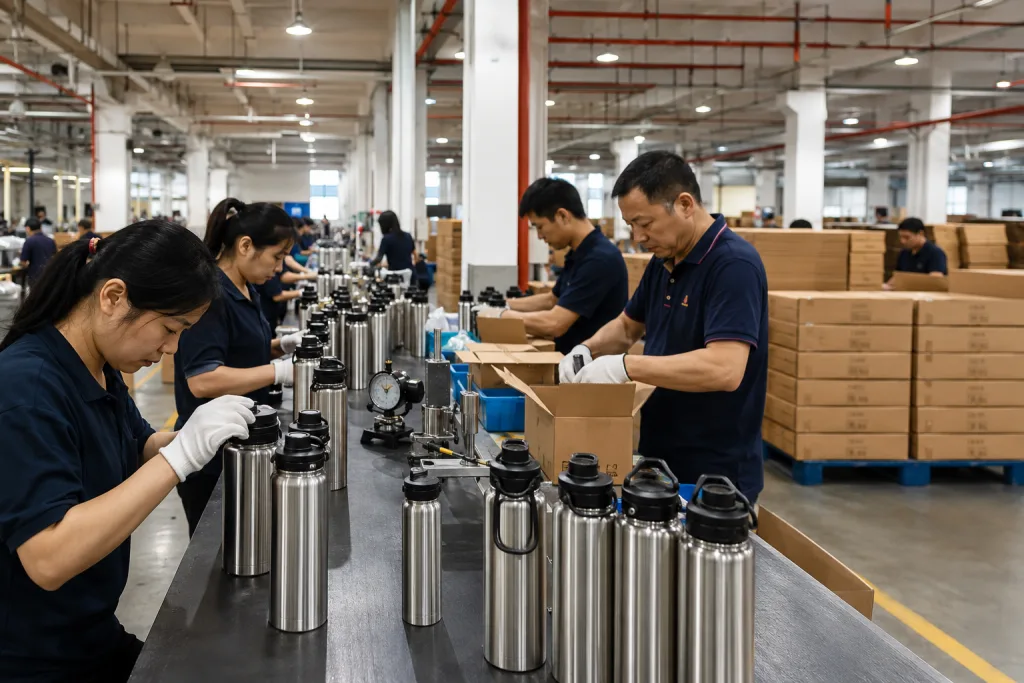
We treat the order like a line job, not a shopping cart. A clean RFQ, sample approval, and a bulk PO with material, tolerance, packaging, and QA details keeps the order on track. We run it this way in Hangzhou because a canteen plant shipping 300,000 units a month cannot afford a typo on carton marks, and neither can you.
Start With a Clean RFQ
I’ll rewrite the section in-place, keep the HTML structure intact, and make the prose sound like a seasoned factory sales engineer.If you send a vague inquiry, you get a vague quote. That is the first mistake most canteen distributors make. A clean RFQ stays short and still gives us the basics: capacity, material, lid style, logo method, target market, and order quantity. For a sport bottle distributor, that is the floor, not a nice-to-have. If you want a canteen custom or custom canteen program, add insulation type, wall thickness, finish, and the test standard for the market. We had a buyer leave out wall thickness once; QC pulled the sample at 0.4 mm and the math did not work for their retail price.
We ask buyers to state the end use first. A gym bottle, school bottle, and promo bottle do different jobs. A canteen promotional order can accept a simpler build, while a customizable growler or customized canteen for retail needs cleaner edges and better packaging. If you need distributor drinkware for Amazon or chain retail, say it up front. Otherwise the canteen supplier can quote a bottle that passes spec but misses the shelf. We have seen that go sideways on a PO typo where the buyer wrote “bulk pack” but wanted FNSKU labels.
- Capacity: 600 ml, 750 ml, 1 L, or 64 oz
- Material: 18/8 stainless steel, Tritan, aluminum, or BPA-free PP
- Logo: silkscreen, laser, emboss, UV print
- Packaging: bulk pack, window box, color box, FNSKU-ready
- Target MOQ: 1,000, 3,000, or 5,000 pcs
In Zhejiang, a clean RFQ usually saves 1-2 rounds of revision. We run the line every day, and that gap shows up fast when you compare canteen factories, canteen manufacturers, and canteen suppliers across China.
Turn RFQ Into A Real Quote
I’ll rewrite the section in-place, keep the HTML exactly as-is, and make the copy sound like a buyer-facing sales engineer from the floor.A quote only matters when it shows the cost drivers. Ask for unit price, sample fee, tooling fee, logo fee, carton spec, and freight basis. If a vendor sends one line, push back. We’ve seen a cap print setup buried in unit price make a 1,000 pcs quote look sharp, then blow up at 10,000 pcs. You need the split, not a pretty number.
For standard custom drinkware, we usually ship FOB Ningbo or FOB Shanghai for buyers in North America and Europe. A basic stainless sport bottle often lands around USD 2.20-3.80 at 1,000 pcs, while a double-wall insulated custom growler sits in the USD 4.80-8.50 range, depending on steel grade, lid parts, and finish. A new mold or special cap can add USD 600-2,500 in tooling. That’s normal. The wrong move is accepting a quote that refuses to separate mold cost from unit cost; the math doesn’t work. On the line, QC pulled a sample with a 0.8 mm lid gap, and that kind of miss gets expensive fast.
“If the quote does not list decoration, packaging, and carton count, it is not a quote. It is a teaser.”
When you compare canteen distributors or canteen vendors, ask if the sample fee rolls into the first PO. We’ve seen USD 30-100 sample charges credited back by Zhejiang factories when the bulk order is real. One buyer once sent a PO with “cartoon” instead of “carton”; the buyer flagged it, and the freight desk had to stop and confirm the pack count before we could book space.
Approve Sample Without Guesswork
I’m rewriting this section in-place, keeping the HTML structure intact and tightening the copy so it reads like a distributor-side sales engineer wrote it.Samples are where most buyers lose time, because they check the wrong points. Don’t just hold the bottle and say it feels fine. Measure the height, check the lid seal, look at the finish, sniff for plastic odor, test thread engagement, and inspect print edges under a lamp. For a customized canteen or customized growler, we also check wall thickness when the market needs it. A single-wall bottle may run 0.35-0.45 mm stainless gauge, while double-wall construction often lands around 0.40-0.50 mm per shell, depending on the build. If the vendor cannot state that spec on the sample card, the math doesn’t work.
Ask for three sample stages on any new order: pre-production sample, decorated sample, and packed sample. We run this on the line all the time, especially for canteen customized products with retail packaging. You want the finished carton, insert fit, barcode position, and warning text checked before mass production starts. One buyer once flagged a PO typo on the carton mark after approval; that turned into a 12-day delay. If you sell through retail channels, ask for drop-test or leakage-test results. A good canteen manufacturer should have the report ready, not “send it later.”
- Sample lead time: 5-10 days
- Sample approval window: 2-5 days on your side
- Leak test: 24 hours inverted
- Color tolerance: Pantone Delta E agreed in writing
For canteen promotional projects, a sample that looks 90% right is still a miss. QC pulled the sample, checked the logo shift at 1.5 mm, and the buyer still asked for one more round—fair enough. You need written approval on every visible detail, especially if you are reselling as distributor canteen stock.
Lock The PO Line By Line
I’ll keep the HTML intact and rewrite only the prose, tightening the PO language with more concrete factory-floor detail and less filler.The purchase order is where margin gets protected or lost. A PO should read like a control sheet, not a polite email. Put the product name, SKU, quantity, unit price, Incoterm, ship window, artwork file version, packaging count, and inspection rule. If you are sourcing customizable canteen or customizable growler lines, list the exact lid code, strap color, finish code, and carton markings. We had one buyer flag a PO because the carton print said “12 pcs/carton” in the email thread and “50 pcs/carton” on the final draft. That typo would have cost the line a full day.
Here are the line items we recommend:
- Item: 750 ml stainless sport bottle, matte powder coat
- Qty: 3,000 pcs
- Unit price: USD 3.26 FOB Ningbo
- Logo: 1-color silkscreen, 1 position
- Packing: 1 pc/white box, 50 pcs/carton
- Inspection: AQL 2.5 major, 4.0 minor
- Lead time: 28 days after sample sign-off
This is the point where a canteen distributor starts acting like a real buyer. You are not chasing “best price.” You are buying output with a paper trail from a canteen factory. We run 200,000 to 300,000 units a month on some lines, and this kind of order discipline cuts rework fast because QC can pull the sample against one spec instead of three versions. The math works; vague POs do not.
If your program covers custom drinkware across multiple SKUs, keep one PO line per color and one per decoration method. Do not bundle them. A 24-hour delay on one silk-screen setup can hold the whole shipment, and we have seen that go sideways when buyers tried to “simplify” the PO. Separate lines keep disputes small and make the carton count easy to check at loading.
Inspect Bulk Like A Buyer
Bulk production is not done when the line says 100%. It is done when the cartons pass inspection on the last pallet. For export drinkware, we run a simple QC plan: incoming material check, first article check, in-process check, and pre-shipment inspection. AQL 2.5 is standard for major defects on many drinkware programs, but if you are buying a premium custom canteen, tighter cosmetic limits make sense. QC pulled the sample on the 3 mm print seam, and that is where a bad run shows up.
Check closure torque, leakage, print adhesion, color consistency, and carton compression. We use a torque wrench on the cap, not a guess, because a loose lid turns into a leak claim fast. A canteen supplier should show test records for thermal retention if it is insulated, plus migration or material compliance papers for EU and North America. If your label says customizable drinkware for retail, the color has to hold from sample to bulk. One weak pallet can wipe out a small launch. We have seen that go sideways on a 2,000-piece order.
For North American distribution, make sure the factory understands carton labeling, master carton quantity, and any FNSKU or barcode requirements. For Europe, confirm REACH documentation and packaging language rules. Zhejiang factories that export every week usually know this, but do not assume. A buyer flagged a PO typo once: 24 pcs on the master carton label instead of 240 pcs. Ask for photos of bulk cartons, inner packs, and pallet layout before shipment. That one step cuts chargebacks later.
When the order is for canteen manufacturers that claim broad capacity, verify actual output with your own sample lane. Run 300 pieces on the same line, with the same cap, print, and carton, then check what fails. A factory in Hangzhou or elsewhere in Zhejiang should not blink at sharing process photos, test reports, and inspection records. If they do, the capacity pitch is noise.
Scale The Next Order
I’ll rewrite the section in place, keeping the HTML intact and tightening the language so it sounds like a factory-side sales engineer, not generic web copy.If the first shipment lands clean, use the numbers to tune the next PO. We run a simple sheet here: defect rate, late shipment rate, sample revision count, freight cost per carton. One buyer once found a typo on the carton mark after 18 days in transit; that line item killed the margin. Those four numbers tell you whether to stay with one canteen vendor, shift volume, or split the business across two canteen suppliers. Good programs get stronger. Bad ones just get bigger.
For repeat buys, the math works when you standardize hard. Lock the lid across three models, keep artwork in the same 45 mm zone, and cut color variants before they eat your MOQ. That is how a one-off custom drinkware job turns into a distributor drinkware line that ships on schedule. If you sell canteen promotional items, ask the factory to pre-buy common caps, gaskets, and rings. On our line, that trims lead time by 3-5 days and keeps dead stock off your books.
Some buyers want to jump from custom canteen to canteen customized to custom growler after the first bottle sells. We’ve seen that go sideways when the base process is still loose. QC pulled the sample and found a 0.4 mm shift in logo position on one run, and the buyer flagged it immediately. A canteen distributor in Europe or North America should care more about repeatability than marketing copy: 0.2 mm tolerance, stable logo placement, on-time loading. That is what keeps a Zhejiang sourcing program healthy over 12 months.
At that point, you are not just placing orders. You are building a supply chain with a canteen manufacturer that can handle the next 5,000, 10,000, or 30,000-piece reorder without drama.
Send your RFQ to a Zhejiang factory today
Share capacity, material, logo, and target quantity. We will turn it into a clear quote, sample plan, and bulk PO within one working day.
Frequently asked questions
What MOQ should I expect from a sport bottle distributor order?
For a standard sport bottle distributor program, MOQ usually starts at 1,000-3,000 pcs per SKU. Simple single-color silkscreen may stay near 1,000 pcs, while custom molds, special lids, or retail packaging often push to 3,000-5,000 pcs. A Zhejiang canteen factory may offer lower pilot quantities, but the unit price usually rises 15-30%. If you want canteen customized or customized drinkware with multiple colors, ask for MOQ by color, not just by model.
How long do samples and bulk orders usually take?
Most custom drinkware samples take 5-10 days, depending on artwork and lid complexity. Bulk production after sample approval is often 25-35 days for standard models, and 35-45 days if tooling or special packaging is involved. If a canteen manufacturer promises 7-day bulk on a new design, ask what is actually being produced. In Zhejiang, fast is possible, but only if the structure is already mature and the factory has the parts in stock.
What should I put in the PO to avoid disputes?
Put quantity, unit price, Incoterm, exact SKU, logo method, packaging count, ship window, and inspection standard. Add AQL 2.5 for major defects, carton labeling requirements, and approved artwork version. If you are buying a canteen custom or custom canteen order, also lock the lid code, finish code, and color reference. A clear PO is the easiest way to keep canteen suppliers and canteen vendors aligned.
Do I need compliance documents for Europe and North America?
Yes. For Europe, ask for REACH and, where relevant, LFGB or food-contact declarations. For North America, ask for food-contact supporting documents and any state-specific requirements if you sell there. Insulated drinkware may also need migration-related testing depending on material and claim. A serious canteen supplier or canteen factory in China should provide documents before bulk shipment, not after the container leaves.
Can I source promotional items and retail bottles from the same factory?
Usually yes, if the canteen manufacturer has enough capacity and different production lines. A canteen promotional bottle may use simpler packaging and one-color print, while retail orders need better cartons, barcodes, and more stable finish control. A factory in Zhejiang with 300,000 units/month can often handle both, but keep the orders separate in the PO. That avoids confusion between distributor canteen stock and retail-ready canteen customized goods.