Key Takeaways
- MOQ for most sport bottle customized runs starts at 1,000 pcs, while complex decoration can push it to 3,000 pcs
- FOB China pricing usually lands around USD 1.20-4.80 per unit depending on material, lid, and print method
- For gym and outdoor retail, 500 ml and 750 ml bottles usually move better than oversized 1,000 ml formats
- AQL 2.5 inspection, REACH compliance, and lid-cycle testing matter more than a pretty render
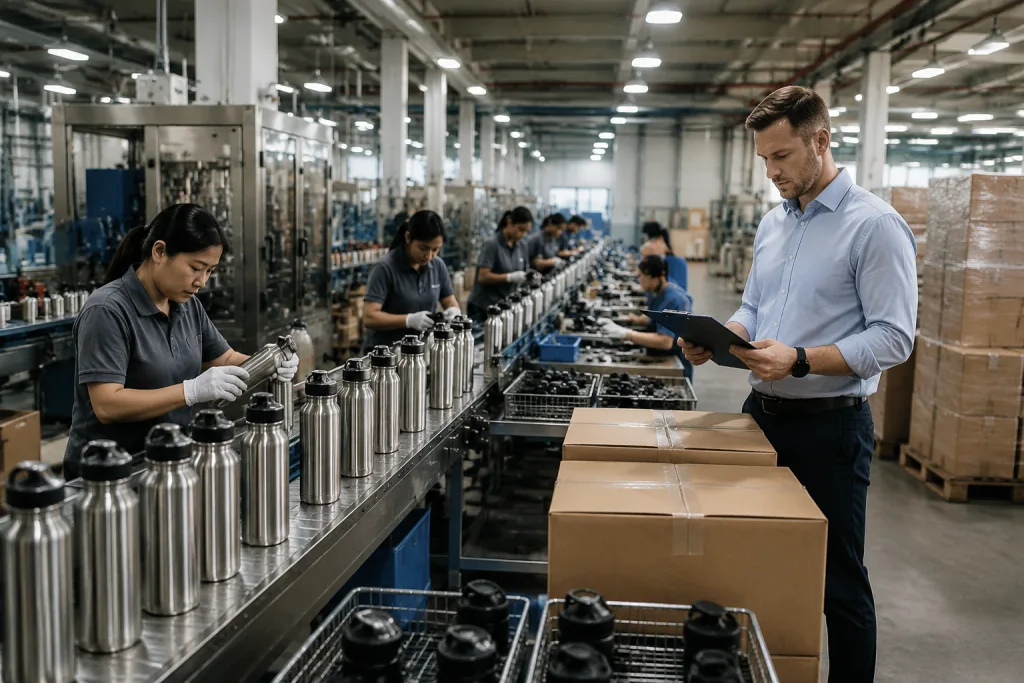
If you are buying sport bottle customized products for retail, corporate gifting, or event programs, “looks good” is not a spec. You need a bottle that survives a 1.2 m drop, runs clean on the line, clears REACH, and still leaves margin. We see buyers burn two weeks because they start with artwork before they lock material, cap type, and end use.
The better call is to compare options head to head: stainless steel against Tritan, screw cap against flip lid, 500 ml against 750 ml. That is the wrong question to ask if you start with color first. We run 300,000 units a month in Hangzhou, with MOQ from 1,000 pcs for standard custom runs and a 25-35 day lead time after sample approval.
Compare the core bottle formats
I’ll rewrite the prose to sound like a factory-side sales engineer, keep the HTML exactly as-is, and preserve the table structure and numbers.Start with the bottle body. That sets cost, weight, and the complaint rate we see on the line. Buyers usually line up stainless steel, Tritan, then aluminum. Stainless steel wins when you need premium positioning, insulation, and fewer crack claims. Tritan fits when the brief is lightweight, clear, and lower-cost customizable drinkware. Aluminum can look solid on a spec sheet, but dent marks and coating wear make it a harder sell in distributor drinkware programs.
Use a spec table early. QC pulled the sample on a 0.2 mm finish scratch last week, and the choice got clear fast.
| Format | Typical FOB China | MOQ | Best use case |
|---|---|---|---|
| 304 stainless sport bottle | USD 2.60-4.80 | 1,000 pcs | Retail, sports clubs, premium corporate gifts |
| Tritan sport bottle | USD 1.20-2.40 | 2,000 pcs | Promotions, schools, volume-driven campaigns |
| Aluminum bottle | USD 1.50-2.80 | 3,000 pcs | Lightweight giveaways with simple decoration |
If you are comparing a custom canteen against a custom growler, the same logic holds: wall structure, closure, and decoration cost more than the headline material. We had a buyer flag a PO typo once—“growler” became “growlyer”—and the whole sample round slipped three days. A canteen manufacturer in Zhejiang can run all three, but not with the same tooling, lead time, or unit economics.
Lids decide the complaint rate
I’ll rewrite the section in place, keep the HTML exactly as-is, and tighten the sales-engineer voice with concrete factory-floor detail.Most first-time buyers fixate on print and skip the lid. That is the mistake. On the line, leaks, snapped hinges, and complaint emails usually start there. For sport bottle customized jobs, a screw cap is the safest pick. It is cheap, stable, and easy for canteen suppliers to source in bulk. Flip lids sell better in gyms and commuter channels, but hinge tolerance has to stay tight. Straw lids work well for one-hand use, yet assembly mistakes show up fast.
We run it this way:
- Screw cap: best for distributor canteen programs and low-MOQ promotions.
- Flip lid: best for retail canteen customized projects that need stronger shelf appeal.
- Straw lid: best for sports, school, and fitness custom drinkware programs where quick drinking matters.
A decent canteen factory should show hinge-cycle data and leak test results. We ask for 3,000-5,000 opening cycles on flip lids and a 24-hour inverted leak test. QC pulled the sample once and found a hinge pin wear mark after 3,200 cycles; that is the kind of detail a real canteen vendor will own up to. If the supplier cannot give you those numbers, the math does not work. In Zhejiang, the better factories will tell you the failure mode before you ask.
Decoration should match channel
I’ll keep the heading and tags intact, tighten the prose, and make it sound like a factory-side sales engineer wrote it. Then I’ll return only the rewritten HTML.Your decoration method should follow the sales channel, not the artwork mood board. We run the line by order type, and the right finish changes the math fast. For low-volume, high-perceived-value orders, laser engraving stays clean on 304 stainless steel and holds up after 50+ hand washes. For color-heavy retail programs, silk screen or UV print gives you more room on artwork. For premium canteen promo runs, powder coating with one-color branding usually beats full-wrap graphics on margin and on shelf. If the buyer wants a sample to “look nicer,” I push back. Sample looks do not pay the freight.
Typical decoration cost changes the equation quickly:
- Laser engraving: adds about USD 0.15-0.35 per unit.
- Single-color silk screen: adds about USD 0.08-0.20 per unit.
- Full-color UV print: adds about USD 0.30-0.60 per unit.
We had one PO come in with “lasar” in the artwork note, and QC pulled the sample because the logo depth was too shallow on a brushed body. For a canteen promotion, engraved stainless units feel more solid and take abuse on the line and in transit. For a distributor selling into 12 accounts, a clear logo on one standard body is easier to reorder, pack, and keep consistent. If you need branded custom drinkware for Amazon-style retail, use a decoration that survives FNSKU labels, carton rub, and warehouse drops. The point is not to print a logo. The point is to keep it visible after the shipment leaves China and lands with the end customer.
Use-case fit beats feature count
I’ll rewrite the section in-place, keep the HTML structure intact, and tune the prose to sound like a buyer-facing sales engineer.Do not chase the bottle with the longest spec sheet. Buy the one that fits the use case. A 1,000 ml insulated bottle makes sense for outdoor retail, but it is awkward on a packed train or in a school bag. A 500 ml Tritan bottle moves well in mass promotion, yet it does not carry a premium ticket. We run samples on this every week, and the buyer usually flags the same thing: hand feel, refill rhythm, and how the customer clips or carries it decide the sale.
Practical fit by channel
- Gym and sports retail: 600-750 ml, flip lid or straw lid, stainless steel or Tritan; QC pulled the sample after the lid passed a 1.2 m drop test.
- Corporate gifts: 500-650 ml, laser-engraved stainless, matte finish; this is where a clean logo beats a busy surface.
- Mass promotion: 400-500 ml, lighter body, simple print, MOQ tolerance at 3,000 pcs, not 30,000.
- Outdoor and hiking: 750-1,000 ml, stronger carry loop, leak-proof screw cap; the line keeps these at 24-hour leak checks before packing.
This is where a canteen customizable program can beat a generic bottle. If your buyer wants hard-use carry, a customized canteen with thicker walls and a plain lid often sells better than a flashy shape that cracks on impact. For a distributor canteen buyer, two sizes and one lid family is the smart move. The math works. That setup keeps replenishment simple, and when your canteen manufacturers are in Zhejiang, repeat orders stay clean without new tooling every season.
Spec checks before you approve
I’ll keep the HTML exactly as-is and rewrite the prose to sound like a real sales engineer, with concrete factory details and tighter wording.Before you sign off on production, ask for the dull paperwork first. That is where the risk sits. We want material declarations, lid drawings, carton sizes, and test records on the desk before the line starts. A proper canteen factory in China should send them fast. If they drag, they are not export-ready.
Use this checklist before deposit:
- Material confirmation: 304, 316, Tritan, or food-grade aluminum.
- Wall thickness: 0.4-0.6 mm for stainless bodies, depending on the bottle shape.
- Drop test: 1 m to 1.2 m, based on customer spec.
- Leak test: inverted for 24 hours, plus pressure checks if the cap design needs it.
- Compliance: REACH for Europe, FDA or ASTM-aligned requirements for North America when needed.
- Inspection: AQL 2.5 for major defects and AQL 4.0 for minor defects is standard on export orders.
If you are buying from a Zhejiang canteen factory, ask for sample photos from the same line that will run your order. That tells you more than a showroom sample ever will. We have seen buyers approve from a display bottle, then the real run missed by 2 mm on lid fit and the print shifted on 1,000 pcs. The buyer who asks for the spec sheet first usually avoids that mess.
Lead times, moq, and factory reality
I’ll keep the HTML exactly as-is and rewrite only the prose to sound like a real sales engineer, with concrete factory detail and tighter wording.Price only counts if the shipment leaves on schedule. For most customized drinkware runs out of Zhejiang, the real lead time is 25-35 days after sample sign-off for standard bodies and prints. Add a new mold, gradient coating, or a multi-part lid, and you are in the 45-60 day range. That is not slow for China export work. That is normal factory reality.
Here is the part buyers usually miss on the first round:
- Standard logo order: 1,000 pcs MOQ, 25-35 days.
- Complex multi-color order: 3,000 pcs MOQ, 30-45 days.
- New mold or bespoke shape: 5,000 pcs+ MOQ, 45-60 days.
If you are comparing canteen supplier options, ask who owns the molding, who assembles the lids, and who signs off final inspection. We run a 24-point QC check on the line, and that catches the small stuff before it turns into a claim. A strong canteen factory in Zhejiang should keep the process in-house, not scatter it across three subcontractors and hope the cartons survive. BottleForge keeps monthly output near 300,000 units, and that number matters because repeat orders only work when the line stays steady. For distributor canteen and distributor growler programs, stability beats a cheap quote almost every time.
Send your spec, get a faster quote
Share your size, lid, logo, and target market. We will match the right sport bottle customized option and quote from Zhejiang with no guessing.
Frequently asked questions
What is a realistic MOQ for sport bottle customized orders?
For standard logo customization, 1,000 pcs is the most common MOQ from a China factory in Zhejiang. If you want a new body shape, multi-color print, or special lid tooling, 3,000-5,000 pcs is more realistic. A simple stainless model with one-color logo may ship at 1,000 pcs, while a full-color promotional run or custom growler shape usually needs a larger batch. Always confirm whether MOQ applies per color, per size, or per artwork. That detail changes your landed cost more than many buyers expect.
Which material is best for customized drinkware retail?
For retail, 304 stainless steel usually gives the best balance of perceived value and complaint resistance. It typically lands around USD 2.60-4.80 FOB China depending on insulation, lid style, and decoration. Tritan is better when you need lower price and lighter weight, usually around USD 1.20-2.40. If your channel is premium corporate gifts or sports clubs, stainless is the safer bet. If your target is volume promotions, Tritan can move faster because it keeps the retail price lower while still looking clean.
How do I check if a canteen manufacturer is reliable?
Ask for three things immediately: recent inspection reports, material declarations, and production photos from the actual line that will run your order. A serious canteen manufacturer should also confirm AQL standards, usually AQL 2.5 for major defects and AQL 4.0 for minor defects on export work. For Europe, ask for REACH support; for North America, ask about food-contact documentation and carton specs. If they cannot give you lid-cycle data, leak test results, and a clear lead time of 25-35 days for standard orders, keep looking.
Can I use one design for canteen customized and sport bottle customized ranges?
Yes, but only if the body shape and lid family are compatible. Many buyers create one visual system and apply it across a sport bottle customized line, a canteen custom line, and even a custom growler program. That keeps branding consistent and reduces artwork costs. The catch is that one lid may not fit all use cases. A gym bottle may need a straw lid, while a canteen customized unit for hiking may need a screw cap. Keep the branding unified, but let the spec follow the use case.
What should I budget for sample and mass production?
A sample usually costs USD 30-80 per style, depending on whether you need printing, engraving, or a new lid. For production, a basic promotional bottle may start around USD 1.20-1.80 FOB China, while a premium insulated stainless unit can land at USD 3.20-4.80. Add packaging, which can change carton cost by 5-12%. If you are selling through a distributor canteen channel or preparing Amazon FNSKU labeling, include an extra USD 0.05-0.20 per unit for packaging and labeling work.