Key Takeaways
- Quote accuracy improves when your RFQ includes Pantone code, bottle capacity, finish, logo size, and target MOQ such as 3,000 pcs
- A pre-production sample normally needs 7-12 days after artwork and Pantone confirmation
- Powder coating usually gives better color stability than wet paint for sport bottle custom Pantone orders
- Your PO should list AQL, carton drop test, barcode rules, spare parts, and FOB China port terms
A sport bottle custom Pantone job looks simple until the first sample comes back 2 shades too blue, the logo is 8 mm off-center on the rotary jig, or QC pulls the cap and the silicone ring slips during a 5 kg pull test. For B2B buyers, color is not decoration. It is brand control. One wrong shade across 10,000 units becomes a warehouse problem, not a design problem.
At our Hangzhou, Zhejiang factory, we run into the same buyer mistake about 30 times a season: asking for “custom drinkware” pricing before fixing the material, coating, Pantone code, print method, carton plan, and inspection level. The line can move fast, but the RFQ must read like a production file. A mood board does not tell us whether to quote powder coating, silk screen, laser engraving, or a 24 pcs/carton export pack.
Start with a usable RFQ
Your RFQ decides whether we send a real quote or a safe guess with padding. For a sport bottle custom Pantone order, don’t send one photo and ask for “best price.” The math doesn’t work. A canteen manufacturer has to price stainless steel grade, capacity, wall thickness, coating, lid structure, logo process, carton size, and test requirements; last month QC pulled a 750 ml sample that looked fine, then found the body gauge was 0.42 mm instead of the buyer’s expected 0.5 mm. If those details are missing, the first quote may look cheap and then move after sampling.
A usable RFQ for customized drinkware should include bottle type, capacity in ml or oz, target retail market, annual volume, first order quantity, Pantone code, surface finish, logo size, packaging style, and delivery term. Write it like this: 750 ml single-wall stainless sports bottle, 0.5 mm body gauge, Pantone 2965 C matte powder coat, one-color screen logo 45 x 35 mm, individual kraft box, export carton 24 pcs, FOB Ningbo. Clear enough. We run this straight to costing, artwork check, and carton calculation instead of sending 6 emails to confirm basics.
At BottleForge Industrial in Zhejiang, our normal MOQ for a custom canteen with Pantone coating is 3,000 pcs per color, while repeat orders can sometimes run at 1,500 pcs if raw material and coating line schedules match. Our monthly capacity is about 420,000 stainless bottles across sports bottle lines, travel tumbler lines, and custom growler lines with separate lid assembly benches. China suppliers can quote fast, but a quote without construction details is not a sourcing decision; we’ve seen this go sideways when a PO said “blue” and the buyer later flagged the approved sample because they meant Pantone 2965 C, not 296 C.
RFQ line items to state clearly:
- Product: sport bottle for bike cages, custom canteen with carry loop, or customizable growler for beer and outdoor retail
- Material: 304 stainless steel, Tritan, glass, or aluminum; tell us if the inner wall touches acidic drinks
- Color: exact Pantone C or U reference, matte or gloss, with tolerance confirmed against a Pantone book under D65 light
- Decoration: silkscreen, laser engraving, heat transfer, or UV print, including logo size and placement in mm
- Testing: LFGB, REACH, ASTM, BPA-free, or FDA food-contact basis; state the market before we book the lab
Choose the bottle construction first
Color matching comes after construction. We’ve seen this go sideways: the buyer approved a custom Pantone chip on an aluminum sample, then switched to stainless after the first quote, and the spray result, weight, unit price, and lead time changed from 12 days to 18 days. On our sample rack, we split sport bottle custom Pantone jobs into single-wall stainless, vacuum insulated stainless, aluminum, Tritan, and glass because each body takes paint and handling differently.
Single-wall stainless fits promotional and outdoor distributor canteen programs because it takes knocks and stays lighter than vacuum products. A 600-750 ml single-wall bottle often uses 0.45-0.55 mm 304 stainless steel, with a finished weight around 150-220 g depending on cap design; QC checks the wall with a digital micrometer before the line starts polishing. Vacuum insulated bottles cost more, but they fit premium retail and corporate gifting. A 20 oz vacuum sport bottle may use an inner wall of 0.4 mm and outer wall of 0.5 mm, with vacuum loss testing after welding.
Aluminum is cheaper for canteen promotional campaigns, but it needs an internal liner and dents faster in a drop test. Tritan works for fitness and school channels where the buyer wants a clear body and low weight; the buyer often flags scratches if the polybag spec is too thin. Glass suits office or lifestyle bottles, not rough outdoor use, and we usually add stronger egg-crate dividers after carton compression testing.
If you are comparing canteen suppliers, ask them to quote the same construction, not just the same capacity. This is the wrong question to ask if the RFQ only says “750 ml bottle.” A 750 ml bottle with a thin 0.38 mm body is not equal to one with 0.50 mm steel. A canteen vendor may win the unit price by shaving metal, but your return rate rises after transit or customer use; we have opened cartons with 14 dented bodies in a 200-piece pilot run. For distributor drinkware, a small saving of USD 0.08 per unit does not work if dents create a 3% claim rate.
PO line items to lock at this stage: capacity tolerance in ml; material grade such as 304 stainless; wall thickness in mm; lid material and gasket type; leak test method used on the line; spare lids or gaskets packed per carton. One PO we received even typed “0.35 mm” instead of “0.53 mm,” and QC pulled the sample before bulk production started.
Control Pantone before sampling
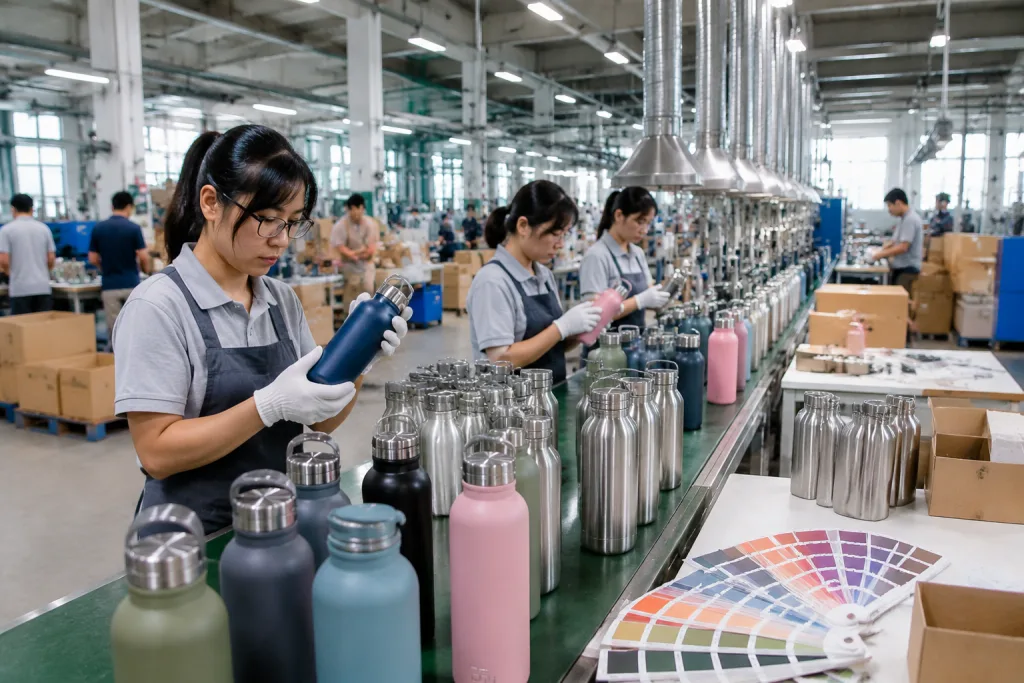
I’ll rewrite the section in place, keep the HTML intact, and make the wording sound like a shop-floor sales engineer wrote it.Pantone matching is not magic; it is controlled finishing on the line. For sport bottle custom Pantone work, powder coating is the usual route for stainless steel and aluminum. Wet paint still shows up on lower-cost programs, but powder coating gives us better chip resistance and steadier batch-to-batch color. For a matte Pantone finish, we need the Pantone number, the gloss target, and one approved reference from a past run or the buyer will keep pushing on shade drift.
Do not approve color from a screen photo. Ask the canteen supplier for a sprayed chip or a coated bottle panel before full sampling if color matters. Under D65 daylight, a normal commercial target is Delta E less than 2.0-3.0, but the right number depends on your brand spec and the bottle surface. QC pulled one matte panel last month and it looked darker than the printed Pantone card by eye; this is the wrong question to ask if the real issue is coating texture.
White, black, navy, beige, and pastel colors each carry a different headache. Light colors show weld marks, oil spots, and carton rub fast. Dark matte colors show fingerprints and handling marks. Metallic and neon Pantone requests need early review because not every coating supplier can hit them with standard powder chemistry, and we have seen that go sideways on the first sample.
For canteen customizable programs with multiple SKUs, keep the color logic tight. Three Pantone colors across two capacities is workable. Twelve colors across four lids, two logos, and three carton artworks starts to eat line time unless the order volume pays for it. Our Zhejiang coating partners usually need 5-7 days for a new powder match after the Pantone code is confirmed, and the spray gun setup stays on hold until that match is signed off.
PO line items to lock here: Pantone number, finish level, approved color chip reference, color tolerance if required, coating adhesion test, and whether batch-to-batch shade variation is acceptable for split shipments.
Build the sample like bulk
I’ll rewrite this section in-place, keeping the HTML structure and tightening the language to sound like a factory-side sales engineer. Then I’ll quickly sanity-check that the tags and the original technical details stay intact.The sample is not a souvenir. It is the bulk order in a smaller box. If you approve a plain bottle and later add a silicone boot, FNSKU label, custom insert, and shrink bag, that is a different product. For customized canteen orders, the sample needs the final cap, final coating, final logo size, final packaging, and the barcode or compliance marks you want on mass production.
For a standard sport bottle custom Pantone sample, we usually need 7-12 days after artwork, Pantone, and sample fee confirmation. A simple laser logo can move faster. A full custom drinkware sample with molded cap color, heat transfer print, retail box, and inner tray takes 15-20 days because tooling, coating, and print setup are separate jobs on the line.
Sample evaluation should be practical. Fill the bottle, invert it for 4 hours, shake it 20 times, and check leakage around the gasket and thread. Rub the logo with a dry cloth, then a damp cloth. Check mouth comfort, cap threading, straw fit if used, and whether it fits common car cup holders if that matters to your market. For vacuum bottles, ask for a heat retention test: 95°C water, room temperature 20°C, readings at 6 hours and 12 hours.
If you are a distributor growler or canteen distributor selling to multiple clients, keep one signed golden sample in your office and one at the factory. Photos do not carry weight when the buyer flags a dispute. The approved sample should show the date, project code, Pantone number, decoration method, and buyer signature. That sample is what QC pulls when production starts.
PO line items after sample approval: golden sample ID, sample approval date, final artwork file name, cap version, packaging version, and any deviations accepted by the buyer.
Price the order beyond unit cost
I’ll rewrite this section in place, keep the HTML exactly as-is, and tighten the pricing language so it sounds like a factory-side sales engineer wrote it.Unit price matters, but it is not the whole landed cost. We have seen a USD 2.18 sport bottle end up costlier than a USD 2.32 one because the carton failed in transit, the print needed a second pass, or the ship date slipped by 12 days. When you compare canteen manufacturers or canteen vendors in China, ask for a costed quote that breaks out product, decoration, packaging, testing, tooling, and inland freight if it applies.
FOB Ningbo or FOB Shanghai is standard for Zhejiang factories. EXW often looks lower on paper, but then you handle pickup, export docs, and the local charge surprise at the gate. For North America and Europe buyers, FOB is usually the cleaner call unless your forwarder has a strong China office. If the order goes to Amazon FBA or a retailer DC, carton weight, carton dimensions, FNSKU placement, suffocation warnings, and master carton labels should be locked before PO release. QC pulled the sample, and one 2 mm label shift was enough for the buyer to flag it.
Price jumps hide in the details. A one-color silkscreen logo may add USD 0.06-0.12 per unit. Laser engraving may add USD 0.10-0.25 depending on area. A custom retail box can add USD 0.18-0.45. A silicone boot might add USD 0.20-0.35. On a custom growler with a swing lid or handle, the hardware spec can move the price by more than USD 0.50 per unit. That is the wrong question to ask if you only chase the unit number.
Payment terms change risk. For a first order, 30% deposit and 70% balance before shipment after inspection is the normal setup we run. Repeat distributor drinkware accounts can sometimes negotiate different terms, but a new canteen supplier will rarely offer open credit on a custom Pantone item, because the color and logo are tied to one buyer and cannot be resold fast. We had one PO with a typo on the carton mark, and that tiny mistake held the line for a full day.
PO commercial line items: unit price, currency, Incoterm, port, payment terms, sample deduction if any, tooling ownership, packaging cost, test fee responsibility, and shipment deadline.
Inspect bulk before it ships
I’ll keep the HTML tags as-is and rewrite the prose to sound like a factory-side sales engineer, with tighter wording and a few concrete shop-floor details.Bulk inspection is where you protect money already spent. For custom drinkware, we run pre-shipment inspection only after production is 100% finished and at least 80% packed. Use AQL sampling, usually AQL 2.5 for major defects and 4.0 for minor defects, unless your retailer asks for tighter limits. Critical defects—leakage, sharp edges, food-contact contamination, wrong logo—get zero acceptance. QC pulled a sample with a cracked rim once, and that carton stayed on the line.
The checklist must follow the PO, not a generic drinkware form. Check Pantone against the approved chip under steady light, not near the dock door. Measure logo position from fixed points, such as 60 mm below the rim and centered opposite the seam if the drawing says so. Weigh bottles from random cartons. Do a cross-hatch tape test on the coating when the spec calls for it. Run leak testing on selected samples and do carton drop testing to ISTA-style handling if the route is rough. The buyer flagged a 2 mm logo shift last month, and the math did not work.
For canteen distributors, mixed cartons and SKU confusion cause most of the pain. If you have six colors and three logo versions, require carton marks that show item number, Pantone code, quantity, gross weight, net weight, carton dimensions, and country of origin. If you ship to the EU, confirm packaging and materials line up with REACH expectations. If you ship to the US, check CPSIA only when the product is for children; otherwise, confirm food-contact declarations and any retailer-specific papers. One typo on a PO, like the wrong carton count, can turn into a 3-day mess at loading.
A good canteen factory should welcome inspection because it cuts arguments. At BottleForge Industrial, final random inspection usually adds 1 day to the shipping schedule if the goods are ready and the documents are in hand. If defects show up, rework takes 3-10 days depending on whether the issue is packing, logo, coating, or leakage. Do not book a vessel before inspection unless you can live with delay costs. We have seen that go sideways on a 24,000-piece order, and nobody enjoyed the port fees.
Final PO and shipment line items: AQL level, inspection agency, defect definitions, carton label file, pallet requirement, spare parts count, export documents, HS code, and latest ship date.
Send your Pantone bottle RFQ for review
Share capacity, Pantone code, logo file, quantity, and delivery market. We will check feasibility before quoting production.
Frequently asked questions
What MOQ should I expect for a sport bottle custom Pantone order?
For stainless steel sport bottles, a realistic MOQ is usually 3,000 pcs per Pantone color for first production. Some China factories may quote 1,000 pcs, but check whether they are using stock colors rather than a true custom powder match. At our Zhejiang facility, repeat orders can sometimes run at 1,500 pcs per color if the coating powder is already available and the bottle body is a standard model. For molded plastic caps in a custom Pantone, MOQ may be higher, often 5,000-10,000 pcs, because injection molding color changes create setup loss.
Can the bottle body, lid, and logo all match the same Pantone?
They can be coordinated, but they may not look identical. Powder-coated stainless steel, PP plastic lids, silicone gaskets, and printed ink all reflect light differently. A Pantone 287 C body may look deeper on matte powder coating than on a glossy plastic lid. For strict brand programs, approve separate color chips for coating, plastic injection, silicone, and print ink. A Delta E target of less than 2.0-3.0 is common for the coated body, but plastics may need wider tolerance. Put the tolerance and approved samples into the PO.
How long does sampling and bulk production take?
A normal sport bottle custom Pantone sample takes 7-12 days after artwork and color confirmation. If you need a molded cap color, retail box, or complex heat transfer print, allow 15-20 days. Bulk production for 3,000-10,000 pcs usually takes 25-40 days after deposit and golden sample approval. Larger orders, such as 30,000 pcs across several colors, may need 45-60 days depending on coating line capacity and packaging complexity. Add 1 day for final inspection and several days for booking if you ship FOB Ningbo or Shanghai.
Which logo method is best for customized canteen programs?
For most customized canteen orders, silkscreen is cost-effective for simple one- or two-color logos and usually adds about USD 0.06-0.15 per unit. Laser engraving is more durable and looks cleaner on stainless or powder-coated surfaces, but it often adds USD 0.10-0.25 per unit. Heat transfer or UV print works for full-color graphics but needs better artwork control and adhesion testing. If the bottle will be washed often or used outdoors, ask for a rub test, tape test, and dishwasher guidance before approving the method.
What should a distributor check before choosing a canteen supplier?
A distributor canteen buyer should check factory capacity, MOQ, export experience, inspection process, and documentation discipline. Ask for BSCI or ISO 9001 status if your retailers require social or quality audits. Confirm whether the supplier controls coating in-house or through a stable partner. Review AQL standards, leak test method, carton drop test, and lead time history. Also ask for real carton dimensions and gross weight before quoting freight to your customer. A low unit price from canteen suppliers means little if carton labels, barcodes, or delivery dates are unreliable.