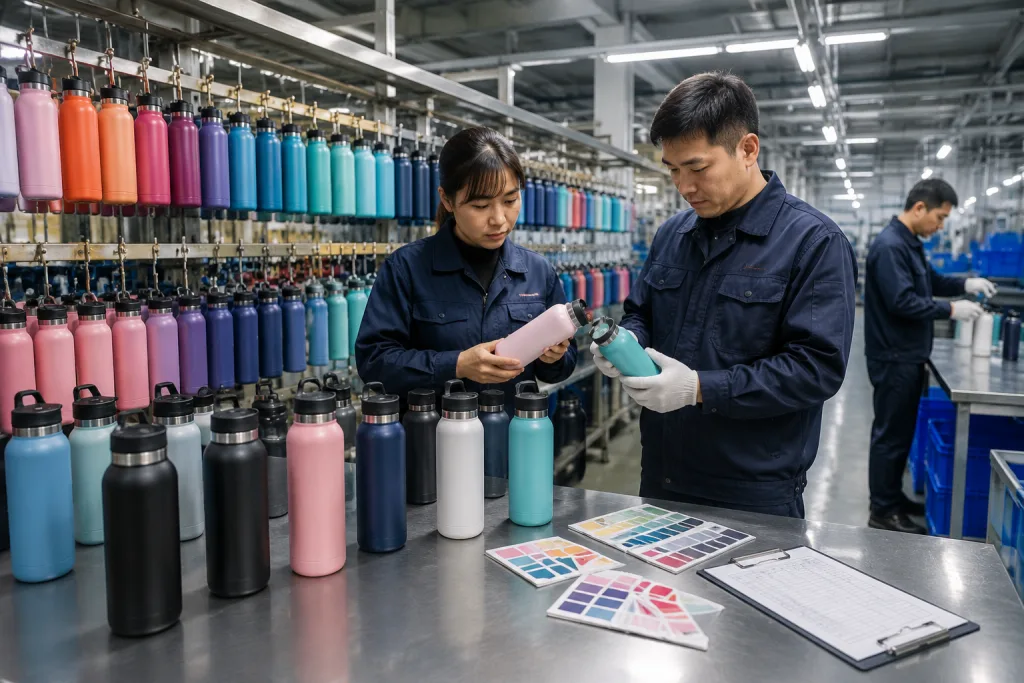
Key Takeaways
- Pantone matched powder coating usually needs 1,000-3,000 pcs per color, depending on bottle body and finish
- Pre-production samples should be approved under D65 light, not only phone photos from the factory floor
- AQL 2.5/4.0 inspections should include color difference, coating adhesion, logo position, and carton labeling
- FOB Ningbo or Shanghai lead time is typically 30-45 days after deposit and sample approval
A sport bottle custom color order looks simple until the first lab dip misses Pantone by 1.8 ΔE, the silicone strap comes off the compression mold half a shade darker, or the carton label fails the retailer’s routing guide. Color is not just decoration. It drives resin choice, powder coating, anodizing, MOQ, lead time, defect rate, and sometimes REACH testing. We’ve seen this go sideways from one unchecked line on a PO: “matte black” written once, “black gloss” written on the carton mark.
If you buy custom drinkware from China, this is the wrong question to ask: “Can you make this color?” Ask how the canteen manufacturer will control it before you pay the deposit. At our Zhejiang factory, we run about 450,000 stainless steel and plastic drinkware units per month, and QC still pulls color panels under a D65 light box before mass production. The line can ship smoothly, or the order can burn 12 extra days in rework because a powder coating batch was approved too fast.
Start With The Color Method
The first question is not “can you make this blue?” That is the wrong question to ask. A serious canteen supplier will ask how the color goes onto the bottle. For sport bottles, custom color usually means one of five routes: colored plastic resin, powder coating, spray painting, anodizing, or stainless steel PVD. On our line in Hangzhou, the method decides MOQ, grip feel, scratch result after a 3M tape test, and whether the price moves by USD 0.08 or USD 0.60 per piece.
For Tritan or PP bottles, resin color works well when your order plan is stable. The masterbatch is mixed before injection or blow molding, so the color runs through the wall, not just on the surface. A typical MOQ is 3,000-5,000 pcs per color because the injection machine, resin dryer, hopper, and screw barrel need cleaning between colors; we usually lose 25-40 kg of purge material on one color change. For stainless steel sports bottles, powder coating is the common choice. It gives a dry, slightly textured surface and holds up better than basic wet spray in a cross-hatch test. MOQ can be 1,000 pcs per color if the factory already runs a similar coating, but special matte, glitter, or gradient colors can push this to 3,000 pcs. The buyer often asks for 500 pcs in four colors. The math doesn't work.
Anodizing applies to aluminum bottles. It looks clean and metallic, but Pantone matching is less exact because the aluminum surface and bath chemistry change the final tone. QC pulled one sample last year that looked fine under office light, then shifted orange under the D65 light box. If your brand guide demands a strict PMS 186 red, do not assume anodizing will hit it. PVD costs more and is usually used for premium stainless parts, not standard promotional sport bottles.
Here is the practical rule: if your buyer accepts “close to Pantone,” you have more color methods to choose from. If your retailer requires Delta E below 2.0, tell the canteen factory before quotation. Put it on the RFQ, not only in a late email after the PI; we once saw a PO typo list “DE<20” and the buyer flagged it only after lab dips were approved. That one sentence changes material, sampling, inspection, and price. A good canteen vendor in China should explain this before the proforma invoice, not after mass production starts.
What MOQ Is Realistic?
MOQ is where 6 out of 10 sport bottle custom color inquiries lose contact with factory reality. A buyer asks for 300 pcs in six colors with four different lids and individual barcodes. That is not a production order; it is a sample program. The math doesn't work. We can sometimes run it on the line, but after powder booth cleaning, barcode setup, and QC sorting on the AQL 2.5 table, the unit price will not look like mass production.
For B2B planning, use these working numbers. Stock bottle body with stock color and printed logo: 500 pcs can be workable. Stock bottle body with custom powder-coated color: 1,000 pcs per color is a practical starting point. Custom molded plastic color: 3,000 pcs per color is more realistic. Custom cap, custom silicone parts, or a new mold: expect 5,000-10,000 pcs depending on part size and tooling. Last month QC pulled a 304 stainless sample with a 0.18 mm coating gap near the shoulder; at low volume, rework cost hits the order fast.
For a distributor drinkware program, reduce the color count and buy deeper. Three colors at 2,000 pcs each usually produce a better FOB price and cleaner QC result than eight colors at 750 pcs each. Powder line changeovers eat 45-60 minutes per color. Silicone accessory color changes add another variable because the mixer needs cleaning before the next Pantone batch. Carton segregation gets messy. Every extra color raises the risk of mixed lids, wrong labels, or uneven coating thickness; we have seen a PO typo turn “navy lid” into “navy body” across 18 master cartons.
Our Zhejiang team usually quotes sport bottle custom color orders with a clear color table: body color, lid color, gasket color, logo method, inner carton, master carton, and shipping mark. For a canteen distributor or distributor canteen buyer, this table matters more than a pretty mockup. It prevents arguments when the shipment reaches your 3PL or retailer DC. One buyer flagged this after arrival because the mockup showed a black gasket, while the approved color table said grey; the table won.
Checklist before asking for MOQ:
- Confirm bottle material: stainless steel, Tritan, PP, PE, aluminum, or glass; we check this first because coating adhesion and drop-test results change by material.
- Confirm whether the body is stock or new mold; a new mold can add 25-35 days before mass production starts.
- List every colored part, including straw, handle, silicone boot, gasket, and carabiner; small parts are where mixed-color complaints start.
- State whether Pantone matching is mandatory or approximate; if mandatory, ask for a sprayed color chip under D65 light.
- Tell the factory if split shipments or mixed cartons are required; mixed cartons need a packing diagram, not just a note on the PO.
How Accurate Can Pantone Be?
Pantone matching works, but it is not magic. The same PMS code shifts on coated paper, matte powder, transparent plastic, brushed aluminum, or silicone rubber. We ask for a physical Pantone card or the brand’s signed color standard before the line opens. A JPEG from a laptop screen is not a production standard; our QC once rejected a sample because the buyer’s PO said PMS 186C, while the attached artwork looked closer to 200C under the light booth.
For powder-coated stainless steel sport bottles, we normally approve color with a metal color chip or a sprayed bottle sample. Under D65 daylight, a workable commercial tolerance is often Delta E 2.0-3.0. For promotional drinkware, some buyers accept Delta E 4.0 if the color family is correct and the logo edge is clean. Retail shelf sets are stricter. If the same color must run across a custom canteen, custom growler, plus a travel tumbler, budget for 2-3 sampling rounds and check each item with a spectrophotometer before mass production.
Silicone is the trouble spot about 6 of 10 buyers miss on the first brief. A silicone handle or boot will not always match the coated bottle body exactly. Pigment loading changes the shade; curing temperature can yellow light colors; surface gloss makes the same color read darker. If your design needs a monochrome look, ask us to sample the bottle, lid parts, and silicone boot in one package. Do not approve the bottle body in week one and the cap in week three as separate items. We have seen this go sideways.
Check gloss level, too. Matte black from one powder batch can look charcoal beside semi-matte black. For customized drinkware programs with strict brand control, specify gloss units and test with a 60° gloss meter, not only by eye. A common powder coating thickness is around 60-90 microns. Too thin, and coverage breaks at the shoulder and base after tumbling. Too thick, and threads, laser engraving edges, or tight-fitting accessories start giving the assembly team problems.
Buyer question: “Can you guarantee 100% Pantone accuracy?” This is the wrong question to ask. The honest answer is no. A good canteen manufacturer controls process variation, makes pre-production samples, records powder batch numbers, and inspects against the agreed tolerance. Anyone promising perfect color across metal, plastic, and silicone is overselling.
Will The Finish Survive Use?
Color approval is only half the job. The finish has to survive packing, shipping, warehouse handling, and real use. A sport bottle gets tossed into gym bags, knocked against bike cages, and washed badly at home. We have seen a carton come off the line clean, then come back with corner scuffs after a 1 m drop test. If you are buying canteen promotional items for a one-day event, your standard is different from a retail outdoor line. Say that clearly.
For powder-coated stainless bottles, ask the canteen factory about adhesion and abrasion checks. A cross-hatch tape test is standard. Some buyers ask for a 3M tape pull after the coating is cross-cut with a knife. We run rub tests with alcohol and water to see whether the logo ink holds. Dishwasher claims need a hard look. Many powder-coated bottles stay on hand-wash recommendation unless the coating, logo, and lid assembly have passed repeat dishwasher cycles, and QC pulled the sample after the third cycle, not the first.
Logo method changes the color plan. Silk screen printing works well for large solid marks. Laser engraving strips the coating and shows the stainless steel, so the look is clean and durable but the artwork changes. Heat transfer handles multi-color graphics, though the edges and scratch resistance still need checking. For a customizable canteen with several brand clients, laser is often safer for small repeat orders because it skips ink color setup and drying time. We have seen a buyer flag a 2-day drying window on a tight PO, and that was the wrong question to ask.
Stainless steel wall thickness also matters. Many sport bottles use 0.4-0.5 mm 304 stainless steel outer wall and 0.3-0.4 mm inner wall, depending on capacity and shape. Thin walls cut weight and cost, but dents show faster after powder coating. If your customer wants rugged outdoor performance, do not chase the lightest FOB price. Ask for the actual gram weight and steel grade on the quotation. A bottle that looks fine at 200 g can feel flimsy on the line.
For plastic bottles, confirm BPA-free resin, food contact compliance, and impact expectations. Tritan is common for premium clear bottles, while PP or PE may be used for squeeze styles. If you sell in Europe, discuss LFGB or EU food contact testing. For North America, FDA food-contact compliance and, when relevant, California Proposition 65 review may be needed. China factories can arrange testing, but you should confirm whether the report covers raw material, finished product, or only a similar item. We have seen a report cover the resin pellet and nothing else, and the buyer was not happy.
Sampling And Approval Workflow
A clean sampling workflow cuts most sport bottle custom color disputes. Do not sign off mass production from a rendering. We run into this on the line all the time. A JPEG will not show coating grain, lid tolerance, or how a logo reads on a curved body.
A practical sequence is: digital mockup, color chip or material chip, physical pre-production sample, signed approval, mass production, inline QC, final inspection, shipment. For stock molds, a custom color sample normally takes 7-12 days after artwork and Pantone confirmation. Our color room keeps the Pantone book next to the 0.01 g weighing scale, because one bad mix throws the whole batch off. If a new powder needs to be mixed or a new plastic resin batch is ordered, add 3-7 days. If you also need a custom cap mold, tooling can take 20-35 days before bottle sampling even starts.
When you review samples, look at them under consistent lighting. D65 daylight is preferred. Office warm light makes whites yellow and blues muddy. QC pulled the sample under a 6500K light box, then the buyer flagged it once the phone photo hid the gray cast. Photograph the sample beside the Pantone card, but do not make photos the only approval record. Sign and date one golden sample, then keep one at your office and one at the factory in Zhejiang. That gives both sides a physical standard during AQL inspection.
For customized canteen and customized growler ranges, approve the full family together if they share a color system. A 32 oz sport bottle, 64 oz custom growler, and 20 oz tumbler may use different processes, but the shelf presentation should still line up. We have seen a 64 oz body land half a shade darker after the wall thickness changed on the line. Approving them one by one is the wrong question to ask.
Approval checklist:
- Capacity and dimensions checked against the specification sheet.
- Color matched to Pantone or the approved chip.
- Logo size, position, and rotation confirmed in millimeters.
- Lid torque, straw length, gasket fit, and leak test completed.
- Retail barcode, FNSKU, warning label, and carton marks verified.
Compliance, Inspection, And Packing
Color does not erase compliance. For Europe, a custom drinkware order still needs REACH, LFGB, EU 1935/2004 food contact paperwork, and packaging waste data when the destination calls for it. For the United States and Canada, buyers ask for FDA food contact declarations, CPSIA for children’s products, and ASTM checks on some kids’ or sports models. We check the coating, the strap, and the small parts on the line, because a kids bottle fails fast if one of those pieces is off.
Factory audits matter too. Some canteen distributors will not open a vendor file without BSCI, Sedex, ISO 9001, or a retailer audit packet. Ask for it early. Do not wait until week four and expect the factory to build documents out of thin air. We ship enough audit files to know the difference between current scope, expired scope, and a report that does not match the actual workshop. If a buyer says, “send it after deposit,” that is the wrong order.
For inspection, AQL 2.5 for major defects and 4.0 for minor defects is standard in drinkware exports. Critical defects stay at zero. QC pulled a sample from a 1,000-piece lot and checked shade against the approved chip, exposed metal at the rim or base, coating bubbles, orange peel, dust inclusions, weak logo opacity, and mixed component colors. Functional checks should cover leak testing, lid assembly, capacity, odor, sharp edges, and drop risk where needed. We have seen a nice color hide a bad lid, and the math does not work on a saleable shipment.
Packing is not glamorous, but it decides whether a distributor growler or sport bottle lands ready to sell. Powder-coated bottles need real separation. A thin polybag alone will not protect a matte finish on a 35-day sea run with carton rub and vibration. For retail, specify white box, color box, hangtag, insert card, or plastic-free packing. For Amazon FBA, confirm FNSKU labels, carton weight below the required limit, suffocation warnings when polybags are used, and scannable barcodes. For wholesale distributor drinkware, mixed color cartons should stay out unless your warehouse asks for them. We have seen mixed cartons create picking mistakes in under 10 minutes.
Our normal FOB Ningbo or Shanghai lead time is 30-45 days after deposit and sample approval for repeat molds. Rush orders happen, but rushing color approval is the trade that bites back. On one job, the buyer changed the Pantone after pre-production, and we lost 3 days before the first full run. The cheapest delay sits before mass production, not after 20,000 bottles are coated the wrong grey.
How To Compare Quotations
I’ll rewrite the section in-place, keep the HTML tags and heading structure intact, and strip the AI-ish phrasing while adding more buyer-floor detail and specific numbers.Two sport bottle custom color quotations can look alike on paper and still be two different products. One includes 304 stainless steel, powder coating, laser logo, individual box, and AQL inspection support. The other uses thinner steel, wet spray, low-cost cap parts, and bulk packing. If you only compare FOB unit price, you can pick the weaker offer by mistake.
Ask each canteen supplier for a line-by-line spec. You want capacity, material grade, wall thickness or gram weight, coating method, logo method, lid material, gasket material, carton quantity, carton size, gross weight, MOQ, sample cost, sample time, production lead time, payment terms, and Incoterms. On our line, that is basic work. If a quotation skips these points, push back.
For budget planning, a stock stainless steel sport bottle with one-color logo may sit around USD 2.20-4.80 FOB depending on capacity, lid, finish, and packaging. A premium insulated model with custom color, silicone boot, laser logo, and color box may land around USD 5.50-9.50 FOB. Plastic sports bottles can come in lower, but custom resin color and tooling change the math fast. These are working export ranges from China, not promises without specs.
Compare communication too. A reliable canteen manufacturer should challenge vague requests. If you ask for “matte blue, premium quality, urgent delivery,” you should get questions, not just a number. Good canteen vendors will pin down the Pantone code, finish, capacity, artwork file, market compliance, packing, and delivery date. We’ve seen this go sideways when a buyer skipped the finish callout and the buyer flagged it at pre-shipment. That early friction helps your margin later.
The best purchasing file is boring: confirmed specification sheet, approved golden sample, signed artwork, inspection criteria, packing diagram, and shipment schedule. For custom canteen, customizable growler, or broader customizable drinkware programs, boring paperwork is what lets you reorder the same color six months later without starting from zero.
Send your Pantone and bottle spec for review
We will check MOQ, coating method, sampling time, compliance needs, and FOB pricing before you commit to production.
Frequently asked questions
What is the minimum order for sport bottle custom color?
For a stock sport bottle body with a custom logo only, 500 pcs is sometimes workable. For custom powder coating, plan on 1,000 pcs per color as a realistic starting point. Plastic resin colors usually need 3,000-5,000 pcs per color because the molding line must be cleaned between batches. If you need a new cap, silicone boot, or molded handle, MOQ can rise to 5,000-10,000 pcs. A canteen supplier may accept lower quantities, but expect higher setup charges, longer sampling time, and less attractive FOB pricing.
Can one Pantone color match stainless steel, plastic, and silicone parts?
It can be coordinated, but not perfectly matched in every material. Powder-coated stainless steel, molded plastic, and silicone all reflect light differently. The same Pantone code may look darker on matte powder and brighter on glossy plastic. For strict brand programs, approve all components together under D65 light and define an acceptable tolerance, such as Delta E 2.0-3.0. If your custom canteen includes a silicone boot, straw lid, and coated body, ask the canteen manufacturer for a complete assembled sample before mass production.
How long does sampling take for a custom color bottle?
For an existing mold and standard coating process, physical samples usually take 7-12 days after Pantone, artwork, and deposit confirmation. If the powder or resin must be specially mixed, add 3-7 days. If you need a new plastic cap mold or custom shaped bottle, tooling can add 20-35 days before final sampling. Do not count production lead time until the golden sample is approved. For most China export orders, mass production then takes about 30-45 days depending on quantity and finish.
Which logo method is best for colored sport bottles?
For simple one-color logos, silk screen printing is cost-effective and clean on flat or gently curved areas. Laser engraving is more durable on powder-coated stainless steel because it removes the coating and exposes the metal below; it is good for premium distributor drinkware programs. Heat transfer works for multi-color artwork, gradients, and photographic effects, but should be tested for edge durability and abrasion. Your canteen vendor should confirm logo size in millimeters, print position, and whether the bottle curvature will distort the artwork.
What quality standard should I put on the purchase order?
Use a written specification plus AQL inspection criteria. A common setting is AQL 2.5 for major defects, 4.0 for minor defects, and zero tolerance for critical defects. Define color defects clearly: wrong shade, mixed components, coating bubbles, exposed metal, heavy orange peel, logo misalignment over 2 mm, and visible scratches. Add leak test, odor check, capacity check, barcode scan, and carton mark verification. If you sell in Europe or North America, also list REACH, LFGB, FDA, ASTM, or CPSIA requirements where applicable.