Key Takeaways
- For a standard 500 ml stainless thermos, MOQ is usually 1,000 pcs per color and lead time runs 25-35 days after sample approval.
- A reliable vacuum bottle should use 18/8 stainless steel with 0.4-0.5 mm inner and outer wall thickness, not vague “food grade” claims.
- FOB Zhejiang pricing for a basic promotional thermos often starts around USD 2.80-4.20 per piece at 3,000 pcs, depending on lid and finish.
- QC should include vacuum retention, lid leak testing, coating adhesion, carton drop tests, and AQL 2.5 for major defects on finished goods.
You are not buying a “nice tumbler.” You are placing an order that has to survive freight, warehouse drops, and real use by customers who twist the lid hard, wash it badly, and judge the cup by whether it leaks in a backpack. When we run vacuum bottle wholesale projects, the hard part is not finding a thermos supplier in China. The hard part is locking the stainless thermos spec before production starts, so the first shipment does not turn into rework and discount stock. We once caught a PO typo on a 500 ml bottle and saved a week on the line.
At BottleForge in Zhejiang, we see the same pattern every season: a buyer asks for a custom thermos, the quote looks fine, and then QC pulled the sample and found a thin wall, weak coating, or a lid that failed after three heat cycles. If you want a bulk thermos program that scales, you need a manufacturer thermos partner who talks in gauges, testing standards, and packaging counts, not marketing language. That is the job here. The buyer flags the sample, and the math has to hold.
Start With the Use Case
I’ll rewrite the section in place, keep the HTML structure intact, and tune the copy to sound like a real factory-side sales engineer.Before you ask for a quote, lock the job first. A promo thermos for a Canton Fair giveaway has different specs from a distributor bottle for outdoor retail. One lives or dies on logo placement and margin. The other gets judged on heat retention, carton strength, and return rate. Skip this, and the whole RFQ gets messy.
Say you need 5,000 pieces for an autumn outdoor campaign. We run a 500 ml stainless thermos in matte black, laser logo, gift box, and leak-proof lid on that kind of order all the time. The lid call still matters. A screw cap with a stainless inner beats a push-button lid when the goods move through distributors and resellers. If the bottle sits on a retail shelf, the box and hangtag pull more weight than they do for factory stock in a private label run.
In Zhejiang and across China, the fastest way to waste time is to ask for “customizable thermos” and leave the user blank. Pick the channel first: outdoor retail, corporate gift, Amazon-style ecommerce, or seasonal promo. Then give us the use temperature, wash method, and shelf-life target. QC pulled one sample on the line last week at 12 hours hot and 24 hours cold, and the buyer flagged the lid seal only after we had already printed cartons. A clean buyer brief usually includes:
- Capacity: 350 ml, 500 ml, or 750 ml
- Target heat retention: 12 hours hot, 24 hours cold
- Decoration: silk screen, laser, or UV print
- Packaging: mailer, gift box, or master carton
That one page cuts weeks of back-and-forth with any thermos factory.
Read the Spec Like a Buyer
I’ll rewrite the section in-place, keeping the HTML structure unchanged and tightening the sales-engineer voice.Once the use case is clear, read the spec sheet line by line. A real thermos manufacturer does not hide behind “stainless steel body” language. You want material grade, wall thickness, vacuum structure, lid parts, coating type, and test basis. If a supplier thermos quote leaves those out, you are not comparing real offers.
For a standard stainless vacuum bottle, ask for 304/18-8 stainless steel on both the inner and outer shells, with wall thickness around 0.4-0.5 mm. That range holds up for retail. Below 0.35 mm, the math does not work: lower cost, yes, but more dents and weaker insulation stability. Check whether the bottle is single-wall or double-wall vacuum insulated, and whether the seam is laser welded. We have seen a 0.3 mm lid insert sink a thermos customized project even when the body looked perfect on the line.
Keep an eye on numbers that matter in sourcing vacuum bottle wholesale:
- Vacuum level and heat retention claim in hours
- Coating thickness or finish type, especially powder coat versus spray paint
- Drop test height, usually 1.0 m or 1.2 m
- Leak test standard, often inverted for 24 hours
If you are buying for distributors, the box has to survive too. A distributor thermos program ships farther and gets handled more times than a direct-to-consumer order. Carton compression, barcode placement, and master pack count all hit the freight result. Ask for AQL terms in writing: for example, AQL 2.5 major, 4.0 minor on final inspection. QC pulled the sample on a 24-hour invert test before, and the buyer flagged a barcode typo on the master carton. That is the level of detail you want. A supplier who keeps saying “best quality” without a measurement is not ready for wholesale.
Price the Order Realistically
I’ll rewrite the section in place, keep the HTML exactly as-is, and tighten the pricing language so it reads like a factory-side sales note.Pricing a custom thermos is not just the bottle price. Split out the body, lid, decoration, packaging, and freight terms. For a 500 ml matte powder-coated bottle with laser logo, FOB Zhejiang at 3,000 pcs usually sits around USD 2.80-4.20 per piece. Add a premium lid, color box, and individual polybag, and you are up another USD 0.35-0.80 per unit. A sleeve plus insert card pushes it higher again.
Do not compare a 1,000 pc quote with a 10,000 pc quote as if the math is the same. MOQ changes tooling use and packaging cost. On our line, stock molds often start at 1,000 pcs per color, while fully custom lid or body shapes usually need 3,000 pcs. For screen printing, setup often lands at USD 40-120 per color; laser engraving is usually a flat charge. The buyer flagged a 1,200 pc order once, then asked why the unit price jumped. That question misses the point.
Here is the practical way to think about it:
- Basic bulk thermos: lower decoration cost, faster lead time
- Custom logo thermos: setup fee, steady value for brand programs
- Fully customized thermos: higher MOQ, more engineering, clearer differentiation
Freight changes the math too. FOB works if you already have a forwarder. If you are new, ask for FOB and DDP so you can see the landed cost. A quote that skips carton size, packing density, and pallet count is not complete. We measured one export carton at 58 x 39 x 28 cm, and that changed the shipment math fast. In China, those details can move landed cost by 8-15% without touching the bottle itself.
Sample, Then Break It
I’ll rewrite the section in place, keeping the exact HTML structure and tightening the prose to sound like a factory-side sales engineer.A sample is not a souvenir. It is a test tool. If you are serious about sourcing vacuum bottle wholesale, ask for two pre-production samples at minimum: one for spec approval and one for decoration approval. If the artwork has fine lines or a multicolor wrap, send a blank body first and a printed unit second. That saves you from chasing dent marks and logo shifts in the same round.
When the sample lands, do not just eyeball it. Measure the opening diameter, weigh the bottle, check lid thread engagement, and fill-test it with hot water. Leave it upside down for 24 hours. Then run it again after thermal cycling. A customized thermos that survives a 5-minute desk check can still fail once the steel expands and contracts on the line. We have seen that turn into warranty claims fast.
Use a simple buyer checklist:
- Logo alignment within 1.5 mm
- Cap closes smoothly with no cross-threading
- Paint does not chip after basic abrasion
- Vacuum performance stays within agreed hours
- Packaging includes correct SKU and barcode
If you source from a thermos supplier in Zhejiang, ask for a sample report with photos and measurement notes. QC pulled the sample, checked the lid gap, and sent one PDF; that is the standard you want before mass production starts. Waiting until a customer flags a print shift is the wrong time to set the spec. For promotional brands, print consistency often matters more than max insulation. Fine. Put it in writing. A “promotional thermos” spec without acceptance criteria is how margins disappear.
Control Production at the Factory
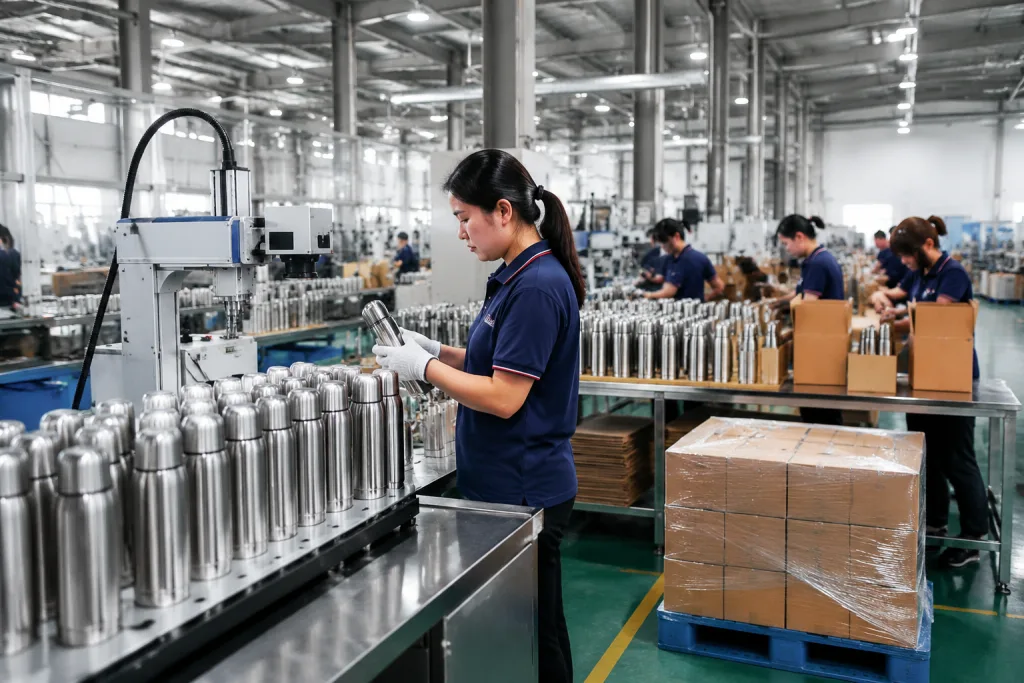
I’ll keep the HTML exactly as-is and rewrite only the prose, with a more grounded factory-floor voice and the requested specifics. Then I’ll return just the cleaned HTML.Once the order is signed off, the line starts moving. A thermos manufacturer should lock the raw material batch, lid assembly line, coating date, and packing slot before the first shell leaves the bend machine. At BottleForge in Zhejiang, a normal stainless thermos line runs 80,000-120,000 units per month depending on model mix, but that number only works if your order gets the right slot. High output does not fix bad control.
Ask for a production schedule with checkpoints. A solid factory thermos program covers incoming material inspection, in-process leak testing, coating cure checks, and final random inspection. For a 5,000 pc order, we run sampling at each key stage, not just one check at the end. If the bottle body is welded off by 0.3 mm, you do not want QC to find it after the logo is printed.
Typical control points include:
- Material verification: 304 stainless confirmation and thickness gauge reading
- Vacuum seal check: sample heating and cooling test
- Decoration check: logo position, color code, and adhesion
- Packaging check: inner box, master carton, and shipping mark
For distributor thermos programs, carton marks matter more than most first-time buyers think. You need outer carton weight, cube, and pallet height matched to warehouse handling, or the forklift team will flag it on arrival. If you plan Amazon or retail compliance, ask for FNSKU or UPC placement early. The same rule applies when the buyer wants one SKU to cover three channels. One missing barcode can cost more than a logo upgrade. We have seen a PO typo on the carton mark turn into a 12-day delay. Write it into the PO. Memory is not a control plan.
Approve QC Before Shipping
I’ll rewrite this section in-place, keep the HTML structure intact, and tighten the sales-engineer tone with concrete QC details and fewer AI-like phrases.The last inspection protects your margin. “Looks okay” is not a QC result. Put a written standard on the PO and make the factory sign it. For a stainless thermos order, the final QA pack should cover appearance checks, lid function, carton drop testing, and defect photos for each issue type. If the shipment is big enough, bring in a third-party inspector or ask for the factory’s QC sheet with AQL sampling.
For most bulk thermos shipments, AQL 2.5 for major defects and 4.0 for minor defects is the usual setup. You control the lot by sample; you do not open every bottle. If you are buying a premium custom thermos line, tighten the limits. We run hot-fill lid tests at 90°C because a gasket can pass cold and leak once it expands. Check the coating after cooling too. We’ve seen a promo thermos win on photos and fail fast when the finish rubs off on the line.
Before release, confirm:
- Carton count matches the PO exactly
- Spare parts or extra gaskets are packed if promised
- Export labels, HS code, and shipping marks are correct
- Both sides sign off on the sample reference
If there is a problem, fix it at the factory, not in your warehouse. A thermos vendor in China can usually swap gaskets, rework prints, or repack cartons before shipment if you catch it early. We had a buyer flag a PO typo on the carton mark once, and the line corrected it before loading. After the goods leave Zhejiang, your options shrink fast. That is why disciplined buyers treat QC as part of sourcing vacuum bottle wholesale, not as an extra step at the end.
Build your thermos order with fewer surprises
Send your spec, artwork, and target price. We’ll help you tighten the build, confirm QC, and quote a real factory thermos program from Zhejiang.
Frequently asked questions
What MOQ should I expect for a custom stainless thermos?
For a standard 500 ml model, MOQ is often 1,000 pcs per color for stock molds and simple logo work. If you want a new lid, a special coating, or a fully customized thermos shape, expect 3,000 pcs or more. In Zhejiang, many thermos suppliers can split orders by color, but they still need enough volume to run coating and packing efficiently. For very simple promotional thermos orders, some factories will start lower, but the price usually rises 10-20%.
How much does a vacuum bottle cost at wholesale?
A basic FOB Zhejiang quote for a 500 ml stainless thermos often lands around USD 2.80-4.20 per piece at 3,000 pcs. Add USD 0.35-0.80 for premium packaging, and more if you need custom tooling or complex printing. If you compare supplier thermos quotes, make sure the same lid, finish, and carton count are included. Otherwise the cheap quote is just missing parts.
What tests should I require before shipment?
At minimum, ask for leak testing, vacuum retention testing, logo adhesion checks, and carton drop tests. For a thermos manufacturer, AQL 2.5 major and 4.0 minor is a common inspection basis, but you can tighten it for premium programs. I also recommend checking lid thread smoothness and weight, because those two issues often show up first in field complaints. If your buyer is retail or outdoor-focused, insist on a sample approval record before mass production.
Should I choose laser engraving or print for logo?
Laser engraving is durable and works well on matte stainless or powder-coated bodies. Screen print is cheaper for one- or two-color artwork and can make a promotional thermos look more vivid. If the item is a custom thermos for outdoor retail, laser usually wins on durability. If it is a thermos promotional giveaway with a tight budget, print can be the better choice. Ask the factory to show wear-test samples so you can compare.
How long does production take in China?
For a standard bulk thermos order, lead time is usually 25-35 days after sample approval and deposit. If you need new tooling, special packaging, or a peak-season slot, add another 7-15 days. A thermos factory in Zhejiang with a monthly output of 80,000-120,000 units can still get delayed if coating or packaging is overloaded, so always confirm your delivery window in writing. For distributors thermos programs, buffer extra time for third-party inspection and freight booking.