Key Takeaways
- Standard glass bottle wholesale pricing often lands at USD 0.42–1.35 per unit FOB China, depending on 250 ml to 1 L size and decoration
- A 2.0 mm wall is usually safer for premium retail, while 1.2–1.5 mm fits lighter promotional bulk drinkware
- For export, ask for REACH, food-contact compliance, and drop-test data; don’t buy on artwork alone
- MOQ is usually 5,000 pcs for custom glass bottles in Zhejiang, but molded shapes can require 10,000+ pcs
If you are sourcing glass bottle wholesale, the first mistake is treating every bottle as “just glass.” On the floor, the real gap shows up in wall thickness, neck finish, closure fit, decoration limits, and breakage once the cartons hit a 20GP or 40HQ. A Zhejiang supplier can quote a low FOB number and still cost you more if the pallet wrap is weak or the defect rate climbs past 2%.
The better way to buy is to compare by use case: beverage retail, hospitality, promotional sets, or alcohol flask wholesale programs. That is where a spec table beats a glossy catalog. We run the line by MOQ, lead time, monthly output, and test standard before anyone talks artwork. At BottleForge Industrial in Hangzhou, we ship about 600,000 units per month, with a typical MOQ starting at 5,000 pieces and a standard lead time of 25 to 35 days after sample approval.
Compare by use case first
I’ll rewrite the prose in place, keep the HTML exactly as-is, and tune the language to sound like a real factory-side sales engineer.When buyers start sourcing glass bottle wholesale, they usually fixate on the shape and miss the job it has to do. That is the wrong order. A cold-pressed juice bottle, a bulk growler for a brewery, and an alcohol flask bulk program each need different closures, glass weight, carton specs, and print methods. We’ve seen the line get stuck because a buyer picked a good-looking bottle first, then found the cap torque or pallet count did not work.
Filter by use case first. For beverage retail, a straight-sided bottle with a 28 mm neck finish and 1.5–2.0 mm wall thickness is usually the cleanest fit. For hospitality or gifting, heavier glass with a weighted base sells the shelf story, but it pushes landed cost up by 8% to 15%. For brewery programs, beer growler wholesale should be judged on seal integrity, handle strength, and carton stackability before anyone argues about the logo. QC pulled a sample last week and the cap test told us more than the artwork ever could.
| Use case | Typical size | Wall thickness | MOQ | FOB China range |
|---|---|---|---|---|
| Juice / water retail | 250–750 ml | 1.2–1.8 mm | 5,000 pcs | USD 0.42–0.88 |
| Growler / craft beer | 1,000–2,000 ml | 2.0–3.0 mm | 5,000–10,000 pcs | USD 0.95–1.35 |
| Alcohol flask program | 100–500 ml | 1.5–2.2 mm | 8,000 pcs | USD 0.58–1.10 |
If you need the right wholesale drink bottle for a private-label launch, pick the category first, then decoration. We had a PO once with “matte black” typed where “frosted black” should have been, and the buyer flagged it only after the trial run. Do the math early; pretty packaging that ships badly is a bad deal.
Glass specs that actually move cost
In China, a glass bottle quote is rarely “wrong”; it is usually missing 3 specs the factory needs before costing. Price moves with neck finish, glass color, bottle weight, mold shape, and the finish work: spray coating, acid etching, decal, or silk screen. A basic clear soda-lime bottle with a 28 mm finish is simple; we run that on existing tooling. Add matte spray, an embossed logo, and a custom closure, and the unit price can climb by 20% to 40%. Last month a buyer flagged a 6-cent jump after sample approval, but the PO had changed “clear” to “frosted spray.” The math didn’t work at the old price.
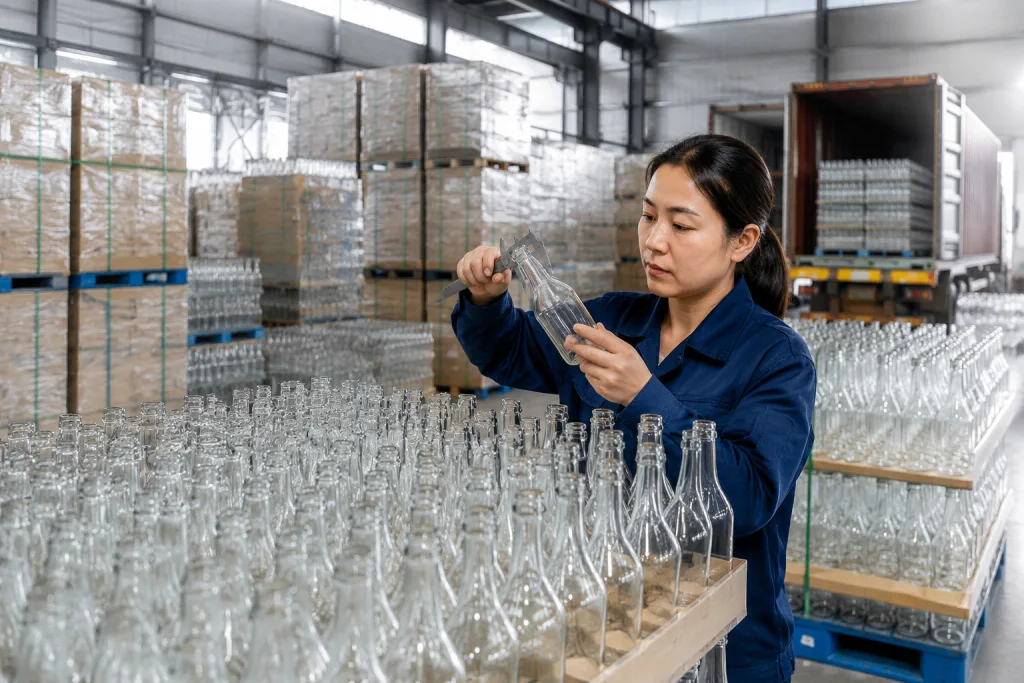
For procurement, the useful specs are the ones that change production yield or breakage. Check wall thickness with a digital caliper during sample approval, not from a PDF drawing. Bottle weight matters because every extra 50 g adds freight cost across a 40HQ, and nobody likes finding that after the forwarder sends the CBM sheet. For wholesale drinkware and drinkware bulk programs, clear glass is cheaper than amber or frosted in most runs, and standard flint glass is easier to source batch after batch from Zhejiang than special colors. QC pulled one sample at 1.1 mm on the shoulder when the drawing said 1.5 mm. We rejected it.
- Wall thickness: 1.2–1.5 mm for lightweight retail, 2.0 mm+ for premium and beer bottle programs; ask QC to measure the body, shoulder, and base separately
- Neck finish: 26 mm, 28 mm, and 33 mm are common; closure availability should be checked before tooling, especially if the cap liner or thread pitch is not standard
- Decoration: silk screen is lower cost than full-body printing for 1-color logos; laser engraving is durable but slower, so the line output drops on large orders
- Carton pack: 12 pcs or 24 pcs per carton is common; inner dividers reduce breakage by 30% to 50%, and we still run a 1.2 m drop test before mass packing
If your program includes canteen wholesale or wholesale canteen SKUs alongside glass, keep the spec logic separate. A canteen bulk line can accept lighter weight and simpler decoration, while glass needs stronger secondary packaging and a stricter AQL plan. We’ve seen this go sideways when a buyer used the same 24 pcs carton logic for both SKUs; glass arrived with corner cracks, while the canteens were fine.
Head-to-head by buyer segment
Buyers ask for the same glass bottle, then judge it by different numbers. A brand owner wants margin and shelf pull. A distributor wants a repeatable MOQ, often 3,000-5,000 pcs per SKU, without shade drift between orders. A procurement manager wants receiving to stop finding cracked necks. We see this during pre-shipment inspection: QC pulled the sample, measured the mouth with a digital caliper, and the buyer flagged a 0.4 mm cap-fit gap. That is why drinkware wholesale decisions should be matched to the buyer, not only the bottle.
| Buyer type | Priority | Best fit | Pitfall |
|---|---|---|---|
| Brand owner | Decoration, shape, shelf story | Custom clear or frosted bottles with one controlled logo process | Paying USD 800-1,500 for mold changes that do not lift sell-through |
| Distributor | Repeat order stability | Standard 500 ml / 750 ml SKUs with confirmed carton specs | Chasing 8 variants when 2 fast movers cover the account |
| Procurement manager | Compliance, damage rate at receiving | Tested export cartons with inner dividers and pallet plan | Ignoring carton compression strength until the bottom layer crushes |
If you buy drinkware bulk or wholesale drinkware for several channels, keep one base bottle and change the finish. One mold with clear, frosted, and single-color print is easier to forecast than four unrelated shapes. The math is simple. On our Hangzhou line, a shared 750 ml body can cut sampling from 18 days to about 12 days because the mold check, carton knife die, and cap test stay the same. We have seen this go sideways when a buyer added a new shoulder curve after the PO, then complained that the launch date moved.
Practical rule: if a supplier cannot explain the bottle’s decoration yield, carton drop test, and monthly output in one call, you are still early in the sourcing process.
For beer programs, compare beer growler in bulk with standard clear bottles only if the channel needs the larger format. This is the wrong question to ask if the buyer only wants a “premium look.” A 1.9 L growler is heavier, takes more space on a pallet, and usually needs a stronger closure than a 500 ml bottle. We run a tighter damage check on these: after a 1.2 m carton drop test, even 2 broken shoulders in a 50-carton pilot shipment will get attention from the importer.
Compliance and test documents
Glass looks simple; the paperwork tells you fast whether the supplier has export discipline. For EU and North America orders, we ask the lab for food-contact compliance, REACH where relevant, and a written heavy-metals statement for decal or spray-color inks. QC pulled a painted sample last month because the red logo rubbed off after 20 ethanol wipes on a white cotton pad. If you are buying alcohol flask wholesale bulk or a promotional beer tumbler bulk run, ask for dishwasher-cycle results or an ethanol-wipe record before you approve mass production.
A practical China factory should send pre-production samples, keep one approved golden sample at the line, and issue a QC plan with AQL levels. AQL 2.5 for major defects and AQL 4.0 for minor defects is a fair starting point for glass, while premium retail buyers often tighten the major level after the first order. We run the golden sample check with a 0.02 mm caliper for mouth diameter and a simple go/no-go lid test. Drop testing belongs on packed cartons, not loose bottles sitting on a meeting-room table. A 70 cm or 80 cm drop test on corners and faces is a common export benchmark.
Do not overlook the carton. The wrong question is “did the bottle pass?”; the better question is “will the packed carton survive 18 days at sea and 2 warehouse transfers?” A bottle can pass the lab test and still break in transit if the outer box is soft. For Zhejiang factories shipping to Europe or North America, a 5-ply export carton and proper dividers are not optional on fragile SKUs. We have seen this go sideways when a buyer pushed for a thinner carton to save USD 0.18 per unit; the claim cost 10 times that. This matters even more for growler wholesale and beer growler wholesale bulk orders, where unit weight is high and stacking pressure shows up on the bottom layer.
Lead time, MOQ, and factory reality
Buyers ask us for the lowest unit price, then miss the real bottleneck on the line. Wrong question. For standard glass bottle wholesale in China, we usually plan 7 to 10 days for sample confirmation, 20 to 30 days for production, and another 10 to 25 days for ocean transit depending on destination. If the order needs a new mold, add 15 to 25 days before production starts; last month QC pulled a 500 ml sample with a 1.2 mm lip variance, and that alone cost 3 days before the buyer signed off.
Typical MOQ in Zhejiang is 5,000 pieces for existing shapes and 10,000 pieces for full custom molds. If you want amber, clear, and frosted on one PO, the MOQ often applies per color, not per PO. Cash flow gets tight fast. A supplier with 600,000 units per month can still run slow if your AI file has the logo at 38 mm on one page and 42 mm on the PO, or if the buyer changes the bamboo closure after sampling. Stable orders move faster than complicated ones; we’ve seen this go sideways.
- Standard lead time: 25–35 days after sample approval, counted from signed sample and deposit arrival
- Custom mold lead time: 15–25 extra days, including mold test and first-article check with calipers
- Sample cost: USD 30–120 depending on complexity, often refundable on order
- FOB port: Ningbo and Shanghai are typical for Zhejiang exports; Ningbo is our cleaner routing for most glass bottle cartons
If you are comparing canteen wholesale and glass programs, remember the glass line needs thicker dividers, drop-test cartons, and better warehouse handling. The math changes. A bulk canteen order can look simpler on paper even if the bottle has more parts, because stainless canteen cartons tolerate forklift handling better than glass; our warehouse team flagged two crushed outer cartons after a 780 kg mixed-pallet trial.
Where glass beats metal or plastic
I’ll rewrite the section in-place, keeping the HTML tags and the product terms intact, while making the prose sound like a real factory-side sales engineer wrote it.For a lot of B2B programs, glass is not the lowest-cost option. It is the right call when shelf look, flavor neutrality, and recyclability drive the order. We ship 500 ml bottles all the time for juices, kombucha, syrups, spirits, and premium retail water, and the buyer usually asks for the same thing: clean appearance with no taste carryover. That is why someone sourcing the best wholesale drink bottle should compare the channel and the use case, not just the material.
Glass beats plastic when the brand story is built around purity, and it beats metal when customers need to see the liquid. For beer tumbler wholesale or beer tumbler bulk programs tied to tasting rooms, transparency sells. For spirit gifting, alcohol flask in bulk works if the neck and closure are set up to cut leakage and the print holds up after carton rub tests. QC pulled one sample with a scuffed logo after 300 rub cycles, so this is not a nice-to-have.
Glass loses on shipping weight. A 500 ml glass bottle can weigh 240 g to 420 g before closure, while some non-glass options come in far lighter. If your project is air-freight heavy or margin tight, the math does not work. We’ve seen buyers push for glass on a low-value SKU and then the landed cost jumps by 18% to 27%. A good supplier in China will say no when glass is the wrong call instead of chasing the PO.
For brands moving from local to export, the best wholesale drink bottle is often the one that gives you 90% of the look at 70% of the cost. In the line, that usually means locking a standard bottle shape and spending on the parts customers actually notice. One PO typo can waste a week, so we check neck finish, fill volume, and closure spec before the mold run starts.
How to brief suppliers properly
I’ll rewrite the prose in-place, keep the HTML structure untouched, and tighten the language so it sounds like a real factory-side sales engineer.Good sourcing starts with a clean brief. Send target capacity, bottle height in mm, neck finish, color, closure, decoration method, packed carton size, and your annual forecast. We run quotes off that first sheet. Include whether you need wholesale growler, wholesale canteen, or wholesale drinkware coverage in the same program, because mixing categories without a clean split creates quote noise and the buyer usually gets three different assumptions back.
A useful brief also states test expectations. List REACH, food-contact declaration, carton drop test, and whether you need barcode or FNSKU labels for Amazon-style handling. If you are doing private label, share vector artwork and Pantone references, not a screenshot from WeChat. If you are comparing beer growler wholesale bulk to standard retail bottles, set the closure torque target and leak test requirement up front; the math does not work if that detail shows up after sample approval. QC pulled the sample at 48 hours and the cap failed once because the spec was missing.
Procurement teams in Europe and North America save time by asking for three things in the first round: ex-factory photos of the mold, a sample with actual decoration, and a landed-cost estimate to one warehouse zip code. That single step catches most hidden issues before you place a deposit. We saw one PO go sideways because the buyer flagged a 1 mm neck finish typo after tooling was already booked. In Zhejiang, the better factories answer fast because they ship export paperwork every week and can spot a serious buyer from a casual quote request.
When the brief is clear, a supplier can tell you whether your project fits standard production or needs a new mold. That is the real decision point.
Request a glass bottle quote with specs
Send your capacity, neck finish, decoration, and forecast. We’ll reply with MOQ, FOB price, and a production timeline from Zhejiang.
Frequently asked questions
What MOQ should I expect for sourcing glass bottle wholesale from China?
For standard shapes, expect 5,000 pieces MOQ in Zhejiang and other export hubs in China. If you need a custom mold, 10,000 pieces is more common, especially for a new silhouette or specialty neck finish. Decorative options like matte spray or embossing usually do not change MOQ, but multiple colors can apply per color. For planning, assume 25 to 35 days after sample approval for normal production and add 15 to 25 days for new tooling. A supplier that refuses to state MOQ in writing usually has not locked the production route yet.
How much does a glass bottle cost wholesale?
For FOB China pricing, a simple 250 ml to 750 ml clear glass bottle often lands around USD 0.42 to 0.88 per unit. Heavier premium bottles, growlers, or decorated alcohol flask wholesale bulk orders can move into USD 0.95 to 1.35 or more. The main cost drivers are weight, color, mold complexity, neck finish, and decoration. Shipping can add a lot because glass is heavy; a 40HQ can be filled quickly by weight, not volume. Always ask for landed cost, not just unit price.
Which spec matters most for breakage control?
Carton design and wall thickness matter most together. A bottle with a 2.0 mm wall can still fail if it is packed in a weak outer box with no dividers. For export, ask for 5-ply cartons, fitted dividers, and a packed drop test. For premium SKUs, many buyers also ask for an internal AQL plan with major defects at 2.5 and minor defects at 4.0. If your bottle is 1,000 ml or more, pay extra attention to the base thickness and pallet stack height.
Can I mix beer growler bulk and standard bottles in one order?
Yes, but only if the supplier has the right production setup and you are clear about scheduling. A growler bulk order usually needs heavier glass, stronger closures, and different packaging than a standard 500 ml bottle. Mixing them in one PO can be efficient if the decoration is similar and the factory has enough monthly capacity, like 600,000 units per month. The risk is confusion in packing, carton labels, and QC. It is cleaner to separate by SKU even if you ship them together.
What documents should I request before paying deposit?
Ask for a quotation with FOB terms, sample photos, a specification sheet, and a compliance statement for food-contact use. For Europe, request REACH-related confirmation where applicable. For North America, ask whether the decoration inks and coatings are suitable for the intended market. If you are buying bulk drinkware or drinkware wholesale for e-commerce, also request carton dimensions and barcode label placement. For private label, make sure the supplier can confirm Pantone matching and final artwork approval before production.