Key Takeaways
- For stainless vacuum bottles, realistic MOQ is usually 1,000-3,000 pcs per color and 35-55 days after deposit
- A 64 oz beer growler bulk order needs different leak testing and carton strength than a 20 oz tumbler
- Laser engraving works well for 304 stainless, while full-wrap prints need tighter artwork control and higher setup cost
- FOB China unit price is only useful after you confirm capacity, lid type, wall thickness, packaging, and AQL level
If you need to source water bottles wholesale, finding 20 factories in China is easy. Picking the right bottle format before tooling, artwork, carton size, and freight plan is where orders get expensive. A 750 ml sports bottle, 1 L canteen, 64 oz growler, and 20 oz beer tumbler all sit under “drinkware” on a buying sheet, but they do not pack, test, or sell the same way. Last month QC pulled a 750 ml sample with a 0.4 mm rim burr; fine on a photo, rejected on the line.
From our Zhejiang production base, we see buyers lose 12 days vs 3 days when they ask for “the best wholesale drink bottle” before fixing use case, test standard, decoration method, and target landed cost. This is the wrong question to ask. We run bulk canteen, wholesale growler, beer tumbler bulk, alcohol flask wholesale, and general bulk drinkware programs with different lids, wall thickness, logo limits, and carton drop-test results. One buyer flagged a PO typo last week: “matte black” in the email, “gloss black” on the PDF. That small mismatch stopped packing for 6,000 pcs.
Compare the main bottle formats
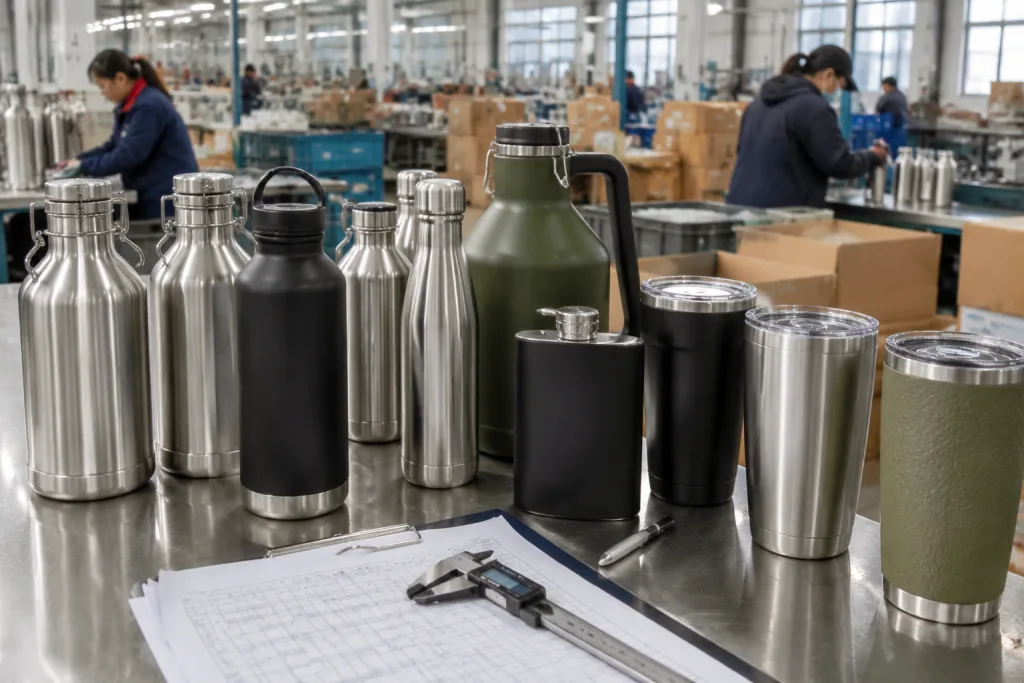
Source water bottles wholesale by job first, shape second. This is the wrong question to ask: “Which model looks best?” We start with where it will fail. A retail hiking bottle needs dent control and a strap that survives a 15 kg pull test. A beer growler wholesale program needs carbonation handling, clean welds, and a decoration panel wide enough for a brewery logo without stretching it. A canteen wholesale order for outdoor retail or military-style kits needs a flatter body and a cap that will not disappear on the first trip. A beer tumbler wholesale bulk order comes down to grip, heat retention, and a rim that feels smooth after polishing. QC pulled the sample last week because the lip had a 0.3 mm burr. Small defect. Big complaint.
This is the quick head-to-head we run with new buyers before we quote, usually before anyone sends artwork or asks for 4 carton marks on the PO.
| Format | Typical capacity | Main material | Best use-case fit | Typical FOB range |
|---|---|---|---|---|
| Sports water bottle | 500-1,000 ml | 304 stainless or Tritan | Gyms, schools, retail, events | US$2.20-5.80 |
| Bulk canteen | 750 ml-1.2 L | 304 stainless, aluminum, or HDPE | Outdoor, camping, survival kits | US$2.60-6.50 |
| Bulk growler | 32-64 oz | 304 stainless, glass, or ceramic-coated steel | Breweries, taprooms, gifting | US$5.80-12.50 |
| Beer tumbler bulk | 16-24 oz | Double-wall 304 stainless | Bars, festivals, premium promos | US$3.20-7.20 |
| Alcohol flask bulk | 4-8 oz | 201 or 304 stainless | Gift sets, travel retail, novelty | US$1.20-3.80 |
The price spread looks wide because wall gauge, lid structure, coating, and packaging change the factory cost fast. A 600 ml single-wall stainless bottle with 0.45 mm body thickness is not in the same lane as a 0.55 mm double-wall vacuum bottle with copper coating inside the vacuum layer. We ship both as drinkware wholesale. The math does not work if a buyer wants the premium vacuum build at the promo FOB. On the line, that extra 0.10 mm changes forming pressure, polishing time, and carton weight by around 1.8 kg per master carton on a 24 pcs pack.
Canteens versus daily bottles
I’ll rewrite the section in-place, keeping the HTML tags and structure intact while making the copy sound like a factory-side sales engineer wrote it.A wholesale canteen is not just a water bottle with a different shape. Buyers pick canteen bulk because it reads tougher on shelf and suits an outdoor brand line, but we always check three things first: carry method, cleaning access, and carton count. That’s the wrong question to ask if you start with looks alone.
Traditional canteens are flatter, often 750 ml or 1 L, and usually come with a screw cap and chain, a textile sleeve, or a shoulder strap. For stainless canteens, 304 stainless is the safer default for Europe and North America because it lines up better with REACH, LFGB, and FDA food-contact checks than low-grade steel. On the line, QC pulled one sample last month where the thread area had a thin coating line; the buyer flagged it before shipment, and that is exactly where aluminum canteens get into trouble if coating control slips.
For daily-use wholesale drinkware, a round 600-750 ml bottle is easier to move. It fits cup holders, bottle cages, cartons, and automatic printing fixtures without fighting the line. A canteen shape can cut carton utilization by 8-15% once you add a strap or pouch, and the math does not work in your favor for sea freight or Amazon-style dimensional weight.
At our Zhejiang factory, a normal stainless bottle line can output about 450,000 units/month across models, but canteens with fabric sleeves run slower because sewing, inspection, and assembly are separate steps. One PO came through with a sleeve color typo, and we had to stop at the sample stage instead of the bulk run. A practical MOQ is 1,000 pcs for an existing mold and 3,000 pcs if you need a custom sleeve color, woven label, or matched gift box. If your brand needs the outdoor look, canteen wholesale is a solid lane. If you need low-risk bulk drinkware for broad retail, a standard bottle is usually the safer buy.
Growlers and beer tumblers
Growler bulk and beer tumbler in bulk look close on a catalog page, but they serve different buyers. A 64 oz beer growler in bulk is a refillable pack-out piece for breweries and retailers, so the seal, the logo area, and the way it survives wash cycles matter. A 20 oz beer tumbler bulk order is a drinking vessel for taprooms, festivals, and gift sets. Different job. Different spec. QC pulled a 64 oz sample last week with a 22 mm neck finish, and the buyer flagged the print position before we even packed the carton.
For beer growler wholesale, start with the lid. Swing-top glass looks traditional, while stainless screw-top units hold up better in shipping and outdoor use. If the bottle will see carbonated beer, ask the supplier straight about the intended use. This is the wrong question to ask if you want weeks of pressure storage; most stainless growlers are built for cold transport, not keg-level retention. We run inverted leak tests and pressure or vacuum checks based on the body shape. For a 64 oz export order, we also spec 5-ply K=K cartons or better, because the leverage on a drop test is ugly. One dent in the shoulder and the line stops.
Beer tumbler wholesale is easier on leakage because most cups are open-top or use a sliding lid, but the rim finish still decides whether the order gets approved. A sharp burr kills the hand feel. We saw a 0.3 mm rim roll fail once after polishing, and the buyer sent it back on the first sample round. For double-wall stainless tumblers, check for 304 inner, 201 or 304 outer based on price target, 0.4-0.5 mm wall thickness, and vacuum insulation that holds at least 6 hours at the test temperature you put in the PO. Powder coating should pass cross-hatch adhesion and a basic abrasion rub. No shortcuts here.
If your channel is taprooms or brewery gift programs, wholesale growler makes sense at a smaller MOQ with premium decoration. If your channel is events or brand activations, beer tumbler wholesale gives cleaner unit economics and less breakage than glass. We ship both all the time, and we've seen the glass route go sideways when a buyer tried to push outdoor festival stock into a retail carton meant for shelf display. The math doesn't work.
Flasks are a separate category
I’ll rewrite the section in place, keep the HTML intact, and tune the prose to sound like a factory-side sales engineer.Alcohol flask wholesale has its own sourcing logic. A hip flask is small, gift-oriented, and price-sensitive, so buyers order alcohol flask in bulk for holiday kits, travel retail, wedding favors, or brand merch. The trap is thinking a cheap unit price means the spec does not matter.
The first call is material. 201 stainless works for low-cost novelty runs, but 304 stainless is the safer pick for repeat use and food-contact checks. For Europe, ask for REACH and LFGB material declarations where applicable. For the U.S. market, FDA food-contact documents and California Proposition 65 screening often come up with larger distributors. On a 6 oz flask, the gap between 201 and 304 can be only US$0.15-0.35 FOB, yet that spread can decide whether a chain buyer signs off.
Decoration for alcohol flask bulk orders usually means laser engraving, silk screen, pad printing, debossed leatherette wrap, or gift-box branding. Laser engraving stays sharp on brushed stainless. Full-color printing on a curved flask needs the right jig; our line drops output by about 30% on that setup, so don’t compare it with flat logo work. QC pulled a sample once because the buyer flagged a crooked mark on the back seam.
MOQ for alcohol flask wholesale bulk is often lower than vacuum drinkware because the body is simpler: 1,000 pcs for standard shapes is realistic, while 3,000-5,000 pcs fits custom packaging or wrapped finishes better. Lead time from China usually sits at 30-45 days after artwork approval. If your range already covers drinkware bulk, flasks can add margin, but they need their own compliance and packaging checklist. We’ve seen this go sideways when a PO says “gift box” and the buyer really means a printed mailer.
Decoration changes the true cost
I’ll rewrite the section in-place, keep the HTML tags intact, and make the copy sound like a factory-side sales engineer wrote it.Buyers usually start with the bottle and leave decoration for later. That order is wrong. Logo method changes the material, finish, MOQ, defect risk, and lead time. We’ve seen a PO call for laser engraving, then the buyer flagged that the same logo needed a coated surface for contrast. If you source water bottles wholesale for a brand program, lock the decoration first, then sign off the sample.
Laser engraving is the safest pick for stainless drinkware wholesale. No ink migration. Small logos stay sharp, and it holds up to dishwashing better than most surface prints. The tradeoff is color; the mark depends on the steel or coating underneath. Silk screen stays cheaper for 1- or 2-color logos, especially on straight cylindrical bottles. Setup usually runs about US$30-80 per color per artwork, based on size. Full-wrap heat transfer or water transfer looks retail-ready, but the line has to control seam alignment, curing, and scratch resistance. We had one case where a 0.8 mm seam shift killed the whole batch.
For powder-coated bottles, ask for coating thickness and adhesion data. A normal layer is 60-90 microns. Too thin, and it scratches fast; too thick, and the threads or lid fit can go out if the coating creeps into tolerance zones. On one 10,000-piece order, QC pulled the sample and found the cap torque was off after coating. For large bulk drinkware orders, we approve a golden sample, then run inline checks every 30-60 minutes for color, logo position, and surface defects.
Packaging is decoration too. A plain white box may cost US$0.12-0.25. A printed color box can land at US$0.25-0.60, depending on paperboard, lamination, and quantity. For e-commerce, add a drop-test mailer or stronger inner protection. If you sell through Amazon or 3PL channels, barcode placement, FNSKU labeling, and carton marks need to go on the purchase order from day one, not during final inspection. We’ve seen a missing barcode typo on a PO hold a shipment for 12 days.
Compliance and inspection choices
I’ll rewrite the prose in place, keep every tag and the structure intact, and make it sound like a factory-side sales engineer wrote it.For North America and Europe, the right wholesale drink bottle is not the cheapest one that photographs well. It is the bottle that clears the buyer’s compliance gate and lands inside the defect limit. We run this every week: a PO can look fine on paper, then the buyer flags a missing test report or a loose lid issue. China factories can build to different levels, but the standard has to be written into the order.
For stainless water bottles, the usual checkpoints are FDA food-contact suitability for the U.S., LFGB or EU food-contact migration testing for Europe, REACH for restricted substances, and BPA-free claims for plastic lids or straws. For kids’ drinkware, ask about small parts, sharp edges, and the ASTM or EN rules that apply. If the product is for children, do not treat it like adult wholesale drinkware. QC pulled the sample at 7:30 a.m. on one run and caught a lid gap that would have failed the child-use spec.
Inspection should follow AQL, not a quick photo check. A common setup is AQL 2.5 for major defects and 4.0 for minor defects, with critical defects at 0. Critical defects include leakage, foreign matter, unsafe edges, severe rust, wrong material, or contamination. Major defects include poor logo placement, lid function trouble, obvious dents, and color mismatch beyond the approved tolerance. This is the wrong question to ask: “Can you just check it by eye?” The math does not work.
For vacuum bottles, ask the factory to test insulation and vacuum integrity. One clean method is filling bottles with hot water and checking the temperature drop after 6 hours, using a set start temperature and room condition. For leakproof products, 100% leak testing is reasonable. For open tumblers with slider lids, call the lid “splash-resistant” unless it truly passes inverted leak tests. That wording matters in retail claims. We had a buyer reject a PO once because “leakproof” was typed on the carton, then the sample only passed a splash test.
Audit status matters too. BSCI, ISO 9001, and Sedex-type social or quality systems do not guarantee a perfect shipment, but they cut risk for distributors. If your customer needs audit documents, ask for them before sampling. One typo on a PO can stall the file for days, and we have seen the same thing happen with missing audit numbers on the spec sheet.
Build the purchase order correctly
I’ll rewrite the section in-place, keep the HTML untouched, and tighten the sales-engineer tone with more concrete factory detail.A solid purchase order for source water bottles wholesale reads like a production sheet, not a logo request. Put in the capacity, 304 stainless or other material grade, inner and outer wall spec, wall thickness target in mm, finish, logo method, Pantone number, lid type, gasket material, packaging, barcode rule, inspection level, and shipment terms. We run the line off that sheet; if the PO is vague, QC will pull the sample and the buyer flags the mismatch later.
FOB Ningbo and FOB Shanghai are standard for Zhejiang suppliers. If you compare FOB quotes, make sure the carton count and pack method are the same line by line. A 24 pcs master carton can look cheaper on paper, but it may blow past a warehouse weight limit; 12 pcs per carton costs more in cardboard and can cut damage on arrival. For a heavy bulk growler order, this is not a side issue.
For a first order, 30% deposit and 70% before shipment after inspection is still the normal term. Lead time usually runs 35-55 days for stainless vacuum drinkware, 30-45 days for alcohol flask wholesale, and 45-60 days for complex growler wholesale or custom gift sets. Add 7-10 days if the buyer wants third-party lab testing before release. The math does not work if someone says “same lead time” for a new mold and a stock item.
Sampling needs to be tied to the real job. A stock sample can go out in 3-7 days. A custom logo sample often takes 7-14 days. A new mold or custom lid can take 25-45 days before mass production even starts. If a supplier says they can do all of that in two weeks during peak season, ask which step got skipped on the line.
For brand owners, the clean sequence is use case, bottle structure, decoration, then packaging. Once those four points are locked, the quotation starts to mean something. Whether you buy canteen bulk, beer growler bulk, beer tumbler wholesale, or standard drinkware wholesale, vague specs still create expensive surprises. We’ve seen one PO with “matte black” and no Pantone code turn into a full rework.
Send your bottle brief for a practical quote
Share capacity, material, logo, packaging, MOQ, and target market. We will check feasibility, lead time, and FOB cost before sampling.
Frequently asked questions
What MOQ should I expect when I source water bottles wholesale?
For existing stainless steel bottle molds, 1,000 pcs per model is a common starting MOQ, but 3,000 pcs is more realistic if you need custom color, custom packaging, or mixed lid parts. For drinkware bulk programs with several colors, many China factories ask for 1,000 pcs per color because powder coating and printing lines need setup time. Alcohol flask bulk can sometimes start at 1,000 pcs, while wholesale growler orders may need 1,000-2,000 pcs depending on body size and lid type. If you need a new mold, budget 30-45 days for tooling and expect higher MOQ.
How do I compare canteen wholesale and normal bottle pricing?
Do not compare only FOB unit price. A 1 L wholesale canteen may cost US$3.20-6.50 FOB, while a standard 750 ml stainless bottle may be US$2.60-5.80. The canteen may also need a strap, sleeve, wider carton, and extra assembly labor. That can add US$0.30-1.20 per unit before freight. Canteens are better for outdoor, camping, and survival retail positioning. Standard bottles are better for gyms, schools, broad retail, and e-commerce because they fit cup holders and pack more efficiently. Ask for carton dimensions and gross weight before deciding.
Are beer growlers safe for carbonated drinks?
Some beer growler wholesale products are designed for cold beer transport, but not all are rated for pressure storage. You must ask the supplier to state the intended use. Glass swing-top growlers and stainless screw-top growlers need different sealing and pressure checks. For beer growler in bulk orders, we recommend confirming gasket material, cap thread strength, leak testing method, and whether the product is for still liquids or carbonated beverages. A 64 oz growler also needs stronger export cartons because the filled product is heavy and the body is large. Do not use vague “leakproof” claims without test conditions.
Which decoration method is best for wholesale drinkware?
For stainless wholesale drinkware, laser engraving is the most durable and lowest-risk method, especially on powder-coated bottles and tumblers. Silk screen works well for simple one- or two-color logos on straight bodies and usually has a setup cost around US$30-80 per color. Full-wrap printing looks more retail-ready but needs tighter control of seam alignment, curing, and scratch resistance. For beer tumbler wholesale bulk or premium bottle programs, approve a physical pre-production sample before mass production. Also define logo position tolerance, such as plus or minus 2 mm, in the purchase order.
What lead time should I plan for a first wholesale order from China?
For a first source water bottles wholesale order from China, plan 7-14 days for logo sampling, 35-55 days for mass production, and additional time for inspection, testing, and freight. Alcohol flask wholesale is often faster at 30-45 days because the structure is simpler. Bulk growler and gift-set projects can take 45-60 days, especially with custom cartons or accessories. If you need LFGB, FDA-related, REACH, or other lab tests, add 7-10 days. During peak season before Q4, build in extra buffer because coating, printing, and carton suppliers become congested.