Key Takeaways
- Typical Tritan bottle MOQ starts at 1,000-3,000 pcs, with FOB China prices often at USD 1.20-3.80 depending on mold and lid.
- A stable supplier in Zhejiang should quote 30-45 days lead time for standard bulk drinkware and 45-60 days for custom color or logo.
- Ask for REACH, FDA/LFGB, and third-party migration test reports before you approve wholesale drinkware.
- If you also buy bulk canteen or bulk growler SKUs, separate your item-level checklist because lid systems and wall thickness are not interchangeable.
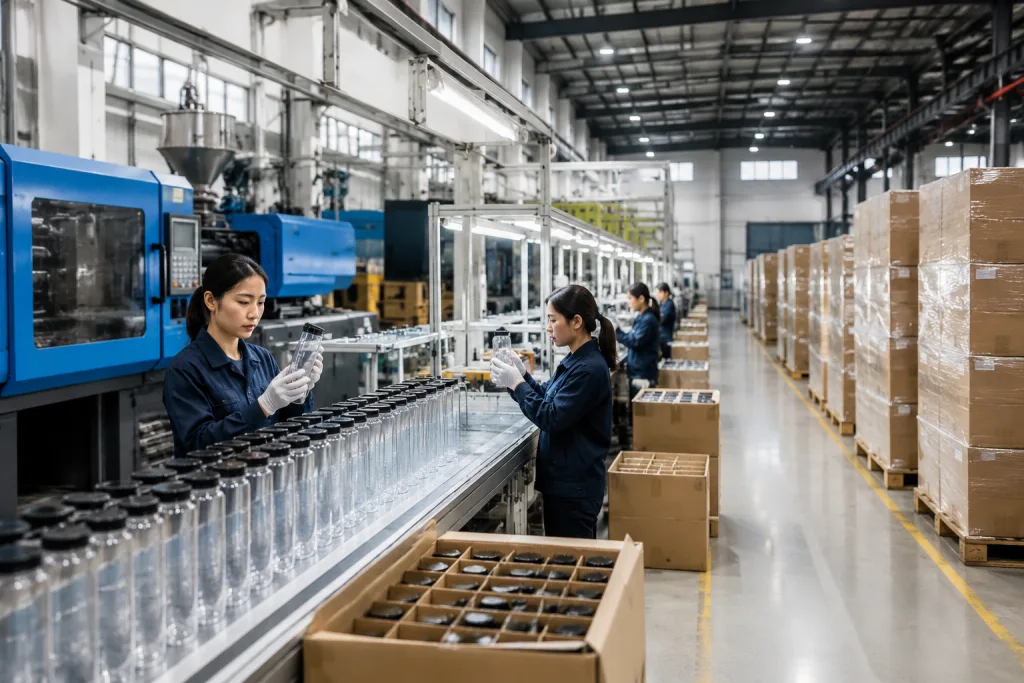
If you want to source tritan bottle wholesale, do not treat it like a plain plastic bottle order. Tritan sells on clarity, impact resistance, and BPA-free positioning, but the margin comes down to resin grade, cap fit, decoration method, and whether the supplier can keep color and mold quality steady across 10,000 units or 300,000 units.
In Zhejiang and across the China drinkware base, plenty of factories say they can run wholesale orders, but not all of them hold tolerances, pass REACH, or ship on schedule without moving jobs around the line. We’ve seen buyers get burned on a 2 mm cap mismatch or a PO that says “blue” with no Pantone code. If you buy for retail, e-commerce, or promotions, you need MOQ, unit cost, lead time, test standards, and packaging spec before you issue a PO. That’s the real starting point.
What buyers mean by Tritan wholesale
I’ll rewrite just the prose, keep the HTML tags intact, and tune it to sound like a factory-side sales engineer wrote it.When buyers say source tritan bottle wholesale, they usually want a bottle that looks clean on shelf, takes a drop on tile, and does not have that cheap, brittle feel you see in low-grade copolyester. Tritan is a resin family, so the real question is not the brand name; it is the resin specification, the masterbatch used for color, and whether the factory can show food-contact paperwork. On export jobs, we ask for the exact resin grade, batch traceability, and whether the body is injection-blown in one line or built from separate parts.
For a 750 ml sports bottle, the usual wholesale target is 1,000 pcs MOQ and USD 1.40-2.60 FOB for plain stock, then another USD 0.20-0.60 for one-color silkscreen or laser marking. If you need custom tooling, mold cost usually sits around USD 3,000-8,000, depending on cavity count and cap structure. We run this kind of quote every week in Zhejiang, and the cheap number is the one that bites later if the cap leaks or the body scuffs in transit; QC pulled a sample with a hairline scratch at 200 pcs, and the buyer flagged it fast.
Q: Is Tritan always better than PET or PP?
A: No. Tritan gives better clarity and impact resistance than many commodity plastics, but it costs more and the math does not work for every program. You pay for appearance, consistency, and fewer complaints, not for some magic resin.
Price, MOQ, and lead time
I’ll keep the HTML exactly as-is and rewrite only the prose for a sharper factory-sales voice. Next I’m patching the section in place, then I’ll return the rewritten HTML only.Your first filter is the commercial model, not the sample photo. For standard wholesale drinkware, a China factory with a stable line usually ships 20,000-50,000 pcs per month per SKU family. For a basic Tritan bottle, we quote 1,000 pcs MOQ for stocked molds, 3,000 pcs for a semi-custom color, and 5,000 pcs if you want a new cap shape or custom handle. The buyer usually pushes back on MOQ first; fair enough, but the math does not change.
Lead time decides whether the order works. Our normal schedule is 7-10 days for samples, 15-25 days for tooling approval if a new mold is needed, and 30-45 days for mass production after deposit. If a supplier says 10 days for a custom bottle, ask what step they cut out. We’ve seen that go sideways when QC pulled the sample and found a 1.5 mm gap on the lid after printing. In Zhejiang, some plants move fast because molding, printing, and packing sit under one roof, but speed with weak inspection just turns into claims later.
- FOB China: confirm the port basis in writing, usually Ningbo or Shanghai.
- Sample fee: USD 20-80, refundable only on some projects.
- Packing: write the inner box, master carton, and carton drop-test spec on the PO; we’ve seen a typo on the carton count become a real headache.
- Payment: 30/70 T/T is common; LC is possible on larger orders.
Do not mix up your drinkware wholesale plan with promotional sourcing. A 10,000-piece retail run needs tighter print and color control than a 50,000-piece giveaway order, and the line will show it. If the buyer wants both in one RFQ, we split the quote first.
Checklist for factory qualification
I’ll keep the HTML structure exactly as-is and rewrite only the prose, with tighter factory-floor language and the requested sourcing detail.Before you approve a supplier, make them answer the same checklist every time. Good factories in China do not flinch. Weak ones go vague fast.
- Do you own the mold, or are you renting it through a trading layer?
- What is the body wall thickness? For Tritan bottles, we usually see 1.5-2.2 mm on the line.
- What is the cap seal structure: silicone ring, threaded PP cap, or double-lock lid?
- Can you provide REACH, FDA, LFGB, and migration test reports?
- What is your AQL standard for appearance and function inspection?
- Can you show production photos from the last 30 days, not just a catalog?
Q: What AQL should you request?
A: For consumer drinkware, many buyers run AQL 2.5 for critical defects and 4.0 for major defects, with leak testing at 100% on the fill line. For premium retail, some brands tighten the cosmetic side. We’ve seen this go sideways when a buyer ignored a 2 mm lid gap and QC pulled the sample before shipment.
If the supplier also sells canteen wholesale, wholesale canteen, or canteen bulk items, do not assume they know Tritan. Metal canteens and Tritan bottles share buyers, not process control. Same story with bulk drinkware versus bulk growler or bulk canteen; the materials, seal parts, and test points are not the same. One PO typo we saw listed a 304 cap on a Tritan bottle, and the buyer flagged it before we cut steel.
Decoration and branding choices
I’ll rewrite the HTML in place, keep the tags and structure intact, and make the copy sound like a real sourcing note from the factory floor.Your decoration choice decides whether the bottle reads premium or cheap. On Tritan, we run silkscreen, pad printing, UV printing, laser engraving on metal caps, and heat-transfer sleeves. For a clean shelf look, silkscreen wins on one or two colors. The screen frame on our line uses a 120T mesh, and that gives a sharp edge without blowing the budget. If you want a tougher mark, laser works well on stainless caps or a metal ring, but it is a bad fit for every plastic body.
For buyers comparing best wholesale drink bottle options, print area and curvature matter more than the logo file. A tall slim body is easier to brand than a heavily tapered bottle, full stop. If you want a wrap logo, ask for the developed surface width in millimeters, not “around the bottle.” We had a buyer flag a PO typo once because the artwork limit was written as 62 mm instead of 26 mm, and the proof had to be redone. A factory in Zhejiang should give you exact artwork limits, usually within 1-2 mm tolerance for repeat jobs.
Q: Which is better for e-commerce, clear body or tinted body?
A: Clear bodies sell well for hydration and fitness. Smoke, amber, or solid tint hides scuffs in transit. For Amazon-style listings, buyers test both because photos and return rates can shift by 3-5%. QC pulled the sample after a 48-hour cart test, and the math was plain: the wrong tint costs clicks.
Separate the SKU language before you place the order. A beer growler bulk order is not the same as a beer tumbler wholesale bulk order, and neither matches an alcohol flask wholesale bulk order. The packaging may look similar, but the use case is different, and that changes cap choice, print placement, and carton spec. If your line sheet groups beer growler wholesale, wholesale growler, and growler wholesale into one bucket, the costing gets muddy fast. We’ve seen that go sideways on a 5,000-piece run when the buyer wanted retail sleeves and the factory had only shipper cartons ready.
Testing and compliance that matter
I’ll rewrite the section in-place, keep the HTML tags intact, and tighten the sales language so it sounds like a factory-side sourcing note.For export buyers, compliance is where a cheap offer turns costly. Ask for documents, not promises. A credible Chinese supplier should hand over REACH paperwork for the EU, and for North America you should ask for FDA food-contact support and, where needed, ASTM test references for physical performance. If your brand sells into grocery or chain retail, you may also need BSCI plus factory traceability files and social compliance records. We’ve seen buyers skip the document pack and regret it on the first customs check.
Leak testing is not optional. A bottle can look clean in the sample room and still fail in transit if the gasket compression is off. Ask for torque spec, seal material, and drop-test results. For a 750 ml Tritan bottle, our normal check is no leakage after a 1.2 m drop test in multiple orientations, though some retailers push that harder. QC pulled one sample with a 0.3 mm cap gap last month; that sort of thing is why we run the test, not just the photo.
“Compliance is not a certificate you file away. It is the difference between one smooth reorder and a container full of claims.”
Q: What documents should you request before deposit?
A: Commercial invoice, proforma invoice, material declaration, test report, packing spec, and, if possible, a pre-shipment inspection plan. For larger orders, ask for photo evidence from IQC, IPQC, and final inspection. A PO typo on carton quantity can snowball fast, so this is basic risk control, not bureaucracy.
How to compare suppliers
I’ll rewrite the section in place, keeping the HTML tags and the existing terms/numbers intact while making it sound like a factory-side sales engineer wrote it.When two suppliers quote the same bottle, do not stop at unit price. A low number can hide a thinner wall, a loose cap, or a carton that caves in on the pallet. We run a simple scorecard on five items: unit price, lead time, compliance, decoration quality, and response speed. If you are buying wholesale drinkware for more than one channel, add carton strength and barcode readiness too, because the warehouse will catch the mistake fast.
Send every supplier the same brief: target capacity, logo artwork, Pantone code, carton count, and destination port. Ask for an itemized quote with body, lid, packing, printing, and sample fees split out. On our line, a 24 oz Tritan bottle with a 58 mm cap and 6-color print is a different job from a plain SKU, so vague quotes waste time. Good Zhejiang factories answer straight. Trading companies often reply quicker but leave out the process detail. That works for a small trial order. It breaks on repeat drinkware wholesale supply.
Q: What is a fair way to compare a China factory and a trading layer?
A: Compare landed cost, not only FOB. If the factory offers USD 1.85 FOB with a 45-day lead time and the trading layer offers USD 1.70 but cannot confirm mold ownership or QC steps, the cheaper quote is usually the riskier buy. We’ve seen buyers chase the lower line and then pay again for rework. Ask which supplier can repeat the same item in 90 days without a redesign; that is the real test.
For mixed-category programs, keep the wording tight: beer tumbler wholesale, beer tumbler in bulk, beer tumbler bulk, beer tumbler wholesale bulk, alcohol flask bulk, alcohol flask in bulk, and alcohol flask wholesale do not mean the same packing or the same buyer expectation. A PO typo on carton count can turn into a warehouse dispute, so this is the wrong place to be loose. Precision protects margin.
What a clean buying checklist looks like
I’ll rewrite the section in place, keeping the HTML tags and structure unchanged while stripping the AI-ish phrasing and adding a few factory-floor specifics.If you want a checklist that works, run this order before you sign a PO:
- Confirm bottle volume, cap type, and wall thickness, down to the mm.
- Get MOQ, FOB port, sample cost, and lead time in writing; no WhatsApp promises.
- Ask for compliance files, including REACH and food-contact support.
- Approve artwork with print size, Pantone code, and placement diagram.
- Lock carton spec, drop-test target, and barcode/FNSKU labels if needed.
- Check first articles, then release full production after leakage and appearance checks.
That order cuts rework. We run this all the time on the line in Zhejiang, and the buyer usually flags the missing detail before QC does. For a new program, budget 10-15% extra for pilot rejects and shipping damage; that is the right math. On repeat orders, a supplier with a stable mold and a clean QC sheet should bring that down fast.
Q: Can you bundle Tritan bottles with other categories in one PO?
A: Yes, if each spec stays separate. It is normal to combine drinkware bulk items in one shipment, but each SKU still needs its own compliance file, packing spec, and QC checklist. That matters if you also source growler bulk, growler wholesale, or beer growler in bulk products, because lid pressure and fill-use checks are not the same.
Request a Tritan bottle quote today
Send your volume, target price, artwork, and destination port. We will reply with MOQ, lead time, and compliance files from our Zhejiang team.
Frequently asked questions
What is the usual MOQ to source Tritan bottle wholesale?
For stocked molds, a common MOQ is 1,000-3,000 pcs. If you need custom color, custom lid, or new tooling, expect 3,000-5,000 pcs or more. For a serious export program from China or Zhejiang, suppliers often quote better unit pricing once you cross 10,000 pcs per SKU. The right MOQ depends on whether the factory owns the mold and how much decoration you need.
What price should I expect for a Tritan bottle from China?
For a standard 750 ml bottle, FOB China pricing often lands around USD 1.20-3.80 depending on mold cost, print method, and cap design. Plain stock runs cheaper; custom logos, boxed packaging, and premium lids push the price up. Always separate body, lid, printing, and carton cost so you can compare quotes fairly.
How long does production usually take?
For a standard order, 30-45 days after deposit is common. Samples usually take 7-10 days. If you need a new mold or a special closure, lead time can move to 45-60 days or longer. Good factories in Zhejiang can move faster, but only if the artwork, compliance files, and packing spec are already approved.
What compliance documents should I ask for?
Ask for REACH support for the EU, FDA or equivalent food-contact documentation for the US, and a migration test report from a recognized lab. If you sell through retail chains, also request factory audit evidence such as BSCI if available, plus a QC procedure. You want documents tied to the exact SKU, not generic certificates from an unrelated item.
Can one supplier handle Tritan bottles and other drinkware categories?
Yes, but do not assume every supplier that sells canteen wholesale or growler wholesale can make Tritan well. Ask for specific experience with wholesale canteen, wholesale growler, beer growler wholesale bulk, or alcohol flask wholesale bulk only if those are relevant to your program. Material and lid systems differ, so each category needs its own technical check.