Key Takeaways
- Silicone water bottle bulk orders usually start at 1,000 pcs MOQ, with FOB pricing often in the USD 1.35-3.20 range depending on structure and lid.
- Food-grade silicone for export should be paired with REACH, LFGB, and FDA documentation; one lab gap can delay a 20,000-unit shipment.
- A 1.8-2.2 mm silicone wall and a PP or stainless cap usually balance durability, weight, and unit cost better than ultra-thin builds.
- For private label, expect 25-35 days production, plus 5-12 days for packaging or labeling changes if you need custom retail cartons.
If you are sourcing silicone water bottle bulk, do not treat it like a plain drinkware PO. It is not. A collapsible bottle, a promo carry bottle, and a retail foldable SKU each run differently on the line, from molding to carton pack. In Zhejiang and across China, factories can turn silicone drinkware fast, but fast does not save you from a 1.8 mm wall that comes out at 1.4 mm, a lid that leaks after 20 open-close cycles, or a lab report that misses your market.
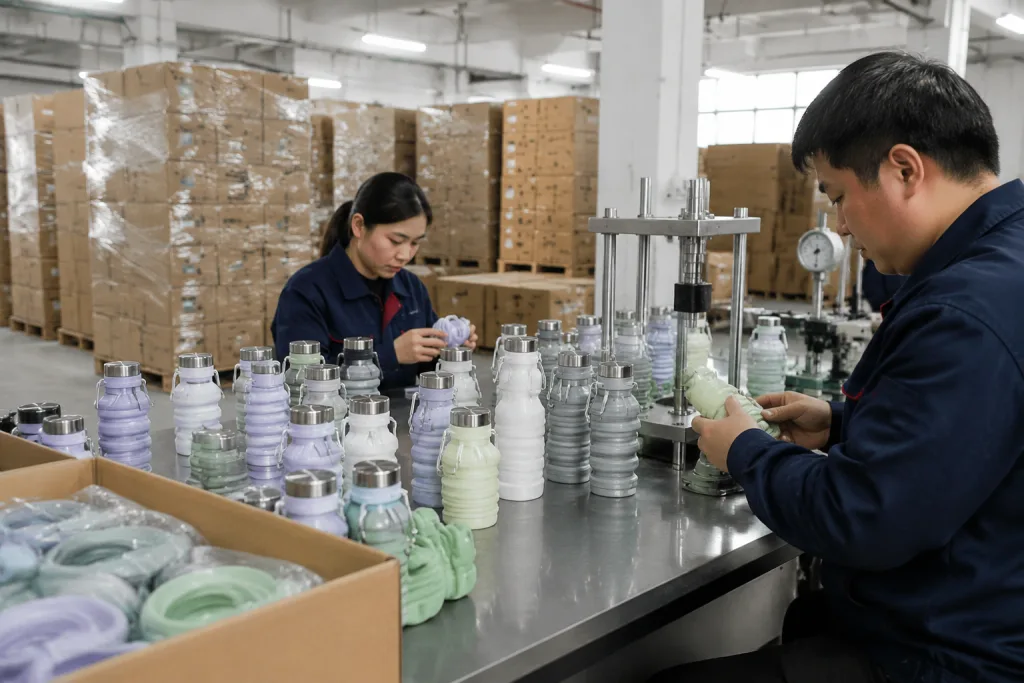
The better move is to lock four points early: material grade, closure system, compliance scope, and pack format. Those four items set MOQ, FOB price, and lead time. At BottleForge in Hangzhou, we ship about 600,000 units a month across silicone and hybrid drinkware, with MOQ starting at 1,000 units and lead times of 25-35 days after sample approval. QC pulled the sample last week and checked the seal ring with a 0.02 mm gauge; that is the kind of detail that keeps a buyer from flagging the order later. If you need wholesale drinkware that can pass retail checks, Amazon FBA prep, or distributor claims, the small sourcing details matter more than the headline price.
Start With the Use Case
I’ll rewrite just the prose, keep the exact HTML structure, and make it sound like a factory-side sales engineer wrote it.Before you talk color, logo, or carton art, lock the use case first. A silicone commuter bottle, a gym bottle, and a promo giveaway are different SKUs. If the buyer wants foldability and low freight, we run one structure; if they want a shelf-ready retail item that reads like the best wholesale drink bottle on a category page, we build another. This is the wrong question to ask later, because structure sets mold cost, cap testing, and pallet count from day one.
Take a 500 ml silicone body with a PP lid. We see it land around 220-260 g. A hybrid silicone-stainless build can go past 320 g, and the freight math changes fast on 10,000 pcs. If you are comparing bulk drinkware, ask what it is replacing: a plastic squeeze bottle, a rigid tumbler, or a compact travel bottle. That answer decides whether you should buy drinkware bulk from a promo line or a tighter retail line. We quote fast in Zhejiang, but a clean brief keeps the buyer from paying for a second round later.
- Promotion use: low unit price, simple lid, 48 pcs per carton
- Retail use: tighter color matching, leak test at 1 meter drop, cleaner print area
- Travel use: closure reliability, compression resistance, 120 mm pack height
Choose the Right Material Stack
I’ll rewrite the HTML in place, keep the tag structure unchanged, and tune the prose to sound like a factory-side sales engineer.Silicone is not a yes-or-no call. You need the grade, the softness, and what sits next to it. For export, most buyers ask for food-grade silicone that passes LFGB and FDA testing. If the bottle body is all silicone, the hand feel is soft and it folds cleanly, but a weak compound will slump in hot water. If you pair silicone with PP, Tritan, or stainless steel, you get more rigidity, and you also get more parts for QC to watch on the line.
Ask for Shore A, not just “food-grade.” We run 50-60 Shore A on a lot of collapsible builds, and that range is where the bottle still compresses without feeling like a toy. For wall thickness, 1.8 mm is lean, 2.0 mm is safer, and 2.2 mm usually reads better in hand. Once you drop below 1.6 mm, the math stops working unless the mold finish and compound are both tight. We’ve seen buyers take the low quote, then the first carton shows soft walls and a PO typo on the spec sheet leaves everybody arguing after the sample is signed.
Good sourcing is not buying the cheapest silicone bottle. It is buying the build that survives the customer’s real use, the compliance file, and the freight bill.
If you also source adjacent categories like bulk canteen, canteen bulk, or wholesale canteen, keep the material stack consistent across the range so the brand does not feel patched together. The same goes for bulk growler, growler bulk, or beer growler wholesale items. Standardizing the bottle body, cap thread, and lid insert can cut setup pain on repeat runs, and we’ve seen that save a buyer 12 days versus 18 days on mixed-MOQ orders when the line is already tooled for the same platform.
Price Is a Structure Problem
I’m rewriting the section in-place, keeping the HTML exactly as-is and tightening the prose to sound like a factory sales engineer. Next I’ll make the price logic concrete, add a few shop-floor details, and trim the AI-ish filler.When factories quote silicone water bottle bulk, the unit price follows the build, not just the silicone resin. A plain 500 ml bottle with a standard cap usually lands around USD 1.35-1.85 FOB at 1,000 pcs. Add a stainless steel lid, laser logo, and custom carton, and it moves to USD 2.40-3.20. If the spec includes a carry strap, inner sleeve, or gift box, the number goes up again. We see this every week on the line.
Do not compare quotes until the spec is matched. One supplier may quote a 1.8 mm body and another a 2.2 mm body; one may include a one-color print, the other ships blank stock. That is the wrong question to ask if the base is different. Ask for separate line items for tooling, sample charges, print setup, and packaging inserts. For drinkware wholesale buying, that matters more than saving 8 cents on the headline number. QC pulled a sample last month and the buyer flagged the wall thickness immediately.
Here is the rule we use in Hangzhou: if the price is below market and the supplier cannot state the silicone compound, lid material, and test standard, treat it as risk. On a 5,000-unit order, 3% leakage plus rework and a second carton run can erase the savings fast. The math does not work. We usually price the landed cost, not just FOB, because a PO typo on carton size or a missing insert can add 12 days and a real cost hit.
- Basic export spec: 1,000 pcs MOQ, 25-35 days lead time
- Custom print or mold change: add 5-10 days
- Retail carton upgrade: add 0.12-0.35 USD per unit
Test the Closure, Not Just the Body
I’ll rewrite the prose in place, keep every tag and the existing bold terms, and make it sound like a factory-side sales engineer wrote it. Then I’ll do a quick pass for the banned filler patterns and closure-test specifics.Most failures on silicone bottles start at the closure. The body can pass appearance check, but the cap starts weeping after transit, or the hinge gives up after a few hundred open-close strokes. If you want a product that survives drinkware bulk programs, tell the factory to test the closure under tilt, drop, and pressure swings. Simple. That is the job.
For export orders, ask for leak testing at 45 degrees and 180 degrees, plus an inverted hold for 24 hours. If the bottle is for hot-fill or warm liquids, add a heat-aging cycle. We had one buyer flag a PO typo on “hot fill” as “hotfilm,” and QC still had to stop the line until the spec was clear. If you are placing alcohol flask bulk, alcohol flask in bulk, or alcohol flask wholesale orders in the same program, push harder: alcohol-compatible packaging and closure integrity leave no slack, because one leak can turn into a chargeback. The same logic applies to beer tumbler bulk, beer tumbler in bulk, beer growler bulk, and beer growler wholesale bulk sourcing, where the seal is part of the sales promise.
For a collapsible bottle, I always ask for a minimum cycle count on the lid hinge or locking feature. If the factory cannot show how it holds after 500 cycles, you are buying a sample, not a product. We run this with a simple fixture on the bench, and the math does not work any other way. This is where a Zhejiang supplier earns margin: not by talking big, but by holding tolerances tight and rejecting weak closures before packing.
Compliance Needs to Match the Market
I’ll keep the tags and list structure intact, rewrite the prose with a more grounded sales-engineer tone, and make sure the compliance points sound field-tested.If you sell into Europe or North America, compliance is a sourcing call, not a folder-cleanup task. We ask for LFGB, FDA, REACH, and California Proposition 65 support before PO release. “Food safe” by itself does not pass review. For silicone drinkware, the test report date and the sample photo need to match the exact formula, because a report for one 12g pink cup does not cover a new pigment or filler.
For private label buyers, we line up the compliance file with the channel first. Amazon, distributor, and retail chain specs do not match, and the buyer will flag it fast. If your SKU needs FNSKU labels, master carton marks, and individual polybags, that packaging plan belongs in the compliance check, not as a last-minute add-on. If you are handling canteen wholesale or wholesale canteen beside silicone bottles, keep the files split by SKU family. We’ve seen mixed programs go sideways on a typo in the carton label.
In China, a serious factory should show sample retention, in-process inspection records, and final QC checkpoints. Ask what they inspect at AQL 2.5 and what gets rejected at AQL 4.0. If the supplier cannot explain AQL in plain terms, the line is probably not set up for export work. That matters when you need growler wholesale, growler wholesale, or bulk drinkware in one shipment, because each channel can need different claim support and carton text.
- Europe: LFGB and REACH are the usual starting point
- North America: FDA food-contact support and buyer-specific testing
- Retail programs: carton marks, barcode accuracy, and complaint traceability
Ask for a Factory That Can Scale
I’ll rewrite the section in place, keep the HTML exactly as-is, and tighten the prose so it sounds like a factory-side sales engineer.Some buyers fixate on price per piece. That is the wrong question if you plan to reorder. The factory you choose for silicone water bottle bulk needs to keep color, logo position, and lid fit steady on the second run, not just the first 2,000 pcs. We’ve seen this go sideways fast: one PO came in with a lid spec typo, 20.5 mm instead of 25.5 mm, and the whole batch had to be held. In Hangzhou and across Zhejiang, the factories that stay in the game win on repeatability.
Ask for monthly capacity, not sales talk. A serious line should tell you how many units it runs per month, how many molding stations are on the floor, and whether raw material is already booked. Our own output across related drinkware lines runs around 600,000 units a month, and that is how we usually hold a 25-35 day lead time after approval. QC pulled the sample on one run and found a 1.2 mm lid gap; we stopped it before shipment. If you need bulk canteen, canteen bulk, wholesale drinkware, or bulk drinkware in the same season, you need a supplier that can schedule the line, not just quote it.
If your line includes beer growler in bulk, beer growler wholesale, or beer growler wholesale bulk products, ask the same capacity questions. Growlers and flasks usually need heavier hardware, cleaner finishing, and tighter carton control; the math does not work if the plant is already stretched. We ship across both silicone bottles and metal drinkware, and the buyers who get burned are the ones who assume one good sample means the plant can scale forever. Ask for actual factory data, not a nice deck.
Send your spec and get a real quote
Share your target size, lid type, MOQ, and market. We’ll quote silicone water bottle bulk with clear FOB pricing, lead time, and test support.
Frequently asked questions
What is a realistic MOQ for silicone water bottle bulk?
For most export factories in China, a realistic MOQ starts at 1,000 pcs per color or per SKU. If you need custom mold changes, special lids, or retail packaging, some suppliers push to 3,000 pcs. In Zhejiang, smaller trial runs of 500 pcs are possible, but the unit price rises fast and the schedule gets less efficient. If you are testing a new retail line, 1,000-2,000 pcs is usually the practical range. For a mixed order with bulk drinkware or canteen wholesale items, you can sometimes combine SKUs to hit the factory’s total production threshold.
What documents should I request before placing an order?
Ask for LFGB, FDA, and REACH test support if you sell in Europe or North America. You should also request the factory business license, product specification sheet, and a clear QC plan. If the supplier is serious, they can show production photos, AQL inspection standards, and material declarations. For Amazon or retail programs, ask for carton labels, barcode setup, and if needed, FNSKU preparation. Do not rely on a verbal “food grade” claim. In China, the better factories in Zhejiang can usually provide these files within 2-5 working days.
How much should I budget per unit?
For a simple silicone bottle with a basic lid, budget around USD 1.35-1.85 FOB at 1,000 pcs. If you add a stainless lid, logo printing, carry strap, or custom retail box, the price often moves to USD 2.40-3.20 FOB. Freight, duties, and local fulfillment can add another 20%-45% depending on your lane and carton density. If you compare this against beer tumbler bulk or alcohol flask wholesale bulk sourcing, the unit economics are different because hardware and finish levels are not the same. Always compare landed cost, not only factory price.
How do I reduce leak risk?
Specify the closure in writing and test it before mass production. Ask the factory to run inverted 24-hour tests, tilt tests, and basic drop tests. For foldable silicone bodies, the cap and sealing ring matter more than the shell. I also recommend asking for a pre-production sample with the exact silicone hardness and wall thickness, ideally 1.8-2.2 mm depending on the design. If the product is for beer growler wholesale or alcohol flask wholesale, be stricter because leak claims damage repeat sales quickly. A clear closure spec saves more money than a lower unit price.
Can I mix this with other drinkware categories in one order?
Yes, but only if the supplier is structured for it. Many buyers mix silicone bottles with canteen wholesale, wholesale growler, or beer tumbler wholesale bulk items to improve container utilization and simplify purchasing. That can work well if the factory has separate production lines or reliable subcontract control. The risk is mixed QC standards: one SKU may be compliant while another is not. If you bundle categories, make sure each SKU has its own spec sheet, carton mark, and inspection point. In Zhejiang, the best factories handle mixed programs cleanly, but you should still validate sample quality for each item.