Key Takeaways
- Ask for steel grade, wall thickness, and lid structure in the RFQ; a vague custom thermos request usually creates a vague quote.
- A proper sample should include leak testing, thermal retention, and logo verification, not just a single visual prototype.
- For bulk thermos orders, lock PO line items on coating color, silicone durometer, carton count, and drop-test standard before production.
- Most silicone vacuum flask manufacturer projects in China move faster when you approve artwork, FNSKU labels, and packaging in one round.
If you are buying for outdoor retail or a promo program, a bad stainless thermos order gets expensive fast, and the first quote never shows the damage. We have seen a buyer approve a clean vacuum flask sample, then the line misses leak performance, coating wear, or logo position once bulk starts. Treat a silicone vacuum flask manufacturer like a production partner. Not a catalog vendor.
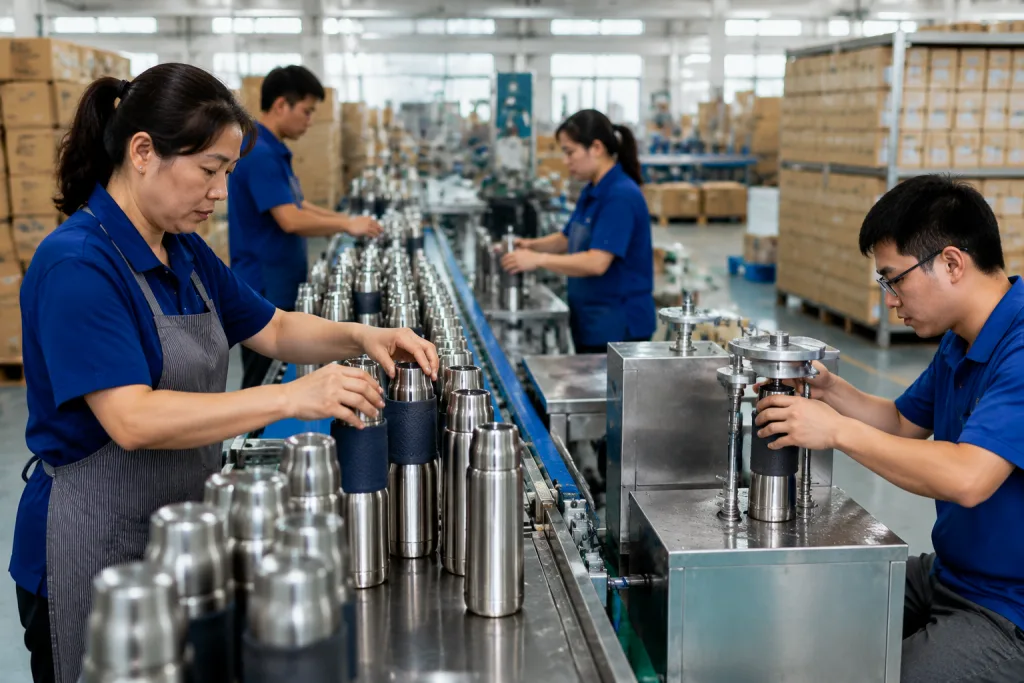
In Zhejiang and across China, the better factories are built for repeat custom thermos work: laser logoing, powder coating, silicone sleeves, double-wall SS304 or SS316 construction, and carton specs for distributor thermos channels. Ask clean questions at RFQ, sample, and PO stage, or the order drifts into rework. BottleForge Industrial in Hangzhou runs 180,000 units per month, with a typical MOQ of 3,000 pcs and standard lead time of 25-35 days after sample approval. QC pulled the sample on a 1.2 mm wall check last week, and the buyer flagged a logo shift of 3 mm. That is the wrong question to ignore.
Start with a usable RFQ
I’ll rewrite the prose in-place, keep every tag and list structure intact, and make it sound like a factory-side sales engineer wrote it.Do not send a one-line inquiry and expect a serious reply. A usable RFQ for a silicone vacuum flask manufacturer should read like a production brief. Give the capacity, usually 350 ml, 500 ml, 750 ml, or 1000 ml; the sales channel; cap style; insulation target; and whether you need a custom thermos for retail shelves or a promotional thermos for event handouts. If you want stainless thermos products for outdoor retail, say it straight. Outdoor buyers usually want a grippier body, a tougher powder coat, and a lid that still works after 200 open-close cycles.
Include these line items in the first message:
- Body material: SS304, SS316, or inner SS304 + outer SS201
- Wall spec: double wall vacuum, 0.4 mm to 0.5 mm inner shell
- Finish: matte powder coat, glossy paint, or bare steel
- Silicone parts: sleeve, base pad, loop, or grip band
- Logo method: silkscreen, laser, deboss on silicone, or UV print
- Packing: white box, color box, gift box, or bulk master carton
Ask it this way, and the supplier thermos quote becomes usable because each choice shows its own cost. We run this every week in Hangzhou, and the math changes fast once you add a silicone sleeve or a gift box with a 1,000-piece MOQ. The buyer flagged it once on a PO typo, and we caught it before the line started. That is the right way to buy. Ask for FOB Ningbo or FOB Shanghai if you want clean export pricing from Zhejiang factories.
Read the quote like a buyer
I’ll rewrite just this section, keep the HTML structure intact, and tighten the copy so it reads like a factory-side sales engineer.A quote from a thermos factory should never be read on unit price alone. For a 500 ml custom thermos, we see USD 2.10 to 4.80 FOB depending on the steel grade, lid structure, and decoration method. A silicone sleeve usually adds USD 0.18 to 0.45 per piece. Laser logo work is cheaper than multi-color silkscreen at low volume; if the buyer needs a larger print area, silkscreen still wins. We ran that comparison on a 1,000 pcs trial last month, and QC pulled the sample twice before the price made sense.
Check the quote against these items:
- MOQ: 1,000, 3,000, or 5,000 pcs per color or SKU
- Sample fee: often USD 40-120, usually refundable against bulk order
- Tooling: new lid, silicone mold, or custom packaging insert
- Lead time: sample 7-12 days; bulk 25-35 days after approval
- Testing: vacuum retention, leak test, coating adhesion, and drop test
If the quote does not split out body, lid, silicone, decoration, and carton cost, push back. This is the wrong question to ask if the buyer is only chasing the lowest FOB. A real thermos supplier in Zhejiang should hand you a clean cost breakdown. We had one PO where the buyer flagged a carton typo of 24 pcs instead of 20 pcs, and the math broke immediately. That level of detail is what keeps a reorder stable six months later, with the same color, carton count, and print position.
Approve a sample that can fail
I’ll rewrite just the prose, keep the HTML structure intact, and make it read like a factory-side sales note with concrete sample-check details.Sample approval is where a lot of buyers slip. They sign off on a flask that looks fine and miss the mechanical stuff that decides whether the bulk run holds up. Treat the sample like a test unit, not a display piece. On our line, the sample has to prove the cap seals cleanly, the silicone sits flat, and the powder coat survives a few knocks at the rim and base.
Run the sample against a short checklist:
- Fill with hot water at 95°C and check 6-hour and 12-hour retention
- Invert for 10 minutes and confirm no leakage
- Open and close the lid at least 30 cycles
- Inspect logo placement under normal retail lighting
- Check silicone odor, edge finish, and fit tolerance
For outdoor retailers, grip wins orders. A 2.0 mm silicone sleeve gives better hold in cold weather and when condensation builds up, and QC pulled that dimension twice on a 500 pcs sample run because the buyer flagged a loose fit. For promotional brands, the sample is your proof that the customized thermos will print cleanly at the target quantity. If you are ordering thermos promotional gifts for a trade show, do not approve until you have seen the carton artwork and the insert sheet; we once caught a PO typo on the insert, and that mistake would have gone straight into 3,000 boxes.
Turn the sample into a PO
I’ll tighten the wording, keep the HTML exactly as-is, and make it read like a factory-side sales engineer wrote it.Once the sample is signed off, push every detail into the purchase order line by line. That is how you stop factory assumptions before they start. A custom thermos order should never hang on one “same as sample” note. Write the full spec into the PO so the manufacturer thermos team can run it without guessing. If the order goes through a thermos distributor or supplier thermos channel, this step matters even more because the file may pass through 2 or 3 hands before it hits the line.
Your PO should include:
- Item name, capacity, and SKU code
- Steel grade and wall construction
- Silicone color, hardness, and placement
- Logo artwork reference and Pantone number
- Packaging spec, barcode, and FNSKU if needed
- Carton quantity, drop-test requirement, and master carton marks
For Amazon or warehouse programs, the PO should also say whether you need polybags, suffocation warnings, or FNSKU labels applied at the factory. We’ve seen buyers leave that out and then blame the plant when the cartons arrive wrong. In China, especially in Zhejiang, a good supplier knows bulk thermos production stays on track only when packaging is locked early. A clean custom thermos PO cuts most of the back-and-forth about “small differences.”
Control bulk production the practical way
I’ll rewrite the prose in place, keep the HTML structure intact, and tune it to sound like a real factory-side sales engineer.Bulk production is where a thermos order turns smooth or turns into a headache. We do not need fancy wording here; we need control. Ask the supplier to confirm incoming checks on steel tubes, vacuum chamber settings, and first-piece approval for the logo and silicone assembly. On a 3,000 pcs run, we expect at least one in-process check before packing. At 10,000 pcs or more, the QC plan needs more teeth.
Useful control points include:
- AQL 2.5 for general defects and 4.0 for minor appearance issues
- Leak test on 100% of lids or a documented sampling plan
- Random thermal retention checks from each production day
- Carton compression and drop-test validation before shipment
Promotional buyers often miss packaging damage. We’ve seen a carton spec fail on a 1.2 m drop test, and the buyer flagged dents only after arrival. A thermos customizable program can look clean in factory photos and still ship with crushed corners if the master carton is weak. Ask for 5-ply export cartons, internal dividers, and edge protection. Put it in writing. That is how we protect margin on a bulk thermos order.
Plan shipment and reorders early
I’ll rewrite the section in-place, keep the HTML tags untouched, and make the copy sound like a factory-side sales engineer wrote it.The last step is not delivery; it is getting the next PO out clean. If your stainless thermos line sells through, keep the production file alive: artwork, Pantone code, carton spec, and approved sample photos. We run repeat orders faster when those four items are current. A good thermos manufacturer can copy the order with fewer misses, but two-region programs still need separate label calls. We’ve seen this go sideways when North America wanted English-only cartons and Europe needed multilingual packs, so settle that before you book freight.
For shipping, decide early on FOB, CIF, or DDP. FOB is the cleanest setup for experienced importers; first-time buyers often pick DDP for the first carton run because customs paperwork gets messy fast. If you work with a thermos supplier in Zhejiang, ask for packed dimensions, gross weight, and pallet count before you lock freight. One typo on the PO can shift the carton count, and the math does not work if the landed cost per unit is off by 0.12 USD. Reorder speed is one of the few real edges in China, but only when the file is tight and QC pulled the sample on the same spec you approved.
Send your RFQ and spec sheet today
We will quote your custom thermos, confirm silicone details, and map the sample-to-bulk path with clear PO line items.
Frequently asked questions
What details should I send to a silicone vacuum flask manufacturer first?
Send capacity, target quantity, logo method, finish, lid type, and packaging needs. For a useful quote, include whether you need SS304 or SS316, silicone sleeve or base, and your target MOQ. If you want an outdoor retail model, mention drop-test expectations and insulation hours. A serious supplier in China can usually respond in 24-48 hours if the RFQ is complete.
What is a realistic MOQ for custom stainless thermos orders?
For most factory thermos projects, MOQ starts at 3,000 pcs per color or per model. Some simpler promotional thermos runs can begin at 1,000 pcs, but you will usually pay more per unit and have fewer decoration options. If you need multiple colors, the MOQ may apply to each color unless the supplier agrees to split production. Zhejiang factories often prefer one clear SKU first.
How much does a customized thermos usually cost FOB China?
A 500 ml customized thermos often lands around USD 2.10 to 4.80 FOB China depending on steel grade, lid structure, coating, and printing. A silicone sleeve may add USD 0.18 to 0.45, and custom packaging can add USD 0.12 to 0.60. If you need a premium lid or multiple color zones, expect the price to move up quickly.
What tests should I ask for before bulk production?
Ask for leak testing, hot-water retention testing, logo durability checks, and carton drop tests. A practical standard is AQL 2.5 for major defects and spot checks for thermal performance from each production day. For a thermos promotional program, also ask for silicone odor control and packaging compression checks. This is the fastest way to catch problems before 3,000 pcs are packed.
Can a thermos supplier handle Amazon FBA packaging?
Yes, many suppliers and manufacturers in China can handle FNSKU labels, polybags, suffocation warnings, and carton marking. Put those requirements on the PO, not in a chat message. If your program uses Amazon FBA or a retail warehouse, also confirm carton dimensions and case pack before production. That prevents rework when the bulk thermos shipment is already finished.