Key Takeaways
- Plan for a real MOQ of 3,000-5,000 pcs per color on a new custom drinkware project.
- Ask for FDA, LFGB, REACH, and assembly-level migration tests, not just resin claims.
- A practical Tritan wall thickness is 1.2-1.8 mm, with silicone seals around 50 Shore A.
- A serious canteen manufacturer should quote 30-45 days production lead time after sample approval.
A silicone Tritan bottle looks simple until we price it. Color and logo come last. First ask whether you need a light retail bottle, a rugged custom growler, or a canteen for a distributor program. Each route changes the mold, the cap, the silicone sleeve, and the test plan. On our line, QC pulled one sample after a 1.2 m drop test and the cap cracked at the hinge. That is the real work.
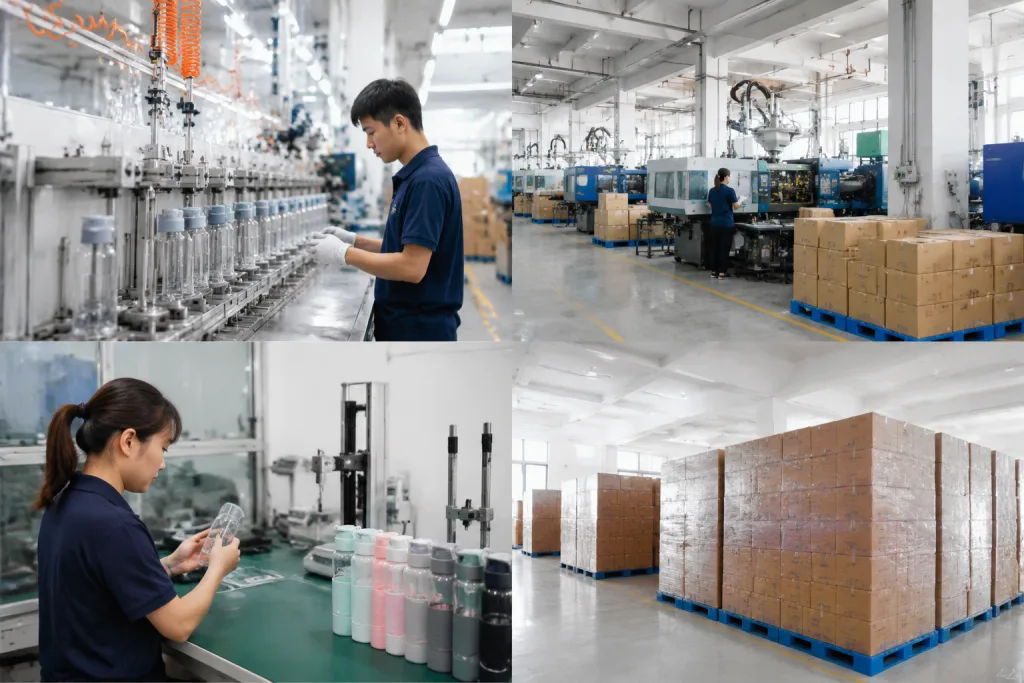
If you are sourcing in Zhejiang or anywhere in China, the right silicone tritan bottle manufacturer should show wall thickness, silicone grade, closure design, and a realistic MOQ before artwork. At our Hangzhou, Zhejiang factory, we run 300,000 units per month, but that does not mean every sketch deserves new tooling. We have seen buyers approve a pretty sample, then the PO typo changes the cap size from 28 mm to 30 mm and the math stops working. Good buyers check shipping, shelf life, and daily use before they chase the print file.
Start With the Bottle Role
The first decision is not “does it look premium?” The better question is where the bottle has to earn its money. A 600 ml Tritan bottle for a school program needs a different body, lid, and target FOB than a 1.9 L custom growler for a beverage distributor. We saw this go sideways on a 5,000 pcs RFQ where the buyer wanted one mold for retail shelves and campus giveaways; the math did not work after we checked the 58 mm mouth, silicone sleeve weight, and carton cube. One design trying to cover every channel usually lands in the bad middle: too costly for promo, too delicate for retail, or too bulky for a canteen distributor to ship by the pallet.
Think by sales channel before you ask us for colors. A distributor drinkware program needs a carton that stacks cleanly, enough barcode space, and a cap we can torque-test so it does not leak after 12 hours in transit testing. Retail buyers care about shelf shape and hand feel; QC pulled one sample last week because the flip lid sounded loose even though it passed the water test. Gym and outdoor bottles need a loop or carry handle that survives real pulling, not just a nice rendering. For corporate gifting, a simple closure can be fine, but pharmacy, school, and brewery programs often need a wider mouth for cleaning and ice.
- Retail: clear Tritan body, steady grip area, and a lid click that feels clean when the buyer tests it by hand.
- Promo: low tooling exposure, one-color logo printing, and landed cost that still works at 3,000 pcs.
- Distributor: carton efficiency, reorder stability, and decoration that repeats within normal AQL 2.5 checks.
- Specialty: custom growler, infuser bottle, or silicone-sleeve version built around one use case instead of a catalog guess.
A canteen factory that understands channel work will not push one SKU into every order. We run the line differently for a 10,000 pcs promo bottle than for a retail order with individual color boxes and hang tags. That is the difference between a canteen supplier and a canteen vendor who only sells what is already on the shelf. If you are building canteen custom, canteen customizable, or canteen customized programs, name the use case first, then ask for the sample.
Get the Material Stack Right
Tritan and silicone solve different problems, so we check them as two materials, not one “plastic bottle” line on the PO. Tritan gives the body clarity, drop resistance, and a cleaner shelf look than standard copolyester; silicone handles grip, sealing, and corner protection. The mistake we see from 6 or 7 buyers every quarter is treating all Tritan as equal and calling silicone “just decoration.” Wrong question. Resin grade, color masterbatch, wall thickness, and barrel temperature on the injection machine all change odor, transparency, stress whitening, and those small flow marks QC pulls under the light box.
For most custom drinkware programs, a Tritan wall thickness of 1.2-1.8 mm is the practical range. Go thinner and the line will see deformation, soft shoulders, and visible flow lines near the gate. Go thicker and the bottle gets heavier, uses more resin, and pushes cost up for little gain; on one 650 ml bottle, moving from 1.5 mm to 2.0 mm added about 18 g. For silicone parts, ask for the exact hardness and process. A seal around 50 Shore A is common for reliable closure compression, while a full silicone sleeve may add 35-50 g to the bottle and raise assembly cost. If you want a canteen customizable with a colored sleeve or handle, confirm whether the sleeve is overmolded, slip-on, or packed loose; we once had a buyer flag a PO because “blue sleeve” meant Pantone 2925C to their team and “light blue” to the factory file.
What to check before you approve material
- Food-contact declaration for both Tritan and silicone, matched to the exact resin and silicone batch number.
- Odor check after hot-water wash and after a 24-hour hold; QC should record the test, not just say “no smell.”
- Clearance for dishwasher cycles if the buyer expects repeated washing, with cycle count agreed before tooling.
- Color stability if you want transparent body plus tinted silicone, checked against the signed color chip under D65 light.
When a canteen manufacturer gives you only a pretty render and no material detail, you are still in the concept stage. We see this go sideways. A serious silicone tritan bottle manufacturer will talk about shrinkage, gate marks, seal fit, and the trade-off between clarity and toughness before the mold deposit is paid. On our floor, that discussion happens around the 3D print, the T0 sample, and the caliper reading at the neck thread. That is what separates customized drinkware that sells once from customized growler or customized canteen programs that reorder.
Read the Factory, Not the Catalog
A catalog can make almost any canteen manufacturer look ready for export. An audit shows whether the line can carry your order without drama. Ask where the mold is stored, who owns the tooling, how many cavities it has, and whether assembly is done in-house or handed to a subcontractor. We ask to see the mold tag, the injection machine tonnage, and one live packing table video, because a nice 3D rendering tells you nothing about a leaky lid. A canteen vendor that outsources the work can still ship well, but only if they name the real workshop, show the inspection points, and explain the handoff from molding to packing.
For a new project in China, a realistic first-order MOQ is usually 3,000-5,000 pcs per color if the mold is new and the decoration is custom. If the factory already has a platform and only changes the color, the MOQ can drop, but do not expect 500 pcs with four Pantone parts and a custom logo. The math doesn't work. Production lead time is commonly 30-45 days after sample approval, and new tooling often takes 15-25 days before the first test shot. On one Tritan bottle project, QC pulled the sample after the first trial because the silicone seal groove was 0.3 mm shallow. That delay matters more than a glossy brochure.
- Output: ask for monthly capacity in units, not “no problem” promises. In Zhejiang, a strong canteen factory may run 300,000 units per month, but we still check machine count, shift hours, and the actual WIP racks beside the line.
- Quality: request AQL 2.5 for major defects and 4.0 for minor defects. Also ask what they count as major: leaking cap, black dot in Tritan, weak strap pin, or logo misalignment over 1 mm.
- Systems: look for ISO 9001, BSCI, and internal traceability by batch. A batch sticker on the carton is not enough; we want the molding date, material lot, and operator record tied together.
- Proof: ask for molding, assembly, and packing videos from the same SKU. If the video jumps from blue bottles to black lids with no carton mark, the buyer should flag it.
If the factory cannot show a consistent line, you are not buying a scalable canteen customized program. You are buying a one-off sample. Short version: be careful. That can work for a canteen promotional run, but it is not enough for canteen distributors who need repeat orders, stable carton dimensions, and predictable fill rates. We have seen this go sideways when the PO said “matte lid,” the workshop ran glossy PP, and the issue was found only during final inspection.
Branding Must Survive Use
Branding is where a lot of custom drinkware jobs go sideways without anyone noticing at the start. The first sample looks clean, then the logo starts softening after a few wash cycles, a few knocks in transit, or a week in a backpack. We have seen QC pull a sample at the packing table and catch the edge already lifting. If you sell into a canteen distributor, a distributor canteen program, or a distributor drinkware channel, the decoration has to survive handling, not just a photo shoot.
For Tritan bodies, screen printing is usually the right call for one or two solid colors. Pad printing fits a small or curved logo area. If you want finer detail, keep the smallest line width around 0.25-0.30 mm and stay away from seams, cap threads, and other wear points. On silicone parts, debossing and embossing usually hold up better than print. If the bottle has a metal accent or a clip, laser marking works there. Do not treat laser as the answer for every surface. The line will prove that mistake fast.
A logo that rubs off after 20 dishwasher cycles is not premium. It is a complaint waiting to happen.
For canteen promotional orders, a one-color print and a plain carton often beat a busy decoration package. For retail, the logo needs to stay visible without crowding the product. For canteen custom and canteen customizable projects, confirm Pantone numbers, print placement, and the color shift you will accept between the bottle and the silicone parts. If you need FNSKU labels, carton marks, or retail barcodes, tell the canteen supplier before sampling, not after. We have seen a PO typo on the carton code turn one clean job into a reprint.
Good decoration is not just the logo. It is whether the bottle still looks deliberate after shipping, display, and daily use. That is the standard. Anything less is a return risk.
Match Compliance to Your Market
Europe and North America do not buy promises. They buy paperwork that matches the finished bottle. For a silicone Tritan bottle, the usual file set includes FDA food-contact declaration, LFGB if you sell into Germany or wider EU retail, REACH for restricted substances, and a BPA-free statement backed by test data. If the bottle is for children, add the relevant CPSIA and ASTM requirements where they apply. If your buyer asks for a canteen manufacturer with a social audit, BSCI helps, but BSCI is not a product safety certificate. On our line, we keep the first-off sample, the test report, and the PO together so the lot does not drift.
Ask for assembly-level testing, not just raw-material paperwork. A bottle can pass on the resin and still fail once the silicone gasket, cap liner, adhesive, or printed ink goes in. We have seen that go sideways on custom canteen, custom growler, and customized growler jobs, where the closure system takes the hit. A proper report should name the exact SKU, color, and production date, not a generic sample from last year. China labs can issue solid reports, but they need to match the final build. One buyer flagged a 0.2 mm ink build-up at the mouth ring, and the leak result changed fast.
- Food contact: request migration testing on the full assembled bottle, not just the Tritan resin.
- Traceability: keep batch codes on cartons and master cartons; we print them on the outer case and the pallet label.
- Inspection: confirm visual and leak checks under AQL 2.5, with the cap torque checked on the bench.
- Market fit: verify labeling for the US, EU, and Canada separately, because one carton copy does not clear all three.
When a canteen suppliers list says only 'BPA free' and nothing else, you are still missing half the risk picture. This is the wrong question to ask if you want a smooth launch. A proper silicone tritan bottle manufacturer should make compliance routine, with the lot number tied to the test file before we ship. That is the goal.
Sample Like You Mean It
About 7 out of 10 new buyers want to approve the first sample because it looks “close enough.” That gets expensive fast. We run samples in stages. Start with a hand sample or rapid prototype to check shape, fill volume, grip comfort, and logo position against the artwork, not by eye only. Then approve a pre-production sample using the booked Tritan body, the real cap, and the actual silicone gasket from the line. Last, sign one golden sample and keep it sealed as the mass-production standard. Our QC team usually measures the neck ID with a digital caliper to 0.1 mm before we let a buyer sign off. Skip straight to bulk, and the math does not work.
Test the sample the same way your customer will abuse it. Fill it with cold water, leave it overnight, then check seepage around the seal and threads on a dry tissue. Run 3 hot-water cycles if the bottle will ever take warm liquid. Drop it from about 1.2 m onto concrete or tile, not a rubber mat. Open and close the cap 200 times to feel hinge wear and latch tension. For a canteen distributor or distributor growler program, test the packaging too: carton compression, label placement, and pallet stability. We once had QC pull a sample because the PO said matte black, but the carton mark read “mat black.” Small typo. Big headache.
- Leak test: 24 hours upright and inverted.
- Mechanical test: 1.2 m drop on corners and base.
- Cycle test: repeated opening and closing before approval.
- Packaging test: confirm retail and export carton fit before mass order.
This is where a canteen manufacturer shows whether it can be a real partner or just another canteen vendor. Samples are not showroom pieces. If the bottle survives normal use and the carton survives handling, the production order becomes a controlled job instead of a bet. We have seen this go sideways when a buyer approved the bottle but ignored the insert tray, then the first 38 cartons arrived with scuffed lids. It matters for a customizable growler, a customized canteen line, or a plain distributor drinkware program that still has to land clean.
Send your specs and get a factory quote
Share capacity, logo method, target market, and MOQ. We will match the right silicone Tritan build, compliance set, and lead time.
Frequently asked questions
What MOQ should I expect from a silicone tritan bottle manufacturer?
For a new custom drinkware project, a realistic MOQ is usually 3,000-5,000 pcs per color if the mold is new and the logo is custom. If the factory already has an existing platform and you only change the color, some canteen suppliers can go lower, sometimes around 1,000-2,000 pcs. Lead time is commonly 30-45 days after sample approval, and new tooling may add 15-25 days. If a canteen vendor promises 500 pcs on a fully customized bottle, check whether they are selling stock parts instead of true customization.
Is Tritan a good material for custom drinkware?
Yes, if you want clarity, impact resistance, and a cleaner premium look than standard plastic. Tritan works well for bottles, canteen custom programs, and light custom growler use because it stays clearer and more rigid than many low-cost alternatives. You still need to specify wall thickness, usually 1.2-1.8 mm, and confirm the final resin grade. Ask for BPA-free documentation, dishwasher expectations, and hot-liquid limits. Tritan is strong, but it is not a free pass for boiling water unless the factory has tested that exact structure.
What compliance documents should I ask for?
For Europe and North America, ask for FDA food-contact, LFGB for EU retail, REACH for restricted substances, and a BPA-free statement tied to the exact SKU. If the bottle is for kids, ask whether CPSIA and ASTM requirements apply. Also request assembly-level testing for the finished bottle, not just raw material paperwork. The silicone seal, cap liner, printing ink, and adhesive all matter. A good canteen manufacturer should give you a report that matches the final color, final tooling, and final production date.
Can I customize the logo and packaging on a silicone Tritan bottle?
Yes, and you should plan both early. Screen printing is usually best for one or two solid colors, while pad printing works on smaller curved areas. Keep fine lines around 0.25-0.30 mm minimum if you want the logo to stay readable after use. For canteen promotional orders, one-color branding and printed cartons are usually the best cost-to-impact mix. If you need retail barcodes, FNSKU labels, or case packs for distributor drinkware, send those specs before sampling so the factory can build them into the process.
How do I choose between a custom canteen and a custom growler?
Choose based on the channel, not the name. A custom canteen usually means a lighter everyday carry bottle with a carry loop, slimmer body, and broader appeal for schools, offices, and promo programs. A custom growler usually needs a wider mouth, stronger closure, and a more rugged feel for beverage or outdoor use. If you are a canteen distributor, check carton dimensions, shelf fit, and re-order speed. If you are launching customized growler or canteen customized retail, ask the factory to quote both options so you can compare material use, unit price, and freight impact.