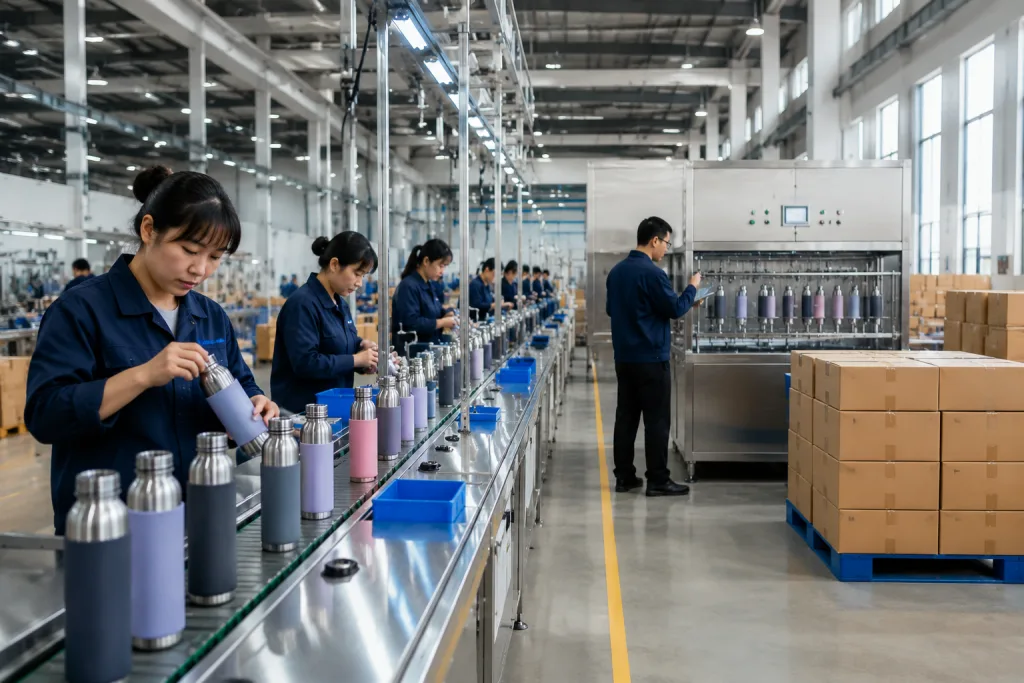
Key Takeaways
- A 500ml custom stainless thermos with a basic silicone ring often lands around USD 2.60-3.30 FOB at 1,000 pcs, while a full silicone sleeve can push it to USD 3.60-5.10.
- Most custom thermos projects have three workable MOQ tiers: 300-500 pcs for stock bodies, 1,000 pcs for light customization, and 3,000 pcs for new mold or PMS color work.
- A realistic China lead time is 5-10 days for samples and 25-35 days for mass production, with peak season orders stretching to 40-50 days.
- For Europe and North America, ask for LFGB, REACH, FDA food-contact files, ISO 9001, BSCI, and AQL 2.5 inspection records before you pay.
If you are buying from a silicone thermos flask supplier, the real question is not whether the render looks sharp. It is what the first 1,000 units cost, how much silicone adds per piece, and whether a China factory can ship in 30 days without cutting corners. For outdoor retailers and promo brands, those three numbers decide margin. We run the line this way every week, and a 2 mm sleeve change can move the quote faster than the buyer expects.
In Zhejiang and across China, the best thermos factory is usually the one that can break down the cost line by line: steel grade, lid tooling, logo method, and carton spec. If a supplier thermos quote feels vague, it usually hides extra cost later. That is the wrong question to ask the factory. You want a factory thermos partner who can speak in FOB terms, show real MOQ tiers, and give you a lead-time range that still holds after QC pulls the sample and packing checks start.
What Drives the First Unit Cost
The first unit cost is a stack of small costs, not one big one. For a 500ml double-wall 304 stainless custom thermos, the body is only part of the bill. You pay for the lid structure, vacuum forming yield, silicone parts, decoration, carton spec, and the 2-3 hours we lose when the line changes tooling. Small costs bite. Last month QC pulled 80 pcs after the vacuum tester showed weak hold on one cavity, and that loss still sits inside the quote. That is why two quotes for the same-looking promotional thermos can be USD 1.20 apart.
At 1,000 pcs, a fair FOB China range for a basic insulated bottle with a silicone base ring is usually USD 2.60-3.30. Add a full silicone sleeve, and you are more likely at USD 3.60-5.10. If you move from 304 to 316 inner steel, expect a 10-20 percent increase. A powder-coated exterior can add USD 0.20-0.45, while a custom lid with a better seal may add USD 0.35-0.90. These numbers come from material weight in grams, mold complexity, and assembly time on the bench; the math does not work if someone quotes below resin and steel cost.
- Steel grade: 304 is standard; 316 costs more and usually makes sense only for salty drinks, outdoor use, or buyers who specify it on the PO.
- Silicone parts: A simple ring is cheap; a full thermos customizable sleeve uses more silicone, needs tighter trimming, and often adds 6-8 seconds per unit on the line.
- Decoration: One-color print is the cheapest custom thermos option; gradient logos or wraparound artwork raise scrap risk because the jig must hold the bottle within about 1 mm.
- Packaging: A plain mailer carton and a printed gift box can differ by USD 0.30-0.90 per unit, especially when the buyer asks for 350gsm paper instead of the usual 300gsm.
At 5,000 pcs, shared tooling can cut cost by 12-18 percent, but only if your artwork, lid, and carton stay locked. If you change those details after sample approval, the factory will charge again. That is normal. We have seen this go sideways when a buyer approved a black lid sample, then the PO typed “matte white lid” two days before mass production. What is not normal is a thermos manufacturer hiding those charges until the PI is already signed.
MOQ Tiers That Make Sense
MOQ is where buyers overpay because they ask for the wrong customization level too early. We see this every month. A Zhejiang thermos factory running 500,000 units/month can quote lower MOQ on stock bodies because the vacuum shell line, leak tester, and powder coating racks are already set up. That does not mean every design should start at 300 pcs. Match the MOQ to the actual change: logo, color, lid, silicone part, carton, or mold.
- 300-500 pcs: Best for stock body with one-color logo and standard carton. This is the realistic entry point for a distributor thermos test run or a small promotional thermos campaign. QC pulled one sample last week where the buyer wanted laser logo, gift box, and three lid colors at 300 pcs; the math did not work.
- 1,000 pcs: Best for custom logo with mixed lid options, silicone base ring, or color-sorted packaging. This is the sweet spot for most outdoor retailers because the line can run a clean batch without stopping every 40 minutes for color change.
- 3,000 pcs: Best for custom mold work, PMS body color, embossed silicone, or a full thermos customized retail program. At this level, the mold fee, silicone tooling, and 2-3 rounds of pre-production samples start to make sense.
If you are a thermos distributor, do the SKU math before asking for a quote. Two colors and two lid styles already make four SKUs, so the real MOQ becomes four times the base order unless the factory agrees to mix lots. We had one PO last season with “black lid” typed in the item line and “silver lid” in the packing note; the buyer flagged it after carton artwork was finished. For thermos bulk programs, the cheapest route is often one body, one lid, one print position, and one carton spec. Sounds boring. Boring makes margin.
China pricing rewards clarity. Standardize before sampling, and you cut the risk of paying for variation that never ships.
In practice, a supplier thermos quote should state whether MOQ is per color, per logo, or per carton. If it does not, ask again. A serious manufacturer thermos team will answer directly, usually with a line like “MOQ 1,000 pcs per powder color, logo can mix by 500 pcs.”
Lead Time, From Sample to Carton
Lead time is not one number. We run it as a chain: tooling check, sample, logo proof, silicone color card, approval, bulk line, QC, cartons. For a standard custom stainless thermos order, sample production is usually 5-10 days when the body mold is ready and the job only needs laser logo, screen print, or a silicone color match against a Pantone chip. If you need a new lid insert or a special sleeve texture, budget 10-15 days for sampling, because the CNC insert and first-shot silicone parts need checking for flash, shrinkage, and fit within about 0.3 mm.
- Sample stage: 5-10 days for existing tooling, 10-15 days for light customization after logo file and silicone color are confirmed.
- Mass production: 25-35 days after sample approval and deposit, assuming the PO, artwork, and carton marks do not change mid-line.
- Peak season: 40-50 days is normal when factories in China are full, especially before Canton Fair and Q4 shipment cutoffs.
- Shipment prep: 3-7 days for inspection, carton labeling, booking, and fixing small findings like a wrong item code on the shipping mark.
If a thermos factory promises 15-day mass production for a fully customized thermos with custom lid, custom silicone, and printed retail box, ask what they do when the vacuum leak test fails or the color batch drifts. This is where the math does not work. QC pulled samples last month where 7 out of 200 lids had a loose silicone plug after the 95°C hot water test, and the buyer flagged the sleeve color as one shade too blue under a D65 light box. Real factories build a buffer into the schedule because rework is part of the business. That is common in Zhejiang, where export orders stack up before trade show season and before Q4 retail launches.
For North America and Europe, do not ignore freight time. Sea freight from China to the US West Coast is often 18-25 days port-to-port. To Northern Europe, it is more like 28-35 days. If you need a shelf date, work backward from the retail arrival date, not from the factory finish date. We ship cartons only after AQL 2.5 inspection, barcode scan checks, and pallet measurements are done; one missing PO digit on a carton label can cost 2 days vs 0 days if the file is locked before production. That is the difference between a supplier thermos quote and a usable plan.
Silicone Details That Change Pricing
A silicone thermos flask supplier should tell you if the silicone is a sleeve, a base bumper, a lid gasket, or a full overmold. Those are four different parts, and the price moves with the part. On our line, a 45 mm base bumper and a 210 mm grip sleeve do not use the same tool time or the same scrap rate. A simple food-grade silicone ring may add only USD 0.08-0.18. A full silicone grip sleeve can add USD 0.25-0.80, and a shaped bumper with texture and Pantone color matching can go higher. We once saw a buyer write "silicone cap" on the PO when they meant a base bumper. The line stopped for a day.
For most bulk thermos orders, the practical specs are 1.5-2.0 mm wall thickness for a sleeve, Shore A 50-60 for a softer grip, and 60-70 for a firmer bumper. Silicone should handle at least -20 C to 200 C for normal drinkware use. QC pulled the sample and checked the durometer at Shore A 58 before release. If you sell into Europe, ask for LFGB and REACH. If you sell into the US, ask for FDA food-contact documentation and a migration report. If the factory says it can provide these but cannot show the test lab name or report number, the math does not work. Keep looking.
- Color matching: Matching Pantone on silicone can add time and cost because the rejection rate is higher than on steel, especially when the first shot off the mold misses by one shade.
- Texture: Matte, ribbed, or embossed surfaces improve grip, but they raise tooling and inspection effort, and the checker on the line will catch a bad grain pattern fast.
- Bonding: Separate sleeves are cheaper than overmolded parts, while overmolded parts look more integrated and usually need tighter process control.
This is where a custom thermos and a thermos customizable program stop being the same thing. A customizable thermos with removable parts is easier to source. A thermos customized with integrated silicone and a special lid needs more engineering, and we've seen that go sideways when the buyer wants "just a small change." If the buyer only wants logo placement, this is the wrong question to ask. If the buyer is an outdoor retailer that cares about grip, durability, and color identity, the extra cost is often worth it.
Logo, Packaging, and Margin
Decoration is where a promotional thermos looks finished or looks rushed. If your margin depends on retail presentation, logo method is not a side note. We run one-color silkscreen for the tightest budgets, usually USD 0.12-0.25 per piece at 1,000 pcs. Laser engraving is cleaner on stainless steel and usually lands at USD 0.18-0.40. UV print, wrapped graphics, and multi-color art all push up the cost and the scrap rate. QC pulled the sample on a 280mm bottle last week because the artwork sat 2 mm off center; the buyer flagged it immediately.
Packaging works the same way. A plain brown box is cheap. A printed gift box, inner tray, barcode label, and shrink wrap can add USD 0.30-0.90 per unit. For distributor thermos orders, that packaging cost can matter more than the logo cost because retail buyers judge shelf impact first. If you ship into Amazon, ask the thermos supplier to handle FNSKU labeling, carton marks, and case-pack counts at the factory. We did one run where the PO had a typo on the carton count, and the warehouse would have reworked 3,200 units; fixing it on the line saved 2-4 days and a truckload of headache.
- Silkscreen: Best for bold branding and lower cost.
- Laser engraving: Best for stainless surfaces and a longer-lasting mark.
- Gift packaging: Best when the bottle is sold as a promotional thermos or retail bundle.
If you need to choose between better decoration and better carton engineering, choose the carton if the product will ship far. A dented bottle is still a return, even if the logo is perfect. That is the wrong question to ask if the shipment is going 12 days by sea versus 18 days with extra handling. We've seen this go sideways after the first export season, usually because the outer carton was fine on paper and weak at the corner drop test.
Picking a Factory That Delivers
Pick a factory, not a trading desk with borrowed workshop photos. A real thermos factory in Zhejiang or another China production base should send weld close-ups, vacuum furnace or vacuum line records, BSCI or ISO 9001 files, and a recent AQL report with defect photos. Ask the monthly output. If they say 500,000 units/month, split it: 320,000 vacuum bottles, 120,000 tumblers, 60,000 promo gift sets, for example. Big capacity means little if your silicone sleeve bottle needs a tight 0.3 mm fit and their line mostly runs straight tumblers. We have seen this go sideways when the PO said “500ml flask” but the buyer expected a carry-loop lid and retail color box.
- Quality control: Ask for leak testing, insulation retention, and carton drop-test results, with photos of the pressure tester, water bath, and dropped corner.
- Inspection standard: AQL 2.5 major and 4.0 minor is a common export baseline, but confirm what counts as major before the line starts.
- Testing: For a 500ml bottle, ask for a hot-hold target of at least 12 hours above 60 C and a cold-hold target of 24 hours below 8 C, if that is what the factory claims.
- Paperwork: Verify REACH, LFGB, FDA, and any market-specific declarations before production; do not wait until QC pulled the sample from packed cartons.
China is not the risk. Vague specs are.
Send a brief we can quote from: capacity, 304 stainless or other steel grade, silicone yes or no, logo method, lid style, target FOB, target ship date, and destination market. Short is fine. Clear is better. If you are buying a thermos bulk order for outdoor retailers, say the carton needs to survive warehouse handling, not just look good in a showroom. If you are sourcing a thermos distributor program with retail packaging, tell us the barcode position, color box thickness, and whether the buyer already flagged scuffed matte coating on past orders. The wrong question is “can you make it?” Most factories will say yes. The better question is whether the thermos supplier runs this exact structure every month and can ship your order without turning it into a 12-day sample delay and an 18-day production headache.
Get A Clear Quote For Your Thermos
Send your capacity, logo method, silicone style, and target ship date. We will map the cost drivers and give you a realistic China lead time.
Frequently asked questions
What is the normal MOQ for a custom stainless thermos with silicone parts?
For a basic stock body with one-color print, 300-500 pcs is realistic. If you add a custom silicone sleeve, a different lid, or a retail box, 1,000 pcs is the more practical MOQ. Once you ask for a new mold, PMS body color, or embossed silicone, 3,000 pcs is more common. A good China supplier should state whether MOQ is per color, per logo, or per carton. If they cannot break it down, you are not getting a clean quote.
How much does a silicone sleeve add to the FOB price?
A simple silicone ring or bumper often adds USD 0.08-0.18 per unit. A full sleeve with grip texture usually adds USD 0.25-0.80, depending on wall thickness, Shore A hardness, and color matching. If you need molded branding on the silicone, add tooling cost and extra inspection time. On a 1,000 pc order, that difference can move a bottle from a promotional thermos price point into a retail-ready custom thermos margin band.
How long does sampling and production take in China?
If the factory already has the body tooling, samples usually take 5-10 days. Light customization with silicone color matching or a different lid can take 10-15 days. Mass production is commonly 25-35 days after sample approval and deposit. In peak season, 40-50 days is normal. Then add freight: around 18-25 days to the US West Coast and 28-35 days to Northern Europe by sea. A serious thermos factory should give you these ranges before you pay.
Which certificates should I request from a thermos manufacturer?
For Europe, ask for LFGB and REACH for the silicone and food-contact parts. For North America, ask for FDA food-contact declarations and any migration testing the lab can verify. For the factory itself, ISO 9001 and BSCI are useful baseline documents. If the supplier says they are compliant, ask for report numbers, test lab names, and the product model tied to the report. Good paperwork matters more than a polished sales sheet, especially when you buy thermos bulk for retail channels.
Can I mix retail and promotional thermos orders in one run?
Yes, but only if the core body is the same. You can often mix logo styles, packaging, and carton labels while keeping one vacuum shell and one lid family. That is the cleanest way to serve both a distributor thermos program and a promotional thermos campaign. Once you split by color, lid, and sleeve style, MOQ multiplies fast. A practical compromise is one body, two print versions, and two box versions. That keeps cost controlled and avoids a messy production schedule.