Key Takeaways
- A 500 ml custom stainless thermos with silicone sleeve often lands at $5.80-$8.50 FOB at 500 pcs, then drops to $4.30-$6.10 at 3,000 pcs.
- Sample work usually takes 5-10 days, while bulk thermos production with custom packaging needs 25-35 days after approval.
- For EU and North America, ask for REACH, LFGB, FDA, ISO 9001, and AQL 2.5/1.5/4.0 before you place a PO.
- A Zhejiang, China factory with 300,000 units per month can still miss your ship date if artwork, Pantone, or lid details change late.
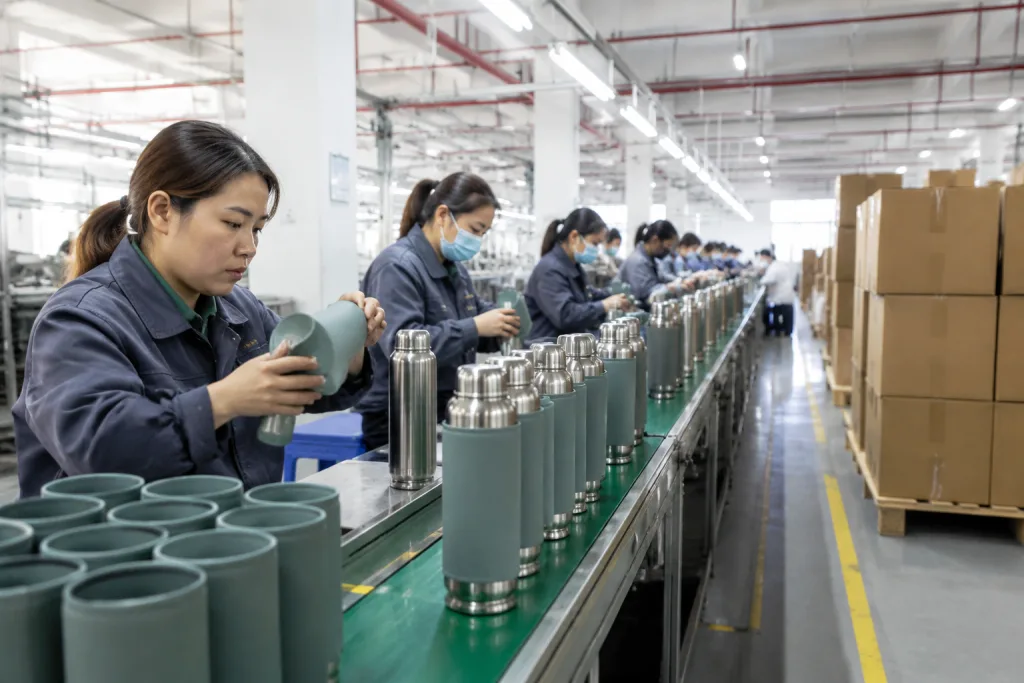
If you are sourcing a custom stainless thermos from a silicone thermos factory, the first surprise is usually not the sample. It is the gap in price and lead time. One quote looks cheap until you add a silicone sleeve, a better lid, carton inserts, and the test reports your market actually asks for. On our line in Zhejiang, we have seen two bottles with the same shape leave with different costs because one uses a 1.5 mm sleeve and a standard cap, while the other gets a thicker wall, a leak-tested lid, and full packing. QC pulled the sample, and the numbers told the story.
For outdoor retailers and promotional brands, the job is to balance cost, lead time, and brand value without filling the warehouse with dead stock. A solid thermos partner should tell you why one custom thermos lands at $5.80 FOB and another reaches $8.50, then show what changes the schedule from 25 days to 40 days. The buyer flagged a PO typo on carton count last month, and that is the wrong question to ignore. On a 3,000 pcs MOQ, a 2 mm change in the sleeve or a printed gift box can move the math fast. That is the level you should expect from a serious silicone thermos factory in China.
What really changes the quote
Most buyers ask for a thermos custom quote, then line up the unit prices in Excel. Wrong question. We price a bottle as parts and shop-floor steps: 304 stainless body with wall thickness, vacuum draw result, lid mold status, silicone sleeve weight in grams, logo process, carton burst strength, then AQL 2.5 final inspection. If one line changes, the quote moves. For a 500 ml custom stainless thermos, a basic 304 body with a simple screw lid and one-color print may sit around $4.80-$6.50 FOB at 500 pcs. Add a molded silicone bumper, upgraded lid, and retail box, and the same customized thermos can jump by $1.00-$2.00 per piece. Last month QC pulled the sample after the sleeve lip measured 1.2 mm off on the caliper, and the buyer flagged the price increase only after seeing the revised packing photo.
Here is the part buyers miss: material grade matters, but process control eats money too. A 0.4 mm 304 stainless shell is standard for many factory thermos programs. Move to 316 on the inner wall and you usually add $0.60-$1.20 per unit. A matte powder coat can add $0.30-$0.70. Silicone colors matched to Pantone often carry a small setup fee plus a color premium, especially when we run 3 color trials before the merchandiser signs the swatch card. This is where the math goes sideways. A bulk thermos order for a distributor thermos program can look cheap on the first sheet, then rise once you lock the last 10 percent of details.
- 304 stainless: baseline for most promotional thermos orders, with stable forming cost
- 316 stainless: higher corrosion resistance, higher cost on the inner wall
- Silicone sleeve: better grip and drop protection, but the mold, sleeve weight, and color matching all push the price
- Retail packaging: the easiest place to overspend when the buyer changes from white box to printed gift box
If you want the quote to hold, give the supplier thermos team a full spec sheet from day one. Simple as that. Missing details turn a factory thermos purchase into 4 rounds of revisions, and we have seen one PO typo, “matte black lid” instead of “matte black body,” delay approval by 12 days vs 18 days on the final ship plan.
MOQ tiers buyers should expect
MOQ is not a random number. It is how a thermos manufacturer protects setup time, material loss, and line rhythm. For a standard promotional thermos using existing tooling, 500 pcs per color is a normal starting point. We run this for brands testing one market, outdoor retailers buying a small seasonal SKU, or thermos distributors placing a quick reorder. On the floor, one color change means cleaning the spray gun, checking the Pantone card under a D65 light box, and pulling 3 first-piece samples before mass production. If you add logo printing on two positions, a custom lid, or a special silicone sleeve color, the workable MOQ often moves to 1,000 pcs. The buyer often asks, “Can we do 300 pcs?” For a real factory order, the math doesn’t work.
For more customized thermos programs, the thresholds are not hard to predict. A new silicone sleeve mold, embossed branding, or a special carry loop often starts at 3,000-5,000 pcs because the factory has to cover tooling, trial material, and rejected first shots. We have seen QC pull a sleeve sample with a 0.4 mm flash on the logo edge, then the mold room needed another half day to polish it. At a capable Zhejiang supplier thermos plant, the line may run 300,000 units per month, but your MOQ still depends on component complexity, not just capacity. Big capacity helps lead time. It does not make a new mold cheap.
Useful rule of thumb
- 500 pcs: stock body, one simple print position, standard lid from the current parts bin
- 1,000 pcs: custom powder color, color box packaging, or 2 lid options packed under one PO
- 3,000 pcs: private-label retail run with tighter color control, usually checked against a sealed PP sample
- 5,000 pcs and up: new tooling, exclusive lid shape, embossed silicone sleeve, or special strap hardware
If you are a thermos distributor or a promotional brand buying thermos bulk, ask for a price ladder at 500, 1,000, and 3,000 pcs. This shows where the real savings start. Last month a buyer flagged a PO typo: they wrote 800 pcs in the quantity line but asked for the 5,000 pcs price in the remarks. We corrected it before PI issue, because the cheaper tier only matters if you can actually sell and ship that volume. If your first sell-in is 800 pcs, chasing the 5,000 pcs quote is the wrong question to ask.
Lead times from sample to ship
Lead time is where thermos suppliers get themselves in trouble. We see it every month. A stock sample on an existing body can move in 5-7 days if the blank cup is already on the sample shelf and the laser room has capacity. A sample with logo engraving, Pantone silicone matching, or a printed packaging insert needs 7-10 days because QC has to check logo position with a vernier caliper and compare the sleeve color under the D65 light box. If you need new tooling for a lid or sleeve, expect 12-18 days before you approve the sample. That is normal for a silicone thermos factory in China, since stainless body production and silicone molding do not run on the same line.
For production, a simple bulk thermos order usually takes 20-25 days after sample approval and deposit. Add a custom sleeve or special carton, and 25-35 days is the honest planning window. If the order includes a new mold, gradient painting, or multiple SKUs, 35-50 days is safer. In Zhejiang, China, even a factory with good line balance still needs time for vacuum forming, polishing, coating, assembly, leak testing, and final pack-out. The buyer often asks us to cut 7 days here. The math does not work. QC pulled a sample last season with a 0.4 mm lid gap after the line rushed assembly, and the whole batch had to be rechecked.
Best practice: freeze artwork, Pantone, lid type, and packaging before you approve the golden sample. Every late change costs time.
Add freight time. Air freight can deliver in 3-7 days, but most distributor thermos orders ship by sea because air cost can eat the margin on a 3,000 pcs PO. To Europe or North America, ocean transit is usually 25-40 days depending on port and season. We once had a buyer flag a PO date typo, 18 June written as 18 July, after cartons were already booked with the forwarder. If your shelf date matters, build the calendar from PO release to warehouse arrival, not just production days.
Silicone details that affect cost
People often use silicone thermos factory as a catch-all term, but the silicone part can mean very different things on the line. One order only needs a silicone base ring or bumper. Another asks for a full sleeve around the body, a soft carry loop, or a food-grade gasket that seals tighter. That changes the unit price and the way we run the mold room. A simple bumper may add $0.35-$0.60. A full sleeve with color matching can add $0.70-$1.50, depending on size and finish.
For outdoor retail, silicone gives better grip, cuts the clanging on concrete, and makes the bottle feel tougher in hand. For promo thermos programs, it also gives you one more print area. The trade-off is cost and process control. A sleeve with a tight tolerance needs cleaner molding and closer QC than a plain stainless shell. If the fit is loose by even 1 mm, the custom thermos looks off even when the print is sharp. We ask for drawings and sample photos before we quote, because a clean render does not tell us what the line will ship.
Common spec choices you should nail down early:
- Silicone hardness: 50A-70A works for sleeves and bumpers
- Wall thickness: keep it even, or the sleeve twists after molding
- Finish: matte hides scuffs better than high gloss
- Color matching: confirm Pantone code, not a vague name
If you are buying thermos customizable products for a retail launch, ask whether the silicone part is food-grade and whether it is bonded or removable. The answer changes cleaning, recycling, and the final cost of the thermos customized design. If the PO says only "silicone cover," the math does not work. We have seen that go sideways on a 5,000-piece run, then the buyer flagged it after QC pulled the sample and found the gasket was not the version they wanted.
Compliance for EU and North America
For outdoor retailers and brand owners, compliance is the line between a clean reorder and a blocked shipment. We run REACH checks for the EU, LFGB for food-contact silicone, FDA requirements for the US market, plus ISO 9001 and BSCI paperwork before the line starts. If the bottle is sold as a drinking vessel, ask for migration testing on the drinking contact parts. A general material statement is not enough. QC pulled one sample from the 18 mm gasket tray last week and the buyer flagged the missing migration page right away.
For a custom stainless thermos order, ask for AQL 2.5 for major defects, 4.0 for minor defects, and zero tolerance on leakage or sharp edges. Our line runs 24-hour leak tests, thermal retention checks, and drop tests at 1.2 meters before we close the cartons. The math does not work if you skip that step and hope freight will be kind. On a 500-carton run, one dented rim can still turn into a claim.
Some buyers look only at the bottle and miss the label and carton copy. For a thermos bulk shipment, that is where we see avoidable holds. Retail-ready packaging, barcode placement, and warning text need to be locked before production starts. If you need FNSKU labels, carton marks, or a shelf-ready display pack, tell us before the first print run. The wrong question is whether we can fix it after shipment; we have seen a typo on a PO become 10,000 relabels at the packing table scanner.
A serious silicone thermos factory in China should be able to show test reports, inspection photos, and sample approval records from the same batch. If the supplier cannot pull those files, treat the low price as a warning, not a deal. We ship from Hangzhou, and when QC cannot match the report to the 304 stainless lot number and the molded silicone insert, we stop the order.
Quote the order like a buyer
The fastest clean quote comes from thinking like the buyer who must compare 3 factory offers on one sheet. Send a short brief with capacity in ml, body size in mm, material such as 304 stainless, lid style, logo method, silicone sleeve color by Pantone code, carton size limit, target market, and delivery date. Miss one item and the price gets padded. We see it often: the PO says “500ml black,” but the artwork shows a silicone grip and the buyer flags the missing sleeve after our caliper check on the pre-production sample. A custom thermos for a distributor thermos program in Europe will not price the same as a thermos promotional gift for a North American trade show.
Ask the quotation to show separate lines for unit price, tooling if any, sample fee, packaging cost, test cost, and freight terms. FOB Ningbo or FOB Shanghai is common for China exports. If you need DDP, duties, brokerage, and last-mile delivery must be written line by line, not buried in one “all-in” number. We had one buyer push back on $0.42 per unit after their forwarder found the quote excluded residential last-mile delivery. A good supplier thermos partner should point out hidden cost before you issue the PO. A second logo color may add $0.08-$0.15. A laser logo is often cheaper to set up than multi-color silk screen, but the finish can look too flat on brushed steel if your brand wants a retail-shelf look.
For custom thermos projects, the biggest cost control lever is spec discipline. The next one is batching. One color, one lid, one carton, one ship date. Simple wins. Every extra variant slows the line because workers change silicone sleeves, swap logo screens, and re-check carton labels against the packing list. We have seen 6 colorways turn a 12-day packing plan into 18 days after QC pulled samples for mixed shade tolerance. If you need a manufacturer thermos that can handle repeat orders, ask how many units they ship per month, what their in-house QC checks at AQL 2.5, and who signs off change control after artwork approval. The headline price is the wrong question to ask if the factory cannot hold the same spec on the second order.
Get a factory quote that matches your timeline
Send your size, logo, sleeve color, and target market, and we will turn it into a clean MOQ and lead-time quote from Zhejiang, China.
Frequently asked questions
What MOQ should I expect for a custom stainless thermos?
For a standard silicone thermos factory setup, 500 pcs per SKU is a normal entry point if the body and lid tooling already exist. If you want a custom sleeve color, special carton, or extra logo position, 1,000 pcs is more realistic. New tooling usually pushes MOQ to 3,000-5,000 pcs because the factory has to recover mold and trial costs. For distributor thermos programs, ask for a price ladder at 500, 1,000, and 3,000 pcs so you can see where the real break happens.
How long does a custom thermos order take?
A simple sample can be ready in 5-7 days, and a fully matched sample with custom silicone and packaging usually needs 7-10 days. After sample approval, production for a bulk thermos order is often 20-25 days for simple specs and 25-35 days for custom thermos projects with silicone sleeves, retail boxes, or extra tests. New tooling or multiple colors can extend the schedule to 35-50 days. If you ship by sea to Europe or North America, add 25-40 days of transit time.
Is silicone more expensive than a plain powder coat?
Usually, yes. A matte powder coat on a factory thermos might add about $0.30-$0.70 per unit, while a molded silicone bumper or sleeve can add $0.35-$1.50 depending on size, hardness, and color matching. The price gap grows when you need Pantone matching or a custom mold. Silicone gives better grip and impact protection, which is why outdoor brands often choose it. For promo buyers, it also gives the thermos more perceived value without jumping to a much heavier design.
What compliance documents should I ask for?
For EU orders, ask for REACH and LFGB, especially on any food-contact silicone. For US orders, ask whether the materials are suitable for FDA food-contact expectations. Also request ISO 9001 or BSCI if you need a documented factory system, plus thermal and leak test records. For QC, a common benchmark is AQL 2.5 major, 4.0 minor, with zero tolerance for leakage or sharp edges. If your buyer is retail or e-commerce, carton and label compliance matter as much as the bottle itself.
Can I mix colors or logos in one bulk order?
Yes, but each extra variant usually adds time and sometimes cost. A thermos supplier may allow two colors under one PO if the body, lid, and packaging stay the same. Once you change silicone color, logo method, or carton artwork, the line needs more setup and the risk of mispacking increases. For a thermos bulk order, the cleanest approach is one product spec, one ship date, and one packaging standard. If you need multiple SKUs, ask for separate pricing by variant so the true landed cost is clear.