Key Takeaways
- Use 18/8 304 stainless steel and 0.35-0.45 mm wall thickness as the practical baseline for repeatable thermal performance.
- Specify food-contact silicone at Shore A 50-60 with 1.5-2.0 mm thickness and a 24-hour odor check at 60 C.
- Ask for a 2-hour upside-down leak test, a 1-meter drop test, and AQL 2.5 major / 4.0 minor inspection.
- A realistic commercial plan is 500-1,000 pcs MOQ, 35-45 days lead time, and FOB pricing around USD 3.20-6.80.
If you buy silicone thermal bottle wholesale, the hard part is not picking a photo. It is turning one good sample into a spec the line can repeat on day 500, not just day 5. We have seen the same bottle pass on the showroom table, then slip when the silicone sleeve shrinks 1.5 mm, the lid leaks under a 45-degree shake test, or the logo print starts to blur after a few washes. That is where bulk drinkware orders lose margin.
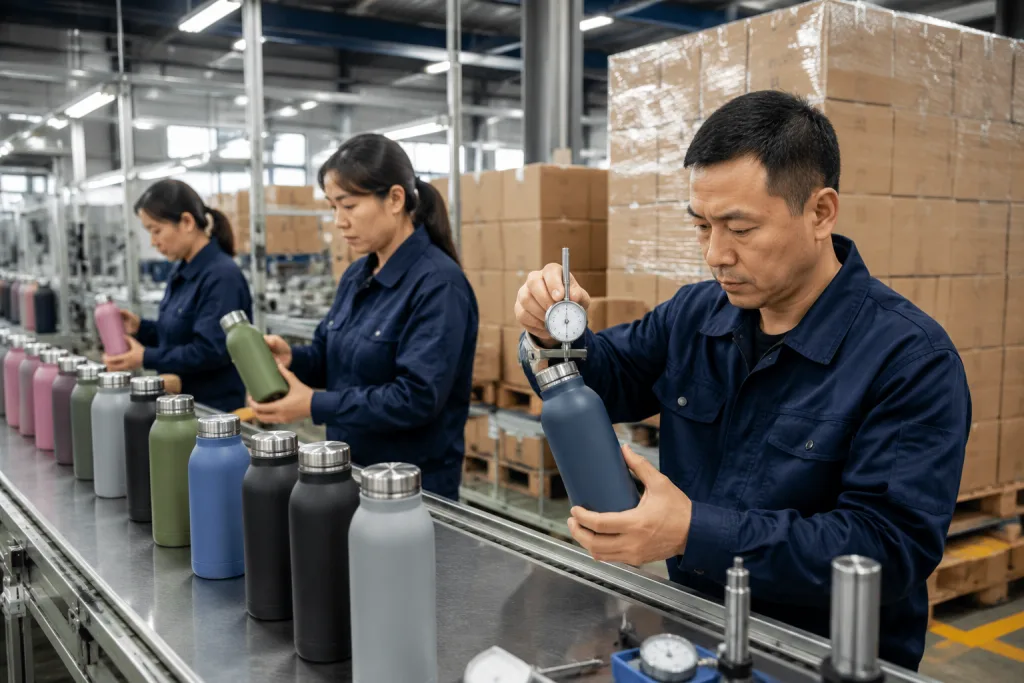
A solid factory in Zhejiang, or anywhere in China, should give you line-item control: steel grade, wall thickness, silicone hardness, retention data, carton count, and the exact test method. QC pulled a sample on the line with a durometer and a torque wrench last week, and that is the level buyers should ask for. A plant running 30,000 units/month can still miss your launch if the PO says "same as sample" and nothing else. If you want the best wholesale drink bottle for retail, Amazon FBA, or a distributor program, this is the wrong question to ask: "Can you make it?" The math has to work on paper first.
Start With the Inner Bottle
Read the spec sheet from the inside out. The inner bottle decides two costs: whether the drink tastes clean after 3 hours, and how many vacuum failures you eat after shipment. For silicone thermal bottle wholesale, we usually run 18/8 304 stainless steel inside, 304 or 201 outside only when the buyer gives a hard FOB target, and wall thickness around 0.35-0.45 mm. QC checks this with a digital thickness gauge at the mouth, shoulder, and base; a 0.08 mm swing is enough for the buyer to feel it in hand. If your market is premium or odor complaints are a risk, stay with 304 inside and outside. 316 makes sense only for saltwater, sports, or chemical-corrosion briefs. It costs more. It will not save a weak weld or a dirty polishing line.
Next, check the vacuum line and the finish. A double-wall vacuum bottle should be tested for 6-12 hours hot and 18-24 hours cold depending on capacity, ambient temperature, and fill ratio. Do not accept a carton printout that says “keeps cold all day” without the test method. Ask whether the factory tests with water at 95 C, a 23 C room, and a capped lid; on our line, QC pulled 12 pcs from a 3,000 pcs pilot run last month and logged every bottle with a probe thermometer. This same discipline applies to wholesale drinkware, bulk canteen orders, or a bulk growler line. If the sample calls itself the best wholesale drink bottle, make the factory show the temperature curve. Otherwise, the math does not work.
- Capacity: 350 ml, 500 ml, 750 ml, and 1 L are the export retail sizes we ship most often; 500 ml usually fits standard cup holders, while 1 L needs a stronger silicone boot to avoid wobble.
- Wall control: keep steel thickness consistent across the batch; we have seen buyers flag bottles that felt heavy in one carton and thin in the next, even though both passed AQL 2.5 visual inspection.
- Surface: matte powder coat hides fingerprints better than glossy paint and sells better in Europe and North America; ask for a 3M tape test and a 48-hour water soak before approving bulk color.
Silicone Sleeve and Grip Specs
The silicone is not decoration. It decides whether a wet hand slips, whether a dropped bottle gets a dent, and whether 12 bottles chatter in a carton during truck transfer. Ask for food-contact silicone with a Shore A hardness of 50-60, a wall thickness of 1.5-2.0 mm, and a documented low-odor compound. We check the first trial sleeve with a Shore durometer and a 0.01 mm digital caliper; if the sleeve is too soft, it twists during washing. Too hard, and it feels like cheap plastic while hiding a poor body fit. A slip-on sleeve costs less. An overmolded sleeve holds better, but tooling cost goes up and color changes slow the line.
Color is where about 1 in 6 sleeve orders drift. Pantone matching works, but the supplier should define delta E tolerance and keep the masterbatch lot number on file. If you are buying bulk drinkware across a family program, lock the silicone color against the lid and print color before production starts; we have seen a PO say “warm grey” while the approved sleeve chip was Cool Gray 7C. QC pulled the sample. The buyer flagged it before packing, which saved a 3,000 pcs rework. The same rule applies to canteen wholesale and wholesale canteen projects, where buyers often assume the sleeve and body are interchangeable. They are not. For retail packs, insist on a 24-hour odor check at 60 C and a dishwasher cycle test if your end customer expects repeated cleaning.
- Fit: the sleeve should not rotate under hand pressure or leave a visible seam gap over 0.5 mm.
- Finish: smooth touch feels premium; micro-texture hides fingerprints and carton scuffs better.
- Replacement: if you want spare sleeves as a service part, decide before tooling starts, or the math does not work.
Lid, Seal, and Leak Control
The lid decides the return rate. A thermal bottle can have a clean powder coat and a thick silicone sleeve, but one wet backpack photo from an Amazon customer can wipe out the margin on 48 cartons. Start with the closure type: screw cap for lower claim risk, flip lid for sports use, push-button lid only if the spring and lock are tested, or straw lid when the buyer accepts more parts to inspect. Then check gasket material, thread pitch, and opening torque with a torque meter, not by feel. Food-grade silicone gaskets should sit flat with no pinching, and the lid should survive at least 10,000 open-close cycles on the test rig if you sell into retail or Amazon FBA. QC pulled one sample last month where the gasket was 0.4 mm proud at the corner. It leaked in 6 minutes.
For a buyer spec we can run, ask for an upside-down leak test for 2 hours at room temperature, then repeat after a 1-meter drop onto the lid edge and base. If the bottle will sit in hot cars, the seal must not soften or smell when filled with 95 C water; the wrong silicone grade gives off a sour rubber note that buyers flag fast. Adjacent products teach the same lesson. Wholesale growler and beer growler wholesale bulk orders need pressure-aware lids, while alcohol flask wholesale bulk programs need tighter cap fit and cleaner mouth polishing. A silicone thermal bottle is simpler, but not forgiving. “No leak” is the wrong spec if there is no method, time, temperature, and drop angle. The line will make its own standard, and we’ve seen that go sideways.
- Torque: ask for a target range in N·m, for example 0.8 to 1.2 N·m, not a vague hand-tight promise.
- Gasket: one-piece silicone gaskets are easier to control than loose rings; loose rings get twisted during assembly when the operator is running 900 lids per hour.
- Travel use: if the bottle rides in bags, test for drips after vibration and drop handling, then check the carton sample again after 12 hours, not just at the packing table.
Branding That Survives Use
Decoration should follow the surface, not the other way around. Matte powder coat, glossy lacquer, brushed steel, and silicone each need a different method. On our line, laser engraving is the cleanest call for metal, and it keeps its edge after a tape test and repeated washing. Silkscreen works for 1-3 solid colors, but it needs flat space and a stable cure. UV print handles detailed graphics, yet the supplier must confirm adhesion on the exact coating you approve. QC pulled the sample from the line and checked it before packing. If the logo cannot pass a tape test after washing, the spec is too loose.
When you order wholesale drinkware, your print file is part of the technical package. Lock the Pantone code, logo height, decoration area, and orientation to the seam or handle. Ask for a preproduction sample with the final print, not a random proof. We had a buyer flag a 2 mm shift on a PO once; it looked small on screen and turned into a rework. For mixed assortments such as beer tumbler bulk, beer tumbler in bulk, or alcohol flask bulk, branding consistency across shapes is what keeps a program looking tight. A good factory in China will tell you when a logo sits too close to a curve or a weld. That is the right answer. Listen to it.
- Laser: best for long-life marks and clean premium positioning on metal.
- Silkscreen: best when your artwork is simple, repeatable, and set for 1-3 solid colors.
- Proofing: always approve on the actual coating and actual curvature, not a flat board.
Compliance and Test Plan
Do not buy on appearance alone. For Europe and North America, your file should cover food-contact compliance, traceability, and the factory system behind the order. Ask for LFGB or FDA food-contact declarations for the bottle parts, REACH paperwork for silicone and coatings, and if you sell into California, check the Prop 65 exposure logic. ISO 9001 or BSCI does not certify the bottle. It does tell you the Zhejiang or China factory runs corrective action, record control, and audit follow-up. On our line, QC keeps a 3 mm sample ring and the batch label has to match the PO before we release packing.
The test plan should be locked before mass production. We run incoming steel inspection, silicone hardness check with a Shore A meter, leak test, thermal retention test, dishwasher cycle test, and final AQL inspection. For export programs, AQL 2.5 major and 4.0 minor is common, but we tighten it on launch items.
Ask for the test method, not just the pass mark.A claim of 12 hours hot means little unless the factory states fill volume, lid type, ambient temperature, and the acceptance limit. We have seen buyers flag a PO that said 500 ml while the carton art called 480 ml. That mismatch burns time. This is the wrong question to ask if the file has no QC sheet behind it.
- Traceability: keep batch numbers on cartons and production records, and match them to the 24-hour sample sheet.
- Inspection: define acceptable dent depth, print misalignment, and a 2 mm lid gap before production.
- Document set: require COA, MSDS, and carton pack list with every export lot.
MOQ, Lead Time, and Packing Math
Now the commercial part. For silicone thermal bottle wholesale, a realistic MOQ is 500-1,000 pcs per color when we run existing tooling. A new lid mold or a special silicone sleeve shape can push the MOQ higher because the line has to reserve molding time and matched color material. Ask the factory to write the MOQ basis on the PI: per color or per design; if they allow one shipment total, get it in writing. This is where buyers get surprised. We once saw a PO say “matte blue” while the artwork called Pantone 2925C, and QC pulled the sample because the sleeve was 1.8 mm off the approved shade card. That single detail changes cash flow more than the unit price does. A Zhejiang factory that runs 30,000 units/month can still miss your launch if you change carton art after the PP sample.
Lead time is usually 35-45 days after sample approval, plus 3-5 days for export cartons and booking. If the silicone color is custom, plan closer to 45 days, not 35. FOB China pricing often lands around USD 3.20-6.80 per unit depending on capacity, steel grade, decoration method, and whether the box is plain kraft or full retail color. If you are buying canteen bulk, canteen wholesale, wholesale growler, beer tumbler wholesale bulk, or alcohol flask wholesale bulk in the same quarter, align the carton spec and ship window so you do not waste freight on split loads. The math does not work when one SKU ships 12 days ahead of the rest and sits at the forwarder. For North American retail, ask for individual boxes and master carton dimensions; if you sell through Amazon, mark the FNSKU position on the dieline before mass printing. For distributors, pack count and pallet pattern matter more than a fancy insert. We ship cleaner when the carton weight stays under 15 kg and the pallet pattern is fixed before booking.
- Packaging: 24 pcs/carton is common; on a 600 ml bottle, we often see about 58 x 39 x 42 cm and 13-15 kg gross, while retail-ready packs may need smaller cartons and stronger inserts.
- Shipping: FOB Ningbo works well for Zhejiang factories; always confirm the port before quoting your landed cost, because one buyer flagged a PI that said Shanghai while the forwarder booked Ningbo.
- Planning: freeze silicone color, print artwork, and box dieline before the final two weeks before mass production. Late changes go sideways fast.
Send Your Spec Sheet Before You Place the PO
Get a line-by-line review of materials, lid fit, branding, and packing so your next China order lands on time and on spec.
Frequently asked questions
What MOQ should I expect for silicone thermal bottle wholesale?
For a standard bottle using existing tooling, expect 500-1,000 pcs per color and 1,000-2,000 pcs per design if you want cleaner production scheduling. If you change the lid, add a custom silicone sleeve shape, or demand retail boxes with custom insert trays, the MOQ usually rises. Sample lead time is often 7-10 days, and mass production is typically 35-45 days after sample approval. If your launch needs three colors, ask whether the factory treats that as 3 separate MOQs or one combined order. That detail affects cash flow, carton planning, and freight far more than a small unit-price swing.
Is food-contact silicone on a thermal bottle really safe and odor-free?
It can be, but only if you specify it properly. Ask for food-contact silicone with LFGB or REACH documentation, then confirm Shore A hardness around 50-60 and thickness around 1.5-2.0 mm. Cheap silicone often smells after a hot water test, especially when the compound is thin or the curing is weak. A practical check is a 24-hour odor test at 60 C, plus a dishwasher cycle if your market expects repeated washing. If the sleeve passes those checks and the factory keeps batch records, the risk drops sharply. If they cannot show the test method, you are buying a guess, not a part.
What price range is normal for wholesale drinkware like this?
For a standard silicone thermal bottle wholesale program, FOB China pricing often lands around USD 3.20-6.80 per unit. The low end usually means simpler decoration, standard lid parts, and existing tooling. The higher end usually means 304 stainless both inside and outside, better powder coating, custom silicone color, premium box packing, or more complex lids. If you want laser engraving, a custom sleeve shape, or retail inserts, budget more. Freight, duties, and local warehousing are separate. For planning, I would not build a launch around a price below USD 3.00 unless you have already audited the factory and locked the spec.
Which logo method lasts longest on a thermal bottle?
Laser engraving is usually the most durable on metal because it does not depend on ink adhesion. It will not fade the way a weak silkscreen can, and it survives abrasion better than most printed marks. Silkscreen is still useful for 1-3 colors and can look clean if the coating is stable and the curing is correct. UV print helps when you need more detail or color, but it must pass tape and wash tests on the exact bottle finish. For silicone areas, embossing or debossing can work if you are ready to pay for tooling. In practice, the right method depends on your price point and retail position.
Can I combine this order with other drinkware SKUs?
Yes, and that is often the smartest way to buy. If your supplier also makes bulk canteen, wholesale canteen, wholesale growler, beer tumbler bulk, or alcohol flask wholesale bulk items, you can usually combine compliance review, carton planning, and booking to improve freight efficiency. The key is to keep the technical files separate even if the shipment is shared. Do not mix label standards, carton art, or packaging assumptions across SKUs. A mixed order can lower landed cost by 8-12% when the pallet pattern and export schedule are planned well, but only if the factory is disciplined about traceability and pack-out.