Key Takeaways
- A serious China supplier should quote 304 or 316 stainless, food-grade silicone, MOQ 3,000 pcs, and 25-35 day production lead time.
- For Europe, ask for LFGB and REACH; for every lot, request AQL 2.5 major and 4.0 minor inspection.
- A 304 stainless body with a silicone sleeve is the best default; 316 usually adds 8-15% cost and makes sense for acidic drinks.
- Custom color runs usually start at 3,000 pcs, while print-only promo orders can begin at 500-1,000 pcs depending on the factory.
A silicone thermal bottle looks simple until a 3,000-piece PO hits the line and QC pulls the sample: the sleeve walks 2 mm, the lid weeps at the torque tester, or the print starts failing after 20 dishwasher cycles. That is the real test for a silicone thermal bottle supplier. We care about what is actual silicone, what is 304 stainless steel, and what still ships clean after cartons sit 18 days on a humid container route without turning into a claim file.
In Zhejiang and across China, the gap between a real canteen factory and a trading-only canteen vendor shows up fast in sample control, lead time, and test data. A buyer once flagged a PO typo on the cap color code, and that mistake would have cost a full rework on a 1,200-unit run. If you buy custom drinkware for retail, promotion, or distributor programs, this is the wrong question to ask: "Can you make it?" The right one is whether the specs hold on paper and on the line. This guide compares the build choices head to head so you can match the bottle to the channel.
Start With the Build, Not the Logo
Buyers usually open the call with logo size. Wrong first question. The real choice is the build. A silicone thermal bottle supplier should confirm if we run a 304 stainless bottle with a removable silicone sleeve, a steel core fully overmolded in silicone, or a stainless body with only a silicone base ring. These are 3 different SKUs on the line. They pack differently in a 48 pcs carton, show different scuff marks after a 1.2 m drop test, and age differently after 6 months in a gym bag.
Here is the comparison we use when a buyer asks for “the same bottle, just cheaper”:
| Build | Thermal performance | Grip and feel | Best fit | Main risk |
|---|---|---|---|---|
| 304 stainless inner + silicone sleeve | Good, typically 6-12 hours hot and 12-24 hours cold depending on lid and wall thickness | Strong grip, familiar hand feel; QC checks sleeve fit with a 0.2 mm feeler gauge at the seam | Custom drinkware, distributor drinkware, retail programs with front-and-back logo space | Sleeve seam marks and poor fit if the mold is loose or the sleeve shrinks after baking |
| Full silicone overmold on steel core | Good, with a slightly heavier body; a 500 ml sample can add 35-60 g versus sleeve type | Best drop resistance and soft touch, especially for outdoor gift sets | Canteen promotional projects and premium gifting where the buyer accepts a higher MOQ | Higher MOQ and tighter color control; Pantone drift shows fast on large silicone areas |
| Steel body with small silicone base ring | Best thermal efficiency at the lowest cost | Cleaner steel hand feel, but less silicone grip on wet hands | Price-sensitive canteen distributor programs and school bid orders | Limited branding area and weaker retail shelf appeal; buyers flag this after seeing the shelf mockup |
For a custom canteen retail launch, the sleeve version usually gives the best price-to-branding math. For a customizable canteen aimed at outdoor or travel use, approve wall thickness, lid seal, and leak test results before artwork. We have seen this go sideways: the PO said “matte black sleeve,” the approved sample was dark gray, and QC pulled the sample only after 3,000 sleeves were molded. A solid canteen manufacturer will show the cross-section, not hide it. In Zhejiang, better factories also state the silicone hardness, usually around 50-70 Shore A, because that number changes the grip, sleeve stretch, and edge wear.
Match the Bottle to the Channel
Each channel needs its own cost model. A canteen distributor working on a 3,000 pc school tender will not buy like a brand owner planning a 12,000 pc retail launch, and a canteen promotional order should not be built like a premium shelf SKU. We have seen this go sideways: the buyer approved a soft-touch silicone sleeve, then flagged the FOB price because the target was off by USD 0.42 per bottle. Wrong spec, wrong margin.
Use this channel fit view:
| Buyer type | Best build | Order logic | What to avoid |
|---|---|---|---|
| Brand owner | Customized drinkware with printed sleeve, retail box, and color-matched lid; confirm Pantone under D65 light box before mass production | Spend on packaging control and repeat color, especially if the second PO must match the first run | Six body colors on the first run when the MOQ only supports two clean batches |
| Canteen distributor | Custom canteen with one body style and two lid choices | Keep tooling simple and reorder fast; one shared mold keeps lead time closer to 12 days instead of 18 days | Four molds for one launch, then 800 pcs per mold |
| Distributor drinkware buyer | Stock body with custom logo and spot color | Protect margin and speed; we run laser logo or one-color screen print when the line is tight | Over-customizing low-volume SKUs that move only 500 pcs per quarter |
| Promotional agency | Canteen promotional bottle with one-color print | Lower unit cost matters more than luxury finish; QC pulled samples at AQL 2.5 for print rub and lid fit | Full-surface graphics that slow production and create registration complaints |
For a custom growler program, the fit changes again. If the customer wants beer or cold brew, a wide-mouth growler is more practical than a narrow thermal bottle. Simple. If the customer wants a customizable growler for retail, ask whether the lid system can handle pressure and whether the internal coating suits acidic drinks; our test room checks lid torque with a digital torque meter, and the wrong gasket hardness will show up fast. A good canteen supplier will push back when the use case is wrong. This is the right kind of pushback.
Test the Claims Before You Price It
Thermal claims get abused. We see “12 hours hot” printed on cartons almost every month, but the brochure is useless unless the supplier shows how the test was run. Ask for the test temperature, fill volume, lid type, room temperature, and pass criteria. On our line, QC records this with a probe thermometer, a 500 ml water fill, and a sealed lid sample pulled from bulk production. If they cannot give you those details, you are pricing a slogan, not a bottle.
What to ask for:
- Hot-retention test: 95 C fill, 23 C ambient, closed lid, results after 6, 12, and 24 hours.
- Leak test: inverted or pressure test for at least 24 hours, especially for travel and distributor drinkware.
- Drop test: 1 meter, 10 drops, including the lid corner and base.
- Odor and migration checks: LFGB for Europe, REACH declarations for material compliance, and FDA-aligned input materials for U.S. orders.
For export orders from China, ask for AQL 2.5 on major defects and AQL 4.0 on minor defects. That gives both sides an acceptance standard, not a sales promise. For customized drinkware going into retail, I would ask for a dishwasher-cycle check too; we have seen pad print look acceptable at 10 washes and start fading at 20-30 washes, while the bottle body still passes. The cap matters. QC pulled a sample last year where the stainless body held temperature, but the silicone gasket sat 0.4 mm too loose and leaked during the inverted test. Test the full assembly, not just the steel cup or silicone body.
Customization That Sells Off the Shelf
Customizing a silicone thermal bottle is not just putting a logo on it. The gap between canteen customizable and canteen customized is tooling, color control, and pack-out. On our line, we separate a 60 mm pad print from a new cavity, because one buyer once asked for a two-color logo in steel and the math did not work. A solid silicone thermal bottle supplier will tell you which mark is cheap, which one needs mold work, and which one just burns cash.
Most effective customization options are straightforward:
- Silkscreen for one or two colors on the sleeve or body.
- Laser engraving on exposed stainless areas for a clean permanent mark.
- Debossed or embossed mold logo for premium canteen custom orders.
- Pantone color matching for sleeve, lid, or base ring on larger runs.
Typical economics matter. Print-only runs can start at 500-1,000 pcs. A custom color run usually starts around 3,000 pcs. A new mold for a customized canteen or customized growler can move to 5,000 pcs or more, depending on complexity. Sampling usually takes 7-10 days; production often takes 25-35 days after approval. QC pulled one sample for a 0.3 mm color shift last month, and the buyer flagged it before we shipped. If you sell to retail chains, fix the carton first. A better insert card, barcode label, and retail carton can beat an expensive shape change. We have seen that go sideways when a buyer chased a new lid profile and lost four weeks. In Zhejiang, the better factories will show you the margin math, not just the artwork.
What a Real Factory Looks Like
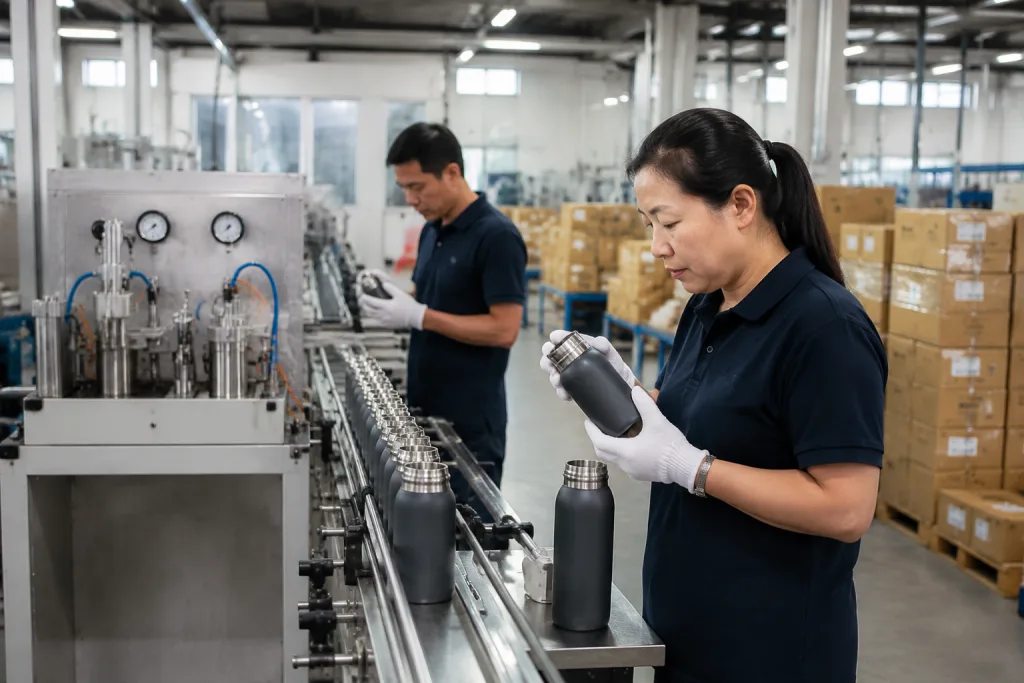
Buyers say canteen factory, but half the time they mean an exporter with a glossy catalog. That is the wrong question to ask. A real canteen maker can show you the forming press, the sleeve jig, the lid torque check, and the carton pack-out without fumbling. If they cannot walk you through that line step by step, they are a trading desk, not a factory. We have seen this go sideways on a 10,000-piece PO when the buyer flagged a lid mismatch after packing.
Here is the direct factory check:
| Check | Direct factory | Trading-only vendor |
|---|---|---|
| Monthly capacity | 300,000 units/month or more | Depends on subcontractors |
| Sample control | Owns mold files and sample approval records | Forwards your request to someone else |
| Quality system | ISO 9001, BSCI, in-house QC, AQL control | Often limited visibility |
| Lead time | 25-35 days for repeat orders in China | Usually slower and less predictable |
In Zhejiang, a capable factory will send video of the vacuum line, sleeve assembly, leak test, and carton drop test before shipment. We run that every week, and QC pulled the sample if the seal gap is off by 0.5 mm. That matters when you are buying from China at scale. If you need distributor canteen programs across Europe and North America, insist on consistent carton counts, clear SKU labels, and spare lids packed separately. One missing lid on a 5,000-piece order is annoying; fifty missing lids turns into a margin hit. Good factories catch that before the goods leave the dock.
When Another Bottle Is the Better Buy
A silicone thermal bottle earns its place on some briefs, but it is the wrong question to ask if the buyer only says, “Can we add a silicone sleeve?” Start with the liquid and the use case. For beer packaging, we steer buyers to a custom growler or customizable growler because a 53 mm wide mouth fills cleaner on the line and pours with less splash than a narrow vacuum bottle. Pressure matters too; we have seen beer samples swell a soft gasket after 48 hours in a warm carton test. For a basic hiking or gym SKU, a sports bottle sells faster at 3,000 pcs because the cap set is simpler. For corporate gifting, a standard stainless thermos often wins on carton count and warehouse handling.
Use this quick rule set at quote review; our merchandiser keeps the same note taped beside the caliper station:
| Need | Better choice | Why |
|---|---|---|
| Beer or cold brew | Custom growler | Wide mouth, cleaner filling, steadier pour |
| Outdoor daily use | Canteen custom or stainless thermos | Fewer lid complaints and easier spare-parts control |
| Promo campaign with tight budget | Canteen promotional SKU | One-color logo, no sleeve mold, lower setup cost |
| Retail shelf differentiation | Customized drinkware with sleeve color and premium box | Stronger shelf read and better gift feel at first touch |
If you are a distributor drinkware buyer, build one core bottle and two variants, not five. The math does not work when every color needs its own lid, carton insert, and spare gasket stock. Keep the body common, change the sleeve color and lid finish, and you protect inventory turns at a 1,000 pcs MOQ per color. We had one buyer flag this after a PO typo listed matte black lids on three SKUs; QC pulled the sample, the line stopped for 26 minutes, and nobody enjoyed that meeting. A silicone thermal bottle supplier who knows retail reorders will simplify the range. That is the gap between a one-time shipment and a SKU that reorders three times a year.
Source a better bottle, not a louder pitch
Send your target price, MOQ, and logo method. We will match the right silicone thermal bottle build for your channel and compliance needs.
Frequently asked questions
What MOQ should I expect from a silicone thermal bottle supplier?
For most China factories, a realistic MOQ is 3,000 pcs for custom color or sleeve work and 5,000 pcs for a new mold. Print-only promotional orders can sometimes start at 500-1,000 pcs if the body is stock. Sampling usually takes 7-10 days, then production 25-35 days after approval. If a supplier promises 300 pcs with full customization, check whether they are a trader or are mixing your order with someone else. A real factory in Zhejiang will usually explain the MOQ by process, not just quote one number for everything.
Is silicone safe for hot drinks and daily export use?
Yes, if the material is food-grade and properly cured. Ask for LFGB for Europe and FDA-aligned material declarations for U.S. orders. For hot-fill use, silicone should handle 95 C water without odor transfer, softening, or oily residue. Good suppliers also run dishwasher checks across 20-30 cycles and confirm that the print or overmold does not peel. The safe answer is not just 'silicone is fine'; it is whether the exact compound, pigment, and adhesive system have been tested together in the final bottle.
Should I choose 304 or 316 stainless for a thermal bottle?
304 stainless is the standard choice for most custom drinkware and is usually enough for water, coffee, tea, and general retail use. 316 is worth considering if the bottle will hold acidic drinks, salted beverages, or premium formulas where corrosion resistance matters more. In practice, 316 can add about 8-15% to the material cost, depending on gauge and volume. For a canteen manufacturer quote, ask whether the inner wall is 0.4 mm or 0.5 mm and whether the lid seal is silicone or TPE, because those details matter as much as the steel grade.
How do I verify quality if I cannot visit China?
Ask for a pre-production sample, a full production video, and a final inspection report showing AQL 2.5 major and 4.0 minor. A good supplier in China or Zhejiang can also provide leak-test images, carton drop-test results, and compliance files for REACH or LFGB. If the order is above 5,000 pcs, request a third-party inspection from SGS or an equivalent service before shipment. Do not rely on one glossy product photo. Ask for the actual bottle under test, the cap closed, upside down, and marked with your SKU.
What is the best product choice for distributors?
If you sell across several channels, the best choice is usually one core silicone thermal bottle with two or three variants in color or lid style. That keeps the SKU count manageable and makes reordering faster. For beer or cold brew, a custom growler is usually better. For a broad promotional campaign, a canteen promotional SKU with one-color print may be more profitable. Distributor drinkware buyers should focus on repeatability, carton efficiency, and fast replenishment rather than chasing a new shape on every order.