Key Takeaways
- A typical silicone thermal bottle custom MOQ starts at 500 pcs, while 300 pcs usually costs 15-30% more per unit.
- Plan on 7-10 days for samples, 25-35 days for production, and 18-35 days for ocean freight from China.
- At 1,000 pcs, a basic 500 ml bottle from China often lands around USD 3.20-5.80 FOB, before freight and duties.
- Ask for REACH, LFGB, FDA-related declarations, and AQL 2.5/4.0 inspection terms before you confirm any order.
If you are sourcing a silicone thermal bottle custom order, the first question is not whether the bottle looks good. It is whether the price, MOQ, and lead time still hold after decoration, packaging, and testing. We run one Zhejiang line at 80,000 units per month, but that number means little if the spec is fuzzy and the buyer keeps changing the lid art. QC pulled a sample last week with the wrong silicone sleeve finish; the quote had to be rebuilt. Fast approvals matter.
Custom drinkware comes down to small choices on paper: 304 or 316 steel, silicone sleeve thickness, lid mechanism, print method, and whether you need REACH or LFGB paperwork. The wrong question is, "Can you make it?" The real question is, "What changes at 500 pcs, 1,000 pcs, and 3,000 pcs?" A PO typo on a lid code once pushed a 30-day plan to 58 days. A clean quote should show the cost drivers up front and spell out what happens at each quantity.
What Actually Changes the Price
The price of a silicone thermal bottle custom program starts with the steel bottle, not the sleeve. A plain 500 ml double-wall 304 bottle from a Zhejiang canteen factory may start around USD 2.10-3.20 FOB at 1,000 pcs, assuming a standard screw lid and no odd carton request. Add a molded silicone sleeve and we usually add USD 0.35-0.90, driven by Shore hardness, 1.5-2.5 mm wall thickness, mold fit, and whether the sleeve runs one color or two-tone. QC checks the sleeve with a digital caliper at the rim because a 0.3 mm loose fit can twist on the line. If you move to 316 steel, expect a 10-18% jump immediately.
Decoration changes the math again. A single-color silkscreen logo may cost USD 0.08-0.20 per piece, while laser engraving often sits at USD 0.15-0.40 because setup is quick but machine time still eats capacity. Retail packaging can add USD 0.25-0.80, and a printed gift box can add more if you need FNSKU or distributor labeling. We had one PO with “matte black” typed as “mate black,” and the buyer flagged it after the first pre-production sample. That delay cost 4 days. This is why a quote for custom drinkware, custom canteen, or customized drinkware should show line items, not one vague price. The math does not work otherwise.
- Base bottle: steel grade, lid structure, insulation spec, and whether the cap uses PP, stainless, or a carry loop
- Silicone sleeve: 1.5-2.5 mm wall, single color, Pantone match, mold texture, and sleeve height in mm
- Branding: print with ink code, laser engraving area, embossed logo depth, or wrap decoration tolerance
- Packaging: bulk pack count, gift box paper weight, barcode position, FNSKU size, and carton marks
- Compliance: FDA, REACH, LFGB, and retailer test rules with the required lab name if specified
If the supplier cannot break the quote into these blocks, you are not comparing canteen suppliers on equal terms. Ask for the cost sheet. We run this check before opening a mold.
MOQ Tiers That Make Sense
MOQ is where about 6 out of 10 first-time buyers read the market wrong. A canteen manufacturer in China may quote 500 pcs because the silicone sleeve mold, lid color batch, and screen-print setup need enough volume to run cleanly. At 300 pcs, we can still run the same bottle, but the per-unit cost usually rises 15-30%, and color choice gets tight. We saw this last month on a 750 ml sleeve: the buyer wanted two Pantone colors, but at 300 pcs the math did not work. For a distributor canteen program, that can wipe out the margin you planned for your sales channel.
The practical tiers are simple:
- 300 pcs: suitable for sample runs and small canteen promotional orders; expect one logo position, stock lids, and stock sleeve colors.
- 500 pcs: the most common starting point for a customized canteen or custom canteen; good for pilot launches where the buyer still wants controlled cost.
- 1,000 pcs: best balance of cost and flexibility; Pantone sleeve matching is usually workable, and we can move to stronger 5-layer export cartons.
- 3,000 pcs and up: enough volume to negotiate sharper pricing, custom molds, or one dedicated lid color without squeezing the line.
For custom growler or customizable drinkware projects, the same rule applies: every added option has to be paid for by quantity. Asking “what is your lowest MOQ?” is the wrong question to ask. Ask where the price breaks. A proper canteen factory will show the breakpoints, then QC can pull the sample against the approved color card before mass production starts.
Lead Time From Sample to Shipment
Lead time is not one number. For a standard silicone thermal bottle custom order, sample work is usually 7-10 days if the factory already has the bottle shape and lid tool on the rack. We run the first sleeve color against a Pantone book under a D65 light box; if you need a new Pantone sleeve or a custom logo plate, add 2-4 days. Once you approve the sample, mass production is commonly 25-35 days for 500-3,000 pcs, assuming the canteen factory in Zhejiang is not already in peak season.
The bottle body is rarely the delay. Approvals slow the order: artwork, carton layout, test requirements, export marking with exact font size. Last month the buyer flagged a PO typo on the FNSKU, and QC pulled the sample cartons back from the packing line for relabeling. A buyer who needs retailer labels, FNSKU, or multilingual packaging should budget another 3-5 days before the goods leave the line. If you are sourcing from China for Europe or North America, ocean freight typically adds 18-35 days depending on the port pair and congestion. Air freight cuts that to 5-10 days, but the math does not work unless it is urgent launch stock or a replacement order.
Clean timeline to plan against: 7-10 days sample, 25-35 days production, 18-35 days ocean transit, plus 3-5 days for final labeling after carton check and barcode scan.
That is the timeline a canteen supplier should be able to defend with a mold schedule, silicone sleeve color record, and packing plan. If they promise 12 days for a fully customized bottle, we have seen this go sideways. They are either overselling or skipping steps you will pay for later.
Materials And Compliance Checks
Material choice sets the feel in hand and the scrap rate on the line. For the steel inner wall, 304 is the default on most custom drinkware jobs because we run it every week, it holds up in forming, and it costs less than 316. If the buyer asks for stronger corrosion resistance, 316 is the safer call, but the quote usually moves up 10-18%. For the silicone sleeve, food-grade silicone is the normal spec. The real question is hardness and wall thickness. A sleeve at 50-60 Shore A with 1.5-2.0 mm walls gives a better grip without turning the bottle into a brick.
Compliance is where first-time buyers get burned. For Europe, ask for REACH and LFGB papers; for the US, ask for FDA-related food contact declarations and any third-party migration tests your customer wants. We had one PO where the buyer flagged a missing lot code on the test report, and the shipment sat for 12 days while the lab reissued it. A factory in China that ships export orders should also show ISO 9001 records and, if it applies, BSCI audit status. Ask for AQL inspection terms before production starts. AQL 2.5 for major defects and 4.0 for minor defects is standard for distributor drinkware, and this is the wrong place to get loose.
- Check steel grade stamped or documented, not just verbally stated
- Confirm silicone color stability after 50-70 wash cycles if possible
- Ask for migration tests on lid, gasket, and sleeve if the sleeve contacts lips
- Require photo approval of pre-production samples before bulk run
That is how you keep a canteen customized order from turning into an after-sales mess.
Branding Choices That Move Costs
Branding looks simple until it hits the quote sheet. On our line, a one-color silkscreen on a stock body is still the cheapest route for canteen customizable jobs because the fixture is simple and the ink pass is fast. Laser engraving gives a clean mark on 304 stainless, and QC pulled the sample to check edge burn; it fits a brushed body better than a coated sleeve. If you ask for a full-wrap print, a second logo position, or two-color art, expect a 10-20% unit-price lift and a longer decoration queue. The math does not lie.
For distributor canteen or distributor drinkware programs, the box can eat more money than the bottle. Bulk pack is the floor. A plain white box still works. A full-color retail box with barcode, carton mark, and FNSKU can add USD 0.25-1.00 per set, depending on board weight and print coverage. We had a buyer flag a PO typo on the FNSKU once, and the reprint cost more than the bottle margin on a 2,000 pcs order. For canteen promotional orders, keep the body standard and put the brand on the sleeve or box. That keeps factory price sharp without killing shelf impact.
The clean middle path is simple: standard body tooling, custom logo on the sleeve, full custom molds only for the hero SKU. We run this split on first-season programs all the time. A 500 pcs MOQ on sleeve print is easier to move than a new mold, and we have seen the mold route go sideways when the buyer is still guessing at sell-through. That is the wrong question to ask if the line has not proved demand yet.
- Lowest cost: one-color print on stock body
- Mid-range: laser logo plus printed box
- Higher cost: wrap print, Pantone sleeve, custom carton, barcode labeling
How To Choose The Right Factory
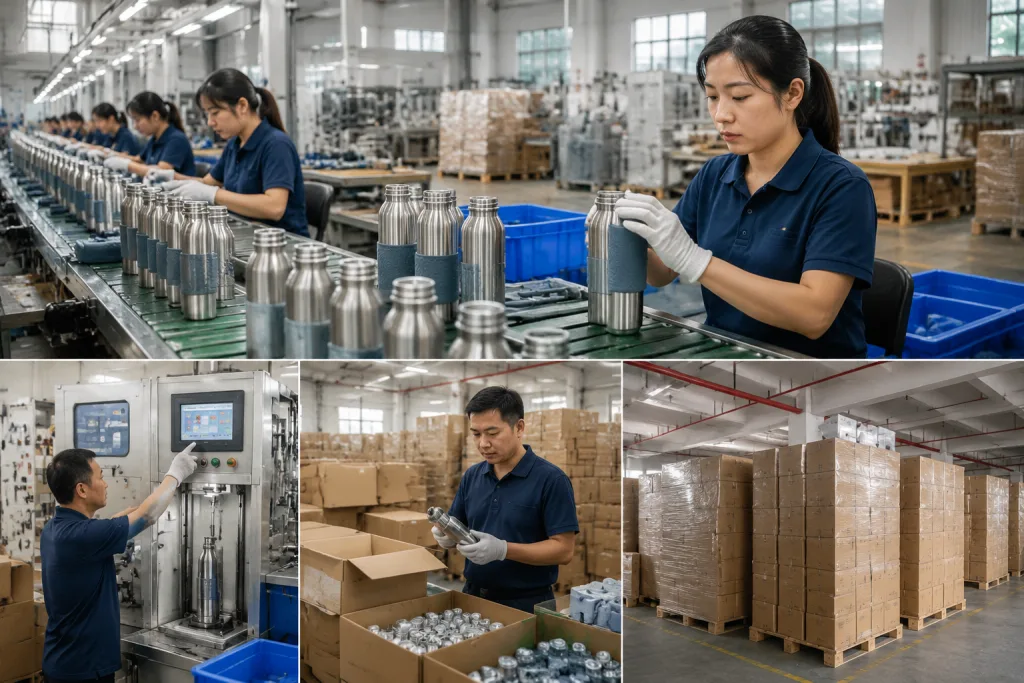
Do not judge a canteen supplier by unit price alone. Ask who makes the bottle. A real canteen manufacturer in Zhejiang should be able to show factory photos, production flow, and monthly output. For a medium-sized plant, 80,000 units per month is a realistic capacity marker for standard insulated bottles; if a vendor cannot break that down by hydraulic forming, vacuum oven, powder coating, logo printing, and carton packing, you are probably looking at a trading layer. We ask for line photos with date stamps. Simple check.
A trading vendor is not always a problem. Some canteen vendors handle mixed programs well, such as 1 stock bottle plus 1 customized growler loaded in the same 40HQ. But if you care about repeat orders, Zhejiang factories with in-house printing, carton packing, and final QC usually give fewer schedule surprises. We have seen this go sideways when the buyer approved a sample, then changed the logo from laser to silk print after the pad-printing jig was already made. Ask two things first: lead time by SKU, and who pays for defects found after arrival.
Use this checklist when you compare quotes from China. The missing line is often the dangerous one; last month QC pulled a sample because the PO said “matte black,” while the artwork file showed Pantone 426C glossy.
- FOB port named clearly, usually Ningbo or Shanghai
- Sample fee and whether it is refunded at order
- Payment terms, often 30% deposit and 70% before shipment
- Inspection standard, ideally AQL 2.5/4.0
- Document pack: packing list, invoice, test reports, and export labels
If the canteen distributor can answer those points within 24 hours, with the carton mark and HS code checked, you are probably talking to the right China partner. If they need 4 days just to confirm Ningbo or Shanghai, the math doesn't work for a tight launch.
Get a factory quote that actually compares
Send your volume, artwork, and target market. We will price the bottle, sleeve, branding, and lead time line by line.
Frequently asked questions
What is a realistic MOQ for silicone thermal bottle custom?
For most projects, 500 pcs is the practical starting point. A factory in China can sometimes accept 300 pcs, but you should expect a 15-30% uplift in unit cost because setup time gets spread over fewer bottles. If you need a Pantone sleeve, a special lid color, or printed retail packaging, 1,000 pcs is usually the better buying level. For distributor drinkware programs, I would treat 500 pcs as a pilot and 1,000 pcs as the first real commercial run.
How much should I budget per piece FOB China?
At 1,000 pcs, a straightforward 500 ml silicone thermal bottle custom order often lands around USD 3.20-5.80 FOB China, depending on 304 or 316 steel, sleeve thickness, and logo method. If you add 316 steel, a printed gift box, or multi-color decoration, USD 6.50-9.00 is a more realistic range. The quote should also show whether the price includes carton marks, barcode labels, or FNSKU handling. That is where many canteen suppliers quietly differ.
How long from artwork approval to shipment?
A clean timeline is usually 7-10 days for samples, 2-4 extra days if you need a new sleeve color or logo plate, and 25-35 days for mass production. Add 3-5 days if you need FNSKU labels, retail cartons, or multilingual artwork checks. If you ship by sea from China to Europe or North America, plan another 18-35 days on the water. During peak season, a Zhejiang canteen manufacturer may need an extra 7-10 days, so confirm the schedule before you send deposit.
Which documents should I ask for before placing an order?
For Europe, ask for REACH and LFGB documentation. For the US, ask for FDA-related food contact declarations and any third-party migration test reports your buyer requires. You should also ask for ISO 9001 records, BSCI status if relevant, and the agreed AQL standard, usually 2.5 for major defects and 4.0 for minor defects. A professional canteen factory will not hesitate to provide sample test reports, carton specs, and a pre-production photo set before bulk production starts.
Is a custom canteen better than a custom growler for retail?
It depends on how your customer will use it. A custom canteen is easier to sell for daily hydration, school, travel, and fitness channels, while a custom growler fits beverage takeaway, craft beverage, or premium gifting. From a sourcing angle, both use similar logic: MOQ, decoration, packaging, and compliance drive the price more than the shape does. If you are a canteen distributor, start with the shape that gives you the broadest repeat order potential and the lowest return risk.