Key Takeaways
- A workable silicone sport bottle order usually starts at 3,000 pcs MOQ, with 25-35 day lead time after sample approval.
- Silicone wall thickness around 1.8-2.2 mm and Shore A 45-55 is a safer retail spec than ultra-soft promotional stock.
- For EU and US sales, ask for LFGB, FDA, REACH, BSCI, and production AQL 2.5/4.0 reports before you place the PO.
- The best fit for silicone is collapsible, travel, gym, and outdoor programs; it is not the cheapest choice for every canteen distributor.
If you are sourcing from a silicone sport bottle factory, the first mistake is treating silicone as a simple color-and-logo job. It is not. The real differences sit in durometer, wall thickness, mold design, cap sealing, and whether the bottle survives 500 collapse cycles, 80°C hot fills, and courier drops from 1.2 m. On our line, QC pulls the sample with a caliper and a leak rack before anyone talks about artwork. For a buyer in Europe or North America, those details decide whether the order turns into repeat business or a pile of returns.
This guide compares silicone sport bottles with other drinkware formats so you can judge fit for use, not just unit price. It reads the way a Zhejiang export team quotes: MOQ, lead time, test standard, and where custom canteen, customizable drinkware, or distributor drinkware needs a different spec. We ship a 3,000-piece pilot before a 30,000-piece run for a reason. The buyer flagged a 1.5 mm wall note on one PO last month, and that typo would have changed the squeeze feel at the line. China has plenty of suppliers; the real question is which one holds tolerance when the order moves from sample to mass production.
What the factory actually controls
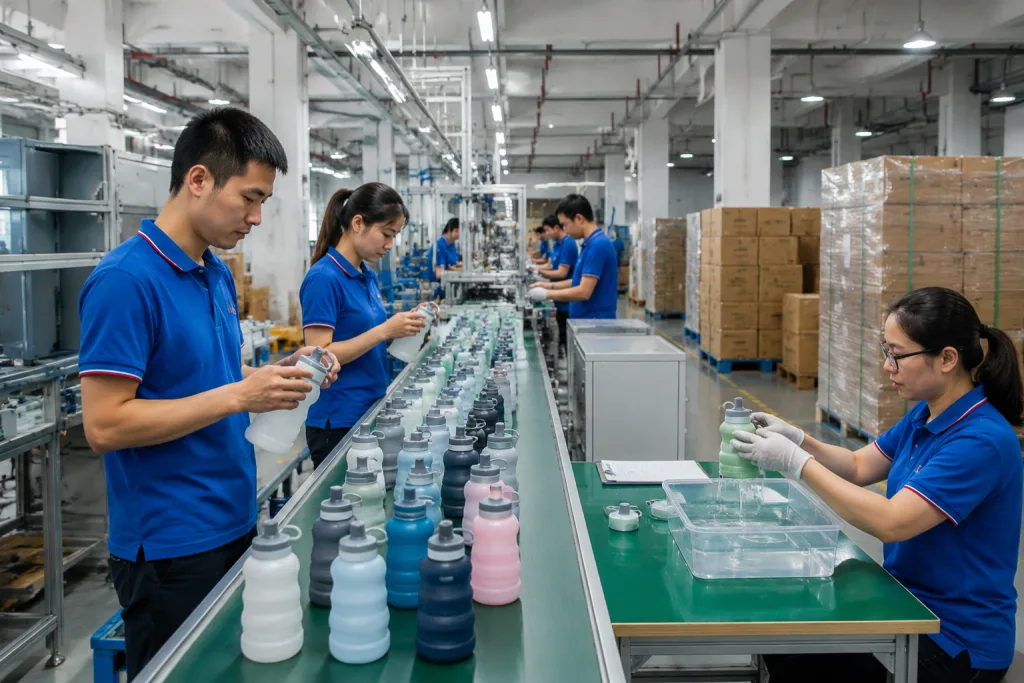
A silicone sport bottle factory is not just shooting colored material into a mold. We control the silicone compound batch, curing time, flash trimming, cap torque, assembly fit, and leak result against the approved sample. QC pulled one 600 ml bottle last month with 0.4 mm flash left on the shoulder; it looked clean in photos but snagged under a fingernail. If one step slips, the bottle can pass the sample bench and start leaking after 20 to 30 dishwasher cycles.
In Zhejiang and across China, stronger factories keep molding away from final inspection. Good plants do this on purpose. A line running 300,000 to 500,000 units per month can still ship trouble if first-off samples are not quarantined, cavity numbers are not recorded, or each lot is not checked against the approved master sample. For custom drinkware, a glossy catalog is the wrong thing to judge first; ask whether the factory can hold a 1.8 mm wall thickness across 8 or 16 cavities with a digital caliper, not just on cavity No. 1. If you are buying a custom canteen or customized drinkware program, that control is what protects your margin.
Ask these before price: what silicone grade is being run and how the plant proves leak performance under order pressure. Then ask monthly capacity, because “we can do it” means nothing if the line is already full. A decent canteen factory in China should answer with test data, not soft sales talk. For export orders, I want to see ISO 9001 procedures, AQL 2.5 for critical defects, and a documented drop test at 1.2 meters, with the cap torqued to the same setting used in mass production. We have seen this go sideways when a PO says “sport lid” but the buyer’s artwork shows a straw lid. If the supplier cannot explain where the bottle will fail, they have probably watched it fail already.
Silicone versus other drinkware
The buyer decision gets easier when you compare use cases, not materials by themselves. Asking “which material is best?” is the wrong question to ask. Silicone wins when the bottle must fold flat in a backpack or event kit. Stainless wins when temperature hold and a premium hand feel drive the order. Tritan works when the buyer wants low weight and a clear body for retail display. On our sample bench, QC pulled three 600 ml silicone bottles last week and checked a 2.0 mm wall with a digital caliper; that small wall difference changes both squeeze feel and collapse recovery. Here is the practical view.
| Format | Best for | Typical spec | Risk to watch |
|---|---|---|---|
| Silicone sport bottle | Gym, hiking, travel, promo kits | 500-750 ml, 1.8-2.2 mm wall, Shore A 45-55 | Odor retention if the compound is poor |
| Stainless bottle | Premium retail, temperature hold | 18/8 steel, 0.4-0.5 mm shell | Dent risk and higher freight cost |
| Tritan bottle | Lightweight consumer retail | 500-1000 ml, BPA-free copolyester | Scratch visibility and heat limits |
If your channel is a canteen distributor selling to outdoor shops, silicone has a stronger story than a rigid bottle that eats carton space. We run collapse tests because buyers ask about this. For event giveaway programs, a folded silicone bottle can cut carton volume by around 30-40% versus a fixed-shape bottle of the same capacity, which matters when the PO says 10,000 pcs and the freight line gets flagged. For canteen customizable retail sets, stainless can still carry a higher shelf price if insulation matters more than packability. No universal winner. Pick the format around how the customer stores it, carries it, and washes it after use.
Specs that move the quote
Price moves the minute the spec changes. On our quote sheet, the same silicone bottle can swing 20% to 35% after the buyer changes from a flip cap to a screw cap with stainless trim, or moves from one-color screen print to laser marking. Last month QC pulled a 500 ml sample because the artwork file said Pantone 299C, while the PO showed 293C; that small typo held the quote for half a day. A basic promo bottle in bulk packing sits in a different price lane from a canteen set with a metal lid and a printed retail carton insert.
The numbers that matter most are boring, so buyers skip them. Bad idea. Capacity is usually 350 ml, 500 ml, 600 ml, or 750 ml, and we ask the buyer to confirm fill volume, not just the catalog name. Wall thickness below 1.6 mm feels flimsy in hand and often warps after the hot-water test on the line. Above 2.3 mm, the bottle gets heavy and does not collapse cleanly. For food-contact silicone, ask for a durometer around Shore A 45-55 if the body needs to fold without feeling limp. If the bottle includes a PP or stainless cap, check torque tolerance and gasket compression with a torque meter. That is where leaks start.
- MOQ: 3,000 pcs is common for a custom run in China; below that, the mold setup fee usually makes the math look bad.
- Sampling: 5-10 days for a plain logo sample, 18-22 days for new molds after the 3D drawing is signed.
- Lead time: 25-35 days after sample approval and deposit, counted from the day our merchandiser gets the bank slip.
- Packing: individual polybag, kraft box, or retail set depending on channel; the buyer flagged crushed corners when the kraft box was under 300 gsm.
For distributor canteen orders, asking only for the lowest unit cost is the wrong question. Shipping efficiency can beat a cheaper EXW price. We run a 60 x 40 x 35 cm master carton check before locking the packing spec, because a collapsible body can cut carton volume by 18% to 25%. That is real money on a 20-foot or 40-foot shipment, especially if your warehouse charges by cubic meter.
Branding that survives real use
On silicone, decoration is not cosmetic. It has to survive flexing, washing, and abrasion on the line. We run 120T mesh for simple logos on flat zones, and pad print when the body has a curve or a shallow groove. Laser engraving belongs on the 304 stainless lid or a metal clip, not on the silicone wall itself. If you want a clean retail result, put the mark where the surface stays stable. That is the right call.
This is where some canteen factories overpromise. A promotional order can look sharp on day one and still fail after 50 dishwasher cycles if the ink stack is wrong for the substrate. QC pulled a sample from a 3,000-piece run last season, and the logo started whitening after the abrasion test. If you are building custom drinkware for a North American distributor, ask for both an abrasion test and a dishwasher test before production starts. For imported retail, packaging is part of branding too. A plain polybag works for a warehouse club program, but it does not carry a customizable drinkware SKU on shelf. The buyer flagged that fast.
Think in terms of channel fit. A custom growler or customized growler program sells premium capacity, so the lid and carton matter as much as the bottle. A canteen distributor selling to hiking accounts may want a matte body, one-color print, and a spare gasket in every carton. We ship that kind of kit all the time, and the math does not work if you spend on the wrong surface. If you want the item to feel like a premium custom canteen instead of a giveaway, spend on the parts the customer touches first: mouthpiece, hinge, seal, and box.
Practical branding choices
- One-color silk screen for MOQ-sensitive programs at 500 pcs and up.
- Laser marking on metal hardware for branding that stays put.
- Embossed or debossed mold logos when you own the tooling.
Quality checks worth paying for
Quality control belongs in the purchase order, not in a sales promise. Put incoming material checks, in-process inspection, final random inspection, and carton drop tests in writing. For export, AQL 2.5 is common for major defects, but a leak on a silicone sport bottle is not a minor issue. We once saw a 28 mm cap torque drift after lunch break on the line, and the only reason it got caught was because QC pulled the sample and logged the result. Skip vague “100% inspected” claims unless the factory can show the method, the record, and the inspector name.
For Europe, REACH and LFGB matter. For the US, FDA food-contact compliance is the baseline, and ASTM methods help on mechanical or packaging tests. If the supplier is BSCI-audited, that helps on social compliance, but it does not replace product testing. A Zhejiang factory that knows export work should hand over third-party reports from SGS or an equivalent lab, plus batch-level traceability down to the lot code on the 500 ml body. We ship a lot of orders like this, and the buyer always flags the same thing first: no report, no deal.
When you compare canteen suppliers, check whether they know the difference between a sample report and a production report. Too many buyers approve one prototype from China, then find the mass order ran a different compound at 18 days lead time instead of 12. That is the wrong question to ask after the PO is already in. Require a signed golden sample, a material declaration, and retention samples from each lot. If your route to market includes Amazon FNSKU labeling, ask for carton and unit label accuracy too. We have seen a typo on a carton mark turn into a full rework for 3,000 units.
Buy the report, not the promise. If the factory cannot document material grade, leak test method, and lot traceability, the quote is too cheap for the risk.
Which buyer profile fits best
The right bottle depends on how your customer buys, not how our factory wants to run the line. Retail buyers check shelf look first: flash on the silicone seam under 0.3 mm, Pantone color within ΔE 1.5, no scuffed gift box corners after the drop test. Distributor buyers care about repeat margin and claim rate; one buyer in Germany flagged 23 leaking caps in a 5,000 pcs trial, and that killed the reorder talk for two months. Promo buyers push for fast ship dates and low landed cost, so we keep the spec plain and avoid parts that slow assembly. Different jobs. One silicone bottle will not fit all of them.
If you are a canteen distributor, a silicone body works well for outdoor and fitness programs because it packs down tighter than rigid drinkware; we can load about 15–20% more pcs per carton on some collapsible models. If you are a brand owner building a premium line, use a tighter hybrid spec: silicone body, 304 stainless cap, molded logo, and a carton sleeve that does not crush at 12 kg stack weight. QC pulled the sample last month because the molded logo edge was 0.6 mm too shallow, and the buyer noticed it before we did. For an event or seasonal launch, keep tooling simple and print to one or two colors. Test demand first.
My blunt view: silicone is strongest when you need portability, a different hand feel, and daily use that survives a gym bag. It is weaker when the buyer expects a rigid premium feel or real heat retention; the math does not work against vacuum stainless. A canteen customizable program should start with channel economics first, then appearance. China has factories that can make almost any version you ask for, but Zhejiang factories that win repeat orders are the ones that keep the gasket size, cap torque, and silicone hardness stable after shipment one. We run Shore A checks on the line for that reason. That is the gap between a one-off PO and a product line worth reordering.
Send the spec, get the right factory quote
Share your capacity, logo, and target market. We will price the bottle for your channel, not just for a sample.
Frequently asked questions
What MOQ should I expect from a silicone sport bottle factory?
For a custom run, 3,000 pcs is a realistic starting point in China, especially if you want a new print layout or special cap. Some Zhejiang factories will quote 1,000 to 2,000 pcs for stock models, but that usually means less flexibility on color or packaging. If you need a new mold, expect the tooling cost to be separate and the first production to take 25-35 days after sample approval. For distributor drinkware, a higher MOQ often lowers your unit price by 8% to 15%.
Can silicone sport bottles handle hot drinks?
Some can, but you should not assume every silicone bottle is suitable for hot fill. Food-grade silicone itself can tolerate high temperature, but the cap, gasket, and any PP parts may limit performance. A safe export spec should define the maximum fill temperature, usually 80-100 C depending on the full assembly. If the bottle is for tea, coffee, or a custom growler-style program, ask the factory for a real heat test and a seal test after thermal cycling. Do not rely on the material claim alone.
How do I compare silicone bottles with custom canteen options?
Start with use case. A custom canteen in rigid stainless or Tritan usually wins on shelf presence and insulation. A silicone sport bottle wins on pack size, portability, and a more flexible retail story. If your customer is outdoors, the collapsible format can reduce shipping volume by 18% to 25%. If your customer wants a premium gift item, a rigid canteen customized with laser marking may sell better. The better choice is the one that fits your channel margin and warehouse cost, not just the sample in your hand.
What compliance documents should I ask for from China?
For Europe, ask for REACH and LFGB testing. For the US, ask for FDA food-contact compliance. If you need a broader manufacturing check, ask whether the factory is ISO 9001 and BSCI audited. A good supplier should also provide material declarations, a golden sample record, and third-party lab reports from SGS or an equivalent lab. For export orders, I also recommend asking for carton drop tests and leak test records. A real factory will have these documents ready, not prepared after you ask.
Can I use silicone bottles for promotional or distributor programs?
Yes, if you match the decoration and packaging to the channel. For canteen promotional programs, keep the logo simple, use bulk packing, and avoid expensive hardware. For canteen distributor or distributor canteen programs, ask for stable color matching, spare gaskets, and cartons that survive pallet stacking. If you want a customized drinkware line that sits beside premium retail items, upgrade the lid, carton, and print durability. The same body can serve three markets, but the spec should not be identical for all three.