Key Takeaways
- A practical MOQ for custom silicone sleeve colors is usually 3,000-5,000 pcs per SKU
- Borosilicate glass should be checked for wall thickness, thermal shock, rim finish, and annealing stress
- Expect 7-10 days for pre-production samples and 30-40 days for mass production after approval
- Use AQL 2.5/4.0 inspection plus carton drop testing before paying the balance
You are not buying a glass bottle with a silicone sleeve only. You are buying a retail-ready item that must pass a 1.2 m drop test, match the approved Pantone sleeve color, keep the cap torque within spec, and reach the shelf without cloudy glass or scuffed lids. QC pulled samples last month where the sleeve lip was 1.5 mm short, and the buyer flagged it before carton packing. A silicone glass bottle factory should catch that before deposit. After shipment, the math doesn't work.
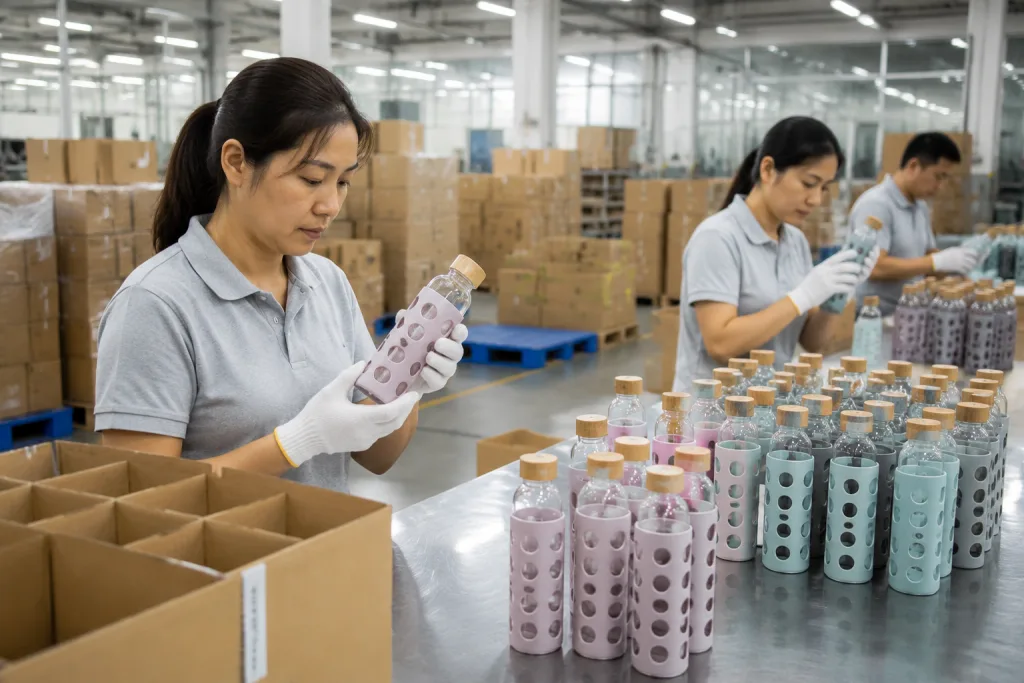
Here is a real order shape we run often: 5,000 pieces of 550 ml borosilicate glass bottles with custom silicone sleeves, laser-marked lids, color box packaging, and FOB Ningbo shipment. BottleForge Industrial is based in Hangzhou, Zhejiang, so our line sees this type of China export project for distributor drinkware and canteen promotional programs. On a job like this, we check the sleeve mold fit with a digital caliper, confirm lid marking position against the artwork file, and make sure the PO does not say “matte black” while the approved sample is charcoal gray. That typo has cost buyers 12 days before.
Start with the real order
Say you are a canteen distributor in Germany, or a drinkware buyer supplying a U.S. retail chain. The customer asks for a cleaner replacement for plastic sports bottles: 550 ml clear borosilicate glass, matte silicone sleeve, bamboo-look stainless lid, retail box, and a one-color logo. The retail channel needs REACH documentation, barcode stickers, and cartons strong enough for pallet movement. We have seen buyers forget the barcode size, then send a 42 mm sticker layout for a 38 mm box side panel. The line stops for small mistakes like that.
The first mistake is asking 10 canteen suppliers for “best price” with no spec sheet. You will get 10 different products. One quote uses soda-lime glass instead of borosilicate. Another uses thin 1.5 mm glass. A third includes a sleeve made from low-grade silicone with odor. QC pulled one sample last year that smelled like tires after 24 hours in a closed carton. Some suppliers quote a flat lid seal when the order needs a screw lid with a food-grade silicone gasket. Price comparison? The math doesn't work.
For this order, the RFQ should state: capacity 550 ml ±5%, bottle height target, mouth diameter, glass type, wall thickness target, silicone hardness, sleeve coverage percentage, lid material, logo method, packaging, test standards, delivery term, and destination port. Add a simple drawing if you have one. Even a 1-page PDF with mm markings beats a long email. If you want a custom canteen look rather than a stock bottle, say whether the mold shape changes or only the sleeve and branding change. Those are not the same job. A new glass mold can push sampling to 18 days, while a stock bottle with a new sleeve color often runs in 12 days.
At BottleForge in Zhejiang, China, we normally split the quote into bottle, sleeve, lid, decoration, packaging, and inland freight. For a 5,000 pcs custom drinkware order, a realistic FOB Ningbo unit price usually lands around USD 2.35-3.80 depending on sleeve weight, lid structure, and box quality. We run sleeve weight checks on a 0.1 g digital scale because 8 g missing silicone changes the hand feel and drop protection. A canteen vendor that gives one lump price without material details is making your comparison harder, not easier.
Lock the materials before artwork
For a silicone glass bottle factory order, the material call is not cosmetic. It sets the breakage rate, the odor complaint rate, the test report, and whether a buyer from a chain retailer will take the file seriously. Borosilicate glass is the usual pick because it handles thermal shock better. It costs more than soda-lime glass, but “glass bottle” is too loose for custom drinkware. Put the glass type in writing. We had QC pull a sample last month and the buyer flagged the wall spec, not the artwork.
For the bottle body, I would call out 2.0-2.5 mm wall thickness for a 550 ml bottle, depending on the shape. At 1.8 mm, the line starts breaking bottles in carton drop tests; at 2.8 mm, freight weight climbs fast and the bottle feels bulky in hand. The rim should be fire-polished or finished cleanly, since tiny chips at the mouth turn into safety and leak claims. A caliper check at the line settles this fast.
The sleeve should be food-contact grade silicone, usually 50-60 Shore A hardness. Softer silicone feels better, but it stretches and holds dust. Harder silicone stays stable, though it takes more effort to fit around curved glass without wrinkles. If your order is canteen customizable with Pantone colors, confirm whether the factory is matching solid silicone color, printed sleeve graphics, or a molded raised logo. Each option carries its own MOQ and mold setup cost. We run into PO typos here all the time.
The lid needs the same discipline. Many buyers stare at sleeve color and leave the cap vague, then the leak test fails. For a leak-resistant build, ask for a 304 stainless steel outer shell or PP inner structure, plus a removable food-grade silicone gasket. If you want bamboo-style decoration, specify real bamboo, bamboo veneer, or wood-effect coating. Real bamboo looks good, but it moves with moisture and shows natural variation. For North America, ask early about FDA food contact expectations; for Europe, ask for LFGB or EU food-contact migration testing where required.
Do not approve artwork until the factory confirms the exact bottle drawing. A logo centered on a flat render can land crooked on a tapered sleeve.
Choose customization that scales
A canteen customized project can be simple or painfully overbuilt. Match the decoration to the order size and channel. For 5,000 pcs, a custom silicone sleeve color plus one-color print is the clean call. A new glass mold is rarely worth it unless the buyer has a 12-month program, because tooling runs USD 3,000-8,000 and adds 25-35 days. The math does not work on a short run.
For custom canteen branding, the common options are silkscreen printing on the silicone sleeve, debossed or embossed sleeve logo, laser engraving on a stainless lid, and paper insert or color box design. Silkscreen is the workhorse for flat logos and short lead times. Debossed silicone looks premium, but it usually means sleeve tooling and a higher MOQ. Laser engraving on the lid stays clean after 50 washes, but it cannot carry full-color marks. On the line, we check the logo stroke at 0.3 mm before QC signs off.
If you are a canteen manufacturer’s buyer building a house line, keep the SKU count under control. Three sleeve colors at 5,000 pcs total sounds neat, but if the factory MOQ is 3,000 pcs per Pantone color, your real MOQ becomes 9,000 pcs. That is the wrong question to ask. For a first order, two colors at 2,500 pcs each may pass only if we are already running the same silicone compound. If not, you pay a color-change fee or accept a later production slot. We once caught a PO that listed Pantone 186 C as 168 C, and QC pulled the sample before it hit the mold.
For promotional buyers, the logo approval path matters more than many people admit. A canteen promotional order usually has a fixed event date, and the schedule needs to be written around that date, not wishful thinking. Build it like this: 2 days to confirm drawing, 5-7 days for blank sample if stock parts exist, 7-10 days for decorated pre-production sample, 30-40 days for mass production after sample approval, and 3-5 days for inspection and inland delivery to Ningbo or Shanghai. Zhejiang helps because glass, silicone, printing, and export packing suppliers sit close together, but missed approvals still burn days. A one-line typo on the ship mark has cost us a full packing day before.
Read the quote like an engineer
A low quote from a silicone glass bottle factory can be real, but first check what is missing. Ask whether the price is EXW, FOB Ningbo, FOB Shanghai, or DDP. For B2B custom drinkware, we usually start with FOB because it shows the factory’s part of the job clearly: packed cartons, export handling, and local port cost. Simple rule. If you need Amazon or 3PL delivery later, quote that separately after carton size and gross weight are confirmed; last month QC measured one packed carton at 54 x 38 x 32 cm, and the buyer flagged the freight because their spreadsheet used 48 x 35 x 30 cm.
For our sample 5,000 pcs order, you might see this structure: bottle body USD 0.85-1.20, silicone sleeve USD 0.45-0.90, lid USD 0.35-0.75, logo USD 0.08-0.25, color box USD 0.18-0.40, export carton USD 0.06-0.12, inland and handling included in FOB. The finished FOB range of USD 2.35-3.80 is normal for a serious build. If another canteen supplier quotes USD 1.70, do not just ask them to match photos; ask what glass type, sleeve weight in grams, lid gasket material, packing spec, and inspection level they cut. We have seen this go sideways: QC pulled the sample, the sleeve was 18 g instead of the approved 26 g, and the bottle felt loose in the hand.
Payment terms change the risk on both sides. A common China factory term is 30% deposit and 70% balance before shipment. For repeat canteen distributors, 20/80 may be possible. For new buyers, open account on a custom order is the wrong question to ask. The factory is buying custom silicone, printing packaging, and reserving production capacity on the line; if the PO has a PMS color typo, someone still pays for that mixed material. BottleForge’s monthly drinkware output is about 600,000 units across stainless steel, glass, and plastic lines, but custom color materials are not sitting as free inventory in the warehouse.
Check quote validity before your team signs off. Silicone, stainless steel, cartons, and ocean freight move, sometimes within 2 weeks. A 15-day quote validity is normal. If your internal approval takes 45 days, ask for reconfirmation before issuing a purchase order; the math does not work when resin rises 6% and the buyer still points to an old PDF. Good canteen vendors will say where the cost pressure is, and we run the same check with the carton supplier before we ship.
Sample approval without guessing
The pre-production sample is where we catch RMB 8,000 problems while they still cost RMB 80. For customized canteen and customizable growler projects, I prefer a signed sample checklist, not a “looks good” email from purchasing. Our checklist covers net weight in g, capacity, height, diameter, sleeve color, logo size and position, lid fit, leakage result, packaging dimensions, barcode, and carton mark. Last April, QC pulled the sample because the PO said “matte black” but the approved sleeve was PMS Black 6C, and the line had already mixed 12 kg of the wrong silicone.
For the 550 ml silicone glass bottle order, measure actual capacity twice: fill to practical drinking level, then fill to brim on a digital scale. A bottle advertised as 550 ml should not hold only 505 ml at brim. Full stop. Check sleeve fit after washing and drying, because a sleeve that feels tight on day one can loosen after 10 removal cycles if the compound hardness or mold allowance is off by 0.4 mm. We run this check with a sample sleeve pulled from the same cavity, not a hand-trimmed showroom piece. Inspect the sleeve seam line for your retail position, too. It will exist; the real question is whether it sits straight and stays within the agreed tolerance.
Logo testing depends on the process. For silkscreen on silicone, do a 3M tape test and a 50-cycle dry rub test before you approve bulk print. For laser engraving on stainless, check contrast, edge clarity, and whether the logo is centered after the lid is assembled. For color box printing, confirm the CMYK proof under normal light at the packing table, not only on a phone screen. If your customer has brand guidelines, send Pantone codes and vector artwork before sampling. Screenshots create arguments. We have seen one buyer flag a 1.5 mm logo shift after cartons were sealed, and the math does not work at that stage.
Leakage testing should be simple and written down: fill with room-temperature water, close the lid, invert for 30 minutes, then shake for 30 seconds. Put the result on the sample tag with the date and inspector name. For hot-fill claims, be careful. Glass handles heat better than many plastics, but trapped steam and user handling risks make “hot water safe” a claim you need to validate properly. This is the wrong place to guess. If you need ASTM or retailer-specific drop tests, say so before quotation, because upgraded inner trays, thicker cartons, or a 5-layer master carton can change the unit cost.
Inspect production before balance
Mass production inspection is not carton counting. Glass drinkware hides problems a warehouse photo will miss, like a hairline crack under the silicone sleeve or a chipped inner rim you only catch with a rim gauge and flashlight. We run an AQL plan, commonly critical 0, major 2.5, minor 4.0, unless your retailer specifies another standard. For 5,000 pcs, an inspector may sample 200 pcs under General Inspection Level II. The exact sample size depends on the inspection standard used, but the rule stays simple: pull randomly from sealed finished cartons, not from 30 clean samples placed on a table.
Critical defects include cracked glass, sharp rim, contamination inside bottle, severe leakage, and wrong material. Major defects include wrong logo size, loose sleeve, cap thread failure, obvious color mismatch, under-cap gasket missing, or color box barcode error. Minor defects include small print specks, tiny sleeve flash, or slight carton mark issues within agreed limits. QC pulled the sample last month and found a 3 mm logo shift after the buyer had approved the artwork, so set the tolerance before the line starts. If you sell as a premium customized growler or distributor growler line, tighten cosmetic limits before production starts. Do not argue this after packing.
Functional tests should include capacity check, lid torque feel, leakage, sleeve adhesion by hand pull, carton drop test, and packing count. For glass bottles, I like a 76 cm carton drop test on one corner, three edges, and six faces, adjusted for carton weight and buyer standard. We also weigh the full carton on a 30 kg scale because a missing inner divider often shows up before the box is opened. If the carton fails, changing from 5-ply to stronger 5-ply or adding dividers may cost USD 0.08-0.20 per unit, which is cheaper than 3% breakage on arrival. The math does not work if you save USD 400 on packing and lose 150 bottles in the container.
Documentation matters too. Ask for commercial invoice, packing list, bill of lading draft, and any test reports before shipment. If you need REACH, LFGB, FDA, Prop 65 assessment, BSCI factory audit, or ISO 9001 certificate, request them during sourcing, not after the container is loaded. We have seen this go sideways when a PO typed “LFGB food contact” but the buyer only asked for FDA on the email thread. China factories can support these, but not every canteen factory has the same document scope.
Plan the next order early
The first order tells you what the spreadsheet cannot. A 550 ml bottle may move fast, while the buyer asks for a 750 ml version on the second PO. A matte black sleeve may look clean in the mockup, then show fingerprints under the 600-lux inspection lamp. A carton that looks fine on paper may sit 8 mm too wide for the shelf tray. Treat that first PO as the start of a product family, not a one-off bet.
If sell-through is solid, we can move into customizable drinkware sets: 350 ml kids bottle, 550 ml everyday bottle, 750 ml fitness bottle, or a custom growler-style glass format for cafes and refill stores. Then the real work starts. Lock the annual forecast, set call-off orders, reserve silicone colors, and share packaging parts where the line can keep them common. The math does not work on repeated urgent 3,000 pcs orders; a canteen supplier will usually price better when the buyer can show 20,000-50,000 pcs a year.
For distributor canteen programs, keep one technical file per SKU: approved drawing, material list, test reports, artwork, carton specs, inspection reports, and shipment photos. We keep those files on the QC desk for a reason. When sales asks for a rush reorder, a missing revision or a typo on the PO can turn into the wrong cap color or the wrong carton size. It also keeps the file clean when the channel shifts from promotion to retail, where compliance questions get sharper fast.
A reliable silicone glass bottle factory should push back when the idea adds cost or opens a quality risk. That is not bad service. It is the difference between a canteen manufacturer mindset and a trading-only mindset. From Hangzhou, Zhejiang, we see both sides of the China supply chain: the buyer wants speed and price, but the orders that repeat are the ones we sample, inspect, and pack the right way.
Send your silicone glass bottle specification today
We will review materials, MOQ, decoration, packaging, and FOB cost before you commit to tooling or a deposit.
Frequently asked questions
What MOQ should I expect from a silicone glass bottle factory?
For stock glass shape with a custom silicone sleeve color, expect 3,000-5,000 pcs per SKU. If you use stock sleeve colors and only print a logo, some factories may accept 1,000-2,000 pcs, but the unit price will be higher. A new silicone sleeve mold usually makes sense from 5,000 pcs upward. A new glass mold is different; tooling can cost USD 3,000-8,000 and normally needs 10,000 pcs or a confirmed annual program.
Can I make a fully custom canteen shape in glass?
Yes, but it is slower and riskier than customizing the sleeve, lid, and packaging. A fully custom glass bottle shape needs drawing, mold development, trial production, annealing checks, and fit testing with the silicone sleeve. You should allow 45-60 days before mass production, not including international transit. For a first canteen customized order, I usually recommend using an existing glass body and investing customization budget into sleeve tooling, lid finish, and retail packaging.
Which tests are important for glass bottles with silicone sleeves?
At minimum, check capacity, leakage, rim safety, glass cracks, sleeve fit, odor, logo adhesion, and carton drop performance. For Europe, REACH and food-contact migration may be required depending on the product and sales channel. For the United States, FDA food-contact expectations and Prop 65 review may apply. Use AQL critical 0, major 2.5, minor 4.0 for final inspection unless your retailer specifies stricter limits. Do not skip carton testing; glass failures often come from weak packing, not weak glass.
How long does production take after I approve the sample?
For a normal 5,000 pcs order using existing glass molds, plan 30-40 days for mass production after written sample approval and deposit clearance. Pre-production samples usually take 7-10 days if materials are available. Custom silicone colors, special lids, retail boxes, or third-party testing can add 5-15 days. If you need delivery for a fixed promotion date, build the schedule backward and leave at least one week for inspection, correction, and export booking.
What information should I send to get an accurate quote?
Send capacity, target quantity, glass type if known, sleeve color, logo artwork, lid preference, packaging style, delivery term, destination port, and compliance requirements. If you are comparing canteen manufacturers or canteen vendors, ask each one to quote the same specification. A request like “customizable canteen, best price” is too vague. A proper RFQ for 5,000 pcs of 550 ml borosilicate bottles with Pantone silicone sleeve and color box will produce a quote you can actually compare.