Key Takeaways
- A practical silicone glass bottle custom MOQ is usually 3,000-5,000 units per color for sleeve molding and stable logo cost
- Specify borosilicate glass wall thickness at 2.0-2.5 mm, not just bottle capacity
- Plan 7-10 days for pre-production samples and 30-40 days for bulk production after approval
- Use AQL 2.5/4.0 inspection plus 1.2 m carton drop testing before final balance payment
You do not buy a silicone glass bottle custom order the same way you buy a blank catalog bottle. The logo is only one checkpoint. Before you pay the deposit, you are already fixing the glass wall thickness, silicone sleeve ID tolerance in mm, lid torque, 1.2 m carton drop strength, Pantone color range, and compliance files. QC pulled one sample last month where the sleeve sat 3 mm high after shrink test. The buyer flagged it, and he was right.
Let’s use a real B2B case: 5,000 units of 550 ml borosilicate glass bottles with colored silicone sleeves and one-color logo, shipped FOB Ningbo from Zhejiang, China. We run orders like this for canteen distributors, promotional buyers, and retail brand owners, and the wrong question is “what is your best price?” Ask for the spec first. On the line, a loose sleeve or a lid that misses torque by 0.3 N·m costs more than a USD 0.02 price difference on the quote sheet.
Start with the buying brief
A good RFQ for a silicone glass bottle custom project should read like a line instruction, not a mood board. If you send only “550 ml glass bottle with sleeve, quote please,” 8 factories will guess 8 different ways. One quotes soda-lime glass; another quotes borosilicate after checking the wall with a digital caliper. One includes individual kraft boxes, another prices bulk polybag packing at 50 pcs per master carton. The lowest quote often has missing work inside it.
Your brief should spell out capacity, glass type, sleeve material, lid structure, decoration method, packing, target market, and order quantity. A workable specification is: 550 ml high borosilicate glass, 2.2 mm nominal wall thickness, food-grade silicone sleeve at 1.8-2.0 mm thickness, stainless steel or PP screw lid, one-color logo on sleeve, 5,000 units, two sleeve colors, FOB Ningbo. We run this through the sample room first, and QC pulled the sample last month because the sleeve measured 1.55 mm at the logo edge.
If you are a canteen distributor selling to multiple accounts, say where the bottle will go: retail shelves with barcode labels, corporate gifting with gift boxes, school campaigns with child-safe artwork, or online fulfillment with drop-test packing. A canteen promotional order normally needs cleaner individual packaging and a tighter visual standard. A distributor drinkware program can accept master carton packing if the buyer repacks locally. These details move the unit price by USD 0.15-0.60, which is too much to ignore on 5,000 units. We’ve seen this go sideways when the buyer flagged carton scuffs after asking for “standard packing” on the PO.
At BottleForge Industrial in Hangzhou, Zhejiang, we prefer to quote with three clear price levels: standard catalog tooling; stock bottle with modified sleeve color and logo; fully customized canteen-style development with new sleeve mold and lid matching. It saves time. It also prevents the usual misunderstanding where you think you asked for a customized canteen bottle and the factory quoted a stock bottle with a logo. One buyer once typed “matte black sleeve” on page 1 and “gloss black sleeve” on page 3 of the PO; we caught it during pre-production artwork check, not after 5,000 sleeves were molded.
Price the product, not the photo
For a 5,000-unit silicone glass bottle custom order, a realistic FOB China price often lands at USD 2.20-3.80 per unit. The quote moves with glass weight in grams, sleeve height in mm, lid material, logo setup, and whether you pack in a kraft box, white box, or color box. A heavier bottle with full-height silicone sleeve and color box can easily cost USD 0.70 more than a minimal sleeve bottle packed in a white box. We weigh the first sample on a 0.1 g digital scale before pricing, because photos hide 30-50 g of glass.
The first cost driver is glass. Borosilicate glass handles temperature change better than ordinary soda-lime glass and is the safer choice for drinkware buyers who want fewer complaints. For cold-water use only, some canteen vendors will suggest cheaper glass. That price looks nice. The math doesn't work for a reusable retail bottle if returns start after customers pour hot tea into it; we've seen this go sideways when a buyer's brief only said “water bottle” and the PO forgot the temperature-use note.
The second cost driver is the silicone sleeve. Standard sleeve colors using existing molds keep MOQ lower. If you need a custom Pantone silicone color, expect a typical MOQ of 3,000 units per color, sometimes 5,000 units if the sleeve is injected at a partner workshop. Write color tolerance as Pantone TCX or C, and keep one signed approval sample as the production standard. QC pulled the sample under a D65 light box last month and flagged a sleeve that was half a shade off; the buyer accepted it only because the approved sample was stapled to the file.
The third cost driver is decoration. One-color screen printing on silicone is economical, usually USD 0.05-0.12 per position. Debossed or embossed sleeve logos require tooling, often USD 150-400 depending on sleeve complexity. A canteen customized project with molded branding looks more premium, but it only makes sense if you will reorder. For a one-time 3,000-unit campaign, screen print is usually more practical. On the line, a curved silicone sleeve needs a simple fixture to hold the bottle steady; without it, the logo creeps 2-3 mm and the buyer will flag the carton samples.
Ask your canteen manufacturer to show the price difference between 3,000, 5,000, and 10,000 units. The curve matters. Our Zhejiang facility can assemble around 180,000 glass and silicone drinkware units per month, but sleeve color batching still controls the real MOQ. We run sleeves by color lot, not by sales promise, so a 2,000-unit odd Pantone order can block the line longer than a clean 10,000-unit black sleeve order.
Lock the sample before tooling
Sampling is where buyers avoid expensive arguments later. For this order, approve two stages: a reference sample and a pre-production sample. The reference sample checks shape, hand feel, lid function, and rough sleeve fit. The pre-production sample locks the exact glass, silicone Pantone color, logo position, box artwork, and barcode layout. We mark the approved sample with a silver pen and keep one sealed set on the QC shelf.
A normal sampling timeline is 3-5 days for a stock reference sample and 7-10 days for a pre-production sample if the sleeve color and logo are simple. If you need a new molded sleeve logo, add 10-15 days for tooling and trial shots. Rushed custom drinkware projects fail for a boring reason: the buyer approves a photo, not a physical production standard. We have seen this go sideways when a PO said “blue sleeve” and the buyer meant PMS 2925C.
For the sample review, fill the bottle with 550 ml water and check the actual brimful capacity. Around 6 out of 10 catalog disputes we see start here: a bottle is sold as 550 ml, but usable capacity is closer to 500 ml. Measure height, base diameter, mouth diameter, glass weight, and sleeve height with a digital caliper and a 0.1 g scale. Record the numbers in a simple approval sheet. A smart canteen supplier will not be offended; they want fewer moving targets on the line.
Test the silicone sleeve by removing and reinstalling it three times. It should not tear at the window edges or creep upward when the bottle is lifted. If the bottle will be sold as a customizable canteen alternative for gyms, schools, or travel programs, the sleeve grip matters more than the catalog photo. This is the wrong question to ask: “Does it look nice?” Ask whether a wet hand can hold it after a 30-minute treadmill session. QC pulled one sample last month because the sleeve climbed 8 mm after five lifts.
Do not approve production until the logo is tested after curing. Rub the print 20 times with a dry cloth and 20 times with a damp cloth. We run this on the actual sample, not a spare flat silicone chip. For dishwasher-safe claims, be careful. Unless the supplier has a validated test report, treat dishwasher wording as marketing risk, not a guaranteed feature; one buyer flagged this after a retail claim because the ink faded after 12 wash cycles.
Check compliance before artwork
Talk compliance before artwork lock, not after the designer has already placed claims on the sleeve and color box. We ask this at RFQ stage because material choice, ink system, carton wording, and even the sticker layout can change. For Europe, request LFGB or EU food-contact testing where applicable, plus REACH for silicone colorants and external coatings. For North America, buyers often ask for FDA food-contact declarations, California Proposition 65 screening for California sales, and ASTM-style physical performance checks for breakage-related risk. QC pulled one sample last year where the artwork said “non-toxic” in 9 pt text; the buyer flagged it after mass production, and the relabeling cost more than the original print plate.
A glass bottle with silicone sleeve looks simple on a catalog page. On the line, we treat it as 6 separate parts: glass body, inner lid surface, gasket, silicone sleeve, external ink, and packaging. If the lid has stainless steel facing, confirm the grade, typically 304 stainless steel for food-contact surfaces. If the lid is PP, ask for resin grade and food-contact declaration. Check the gasket, too. We have seen suppliers write “silicone” on a PI while the incoming material sheet showed TPE; that is the sort of 1-word mismatch that kills an export order during document review. A canteen manufacturer that cannot identify the gasket material is not ready for a serious export order.
For claims, use tighter wording. “BPA-free lid,” “food-grade silicone sleeve,” and “borosilicate glass” are manageable if the lab reports support them. “Eco-friendly,” “non-toxic,” and “dishwasher safe forever” are where the math doesn’t work; the words sound easy, but the proof is messy. We run dishwasher checks by cycle count, not by forever. If the buyer wants a dishwasher claim, define the test, such as 50 cycles at a stated temperature, then match the artwork to that result. Customized drinkware sold through retailers or online platforms gets stricter claim review than a closed corporate gift order.
If you are buying as a canteen vendor or distributor growler buyer with several product families, standardize the compliance file format. Use the same request list across custom canteen, custom growler, and glass bottle programs: material declaration with part names, test reports by SKU, factory audit status, and batch traceability tied to production date. BSCI, ISO 9001, or similar factory systems do not replace product testing, but they tell you whether records will be there when a complaint arrives 6 months later. We ship mixed programs often, and the cases go sideways when one PO says “matte black sleeve” while the test report only covers “black silicone sleeve” with no Pantone or batch number.
In Zhejiang, China, export factories are used to documentation, but you still need to name the destination market on the PO. A bottle acceptable for one region may need extra labeling or warnings for another. Simple rule: tell the factory where it will sell before we open the print file.
Inspect sleeves, lids, and cartons
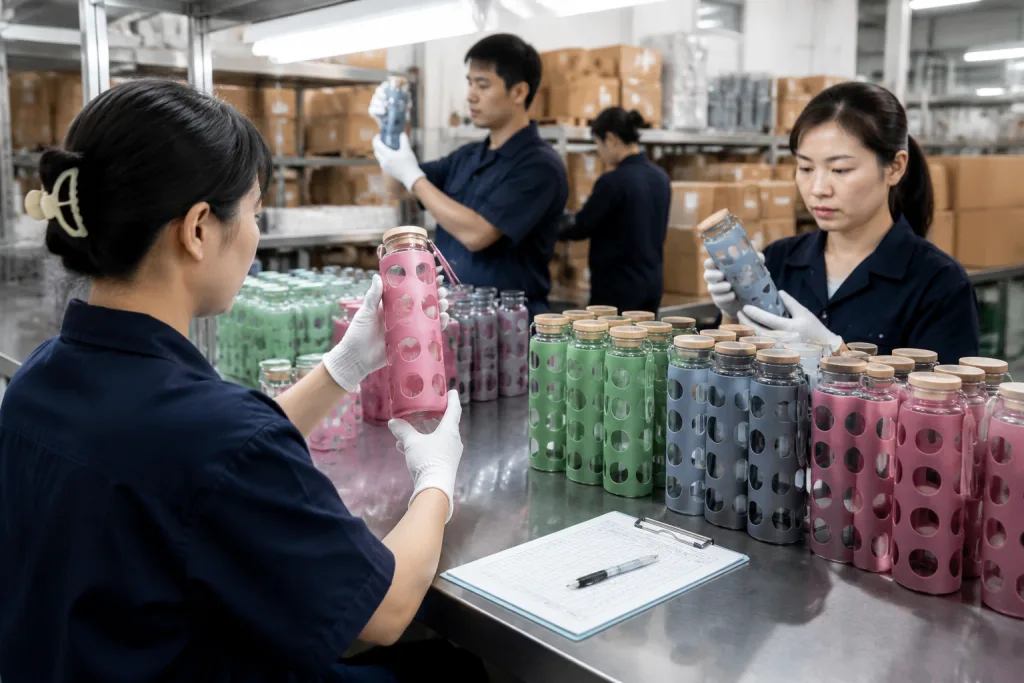
Quality control for silicone glass bottle custom orders should be physical, not just visual. We run an AQL plan such as critical 0, major 2.5, minor 4.0 for final random inspection. For 5,000 units, our inspector normally pulls 200 samples under general inspection level II, based on the chosen standard. Calipers, a torque cap tester, and a clean white inspection table catch problems a phone photo misses. Define defects before production starts, or the factory and buyer end up arguing at the warehouse door.
Critical defects include cracked glass, sharp mouth edges, contamination inside the bottle, wrong food-contact material, and lids that leak under normal use. Major defects include loose sleeve fit, incorrect logo color, print peeling, lid thread mismatch, heavy scratches, deformed cartons, and wrong barcode. Minor defects include small silicone flow marks, slight box scuffing, or tiny print position variation within the approved tolerance. Last season QC pulled a sample with a 1.8 mm sleeve gap near the base; the buyer called it “acceptable,” but on shelf it looked crooked. We rejected that batch.
For leak testing, fill the bottle to 80% capacity, close the lid to normal hand torque, invert for 30 minutes, then shake for 20 seconds. On our line, we check torque at about 0.8 to 1.0 N·m so one operator is not “hand tight” while another is crushing the gasket. A glass bottle is not a carbonated custom growler, so do not sell pressure performance you did not test. If your product is a customizable growler or customized growler for beer or sparkling drinks, that is a separate engineering brief with pressure testing and cap requirements. The math does not work if marketing promises beer-growler performance on a standard tea bottle lid.
Carton testing matters because glass hates bad logistics. For individual boxes, use at least 350 gsm white card or E-flute corrugated for retail packing. Master cartons should usually be 5-ply export cartons, with dividers or a snug inner box fit. Run a 1.2 m drop test on a packed master carton: one corner, three edges, and six faces. If two bottles break in one carton, redesign the packing before shipment. We have seen this go sideways when a buyer cut 0.12 USD from the inner tray, then lost 37 bottles after the first LCL transfer.
Ask for inline photos at 20%, 50%, and 80% completion. A solid canteen factory can correct sleeve alignment early, while the silicone is still being seated and the print jig is still on the bench. Ask for one top view, one side view, and one carton-mark photo each time. A late inspection can only sort, rework, or reject.
Plan packing and shipment early
Packing is part of product design for glass drinkware. For this 550 ml order, we would normally quote one bottle in a polybag, then a printed color box, with 24 units per master carton. Carton size often lands around 48 x 36 x 32 cm after we measure the bottle plus silicone sleeve with a caliper, and gross weight is usually around 14-18 kg. That changes container loading, courier charges, and how your warehouse team lifts cartons all day. The math doesn't work if the gift box looks nice but the carton fails on the corner compression test.
If you sell online, lock barcode, FNSKU, suffocation warning for polybags where required, carton labels, and drop-test requirements before box printing. We have seen this go sideways: the buyer approved the artwork, then Amazon flagged the missing FNSKU after 5,000 boxes were printed. Amazon-style fulfillment is stricter than distributor canteen shipping to one warehouse. A missing FNSKU label can cost more than the logo printing, especially when workers must relabel every color box by hand at the packing table.
For sea freight, FOB Ningbo or FOB Shanghai is common from Zhejiang. Production lead time for a confirmed 5,000-unit order is usually 30-40 days after sample approval and deposit. Add 3-5 days for final inspection booking and export paperwork. If you need goods before a campaign date, count backward from the shelf date: sample approval, production, inspection, vessel booking, sailing time, customs clearance, and local trucking. We run the schedule on a whiteboard beside the packing line, and one late silicone sleeve color approval can move a 12-day buffer down to 3 days.
Payment terms for new buyers are often 30% deposit and 70% before shipment after passed inspection. Established canteen distributors sometimes negotiate different terms after two or three clean orders, but first orders need tight control on both sides. Simple reason. The factory needs cash for glass bottles, silicone sleeves, color boxes, and carton materials before mass production starts; you need inspection leverage before the container leaves Ningbo. Last month QC pulled the sample set after finding 2 scratched logos in a 32-piece check, and the balance payment stayed open until rework was done.
For mixed programs that include silicone glass bottles, custom canteen models, and distributor drinkware sets, consolidate only if carton handling stays safe. Combining metal bottles, glass bottles, and accessories in one shipment can cut freight cost, but weak SKU labels create warehouse trouble fast. We ship mixed containers, but we ask for a carton mark layout with SKU, color, quantity, and PO number in at least 8 mm text. One buyer flagged a PO typo after cartons were sealed; nobody enjoyed reopening 210 cartons for a sticker change.
Decide what is worth customizing
Not every part of the bottle needs custom work. Spend on what the buyer sees on a shelf or in an unboxing, not on hidden tooling. For a first silicone glass bottle custom order, we usually run sleeve color to a Pantone chip, a 1-color or 2-color logo, retail box artwork, and sometimes lid color if the cap supplier has stock resin. I would not change the glass mold unless annual volume is confirmed above 30,000 units or the retailer has a fixed shape requirement in its planogram. New glass tooling looks attractive on a render, but the math often does not work.
A canteen customizable program for distributors works better in layers. Layer one: stock bottle plus logo, usually the safest route for a 1,000 to 3,000 pcs trial order. Layer two: Pantone silicone sleeve matched under a D65 light box, plus custom packaging with barcode and country-of-origin text. Layer three: molded sleeve branding, custom lid insert, and carton marks tied to the buyer’s SKU system. Layer four: new bottle shape, which means mold cost, longer sampling, and more pressure on forecast accuracy. We have seen this go sideways when a buyer approved 8,000 pcs, then changed the sleeve color after the T1 sample was already cut.
For brand owners, molded silicone branding is often worth the cost because it survives rubbing better than pad print and gives the bottle a more owned look. QC pulled one sleeve sample last year after 50 rubs with an alcohol cloth; the printed logo faded, while the debossed logo still passed visual check at 30 cm. For short promotional orders, printed logos are faster and easier to switch between end clients. If you are running a canteen promotional campaign for several customers, keep the artwork flexible and skip permanent tooling unless one client pays for that mold.
Watch the product name. If the PO says canteen, canteen bottle, glass bottle, or travel bottle, the function has to match what the customer thinks they are buying. A glass bottle with silicone sleeve is not a metal hiking canteen, and it is not an insulated growler. Simple mistake, big claim. We once had a buyer flag a carton label because their PO said “camping canteen” while the approved sample was a 550 ml glass bottle for office use. If your line also includes customized canteen or distributor growler products, keep separate specification sheets, carton labels, and test standards.
The practical target is boring: approved sample, stable mass production, clean inspection, no surprise claims. That is what makes a canteen supplier useful. Marketing likes the fancy render, but on the line we trust the signed sample, the sealed golden sample bag, and the QC checklist with AQL 2.5 notes. If the sleeve thickness is 2.0 mm on the approval sample, production should not ship at 1.6 mm just because the color looks right.
Send your silicone glass bottle specification for review
BottleForge will check MOQ, tooling, compliance, packing, and FOB China pricing before you commit to sampling.
Frequently asked questions
What MOQ should I expect for a silicone glass bottle custom order?
For a serious B2B order, expect 3,000-5,000 units per sleeve color. If you use a stock bottle, stock lid, and standard silicone color, some canteen suppliers may accept 1,000-2,000 units, but the unit price will be higher and logo options may be limited. Custom Pantone silicone usually starts at 3,000 units per color because silicone mixing and sleeve production need batch efficiency. Molded sleeve logos often make more sense at 5,000 units or above. For a first order, 5,000 units is a practical balance: enough volume for stable FOB pricing, but not so large that you carry excessive inventory.
Is borosilicate glass necessary, or can I use cheaper glass?
For reusable drinkware, borosilicate glass is usually the better choice. It handles temperature changes better and gives buyers more confidence, especially in Europe and North America. Soda-lime glass can be cheaper, sometimes by USD 0.20-0.40 per unit, but it is less forgiving if users add warm drinks or wash the bottle aggressively. If your order is a short canteen promotional giveaway for cold water only, cheaper glass may be acceptable if labeled honestly. For retail customized drinkware, I would specify borosilicate glass at 2.0-2.5 mm wall thickness and approve the actual sample weight before production.
Can I print directly on the silicone sleeve?
Yes, one-color screen printing on silicone is common and economical. Typical cost is around USD 0.05-0.12 per position, depending on logo size and ink system. The key is curing and adhesion. Ask the canteen manufacturer to test print rub resistance before bulk production. A simple check is 20 dry rubs and 20 damp rubs on the approved sample. Multi-color printing is possible but registration on flexible silicone is not as sharp as printing on paper or stainless steel. If you need a premium permanent logo, debossed or embossed silicone tooling is better, usually with tooling charges around USD 150-400.
How long does production take after I approve the sample?
For a 5,000-unit silicone glass bottle custom order from Zhejiang, China, plan 30-40 days after pre-production sample approval and deposit. Sampling normally takes 7-10 days if you use existing molds and only customize color and logo. New sleeve tooling can add 10-15 days. Final inspection, packing correction, and export paperwork add another 3-5 days. If you are shipping to Europe or North America by sea, do not treat the factory lead time as the delivery lead time. Add vessel booking, sailing time, customs clearance, and local delivery to your schedule.
What should I inspect before paying the balance?
Inspect glass cracks, sharp rims, sleeve fit, lid leakage, logo accuracy, color match, odor, box printing, barcode labels, and master carton strength. Use AQL critical 0, major 2.5, minor 4.0 unless your company has a stricter standard. For leak testing, fill samples to 80%, invert for 30 minutes, and shake for 20 seconds. For packing, run a 1.2 m drop test on a sealed export carton. Do not release the 70% balance only because the factory sends nice photos. Photos help, but a random final inspection gives you real leverage before shipment.