Key Takeaways
- Standard silicone drinkware MOQ usually starts at 1,000 pieces per color, while new molds often need 3,000-5,000 pieces
- LFGB-grade silicone can cost 12-25% more than basic FDA-grade material but reduces odor and EU compliance risk
- Logo method, cap structure, and packaging can change landed cost more than the bottle body itself
- For wholesale drinkware programs, confirm AQL, REACH/LFGB testing, carton drop test, and lead time before deposit
Silicone drinkware wholesale looks simple until the quotes hit your inbox. One supplier prices a collapsible bottle at USD 1.35, another quotes USD 2.10, and both write “food grade silicone.” Same words. Different product. We’ve had QC cut samples on the bench and find 0.8 mm wall thickness on one cup versus 1.2 mm on the approved sample. The price gap is usually tied to silicone grade, wall thickness, cap material, tooling ownership, odor control, or whether LFGB/FDA testing is already included.
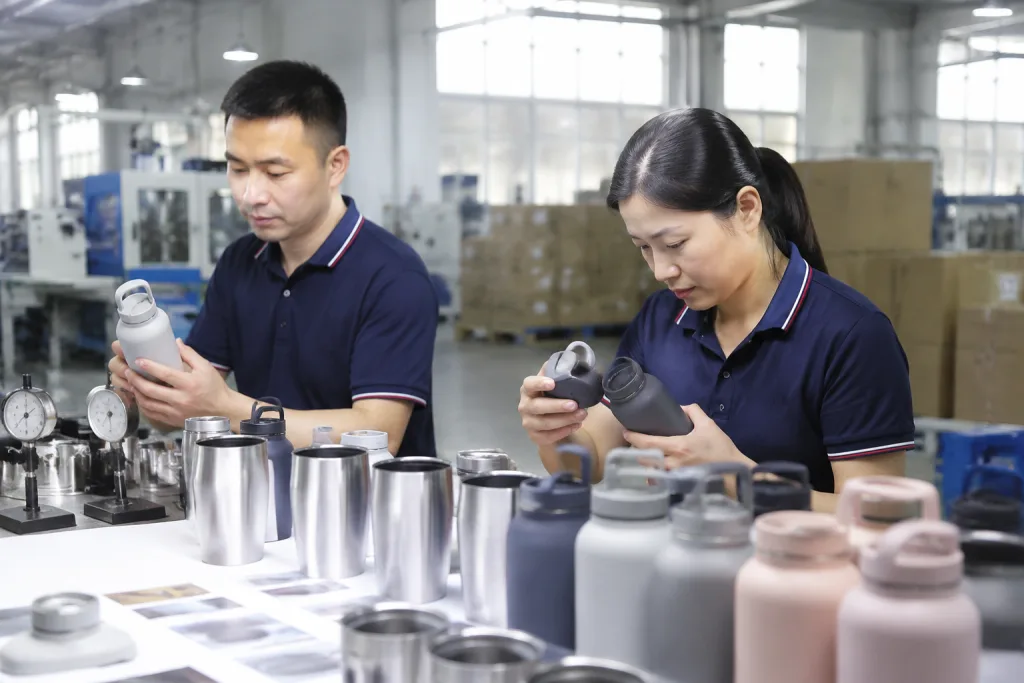
If you buy bulk drinkware for retail, corporate gifts, outdoor channels, beer promotions, or private label programs, ask about construction before asking for the lowest price. The math doesn’t work if a USD 0.18 saving turns into odor complaints after arrival. Our Zhejiang, China team produces and sources drinkware programs at 300,000 units/month capacity, with typical MOQ from 1,000 pieces per color for standard molds. On the line, we run trial shots, check the first 20 pieces with a digital caliper, and pull samples for smell, lid fit, and logo position before mass packing.
Start with the product job
Do not start silicone drinkware wholesale sourcing by asking, “What is your best price?” Start with the job the product must do. A collapsible silicone bottle for gym retail sits on a different line than a soft-touch kids cup, a silicone-sleeved glass bottle, or a promotional beer tumbler bulk order for a 5,000 pcs event run. Wrong first question. Last month a buyer pushed for one mold to cover two channels, and QC pulled the sample after the cap strap tore at the hinge during a simple bend check.
You should decide four points before you ask for quotations: drinking use, sales channel, compliance market, and branding level. If the item touches hot water, acidic drinks, beer, or spirits, the silicone grade and cap material decide whether the order passes or comes back with questions. For EU retail, budget for LFGB or relevant EU food contact testing. For North America, FDA food contact and California Prop 65 screening may be requested by larger buyers. If children are involved, ask early about small parts, choking risk, and ASTM-style mechanical checks. We run the first review with a caliper, a 500 ml fill test, and the artwork PO side by side; one buyer once typed “silicon” instead of “silicone” on the PO, and the lab paperwork had to be corrected before shipment.
The product category also affects the right supplier. Silicone works for collapsible bottles, foldable cups, protective sleeves, straw components, seals, and anti-slip bases because those parts need flex, grip, or compression. It is a poor choice as the main rigid vessel for pressure, carbonation, or long-term heat retention. The math doesn't work. If your brief includes beer growler wholesale, bulk growler, or wholesale growler programs, you are usually better served by stainless steel or glass with silicone seals and sleeves, not an all-silicone body. We have seen this go sideways on carbonation samples: after 24 hours at room temperature, the wall swelling was visible before the leak test even started.
For canteen wholesale and bulk canteen programs, the same logic applies. A hiking canteen can use silicone bumpers, handles, and leak-proof gaskets, but the structure usually needs stainless steel, Tritan, or aluminum. A good China factory should tell you when silicone is the wrong main material. We ship stronger programs that way. On the factory floor, we normally check gasket compression at 1.5 mm to 2.0 mm and run a 100% leak test before packing; saving USD 0.03 on a weak body design will not cover one rejected carton at destination.
Choose silicone grade deliberately
“Food grade” is too vague for a purchase order. In silicone drinkware bulk sourcing, we split it into standard FDA-grade silicone, LFGB-grade silicone, and platinum-cured silicone, then check the quote against compound price, pigment loading, curing method, part weight, and post-curing time. On our line, a 28 g sleeve and a 6 g gasket do not cost the same just because both are “food grade.”
For entry promotional wholesale drinkware, FDA-grade silicone works if the destination market and importer file allow it. For EU retail, we usually push LFGB-grade silicone because migration limits are stricter, and buyers in Germany, France, the Netherlands, and Scandinavia ask for documents more often. LFGB material typically adds 12-25% to the silicone part cost. The math still works. We have seen a buyer save USD 0.018 on a gasket, then lose 12 days on retesting after QC pulled the sample for odor and migration review.
Odor gets orders rejected fast. Low-cost silicone can smell oily or rubbery, especially after 500 pcs sit sealed in polybags for a week. Post-curing at 200°C for 2-4 hours drives off volatiles, but some factories skip it unless the PO says it in black and white. If you plan alcohol flask wholesale, alcohol flask in bulk, or alcohol flask wholesale bulk, be stricter. Spirits expose taste and odor problems quickly. For alcohol flask bulk programs, stainless steel is normally the main vessel, while the silicone gasket or sleeve gets tested as a separate contact part.
Ask your supplier for the exact test plan before sampling. A sensible plan includes overall migration, specific migration where applicable, odor check after hot-water soak, dishwasher simulation if claimed, and colorfastness for bright pigments such as PMS 186C or neon orange. For Zhejiang export production, we normally lock the material grade in the proforma invoice and keep batch traceability for the silicone compound, including the supplier lot number on the incoming material label. It protects both sides if a later production lot is questioned.
Match molds to order economics
Tooling is where silicone drinkware wholesale projects often stop making sense. Silicone compression molds cost less than stainless steel tooling in some cases, but a custom shape still needs cavity layout, vent slots, shrinkage allowance, and at least 2 trial runs on the press. A simple silicone sleeve mold may cost USD 800-1,800. A full collapsible bottle mold with cap interface can run USD 2,500-8,000 depending on cavities and complexity. We had one buyer push for a “small change” to the mouth diameter by 1.5 mm; the math did not work after the cap gauge failed on the first T1 sample.
If you need speed, use an existing mold and customize color, logo, lid, strap, and packaging. Faster. Safer. For standard items, our Hangzhou-area supply chain in Zhejiang can usually sample in 7-10 days and produce in 25-35 days after artwork approval and deposit. MOQ is commonly 1,000 pieces per color for existing molds. For a new mold, expect 3,000-5,000 pieces for the first order, because machine setup, trial loss, testing, and packing line time need to be absorbed. On the line, a 200-ton compression machine still needs mold warm-up, trimming setup, and first-piece QC before we ship anything.
Color decisions cost more than buyers expect. A Pantone-matched silicone batch often needs a minimum pigment mix and a test button before mass production; QC pulled the sample last month because the approved grey shifted after curing by about half a Pantone step. If you order six colors at 1,000 pieces each, the unit price can be higher than one color at 6,000 pieces because each color change creates cleaning time and scrap. This applies to bulk drinkware, canteen bulk, growler bulk, and beer tumbler wholesale bulk projects. Six colors sounds retail-ready, but we’ve seen this go sideways when the PO says “assorted” and the carton mark needs exact color ratios.
For brand owners trying to find the best wholesale drink bottle, the best choice is not always the most custom one. This is the wrong question to ask if your launch date is fixed. A proven mold with a reliable leak rate below 0.5% after inline water testing can beat a beautiful new design that has not survived real production. During inspection, we run a cap torque check, fill test, and upside-down water test before packing; one tiny flash line near the sealing lip can ruin a 10,000-piece order. Use customization around a tested structure first, then develop exclusive tooling for the second order.
Engineer the lid and seal
Most drinkware failures do not start in the cup wall. They start at the lid, gasket, thread, hinge, straw, or vent. We see this often in silicone drinkware wholesale because the body flexes when the buyer squeezes it, folds it, or cartons are stacked 6 layers high on a pallet. One sample passed flat-desk testing in our QC room, then leaked after we compressed it under a 12 kg carton load for 30 minutes.
For collapsible bottles, check the neck ring hardness, thread engagement, gasket thickness, and cap torque. A common food-grade silicone gasket may be 1.5-2.5 mm thick, but thickness alone does not seal the bottle. The compression set decides the complaint rate. We run the cap on a torque meter, then leave samples in a 70°C oven before retesting; if the gasket takes a flat set, the leak usually shows up after 3 weeks of use, not during AQL inspection.
For beer tumbler wholesale, beer tumbler in bulk, or beer tumbler wholesale bulk, silicone is often used as a lid seal, base pad, sleeve, or grip band. If beer aroma retention matters, reject porous, dusty, or under-cured silicone parts. QC pulled one black lid seal last season that left powder on a white glove after 10 rubs. For beer growler bulk, beer growler in bulk, beer growler wholesale, and beer growler wholesale bulk, pressure is the real issue. Do not accept a supplier saying a soft silicone closure can hold carbonation unless the structure has pressure-test records. The safer choice is a stainless steel or glass growler with a validated seal.
For wholesale canteen and canteen wholesale projects, check carry loops and hinge pins early. A silicone loop that feels soft in hand can tear at 5-8 kg pull force if the section is too thin or the gate mark sits at the stress point. We normally pull-test straps and loops at 2-3 times the expected filled weight using a simple tensile fixture on the line. Small test. Big save. We have seen this go sideways when a buyer approved the color swatch but skipped the loop test.
Leak proof is not a slogan. It is a defined test: fill volume, water temperature, orientation, duration, drop height, and pass/fail standard. Write those numbers on the PO, not just “no leaking.”
Price the whole landed program
A unit quote without packaging, testing, freight terms, and inspection standard is not a buying price. It is a half quote. For drinkware wholesale programs, compare FOB Ningbo or FOB Shanghai line by line, including carton size, gross weight, and who pays for the pre-shipment inspection. We ship from Hangzhou, so Ningbo often saves 1-2 days on trucking versus Shanghai, but Shanghai sometimes has better sailing space in peak season. Last month the buyer flagged a USD 0.03 price gap; the real difference was a 58×42×36 cm carton versus a 52×39×34 cm carton.
A typical silicone collapsible bottle might quote at USD 1.20-2.80 FOB depending on capacity, silicone grade, lid structure, printing, and packaging. A silicone sleeve for glass or stainless bottles may be USD 0.25-0.90. Custom retail packaging can add USD 0.18-0.65 per unit. Barcode labels, FNSKU labels for marketplace fulfillment, master carton markings, and insert cards all add handling time. The costs look small until the PO says 20,000 pieces and the warehouse asks for 3 label positions per unit. We run those labels at the packing table, not on the molding line, so labor and error risk go up. QC once pulled 37 cartons because the FNSKU was correct but the PO had a typo in the color code.
Logo choice changes the math. One-color silkscreen is economical for flat or gently curved areas, often from USD 0.04-0.10 per print depending on size. Debossed or embossed silicone logos require mold changes or separate tooling, but they do not wear off. Heat transfer can achieve more color, yet it needs adhesion testing on flexible silicone; we usually bend the sample 50 times and check edge lifting with 3M tape. Laser engraving works on stainless components but is not the main method for silicone bodies. If the buyer wants a 6-color logo on a collapsible cup and still asks for the silkscreen price, the math does not work.
Payment terms and quality risk belong in the price discussion. A common structure from China is 30% deposit and 70% balance before shipment after inspection. For new buyers, that is normal. If a supplier offers a low price with no AQL inspection, no material test commitment, and vague lead time, you are not comparing the same product. You are accepting hidden risk. We have seen this go sideways: the sample passed, bulk silicone smelled strong, and the buyer had no inspection clause to hold the balance. Put AQL 2.5, material standard, packaging version, and shipment port on the quote sheet before you approve the PI.
Control quality before shipment
Quality control for silicone drinkware wholesale belongs on the PO before the line opens, not after cartons are stacked. We work from one approved golden sample, signed artwork with logo size in mm, a Pantone chip under a D65 light box, material specification, packaging layout, and the agreed AQL level. For most drinkware bulk orders, buyers use AQL II with critical defects at 0, major defects at 2.5, and minor defects at 4.0. Stricter settings are fine, but price it into the job; the math does not work if a buyer asks for cosmetic-grade sorting on a 3,000 pcs promo order.
The inspection checklist should cover visual defects, flash at the parting line, short molding around the rim, color deviation against the approved chip, odor after 24 hours in a sealed PE bag, dust contamination, logo position, lid fit, leak test, capacity check, barcode scan, carton drop test, and carton weight. For silicone parts, flash trimming matters. QC pulled a sample last month with a 0.6 mm rough edge near the mouth area; it passed function, but the buyer flagged the hand feel at once. For retail wholesale drinkware, feel is quality.
Do not rely only on final inspection. For new molds or new colors, ask for first-article samples from mass production, taken after the mold temperature and curing time are stable. The first 50-100 pieces often show issues that lab samples missed, such as a loose gasket groove, a dull logo, or a lid that measures 1 mm undersize after cooling. Inline checks every 2 hours beat finding 8,000 lids with loose gaskets when the packing table already has cartons taped shut. We have seen this go sideways.
Compliance documents should match your shipment, not a random old report from another color or another supplier. Ask whether the report covers the same material grade, color family, and food-contact part; our document team checks the report number against the BOM before we ship. Dark pigments, metallic effects, and bright red/orange colors need closer review because migration results can change. If your importer requires REACH, LFGB, FDA, Prop 65, BSCI factory audit, or ISO 9001 support, say it before quotation. A serious Zhejiang, China supplier treats documents as part of the export package, same as the carton mark and the CI packing list.
Decide when silicone is enough
Silicone works well when the product needs wet-hand grip, a folding body for travel, impact protection on the base, quieter handling on a table, or a soft-touch logo area. It is not the right answer for every bulk drinkware brief. If you need 12-hour heat retention, use double-wall stainless steel. If you need premium beer presentation, consider stainless or glass with silicone protection. If you need a lightweight kids bottle, Tritan or stainless with silicone bumper parts may survive school-bag abuse better than a full silicone body. On our line, QC pulled a full silicone kids bottle after a 1.2 m drop because the cap thread distorted by 0.6 mm. The math doesn’t work if the body feels soft but the lid starts leaking.
Search terms cause trouble. Buyers ask for growler wholesale, wholesale growler, beer tumbler bulk, or wholesale canteen, then the drawing they approve is actually a mixed-material design. Your sourcing team should turn the market idea into a buildable spec, not just repeat the keyword from the sales brief. We have seen a PO say “silicon growler” when the buyer meant a 304 stainless beer tumbler with a silicone base ring. That typo cost 2 days of back-and-forth before tooling review. The right build may be a stainless beer tumbler with a 68 mm silicone base, a glass bottle with a sleeve that covers the impact zone, or a canteen using a silicone gasket plus a carry strap.
For brand owners, we usually recommend 3 samples: an existing mold to check price and timing, an upgraded material version with the correct Shore hardness and color masterbatch, and one mixed-material option that matches the retail use case. Test them with real users for 7 days. Fill, wash, drop, smell, squeeze, and pack them in the intended retail box. Simple work. Better answers. A 30-user test will expose cap squeak, dust pickup on matte silicone, carton scuffing, and that faint rubber smell after hot water sits inside for 20 minutes. You will learn more from 30 honest users than from a perfect studio photo.
When you brief a China supplier, include capacity in ml or oz, target FOB price by quantity break, market and testing needs such as FDA or LFGB, packaging format, expected annual volume, and launch date. Add the details we need to run the quote: Pantone code, logo size in mm, carton drop requirement, barcode position, and MOQ target such as 3,000 pcs per color. If you only send a photo and ask for “best price,” you will receive a weak quote. We ship those projects too, but they go sideways fast. Send a clear buying spec, and you get a production answer you can approve, cost, and reorder.
Send your silicone drinkware brief for factory review
We will check material, MOQ, tooling, compliance, and FOB cost before you commit to samples or production.
Frequently asked questions
What MOQ should I expect for silicone drinkware wholesale?
For existing molds, a realistic MOQ is usually 1,000 pieces per color, or 3,000 pieces total if you accept limited color options. For new silicone molds, expect 3,000-5,000 pieces for the first production run. Small trial orders below 500 pieces are possible for stock items, but custom Pantone colors, logo printing, and retail packaging become expensive. If you need canteen bulk or beer tumbler bulk with mixed materials, the MOQ may be driven by the stainless bottle, lid, or carton supplier rather than the silicone part.
Is silicone drinkware safe for EU and North American retail?
It can be safe if the material and testing match the market. For EU retail, ask for LFGB or EU food contact migration testing on the actual silicone part and color family. For North America, FDA food contact is common, and some retailers also ask for California Prop 65 screening. If the product is for children, add mechanical safety checks and review small parts. Do not accept a generic “food grade” claim without reports. Testing budget may run USD 300-1,200 depending on scope, material count, and lab.
How long does production take after I approve samples?
For standard silicone drinkware wholesale using existing molds, production usually takes 25-35 days after deposit, artwork approval, and packaging approval. Sampling is commonly 7-10 days for available molds and 20-35 days if new tooling is required. Add 3-7 days for third-party inspection, document preparation, and booking. Ocean freight to Europe or North America can add 25-45 days depending on port and season. If your launch date is fixed, approve color, logo, and carton specifications before paying the deposit.
Can I use silicone for beer growler or alcohol flask programs?
Use silicone carefully. For beer growler wholesale or alcohol flask wholesale, silicone is usually best as a gasket, sleeve, grip, base pad, or protective boot, not the main vessel. Beer growlers may face pressure from carbonation, so stainless steel or glass is normally safer. Alcohol can reveal odor and taste transfer, so under-cured silicone creates complaints quickly. For alcohol flask bulk or beer growler in bulk, specify the main vessel material, seal test, odor test, and migration test before quotation. Do not rely on a soft closure unless it is pressure-tested.
What should I include in a quotation request?
Send capacity, product type, target market, expected order quantity, color count, logo method, packaging style, compliance requirements, and target FOB price. If you know the sales channel, say it: retail, distributor, corporate gift, Amazon FBA, outdoor store, or brewery promotion. For wholesale drinkware, also include carton limits, barcode or FNSKU needs, and whether you require BSCI, ISO 9001, REACH, LFGB, FDA, or Prop 65 support. A complete RFQ can reduce quotation revisions from 5 rounds to 1-2 rounds.