Key Takeaways
- Set RFQ specs down to silicone grade, capacity tolerance, logo size, carton quantity, and AQL level before asking for USD pricing
- A realistic MOQ for customized drinkware is 1,000-3,000 pcs per color, depending on mold status and packaging complexity
- Samples should confirm smell, grip, lid torque, leakage, logo durability, and packaging fit within 7-12 working days
- Your bulk PO should separate unit price, mold fee, logo fee, testing cost, spare parts, and FOB China port terms
Buying from a silicone drinkware supplier looks simple until the first quote comes back with 3 silicone grades, a loose logo charge, and a carton size that pushes sea freight up by 18%. We see it every week. For custom drinkware going into retail shelves, promo kits, or distributor programs, a 2 mm wall change or 6 pcs per inner box can decide whether the order ships clean or eats your margin.
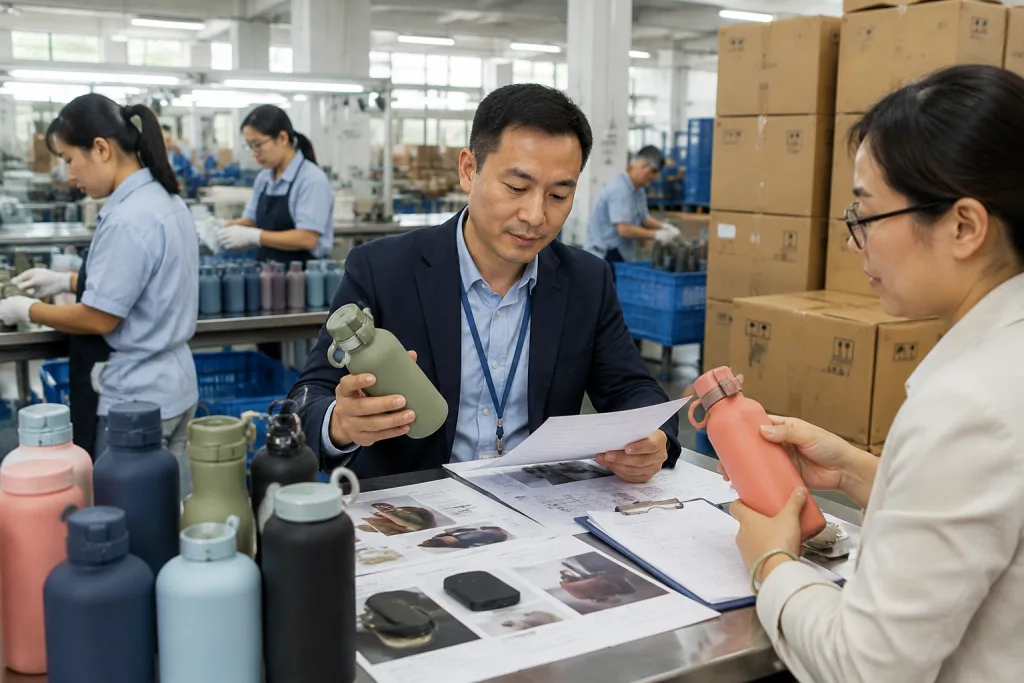
From our factory base in Zhejiang, China, we see the same pattern: good buyers do not ask for “best price” first. They lock the canteen custom requirement, sample route, test standard, packaging, and PO line items before the deposit moves. Our monthly mixed drinkware capacity is about 480,000 units, but capacity means little if the spec is loose; last month QC pulled a pre-production sample because the PO said Pantone 186C and the artwork file showed 185C.
Start with the RFQ sheet
A serious RFQ for a silicone drinkware supplier should read like a small engineering brief, not a mood board. Tell the canteen supplier what to measure, print, pack, and test. If you send one lifestyle photo and a target price, the quotation gets built on guesses. That is where late artwork changes, mold rework fees, and “why is the carton bigger?” arguments start; last month QC pulled a pre-production sample that was 6 mm taller than the buyer’s shelf limit because the RFQ never gave a max height.
For silicone canteen products, define the body material first: food-grade silicone, LFGB-grade silicone, or platinum-cured silicone if your market needs a higher standard. State whether the bottle is fully silicone, silicone over stainless steel, collapsible, or built with PP, Tritan, or stainless components. This matters. A custom canteen with a rigid neck ring uses different tooling and assembly steps from a soft collapsible travel bottle; on our line, that neck ring means an extra fit check with a digital caliper and a separate leak test after cap assembly.
Your RFQ should include capacity, such as 500 ml, 750 ml, 1 L, or 64 oz for a custom growler. Give the acceptable tolerance, normally plus or minus 3-5%. Specify wall thickness where it matters: 1.8 mm feels light in hand, while 2.5-3.0 mm gives better grip but raises silicone weight and unit price. The math does not work if the buyer asks for a 2.8 mm wall, 12 Pantone colors, and a 500 pcs MOQ per color at the same price as a thin stock bottle. For canteen promotional projects, confirm color by Pantone code, not “navy” or “green”; we once had a PO typed as 296C while the approved swatch was 295C, and the buyer flagged it during carton sampling.
At RFQ stage, your draft PO line items should already include: product SKU, capacity, silicone grade, color, logo method, MOQ per color, packaging type, test requirement, delivery term, and requested quote validity. For Europe, mention REACH, LFGB, and EU 1935/2004 if applicable. For North America, mention FDA food-contact expectation, CPSIA if children may use it, and ASTM-related physical safety where relevant. We run cleaner quotes when these items are fixed before sampling; otherwise a 12-day sample plan turns into 18 days after the lab test request and gift box dieline arrive separately.
Price the product, not the picture
We see this at least 8 times a month: a buyer sends the same canteen photo to three canteen manufacturers and gets three prices that do not match. One canteen factory quotes regular food-grade silicone, one quotes LFGB material, and the cheapest one quietly cuts 0.4 mm from the wall or switches to a lighter cap. Same picture. Different product. Last month QC pulled the sample from a “matched quote” job and the neck collapsed at 6.8 kg pressure, because the supplier had reduced silicone weight to win the price.
Ask your canteen manufacturer to split the quotation line by line. A usable quote should show the FOB unit price, any mold fee with cavity count, logo setup by printing method, sample cost with courier charge, packaging cost by box type, testing cost if quoted, plus estimated carton data with pcs per carton and gross weight. For a typical 750 ml silicone customized canteen, you may see FOB Ningbo or Shanghai around USD 3.20-5.80 depending on silicone weight, cap construction, printing, and packaging. A customized growler with a larger body, stronger neck, and handle may sit higher, often USD 7.00-12.00 before special retail packaging. The buyer usually asks, “Can you match USD 2.90?” Sometimes the math doesn't work.
MOQ is not just a factory preference. On the line, silicone color changes mean mixer cleaning, material preparation, first-piece color checks under a light box, and scrap control during the first 30-50 pcs. For an existing mold, a practical MOQ is often 1,000 pcs per color for simple logo work and 2,000-3,000 pcs per color for exact Pantone matching or complex gift-box packing. If you are a distributor canteen buyer building a catalog, launch fewer colors at real MOQ instead of forcing five colors at 300 pcs each. We have seen that go sideways: the buyer saved face on assortment, then paid small-batch premiums hidden inside printing and packing.
Your quotation-stage PO line items should name the price basis such as FOB Ningbo, currency in USD, quote validity for 20-30 days, payment term such as 30% deposit and 70% before shipment, and any tooling ownership statement. Put the boring details in writing. In Zhejiang, China, we prefer to state carton quantity and gross weight before PO confirmation because freight can change landed cost by more than the logo charge. One PO last quarter had “FOB Shanghai” in the header and “EXW Hangzhou” in the remarks; the buyer flagged it after booking, and we lost 2 days correcting paperwork.
Lock artwork before sampling
Sampling turns a customizable canteen from PDF into something you can hold, but the artwork has to be frozen before we run the sample. Silicone moves. It stretches on the mandrel, it can have a matte texture, and most bottle walls are curved by 2-4 mm across the print zone. A logo that looks clean on a flat PDF can grow fat at the edge of a soft bottle. Ask your silicone drinkware supplier for the printable area in millimeters and the jig position we will use on the line, not a loose “logo is OK.” QC pulled one sample last month because a 38 mm logo was placed on a 32 mm flat area. It looked fine on screen. It failed in hand.
Branding choices usually come down to silkscreen printing, heat transfer, molded deboss, molded raised logo, or laser marking on a stainless or metal cap part. For canteen promotional orders, silkscreen is usually the lowest-cost choice, often USD 0.08-0.25 per position depending on color count and size. Molded logo costs more upfront because it may need a logo insert or dedicated mold part, but it gives a cleaner result for a customized canteen program that will repeat for 5,000 pcs or more. The buyer often asks, “Can we decide the logo after the sample?” Wrong question. If the mold shop has already cut the insert, the math does not work.
For sampling, ask for one physical color chip or silicone plaque if exact color matters. Pantone matching in silicone is possible, but material translucency and curing temperature can shift the appearance after vulcanizing at 170-180°C. Approve under D65 light if your retail team is strict. Also confirm whether the sample is made from production material or hand-mixed lab material. They are not always identical. We have seen a lab-mixed blue pass the buyer’s desk, then the bulk material looked half a shade milkier because the production batch used a different silicone hardness, 60 Shore A instead of the 55 Shore A sample.
Your sample PO line items should spell out the sample quantity, color target, artwork file name with version, logo size in mm, logo placement from a fixed reference point, cap color, packaging mock-up, sample lead time, courier account, and approval criteria. Be boring here. A typo like “Logo_V2.ai” on the PO while the attachment says “Logo_V3.ai” can waste 2 days before the line even starts. A realistic sample lead time is 7-12 working days for an existing mold with printed logo, and 18-30 days if a new mold or debossed logo insert is required. Do not approve a sample by photo only for a new canteen customizable program. We ship samples by DHL all the time, but a photo will not show edge distortion, ink thickness, or whether the cap color fights the silicone body.
Test the sample like production
A good-looking sample is not a pass. Silicone drinkware fails in plain ways: odor, weak cap bite, dust pickup, color migration, or leakage after the carton compression test. We had QC pull 32 bottles from one pilot run last spring; 5 leaked after being packed under 18 kg for 12 hours. If you sell to canteen distributors or retail chains, ask for test evidence before bulk starts, not after 3,000 pcs are sealed in master cartons.
Start with sensory checks. Food-grade silicone should not carry a sharp chemical smell after normal washing and airing. A little odor from a sealed polybag is normal, but it should drop after 24-48 hours. Test the bottle with room-temperature water, warm water, and upside-down shaking for 60 seconds. For collapsible silicone drinkware, we run 50-100 compress-and-expand cycles by hand on the line and look at the fold ribs under a 600 lux inspection lamp. Whitening at the fold is a warning sign. Cracks are a reject.
Then check function. Measure filled capacity on a digital scale, cap fit with a go/no-go thread gauge, thread smoothness, strap strength, and standing stability on a flat glass plate. If the item is a custom growler or customizable growler for outdoor use, test handle load with at least 1.5 times the filled weight for a short static pull; we usually hang the load for 10 minutes and record any stretch. For children’s use, ask early about small parts, bite areas, and CPSIA expectations. For Europe, REACH and LFGB migration testing may be needed; for the United States, FDA food-contact compliance documents are usually requested by buyers and platforms. Waiting until shipment booking is the wrong question to ask.
Your sample approval PO line items should list the required tests, who pays the lab fee, the lab name if nominated, and the pass/fail rules. Be exact. We once saw a PO typo that said “odor test: visual only,” and the buyer flagged it two weeks later when the lab invoice arrived. For bulk inspection, state AQL before production. A common starting point is AQL 2.5 for major defects and 4.0 for minor defects, with critical defects at 0. If your brand has a stricter standard, write it before deposit payment. A canteen vendor cannot price proper control if the control level is invented after production.
Write a bulk PO that prevents arguments
The bulk PO is where 8 out of 10 problems should die. If your PO only says “customized drinkware, 5,000 pcs, blue, logo,” you have not bought a product; you have bought an argument. This is the wrong place to be brief. We once had QC pull a sample where the silicone cap thread was 0.4 mm loose because the PO never locked the approved cap version.
For a 5,000 pcs distributor growler or custom canteen order, include the SKU number and approved sample reference; capacity and material specification; color Pantone and logo method with exact logo size; packaging, barcode or FNSKU needs, carton mark, spare parts, inspection standard, and shipment term. If you need Amazon or marketplace preparation, state FNSKU label size such as 50 x 30 mm, label placement, suffocation warning for polybags, carton weight limit, and master carton dimensions. Do not assume the factory knows your warehouse rules. The buyer flagged it after packing once, and re-labeling 120 cartons on the line cost two full shifts.
Payment terms should match risk. For existing molds, 30% deposit and 70% balance after pre-shipment inspection is common in China. For new molds, tooling payment may be 50% upfront and 50% after first qualified samples, or fully paid before cutting, based on mold complexity. If you want mold ownership, the PO should state whether the mold is exclusive, whether we can run it for other customers, and how long the factory stores it without repeat orders. Put the mold number on the PO too; our tool room tags each mold rack, and a missing code can turn a 10-minute check into a half-day search.
Bulk PO line items should be separated clearly: unit price and tooling on their own lines; logo charge, inner packaging, retail box, master carton, spare caps, testing, inspection, and freight if quoted. For FOB China terms, specify the port, such as Ningbo or Shanghai. Our Zhejiang team normally plans 25-35 days for mass production after deposit and sample approval for 3,000-10,000 pcs, assuming packaging artwork is complete and no special lab queue delays occur. If the retail box dieline arrives 6 days late, the math does not work.
Control production before it ships
Once bulk starts, strong buyers stay visible without sitting on the factory’s shoulder. Ask your silicone drinkware supplier for a dated production schedule covering raw material preparation, Pantone color mixing, molding, trimming, logo application, assembly, packing, and final inspection. We run this in a simple Excel Gantt with mold numbers and line names, because a 3-day delay on one cap color can hold a full container. For distributor drinkware programs with 6-12 SKUs, this is where orders go sideways.
Silicone molding has its own quality traps. Color drift can show up between two mixed batches, so QC should keep the first approved color chip beside the press, not buried in an email. Flashing on mold parting lines needs clean trimming; 0.5 mm looks small on the table but ugly in a buyer’s unboxing video. Soft bodies attract dust before packing. Printing also needs enough curing time before products are nested, folded, or bagged. If your order is a canteen customized project with a light logo on dark silicone, ask for a rub test after curing. We usually do dry rub and wet rub checks on 10 pcs first; better to fail 10 samples than reopen 5,000 packed pieces.
For inspections, define defect categories before the line finishes. Critical defects include unsafe material, sharp edges on hard components, contamination, or severe leakage. Major defects include wrong logo, obvious color mismatch, cap not closing, printing misalignment beyond agreed tolerance, or damaged retail box. Minor defects include small cosmetic marks within an agreed size, such as a 1 mm black dot on the bottom area. Use AQL sampling rather than emotional judgment. If you require a third-party inspection, book it 5-7 days before the planned ship date, not the afternoon before container loading. The math does not work when a 40HQ is booked for Friday and the inspector finds leakage on Thursday at 4 p.m.
Your production-control PO notes should include inspection window, rework responsibility, replacement rules, and photo reporting requirements. A practical report pack includes production line photos, packed carton photos, carton marks, barcode scans, gross weight, and random leakage test videos. Ask for clear photos of the master carton label too; we once had a buyer flag a PO typo where “blue” became “bule” on 86 cartons. A reliable canteen vendor should not be offended by this. It is normal B2B control.
Ship with landed cost in mind
Silicone drinkware is not always heavy, but it cubes fast. We run 12 oz collapsible cups at 100 pcs per export carton, while a rigid custom growler with handle and color box can hit the carton volume limit before the weight looks scary. Before you approve packaging, ask for carton size in cm, carton quantity, net weight, gross weight, and estimated CBM. Small detail, big money. Freight can turn a good FOB price into a weak landed margin; we have seen a USD 0.18 cheaper unit price lose money after the buyer changed to a taller retail box.
For North America, check whether your distribution center caps pallet height at 1.6 m, requires a 76 cm carton drop test, or needs GS1 labels on two sides. QC pulled one sample carton last season because the FNSKU label was 8 mm too close to the edge. For Europe, confirm each sales language, recycling marks, importer information, and the compliance document format your retailer accepts. If you sell through wholesale and e-commerce, set one master carton for warehouse picks and one mailer-ready pack for parcel shipping. Decide this before mass packing, not after the forwarder asks for dimensions.
Shipping terms matter. EXW gives you control, but your team must handle pickup, local trucking, export customs, and port cut-off timing. FOB Ningbo or Shanghai is usually cleaner for overseas buyers because the canteen factory handles export customs and delivery to port; our line normally books the truck 2 days before vessel closing. CIF or DDP works for smaller buyers, but compare the full cost and ask what is included. The math does not work if a supplier quotes cheap product pricing and then adds vague local charges, warehouse handling, or “document fees” after production.
Your shipment PO line items should include Incoterm, port, required ship date, carton marks, palletization details, document list, and who books freight. We once had a PO typo showing FOB Shanghai on page 1 and EXW Hangzhou on page 3; the buyer flagged it only after the forwarder refused pickup. Standard documents include commercial invoice, packing list, bill of lading, certificate of origin if required, test reports, and compliance declarations. If you want a long-term silicone drinkware supplier in China, judge them by how cleanly they close the order, not only by how fast they answered the first email.
Send us your silicone drinkware RFQ today
Share capacity, silicone grade, artwork, MOQ, and target market. Our Zhejiang team will return a structured FOB quote with sample timing.
Frequently asked questions
What MOQ should I expect from a silicone drinkware supplier?
For existing molds, expect 1,000 pcs per color for simple customized drinkware with one logo position. For exact Pantone silicone, retail boxes, or multiple accessories, 2,000-3,000 pcs per color is more realistic. New mold projects usually need a commercial commitment of 5,000-10,000 pcs to make tooling worthwhile, even if the first shipment is smaller. A canteen distributor asking for 300 pcs in five colors can get a quote, but the unit price will rise because color changes, setup time, and scrap are spread over too few units.
How long does sampling and bulk production normally take?
For an existing mold, printed silicone canteen samples usually take 7-12 working days after artwork confirmation and sample payment. If you need a molded logo, new lid, special strap, or new body tool, sample timing can move to 18-30 days. Bulk production for 3,000-10,000 pcs normally takes 25-35 days after deposit, sample approval, and packaging artwork approval. Add 5-10 days if third-party lab testing is required before shipment, because lab queues in China can vary by season.
Which compliance documents should I request for silicone drinkware?
For Europe, ask about LFGB, REACH, EU 1935/2004, and any country-specific food-contact declaration your importer needs. For the United States, buyers usually request FDA food-contact supporting documents; if the product is for children, CPSIA and small-parts considerations may apply. Do not accept a random old test report without checking product description, material, color, date, and applicant. For custom canteen production, the safest path is testing your actual production material and color, especially for dark pigments or printed surfaces.
Should I choose printed, debossed, or molded branding?
Silkscreen printing is best for canteen promotional orders where budget and speed matter. It may cost around USD 0.08-0.25 per logo position, depending on size and color count. Debossed or raised molded branding looks more permanent and avoids print wear, but it may require a mold insert or new tooling, so upfront cost is higher. Heat transfer can handle more complex graphics, but you should test adhesion on curved silicone. For a long-term distributor canteen line, molded branding usually feels more premium.
What should I put on the purchase order besides price?
Your PO should list SKU, approved sample reference, capacity, silicone grade, Pantone color, logo method and size, packaging, barcode or FNSKU rules, carton marks, spare parts, testing, AQL level, Incoterm, port, lead time, and payment terms. Separate tooling, logo, packaging, testing, and unit price as individual line items. This prevents disputes when the canteen vendor ships exactly what they thought you wanted but not what your warehouse needs. Attach artwork files and packaging dielines by version number.