Key Takeaways
- Silicone drinkware custom works best when you need drop resistance, foldability, or low pack-out volume, not maximum heat retention.
- A practical MOQ for a stock mold is often 3,000 pcs, while fully custom tooling usually starts at 5,000 to 10,000 pcs.
- For EU and North America, ask for LFGB, FDA, and REACH documentation; use AQL 2.5 for major defects and 4.0 for minor defects.
- For a canteen promotional or distributor drinkware program, simple decoration and one lid style usually beat complex, multi-part designs.
Silicone drinkware custom looks simple until you compare it with stainless, Tritan, or glass on the packing table. The material is flexible, handles rough shipping, and cuts breakage on small runs, but it is not the right fit for every promo brief or retail launch. If you are buying for a brand launch, distributor program, or a seasonal canteen order, match the cup to the channel first; decoration comes after that. We have seen a buyer approve a soft-touch cup in hand, then reject it when the print washed out after a dishwasher test on the line.
In Zhejiang and across China, the better factories ask about use case, target price, and test standard before they talk capacity. That is the right question to ask. A plant running 180,000 units per month can still hand you the wrong result if the wall is 1.8 mm instead of 2.2 mm, the lid snaps too loose, or the logo method cracks at the rim. QC pulled the sample, checked the gauge, and the math did not work. Buy a customizable drinkware item that ships clean, passes compliance, and still makes sense when the end customer opens the box.
Start With The Use Case
Do not start with color chips or logo position. Start with the sales channel and the way the bottle or cup gets used after delivery. Silicone drinkware custom makes sense when the buyer needs a soft grip, squeeze resistance, or a collapsible body that cuts carton volume by about 30%. It is the wrong question to ask if the customer expects vacuum-flask heat retention. We checked one 500 ml silicone sample with a probe thermometer on the line: after 2 hours, the water was already close to room temperature. A silicone body can feel clean and premium, but it will not perform like a double-wall 304 stainless bottle.
A practical canteen manufacturer will split the brief by channel, user, and target price, then quote from there. A school or gym campaign usually needs a canteen customizable for a one-color logo, 3,000 pcs MOQ, and rough daily handling. A retail launch needs cleaner molding, tighter lid fit, and less flash around the mouth, usually under 0.3 mm after trimming. QC pulled the sample on one retail order because the buyer flagged a visible parting line near the logo, and he was right. A canteen distributor with 6 accounts may split the range into a lightweight promo SKU and a better-finished retail SKU. If your buyer list includes canteen suppliers in Europe and a distributor canteen program in North America, the product has to pass both the sales pitch and the dishwasher complaint that comes 18 days after arrival.
Use-case fit changes the shape. A custom canteen for hiking needs a loop, a leak-safe cap, and a body that still stands after compression. A custom growler for events needs display area and fast filling, not a tiny lunch-box profile. We have seen this go sideways when the PO only says “silicone bottle, custom logo” and leaves the line to guess the wall thickness, usually 1.8 mm or 2.2 mm. The factory then quotes the cheapest version, the buyer compares only unit price, and quality drops before the first mold trial.
Silicone Versus Other Materials
Use this comparison before you brief the mold room. We had a buyer ask for “the cheapest collapsible cup with 8-hour insulation” on a PO last March; that spec fights itself, and the math does not work.
| Material | What it does well | Trade-off | Best use-case fit |
|---|---|---|---|
| Silicone | Handles drops, folds down, saves carton space, gives a softer grip at 55-65 Shore A | Limited heat retention, odor risk if the compound or post-curing is weak | Travel cups, camping kits, kids’ bottles, promo gifts, collapsible SKUs |
| Stainless steel | Strong heat and cold retention, heavier hand feel, good shelf value | More weight, higher tooling cost, more finish checks on paint and laser logo | Retail tumblers, insulated canteens, corporate gift programs |
| Tritan | Clear body, low weight, solid impact resistance for daily bottles | Cannot fold, scratches show faster than silicone scuffs | Gym bottles, office bottles, visible-liquid SKUs |
| Glass | Clean taste, sharp retail presentation | Breakage risk, thicker EPE or molded pulp packaging needed | Home drinkware, tea infusers, premium retail sets |
For a canteen custom promotion, silicone usually wins because one 40HQ can carry about 18-25% more folded product than rigid bottles, depending on lid height. We run carton drop tests from 76 cm, and silicone samples usually come back with scuffs, not cracks. For a premium customized canteen sold at retail, stainless steel still wins on perceived value. For a canteen vendor serving a price-sensitive distributor, Tritan sits in the middle. Silicone is the right call when the brief says light, foldable, easy to carry, and hard to break.
Do not ask only, “Is it food grade?” That is the wrong question. Food-grade LFGB or FDA silicone is not generic rubber with a nice color. QC pulled the sample last week because the first post-cure batch still had a rubber smell after 4 hours at 200°C, so we held packing until the second bake passed. A serious canteen supplier in China should give you the Shore A hardness, pigment system, post-curing time, and odor-control method before you sign the order.
The Specs That Change Your Quote
Price moves fast once you change the real specs. Material grade is the first lever: liquid silicone rubber, solid silicone, and mixed-material assemblies all price out differently. Wall thickness is next. On a lot of drinkware shapes, 2.0 mm versus 3.5 mm changes the hand feel and the mold cycle time; on our press line, that extra 1.5 mm can add 18 seconds a shot. Thicker walls feel better in the hand, but the math does not work if you ignore resin cost and cycle loss.
Then come the parts people touch every day. A lid with a silicone gasket, a PP cap, a flip-top mouthpiece, or a carry loop all move the quote. If you are buying a customized growler or a customized canteen for outdoor use, ask whether the cap thread is standard or proprietary and whether the seal is replaceable. This is the wrong question to ask if you only chase a lower unit price. In one Zhejiang canteen factory run, QC pulled the sample because the gasket sat 0.3 mm off center, and that kind of miss shows up fast on the line. The quote should break out the body, lid, gasket, printing, and packing.
For compliance, ask for LFGB if you sell into Germany, FDA for the US market, and REACH for the EU. If your buyer is a distributor canteen program, ask for BSCI, material traceability, and a test report with migration data. We keep those files with the batch card and oven log, not in some loose PDF folder. A practical production setup often uses AQL 2.5 for major defects and 4.0 for minor defects. A normal MOQ for a stock mold can be 3,000 pcs, while fully custom tooling often starts at 5,000 to 10,000 pcs. Lead time is commonly 25 to 35 days after sample approval. If a supplier says "sample ready" but skips the test report, we've seen that go sideways.
Logo, Color, And Packaging
On silicone, the logo choice decides whether the cup looks built for the order or pulled from a shelf bin. We run molded color, embossed or debossed logos, and simple pad print or screen print on the line; laser engraving is for stainless steel, not silicone. For a 1,000-piece canteen promo run, a debossed mark held up after 20 wash cycles when QC pulled the sample, while a surface ink logo started to blur at the rim.
The rule we give buyers is simple. Use embossed or debossed branding when the artwork can be reduced to a 0.5 mm relief and you want a cleaner finish; the tooling cost is higher, but the line stays sharp. Use one-color screen print when the order is 5,000 pieces or more and the art is flat. Use pad print when the logo panel is small, around 20 mm wide, and the buyer is watching unit cost. We saw one PO with the logo spelled wrong by one letter, so check the proof before the mold is cut. For event growler orders, a tactile logo still reads after condensation and a rough hand wash. For retail, a two-color body with one clear mark beats a crowded layout. The math does not work otherwise.
Packaging needs the same discipline. A single polybag cuts scuff marks, but it adds one packing step and more waste. Retail cartons improve shelf appeal, though they raise carton count and take more space in the master case. For Amazon or DTC, we check barcode position, suffocation warnings, and drop test packing on the 60 cm test table. For a distributor order, bulk packing in master cartons often wins on freight; one buyer pushed back on 24-piece inner packs because the carton cube jumped by 18%.
MOQ, Quality, And Factory Reality
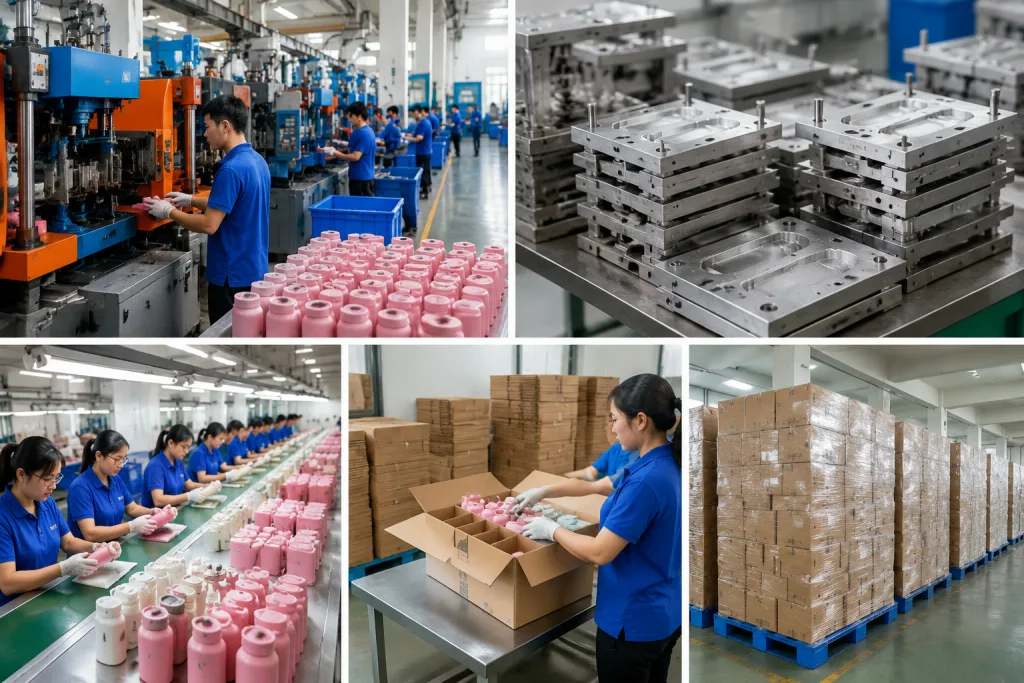
The easiest mistake is comparing only unit price. That is the wrong question to ask. Ask whether the canteen manufacturer can hold quality at your target MOQ, for example 3,000 pcs, and still ship in 22 days instead of slipping to 35. A good canteen factory should walk you through the production flow, not just send a polished sample shot under office lights. Ask how many molding machines they run, how many QC staff stand on the line, and whether raw silicone, assembly, and packing sit in separate marked zones. We run 12 compression molding machines here; if a buyer asks, we show the mold rack, the trimming table, and the packing scale. In Zhejiang export factories, this should be a normal commercial discussion, not a special favor.
Quality control for silicone needs more than a visual check. You want incoming material verification with batch numbers, color tolerance checked against a Pantone card, odor testing after curing, sealing checks, and a finished-product inspection plan tied to the PO. For a standard export order, ask for pre-production samples, then a sealed golden sample for reference. QC pulled one sample last month where the logo sat 1.8 mm off center; that is exactly why the golden sample matters. Use AQL 2.5 for major defects such as leakage, broken lids, or misaligned logos, and 4.0 for minor defects such as small cosmetic marks. If your item is sold as customizable drinkware in Europe, request migration and compliance documents before mass production, not after shipping. After shipping, the math does not work.
A distributor drinkware buyer should also ask for replacement parts. A spare gasket or alternate lid can save a season, especially when a retailer loses 300 lids during repacking. We ship gasket sets in 2,000 pcs cartons, and the buyer flagged it once because the PO said “grey” while the artwork file said “gray.” Small typo. Big delay. If the supplier cannot support spare parts, the lowest quote can become the most expensive order you place.
Match The Product To Your Channel
Channel fit is where 7 out of 10 silicone drinkware custom projects either get clean repeat orders or die after the first PO. Retail needs a better shelf face, Delta E under 1.5 on color checks, and a color box that does not crush in a 12 kg master carton. Promotions need a simple body, low logo cost, and re-order timing the buyer can explain to their boss. We run this on the line often: a canteen promotional campaign usually works better with a compact, one-logo design than with a tricky shape and 3 lid parts. For a canteen distributor, wide lid compatibility and stable repeat orders beat novelty. The math doesn't work if every reorder needs a new mold adjustment.
Start with the buyer who will reorder. A canteen supplier serving corporate gifting may need a customizable canteen that can change from Pantone 186C to 286C without touching the mold. QC pulled one sample last month where the logo sat 2 mm too close to the fold line, and the buyer flagged it before the pre-production sample was approved. A canteen vendors network for outdoor events may prefer a fold-flat cup or a soft-sided custom canteen because it packs smaller and cracks less in mixed cartons. A distributor growler program usually needs a more rigid body or a silicone-and-PP hybrid, because pure silicone can feel too soft for craft-beer presentation. A customized growler is better as a special-use SKU, not the main line.
For North American and European buyers, the cleanest plan is still the one that gets reordered. Keep one or two body sizes, one lid family, and one decoration route such as silk screen or laser plate logo. Then build colors and inserts around that base, with carton marks checked against the PO before mass packing. We have seen this go sideways over small details: one PO said “matte black,” the artwork file said “soft black,” and the buyer expected a retail finish. If the item is a customized canteen for retail, the line should look planned. If it is for promotion, it should be easy to reorder in 30 days without another engineering call.
Build Your Silicone Drinkware Line
Send your target capacity, logo file, and compliance needs. We will quote the right custom drinkware spec for China production, packaging, and repeat orders.
Frequently asked questions
Is silicone drinkware custom safe for EU and US markets?
Yes, if the material and paperwork are right. For Europe, ask for LFGB and REACH documentation; for the US, ask for FDA-compliant food-contact silicone. If the product uses pigments, caps, or gaskets from different suppliers, get test reports for the whole assembly, not just the body. A good factory in China should also provide traceability, batch numbers, and a declaration of material. For retail or distributor drinkware, I would also request a migration test and a pre-shipment sample. If the supplier cannot show consistent odor control and color stability after heat aging, keep looking.
What MOQ should I expect for a custom canteen or silicone bottle?
For a stock mold, 3,000 pcs is a realistic starting point in many factories. For a fully custom shape, expect 5,000 to 10,000 pcs, especially if you want a new lid or a special gasket. If you are ordering from Zhejiang or other export hubs in China, MOQ often depends on whether the factory already has the tooling. A canteen distributor may negotiate mixed colors against one mold, but not usually mixed body styles. If your launch is small, ask for a sample run first and confirm whether the supplier can hold your price at repeat volumes of 5,000 pcs or more.
Which logo method lasts longest on silicone drinkware custom orders?
Embossed or debossed logos usually last the longest because the artwork is built into the mold. Screen print and pad print can look good, but they depend on ink adhesion and the washing pattern. For a canteen promotional product that will be hand-washed often, a molded logo is safer than a surface print. If the artwork is fine detail or small text, check whether the factory can keep the edges sharp after curing. I would also ask for a wash-test sample, ideally 50 dishwasher cycles, before you approve mass production.
Can silicone drinkware go in the dishwasher or microwave?
Most food-grade silicone drinkware can handle dishwasher cleaning and short microwave use, but the full assembly matters. A silicone body may be fine at high heat, while a PP lid, metal insert, or printed logo may not be. Ask the supplier for the maximum recommended temperature for the entire product, not just the cup or bottle body. For a custom growler or custom canteen with mixed materials, I would also check if the gasket stays seated after repeated heat cycles. If the seller cannot give a clear temperature range, treat that as a warning sign.
How long does sampling and production usually take from China?
For a straightforward order, sample development often takes 7 to 12 days if the mold already exists. After sample approval, production is commonly 25 to 35 days, depending on order size and decoration complexity. If you need a new mold, add tooling time before that. Shipping from China to Europe or North America adds another 20 to 40 days by sea, less by air but at a much higher cost. A serious canteen manufacturer should give you a production calendar, not just a vague promise. If they can also show monthly output and line capacity, you can plan your launch more accurately.