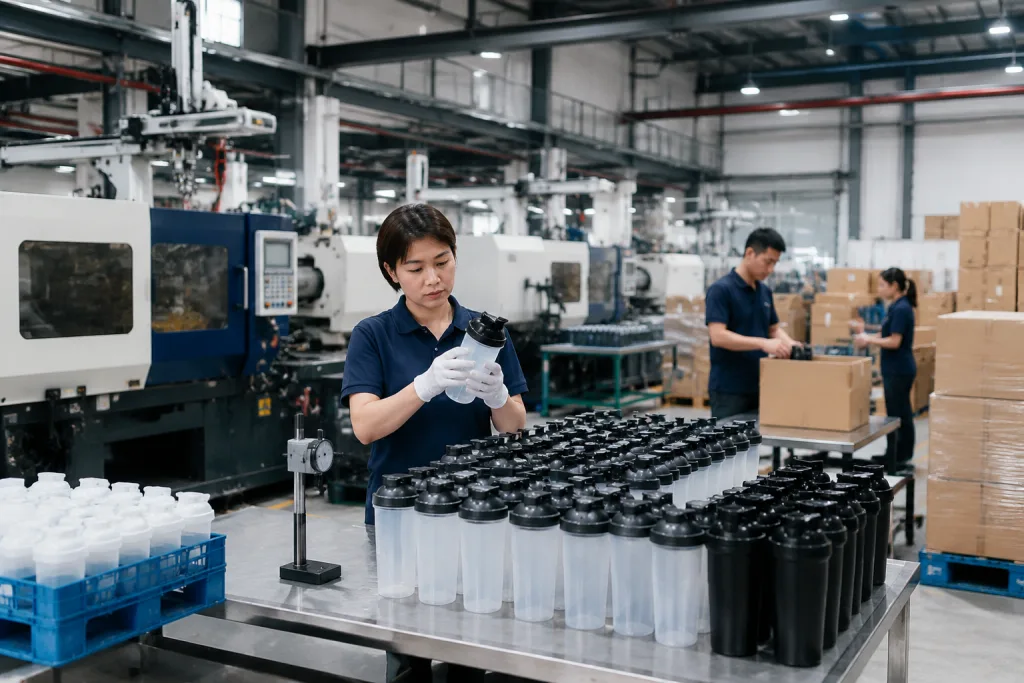
Key Takeaways
- A realistic custom shaker bottle MOQ is often 1,000-3,000 pcs per color, with 20-35 day lead time after sample approval.
- For bulk gym water bottle sourcing, ask for REACH, LFGB, FDA, ISO 9001, and BSCI documents before you compare price.
- A Zhejiang factory with 120,000 units/month output can usually keep repeat orders moving without constant schedule slippage.
- The safest custom logo shaker bottle spec includes material, wall thickness, gasket type, carton count, and a 24-hour leak test requirement.
If you are building a shaker bottle supplier list for a gym chain, fitness brand, or distribution program, names are easy to find. The hard part is cutting out the factories that fail a 3-meter leak test, drift on Pantone color, or turn a 30-day promise into 75 days. For bulk fitness water bottle programs, we run into this all the time: you need a supplier that understands export packing, compliance, and repeat decoration, not a one-off sample that looks fine on the bench.
In Zhejiang and across China, the factories worth your time look plain on paper: MOQ 3,000 pcs, clear spec sheets, and a sales team that can answer wall thickness, cap thread, and decoration limits without guessing. That is the list you want. A custom shaker bottle order is not hard, but a 0.5 mm lid gap or a print shifted 2 mm will trigger complaints fast. QC pulled the sample with a caliper and a go/no-go gauge for the cap. We have seen buyers chase the lowest quote and then pay for rework; the math does not work. For Europe or North America, start with quality, then price.
Start With Supplier Filters
Do not build your shaker bottle supplier list from Google results and nice catalog shots. Start with filters that match your order size and sales channel. If you are buying for a 32-club gym chain, distributor program, or retail launch, the supplier needs export discipline, not just clean product photos. My first screen is blunt: can they quote a bulk shaker bottle with MOQ, lead time, carton size, GW/NW, and packing detail in one reply? If the reply comes back with “dear friend” and no carton measurement in cm, we cut them. Move on.
For a custom sports water bottle program, I sort suppliers into three buckets. First, factories with their own line, testing records, and export shipments. Second, trading companies that can manage sourcing but add margin and 3-5 days when artwork or samples need chasing. Third, generalists selling mugs, yoga mats, phone cases, and whatever else is hot this month. The third bucket is where we have seen this go sideways: one buyer flagged a 750ml shaker sample because the scale mark was 4 mm off after silk printing. If you need a custom gym water bottle or custom fitness water bottle for a seasonal launch, bucket one cuts risk fastest. Ask for factory address in Zhejiang or another China manufacturing base, annual output, and active export markets. A serious supplier usually answers while QC is still pulling the sample from the line.
- MOQ: 1,000 pcs is common for one color and one logo position.
- Lead time: 20-35 days after sample approval.
- Output: a stable line in Zhejiang may run 120,000 units/month.
- Documentation: ISO 9001, BSCI, and test reports should be easy to share.
That is how we turn 80 search-result names into a short shaker bottle supplier list you can actually quote from.
Ask For A Real Spec Sheet
Most failed custom shaker bottle projects start with loose buying words. If you ask for a “customizable shaker bottle” or “customized sports water bottle” without a full spec sheet, 7 out of 10 suppliers will quote the mold already sitting on their shelf. We see it every month. Last March, QC pulled a 700 ml sample that measured 685 ml to the fill line because the buyer’s PO only said “large gym bottle.” A real spec sheet should state volume, outer diameter, height, material grade, lid structure, sealing method, decoration area, carton size, and target market compliance.
For a bulk fitness water bottle or bulk gym water bottle, the useful details are engineering details, not nice-looking words. Ask for exact capacity, such as 700 ml, 800 ml, or 28 oz; wall thickness, often 1.0-1.5 mm for PP or Tritan; and the lid type with a drawing, not just “sport lid.” Flip cap and screw cap tooling run differently on the line. If you want a custom made shaker bottle for retail, ask for the mesh insert or mixing ball material, because stainless steel, PP, and removable spring balls do not pass drop testing the same way. We run the print jig in mm, so request print area dimensions and the exact artwork file format, usually AI or PDF.
When the quote is based on a true spec, you can compare a distributor shaker bottle offer against a direct factory offer without playing detective. Without that, the math does not work. One buyer flagged a USD 0.11 price gap, then we found the cheaper quote used a 42 g lid while our quoted lid was 58 g with a silicone ring.
Good buyers do not ask for the cheapest shaker bottle first. They ask three factories for the same specification, then check which factory quietly removed the gasket, changed the carton, or skipped the mixing ball.
That habit saves 12 days vs 18 days on sample revisions in our normal schedule. It also catches the small charges that go sideways later: Pantone color matching, mold polishing, inner box changes, or a PO typo like “matte black” becoming “mate black” on the sample label.
Check Materials And Compliance
For Europe and North America, material choice is not a line-item detail. A custom sports water bottle for a gym chain has to smell neutral after 3 wash cycles, keep the lid thread clean, and survive daily locker-room handling. We run PP for price-driven bulk sports water bottle jobs, often around 88-95g per body on a 600ml shaker. Tritan costs more, but the clarity is better, and the bottle looks less like a giveaway item on a retail shelf. For a custom fitness water bottle with higher perceived value, Tritan is the stronger retail pick.
Compliance is where 7 out of 20 supplier lists we see start to fall apart. Ask for REACH with substance scope, LFGB for German food-contact buyers, and FDA food-contact support with the lab name shown on the report. If the factory claims a management system, check ISO 9001 or BSCI status instead of accepting a logo in a PDF. For North American retail, buyers often ask us for ASTM-style drop notes or durability records, even when the legal wording is different. QC pulled one file last month where the PO said “LFBG” instead of LFGB, and the buyer flagged it before deposit. Ask for test reports, issue dates, and SGS, Intertek, TUV, or the actual lab behind the stamp.
In Zhejiang, serious factories understand this because we ship to strict markets every week, not once a year. In China, the factories that last are the ones with records on file: resin batch labels, ink MSDS sheets, and dishwasher-use notes tied to the actual lid design. If a supplier hesitates to share compliance documents for a customizable fitness water bottle, treat it as a warning sign. Same story with odor and stain resistance. We have seen this go sideways from a lid gasket 0.2 mm undersize; the bottle body passed, but the protein powder smell stayed in the cap groove.
Practical rule: if a supplier cannot explain material safety, print ink safety, and packaging compliance with separate documents, they are not ready for a serious distributor fitness water bottle program. The math does not work when a 3,000 pcs reorder gets held because the hangtag ink or polybag warning was never checked.
Know MOQ, Price, Lead Time
Price only makes sense when MOQ and lead time fit the same order. For a custom logo shaker bottle, plenty of China factories drop the unit price after 3,000 pcs, but the first PO usually sits at 1,000-2,000 pcs per color. We run that split all the time. What matters is whether the supplier can support your replenishment cycle without forcing a new tool change every reorder. If you are a distributor fitness water bottle buyer, ask about repeat order storage, blank stock, and Pantone retention. QC pulled a retained sample from the shelf last week, and the color match was still on spec.
For reference, a basic PP bulk shaker bottle with one-color logo and standard carton packing may land around USD 0.95-1.80 FOB depending on size, artwork, and lid complexity. A Tritan model or a customized shaker bottle with special cap color, matte finish, or multi-step decoration can move to USD 2.20-3.60 or more. Freight, duty, and inland charges sit outside that number, so the math breaks fast if you compare ex-works to landed pricing as if they were the same quote. This is the wrong question to ask if you only chase the lowest unit price. We saw one buyer flag a PO because the supplier mixed FOB and DDP on the same sheet.
Lead time is usually 20-35 days after artwork approval and deposit. If the supplier claims 7 days for a custom gym water bottle, check whether they are offering stock goods with a logo sticker instead of true manufacturing. A Zhejiang factory running 120,000 units/month can often hold a better schedule than a small workshop, but only if the specification is clear and the color list is limited. Our pad-print line needs a 2-hour changeover for each new ink mix, and that is where sloppy specs burn time.
- Use one Pantone color for the first order if possible.
- Keep the carton count standard so the pack-out table does not slow down.
- Expect mold or tooling fees only if the lid or shape is custom.
That is the math behind a workable shaker bottle supplier list.
Customize Without Raising Risk
Customization should make the bottle easier to sell, not harder to run on the line. On a first sample, we keep it to one body color, one logo position, and one standard lid. Then the factory can lock the mold, check the cap torque, and let QC pull the sample after the third cycle. Once the base model is stable, you can add a second print area, a custom grip pattern, or a special insert. If you stack too many changes at once, the scrap rate jumps fast.
For a custom made shaker bottle, the decoration method is the real decision. Silk screen is the workhorse for flat logos and low cost. Pad print handles curved shoulders and small marks better, especially when the logo sits inside a 25 mm band. Laser works on metal parts, not on plastic lids, so do not push it where it will burn or fade. If you want a custom logo shaker bottle for a premium fitness launch, a matte body, tone-on-tone print, and a cap color matched to your brand usually beat a complicated shape. We have seen buyers chase shape first and then wonder why the print cracked on the 200th wash.
Custom packaging matters for distributors too. A distributor shaker bottle program often needs barcode labels, retail-ready cartons, and, for Amazon-style fulfillment, FNSKU labels on each unit. We ship these with a handheld scanner on the packing table, because one wrong barcode can stop the whole carton at intake. If you are supplying a gym chain, the pack can stay simple, but the batch-to-batch print position has to stay tight. Ask the factory whether they can hold the same print registration across 5,000 pcs. That is the right question. Asking whether they can print a logo at all is the wrong one.
My view is simple: choose customization a factory in China can repeat ten times without drama. We run plenty of jobs where the buyer flagged a PO typo on the carton code after the first 300 pcs, and the fix cost more than the print itself. Keep the spec clean, keep the changes small, and leave room for the line to breathe. That is the kind of customization that scales.
Audit Samples Before You Buy
Samples are not a courtesy item. They are the cheapest place to catch a lid that weeps at the silicone ring, a flip hinge that turns white after 80 open-close cycles, or a logo sitting 2 mm off the center line before you release a bulk sports water bottle order. Ask for a pre-production sample using the final material, final artwork, final carton spec with the same ECT paper grade. Then abuse it like your end user will. We run a 24-hour water leak test upside down, a 1.2 meter drop test on concrete, and an odor check after 60°C warm water sits in the bottle for 30 minutes. QC pulled one shaker sample last month because the PP lid passed dry fitting but leaked once the gasket was seated with a torque gauge.
For larger programs, set the incoming QC plan before the PO is signed, not after the first pallet lands. Use AQL 2.5 for major defects and 4.0 for minor defects. That gives both sides a number to work from when 42 cartons arrive in Europe or North America and the warehouse team starts cutting tape. If the bottle is going into mixed stock, request lot coding and carton marks with SKU, color, batch date, and carton count printed at no less than 8 mm high. If it ships straight to stores, check print scuff resistance with a 3M tape pull and check the cap seal after 200 opening cycles. The buyer flagged this once on a PO as “black lid,” while the approved sample said “charcoal 432C.” That typo cost 12 days.
Inspect the factory too. This is the wrong question to ask: “Can you make it?” Almost every broker says yes. A Zhejiang supplier with organized injection molding machines, pad printing stations, UV curing, and packing tables is easier to trust than a trader moving samples between 3 unknown sites. Ask for line photos, production videos, and a sample retention policy tied to the order number. In our shop, we seal one master sample in a PE bag, sign across the label, and keep it on the QC rack beside the Pantone card. If they keep a sealed master sample, reorder disputes are easier to settle. For a custom fitness water bottle or customized gym water bottle program, that habit saves real money because the math does not work once 5,000 wrong caps are already packed.
Accept samples only when they match the final mass production plan. Anything else is a placeholder, not proof.
That is the line between a supplier and a real manufacturing partner in China. We have seen this go sideways when buyers approved a “close enough” sample and then expected mass production to fix the gap.
Build your shaker bottle sourcing list now
Send your target MOQ, artwork, and market requirements. We will help you compare factories in Zhejiang and China with fewer surprises.
Frequently asked questions
What should be on a shaker bottle supplier list?
Your list should include factory name, location, product range, MOQ, lead time, compliance documents, and export experience. For a serious custom shaker bottle order, also record material options, decoration methods, and monthly output. I would not shortlist any supplier that cannot confirm a 1,000 pcs MOQ or show a clear production schedule. Ask for ISO 9001, BSCI, and REACH-related paperwork before you compare price. If you are buying for Europe or North America, add carton dimensions, drop-test method, and packaging format to the list. That turns a vague supplier list into something you can actually use for sourcing.
What MOQ is normal for custom shaker bottles?
A normal MOQ for a custom made shaker bottle is often 1,000-3,000 pcs per color, depending on the lid, print method, and packaging. For a simple PP bulk shaker bottle with one logo color, 1,000 pcs is common. For a more premium Tritan model or a special cap color, 2,000-3,000 pcs is more realistic. Lead time is usually 20-35 days after sample approval and deposit. If a supplier promises 300 pcs with full customization, check whether they are using stock goods, sticker labels, or an existing mold instead of real production.
Which material is better for a bulk gym water bottle?
For a bulk gym water bottle, PP is the low-cost workhorse and Tritan is the premium option. PP usually gives you the best price for promotions and distributor programs, and it is common in 700 ml to 800 ml bottles. Tritan costs more, but it gives a clearer body and stronger retail appeal for a custom sports water bottle. Many buyers also ask for BPA-free material declarations, REACH support for Europe, and FDA food-contact documentation for North America. If your customers care about appearance and repeat washing, Tritan usually wins. If your priority is margin and volume, PP is often enough.
How do I verify compliance for Europe and North America?
Ask for written test reports, not just a statement. For Europe, you usually want REACH and LFGB support. For North America, ask for FDA food-contact compliance evidence and, if needed, internal durability checks tied to ASTM-style methods. If the factory says they are certified, request the certificate number, issue date, and issuing body. A reliable supplier should also be able to show BSCI or ISO 9001 records if they work with export buyers. For a custom logo shaker bottle, verify both the plastic body and the print ink. Compliance on the body is not enough if the decoration system is weak.
Can I order mixed colors or custom packaging?
Yes, but mixed colors and custom packaging can raise cost and extend lead time. A common setup is 1,000 pcs total with 500 pcs in two colors, but some factories will charge extra for each color split. Custom cartons, barcode labels, and retail sleeves are normal for a distributor shaker bottle program, especially if you sell through chains or Amazon-style channels. If you need FNSKU labels, tell the factory early. For the first run, I would keep the bottle body to one or two colors, then add packaging changes after the sample is approved. That keeps your MOQ and defect risk under control.