Key Takeaways
- For elementary schools, 350-500 ml is usually the right size; 600-750 ml is often too heavy for smaller children.
- A realistic MOQ from a children water bottle factory in Zhejiang is 500 pcs per color, with 25-35 day production after sample approval.
- For U.S. and EU orders, ask for FDA, CPSIA, REACH, and LFGB documents before you confirm the bulk kids bottle spec.
- Laser engraving on stainless and molded or printed logos on plastic each have a different cost; expect USD 1.20-6.50 depending on material and build.
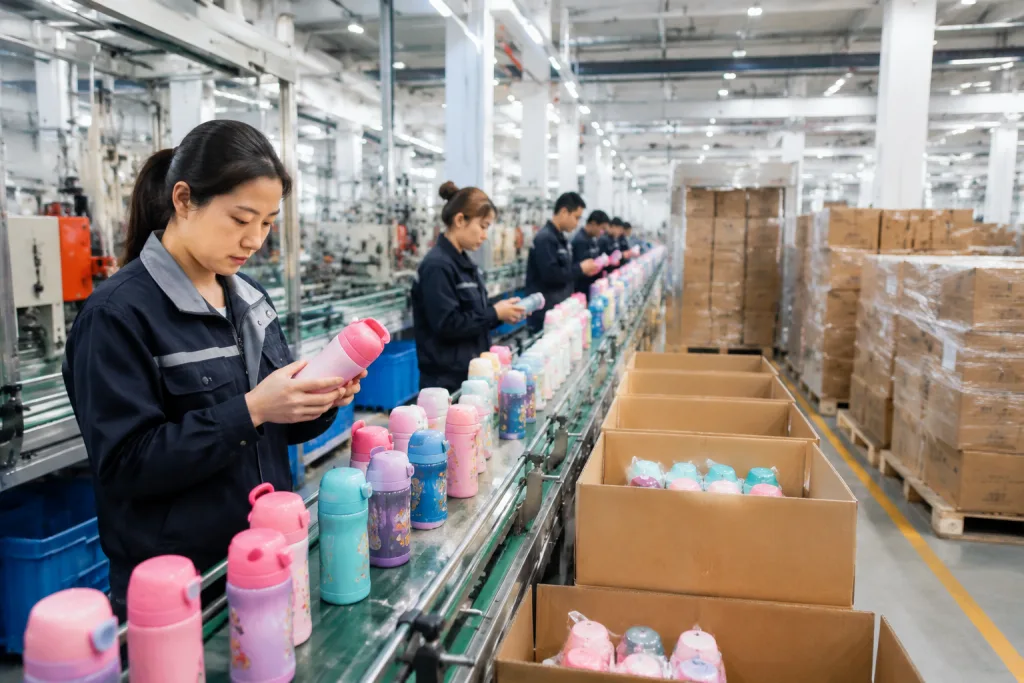
Buying for schools is not retail buying, and the wrong question is, “What is the cheapest bottle?” A school water bottle vendor has to handle 30 open-close cycles a day, dishwasher heat, lost caps, and drops from 1 meter. We run those checks on the line because a bottle that looks fine in a sample can still leak in week 3. For district buyers and kids-product importers, the job is to match a clean spec, a stable bulk price, and a MOQ that fits the program.
If you source from Zhejiang or anywhere else in China, ask for more than a nice sample. QC pulled the sample at the leak test bench, then we checked the carton spec, the print position, and the lid torque before release. A serious children water bottle manufacturer should send test reports, decoration options, carton specs, and a clear MOQ before you place a PO. We've seen this go sideways when a buyer approved a cute bottle and the PO had the wrong logo size by 2 mm; that is how you end up with a custom school water bottle that fails after one term.
What school bottles must survive
A school water bottle vendor should think like a line supervisor, not a lifestyle brand. On our line, the same bottle gets dropped on tile, stuffed into a backpack, rinsed fast, and twisted open by a child with small hands. We run a 1.2 m drop check on the concrete slab for a reason. The spec has to survive first, look good second. If it cannot make one school year, the unit price does not matter.
For most school district programs, a bulk school water bottle should have a leak-resistant lid, a body that resists cracking, and a shape that fits a standard lunch bag pocket. For younger students, 350-500 ml is the practical range. For older children, 500-650 ml is safer than oversized 750 ml models because weight matters once the bottle is full; we have seen a 750 ml sample tip a tray during a pack-out test. That is the wrong question to ask if you start with the largest size.
What to prioritize
- Leak control: Ask for a 48-hour inversion test and a drop test from 1.2 m. QC can pull the cap ring and mark it with blue dye before the run.
- Grip: A bottle with a narrow waist or molded finger zones is easier for small hands, and it cuts the slip complaints we hear from buyers after the first carton sample.
- Cleaning: Wide mouths around 45-55 mm reduce mold risk and make inspection easier. A skinny opening slows the wash line and leaves residue at the shoulder.
- Replacement parts: Extra straws, seals, and lids matter when you buy children water bottle bulk quantities, because one broken gasket can turn a 3,000-piece order into a pile of returns.
If you are a children water bottle distributor, do not over-spec features that make the bottle harder to use. A complicated lid looks premium in a photo, but schools care about speed, hygiene, and low breakage. The buyer flagged a three-step cap on a 5,000-piece PO, and the line slowed down. The best custom kids water bottle is the one teachers do not need to troubleshoot.
Materials that pass real school use
Material choice drives safety, drop resistance, and landed cost. For a custom children water bottle, we run three common builds on the line: Tritan copolyester, PP, and 304 or 18/8 stainless steel. Tritan gives clear walls and low weight. PP is the budget pick and works well for caps, lids, and some body styles. Stainless is the right call if you want insulation, a premium feel, or a longer retail life for a custom made kids bottle. We have seen buyers try to force one spec across school, sports, and gift sets; the math does not work.
For Europe and North America, do not buy on the material name alone. Ask for compliance against REACH, FDA, CPSIA, and if you sell into the EU children market, request documentation for child drinking equipment such as EN 14350 where relevant. A children water bottle supplier in China should also show BPA-free and phthalate-free declarations plus migration test reports from an accredited lab. QC pulled the sample last month and the buyer flagged a PO typo on the test report number; that kind of slip is small, but it stops a shipment fast.
Wall thickness matters too. A typical Tritan body should sit around 1.2-1.5 mm if you want durability without extra weight. For stainless, 0.4 mm to 0.5 mm 304 is common in kids bottles. Thin shells save money, but they dent, flex, and turn into warranty claims. On one 550 ml run, a 0.38 mm shell came back with seam marks after the drop test; that was the wrong spec for school use. In Zhejiang, a capable children water bottle factory will explain why one mold works for 350 ml and another for 550 ml, rather than pushing one body for every age group.
Ask for the exact resin grade, steel grade, and third-party test report. If the answer is vague, the source is not ready for school business.
Caps, straws, and sizes
The lid is where most school bottle failures start. A child will not care about the body finish if the cap leaks into a backpack. On our line, we catch that first with a 1.2 m drop test and a torque check on the cap ring. For a bulk kids bottle program, you usually choose between a straw lid, a flip-top spout, or a simple screw cap. The wrong question is which one looks neat. The real one is which lid survives 3,000 open-close cycles and a few weeks in a classroom.
Straw lids work well for younger children because they cut spills and let kids drink with one hand. We ship a lot of 450 ml units this way, but QC will pull the sample fast if the straw cannot be removed. Fixed straws lead to hygiene complaints, and parents notice that on day one. Flip-top lids suit older kids, but the latch has to hold in a schoolbag. We have seen a cheap spring fail before 800 cycles. Screw caps are the lowest-cost and toughest option, but they are slower at recess and less convenient in class.
Buyer-friendly size guide
- 350-400 ml: Preschool and early primary school.
- 450-500 ml: The safest all-around choice for bulk school water bottle orders.
- 600-650 ml: Better for sports days and older children.
Do not skip mouth diameter. A 45-55 mm opening makes brush cleaning faster, helps with ice, and lets QC inspect the inside with a caliper in seconds. Check the carry loop and lid lock too. A good custom school water bottle should open easily, close with a clear click, and stay shut when it hits the floor. If you are sourcing from children water bottle manufacturers in China, ask for a lid cycle test of at least 3,000 open-close cycles before tooling sign-off. A 2 mm latch mismatch can turn into a full rework. We have seen that go sideways.
Branding that lasts the semester
Branding is where a lot of buyers spend money on the wrong decoration. The wrong question is not "what looks nice on a mockup"; it is "what still looks clean after 60 dishwasher cycles and a semester of backpack abuse." For a children water bottle custom program for a school district, we match the print method to the body material and the way the bottle will be handled on the line.
On plastic bottles, silkscreen printing is the steady choice for 1 to 4 colors when the school logo has clear edges. The screen room can hold good registration, but we still check the 0.3 mm alignment before curing. For stainless steel, laser engraving is usually the better call because it does not peel. If you want a custom logo kids bottle built for rough use, laser marking is often worth the higher setup cost. A printed logo might save a few cents per piece, then the buyer flags it after a hot wash test at 65 C.
Color matching needs a real target. Ask for Pantone references and a working tolerance, not a soft promise from a sales sheet. A Delta E under 2.0 is a fair target on stable materials. If your children water bottle customizable order uses a fixed school color, confirm whether the cap, body, and logo need separate tooling or can run from stock parts. We have seen POs where the school name was typed wrong by one letter, and that mistake cost two extra days on the packing line.
- Best for budget: single-color silkscreen on PP or Tritan.
- Best for durability: laser on stainless.
- Best for premium gifting: multi-step print plus retail box.
For distributors, this is where you separate a real children water bottle vendor from a trader: ask for print adhesion data, not just a mockup. QC pulled the sample after a 24-hour tape test at the bench, and that tells you more than any render on a laptop.
MOQ, price, and lead time
Most school buyers want one straight answer: what will it cost and how fast can you ship? For a serious children water bottle manufacturer in Zhejiang, 500 pcs per color is a workable MOQ on a standard model with simple print. If you want a custom lid, a new mold, or mixed decoration, 1,000-3,000 pcs is the cleaner number. That is how we run the line. It keeps the unit price from jumping around.
Price depends on the build. A basic PP or Tritan custom kids bottle often lands around USD 1.20-2.20 EXW, depending on size and decoration. A stainless insulated model usually starts around USD 3.20 and can go above USD 6.50 once you add better parts and packaging. On the shop floor, QC pulled the sample and checked the lid torque before release, and that is where cheap quotes often start to fall apart. If you are comparing children water bottle wholesale quotes, make sure each quote lists carton count, spare seal cost, and the print method. The buyer flagged it only after the PO said nothing about spare rings.
Lead time is usually 25-35 days after sample approval for standard bulk children water bottle orders. Sampling takes 7-10 days if the mold exists, and new tooling adds real time. A factory in Zhejiang with a capacity of 200,000 units per month can cover a school season, but only if you book the production window early. We have seen this go sideways when a school buyer pushed for August delivery in late June. Ask whether the quoted FOB port is Ningbo or Shanghai, and check whether the shipment uses export master cartons, not domestic retail packs with flimsy inserts.
Practical buyers also ask how many units can move in a month. If the answer is vague, the supplier is probably a middleman, not a real children water bottle factory. A real plant can tell you what the packing table, the cap assembly station, and the carton count can handle in a week. If they cannot, the math does not work.
Quality checks before you place PO
Build quality control into the PO before the line runs. If you are buying a bulk kids bottle or a bulk school water bottle program, put defect definitions on paper and sign off the sample first. We have seen a buyer flag a lid color typo on a PO, and that one word turned into a 1,200-piece dispute. The wrong question is asking for a cheap unit price first.
Start with incoming material review: resin grade, stainless grade, gasket material, and print ink declaration. Then lock the production checks. A normal setup is AQL 2.5 for major defects and AQL 4.0 for minor defects, with visual checks for scratches, logo position, color variation, and lid alignment. For function, ask for leak testing, torque testing on threaded parts, and drop testing from 1.2 m onto hard surface. We run these with a torque meter and a drop table, not guesswork.
Documents to request
- Factory audit or social compliance such as BSCI.
- ISO 9001 certificate if the factory has one.
- REACH, FDA, CPSIA, or LFGB test reports based on target market.
- Pre-shipment inspection photos and carton drop test results.
If you sell through schools or tenders, these records help when a buyer asks for proof. A reliable children water bottle supplier in China should show batch traceability and keep one sealed sample from each lot for at least one season; we keep ours in the QC room for 6 months. If a vendor says this paperwork is optional, the math does not work. That is how a children water bottle promotional program stays out of the warranty pile.
Get a quote for your school bottle program
Send your size, logo, and target market. We will match the right material, MOQ, and compliance set for your bulk order.
Frequently asked questions
What size is best for an elementary school bottle?
For most elementary schools, 350-500 ml is the sweet spot. It is light enough for small hands and still holds enough water for a half-day. Once you go to 600-750 ml, the bottle gets heavier, the wall has to work harder, and younger children are more likely to leave it behind. If the school has outdoor sports or longer day programs, you can offer a second size, usually 550-650 ml, as an upgraded option. A good school water bottle vendor will show both sizes with the same lid system so teachers and parents do not have to learn two different closures.
Can you make a custom logo kids bottle for a school district?
Yes. A custom logo kids bottle is standard work for a children water bottle factory, not a special favor. For plastic bodies, silkscreen printing is usually the lowest-cost route for one to four colors. For stainless steel, laser engraving is better if you want the mark to survive repeated washing. Most school district projects start with a sample showing the school colors, logo placement, and one carton mockup. Expect a setup fee for printing plates or laser programming, then an MOQ around 500 pcs per color for standard items. If you need molded-in color or a special lid, the MOQ usually moves higher.
What MOQ should I expect from a children water bottle supplier?
For a standard model, a realistic MOQ is 500 pcs per color if the factory already has the mold and your decoration is simple. If you want mixed colors, a new cap, or a fully custom body, the MOQ can move to 1,000-3,000 pcs. That is normal in China and especially common in Zhejiang factories that run export programs. Do not only ask for MOQ; ask how MOQ changes with print method, packaging, and spare parts. A serious children water bottle supplier will separate unit price, tooling, and packaging cost so you can compare offers on the same basis.
Which material is safest for school use?
For non-insulated bottles, Tritan and food-grade PP are the common choices because they are light, tough, and easy to inspect. For insulated models, 304 or 18/8 stainless steel is the standard. The safer answer is not one material alone; it is material plus testing. Ask for BPA-free and phthalate-free declarations, then confirm FDA or LFGB, plus REACH for Europe and CPSIA for the U.S. If the bottle uses a straw or gasket, those parts need testing too. A good children water bottle manufacturer in China will provide lab reports for the whole assembly, not just the main body.
How do I verify compliance before ordering from China?
Start by asking for factory paperwork and third-party test reports before you approve the sample. For North America, look for FDA-related food contact documents and CPSIA where needed. For Europe, request REACH and LFGB, and check whether the design fits child-use expectations. Then ask for an inspection plan with AQL 2.5 for major defects, leak testing, and drop tests. If the supplier is in Zhejiang or another part of China, request the company name on the reports so you can match the documents to the factory, not to a trading office. That simple step prevents many sourcing mistakes.