Key Takeaways
- Most school orders work best at 350-650 ml, with no more than 2 sizes in one rollout.
- A realistic MOQ from a children water bottle factory is 3,000-5,000 pcs per design, with 25-35 day lead time after sample approval.
- For Europe, ask for LFGB and REACH; for North America, ask for FDA food-contact docs and review CPSIA or Prop 65 where needed.
- Leak testing, AQL 2.5 major defects, and 100% cap checks protect you from the most expensive returns.
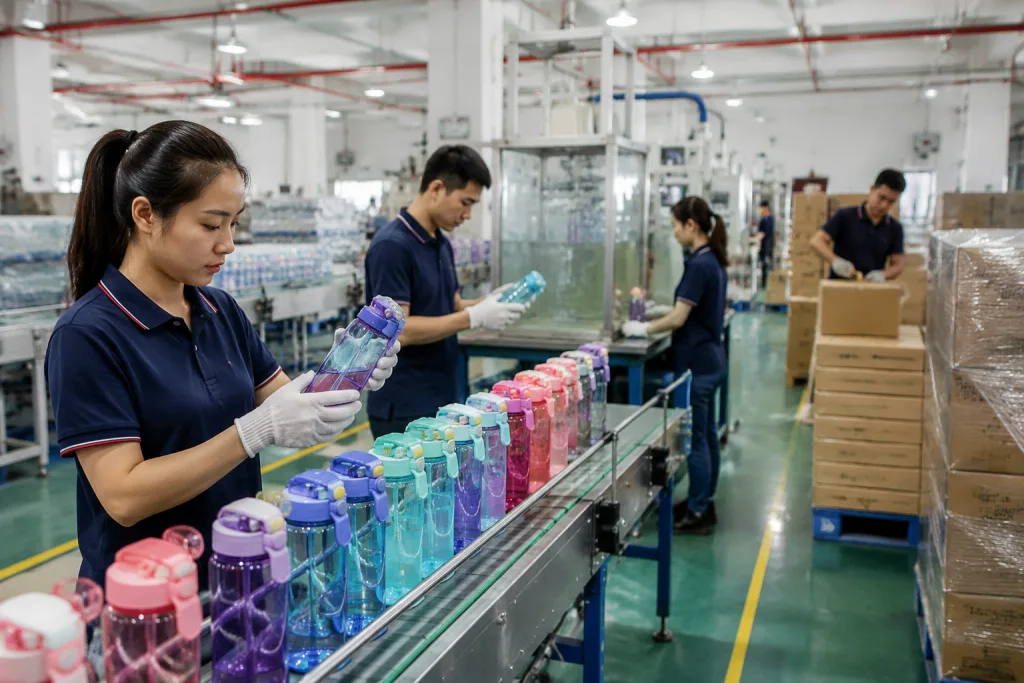
If you buy for a school district or a kids-product import program, the hard part is not finding a bottle. It is finding a school water bottle supplier that can run a 3,000-piece MOQ, pass leak and drop tests, and still ship on schedule. On our line, we check cap torque and print adhesion before the cartons close. A $0.08 cap that cracks on week two costs more than the unit price ever saves.
Good suppliers in Zhejiang and across China should put material data, leak-test results, and carton specs on the table before you place a bulk school water bottle order. If they cannot explain why a 450 ml classroom bottle is not the same as a children water bottle promotional item, the buyer should walk. QC pulled the sample, the logo smeared after 30 rubs, and the PO had one typo that would have sent the wrong school name. We see this go sideways fast, so the safe buyers treat sourcing like an engineering check, not a guess.
Define the School Use Case
Before you ask a school water bottle supplier for price, lock down the job first. A district order for 1,200 desks is a different brief from a children water bottle giveaway at a spring fair. School staff want leak control, easy washing, name labels, and a bottle that fits a lunch bag or backpack pocket. Importers watch landed cost, carton pack count, and whether one mold can cover bulk children water bottle programs across several grades. The wrong question is “what is the cheapest bottle?” We see that go sideways on the line all the time.
Start with age and volume. For children aged 5-7, 350-450 ml is easier to carry; for 8-12, 500-650 ml is the sweet spot. Go too large and kids leave it on desks or in buses. Go too small and the school gets refill complaints by week two. On one run, QC pulled the sample and the 500 ml bottle still cleared a standard backpack pocket, but the 650 ml version rode too high and got pushed back by the buyer. For a bulk school water bottle order, standardize no more than two sizes and two lid colors. That keeps reordering clean and cuts pick errors. Ask the children water bottle factory for sample packs, carton dimensions, and per-unit weight before you approve the design.
- Primary grades: 350-450 ml
- Upper grades: 500-650 ml
- One master design, two colorways max
- Request name panels if the school wants custom school water bottle identification
A practical buyer thinks in replacement rate too. A 2-3 percent spare stock allowance is normal for first-year school rollout. We usually tell clients to budget that from day one, because one typo on a PO or a few cracked lids can burn through the buffer fast.
Materials That Hold Up Daily
Material choice drives complaints. For a custom kids water bottle, Tritan copolyester is the safest clear-bottle pick: it stays clear, does not hold odors, and takes daily school drops better than bargain plastic. Polypropylene costs less and works for a low-price bulk kids bottle, but we see it scratch and haze fast when the wall comes in under 1.0 mm; on the line, QC checks that with a caliper before packing. 304 stainless steel is the steady call for insulated programs. It is heavier, usually 220-280 g for a 500 ml bottle, yet it takes abuse far better.
Do not let a children water bottle supplier hide behind "BPA-free." That is the entry ticket, not the selling point. Ask for food-contact compliance for your market: FDA for the US, LFGB and REACH for Europe, plus a signed declaration for inks, gaskets, and colored masterbatch. We had a buyer flag a PO once because the gasket code was missing; the sample passed, but the paperwork did not. If the bottle has a soft-touch overmold or silicone sleeve, give it 24 hours of ventilation. If the smell still hangs around, walk away.
For school use, I lean toward:
- Tritan for clear classroom bottles that need to survive daily backpacks and desk drops
- PP for the lowest opening price and short promo runs where the buyer watches unit cost
- 304 stainless for heavy-use orders or older students who toss bottles around
If the supplier cannot state the resin grade, wall thickness, and test method, the math does not work. You are buying a guess, and that is where claims start. On a real factory floor, we pull the sample, check the spec card, and compare it to the bottle with a micrometer. If the answer stays vague, move on.
Lids, Sizes, and Carry Features
The lid is where bulk kids bottle programs go wrong. A nice body with a loose cap turns into a leak complaint on day one, and we see it fast on the line. For younger students, a flip-top or push-button lid is simpler than a tight screw cap. For older kids, a straw lid with a silicone valve works, but call it spill-resistant unless the vendor shows test data from the lab. For a school order, the cap should open with one hand and stay shut in a backpack.
Ask the children water bottle manufacturer for a 1.2 m drop test when full, plus at least 3,000 open-close cycles on the lid. If the bottle has a straw, it should stay seated after repeated washing, and the bite valve should not tear after 200 pulls. We had one buyer flag a PO typo on the lid color code, and QC pulled the sample before packing. Size matters too: 350 ml fits kindergarten, 500 ml fits primary school, and 650 ml works if the bottle has a carrying loop and a slim body.
Do not ignore the mouth opening. Wide-mouth bottles are easier to wash and add ice to, but small hands sometimes miss the thread and cross-tighten it. Narrow-mouth bottles are easier to drink from on the move, but they are harder to scrub. The clean answer is to match the lid to the age group and keep one body shape across the order. That is the right question to ask.
One bad lid can cost more than a 20 cent price difference ever saves.
Branding That Survives Washing
Branding is more than decoration. On a custom kids bottle, the mark has to survive dishwasher heat, backpack rub, and the school sink. We run sample checks after 50 wash cycles on the line, and bad ink shows it fast. Screen print is the lowest-cost choice for 1 or 2 colors. Pad print works on small logos and curved caps. Laser engraving is the tough option for stainless steel, while UV print gives full color but only if the curing and test plan are locked in.
If you want children water bottle customizable options for districts, ask for 2 levels of personalization. First is fixed branding: school name, mascot, grade color, or house system. Second is variable personalization: student names, homerooms, or barcodes. This is the wrong question to ask if the school wants 3,000 mixed names on the first order. Variable print pushes MOQ up and slows packing, and we have seen POs come in with 38 different spellings. For a children water bottle promotional order, one base bottle with 2 sleeve or label colors usually ships cleaner.
Be strict on color control. A decent vendor should hold PMS colors within Delta E 2.0 on the bottle body. We check that with a handheld spectro on the first 10 pieces. If they miss the brand color, the bottle looks cheap even when the plastic is fine. For bulk children water bottle orders, ask for a wash test of at least 20 cycles. If the logo lifts, fades, or turns sticky, reject that print method on the spot.
When the buyer wants a custom made kids bottle that feels special, a molded logo on the lid or handle is usually the better call than oversized print on the body. It looks cleaner. It also wears better. A 1.2 mm raised mark still reads after a year in backpacks, while a big body print gets scuffed and the buyer flags it in QC.
Compliance, Testing, and QC
Compliance is where a serious children water bottle manufacturer separates itself from a trader. On our line, QC ties REACH and LFGB to the exact resin lot, ink code, and decoration method, not a generic folder. For the US, ask for FDA food-contact statements and, when the product includes accessories aimed at children, check whether CPSIA or ASTM F963 issues apply. California buyers should also review Prop 65. Do not accept a vague PDF that says the factory is compliant. Ask for batch-specific test reports and keep the approved sample on file.
Quality control should also be written into the purchase order. For a bulk school water bottle shipment, we run AQL 2.5 for major defects and 4.0 for minor defects, plus 100 percent leak testing of assembled lids on the vacuum tester. Ask for a golden sample, a pre-production sample, and a first-article inspection before the rest of the lot runs. Carton drop testing from 1.0 m and a simple odor check after unpacking are worth doing. They sound basic because they are basic, and basic failures create the worst complaints.
A good school water bottle supplier will also track:
- Volume tolerance within plus or minus 5 percent
- Cap torque and sealing force
- Print abrasion after washing
- Carton compression for export freight
If the factory promises everything and documents nothing, your savings will disappear in chargebacks and replacements. We have seen this go sideways on a packing table from one PO typo, and the buyer flagged it before the cartons left the line. The math does not work.
Source from China Without Mistakes
When you source from China, especially Zhejiang, split a real factory from a middleman fast. A children water bottle factory should tell you monthly output, mold ownership, and the exact line for your order. On a 12-head injection line, a serious plant usually runs 100,000 to 200,000 units per month for standard SKUs. For a custom kids water bottle with standard colorways, 3,000 to 5,000 pcs per design is a realistic MOQ, and 25 to 35 days after sample approval is normal. New tooling or special packaging adds days. That's where a lot of buyers get tripped up.
Ask for FOB terms from Ningbo or Shanghai, sample charges in the $30 to $80 range, and clear carton data before booking freight. If you are a children water bottle distributor, check whether the factory can mix cartons by SKU and provide barcodes, FNSKU labels, or retail hang-tags. If you are buying for schools, ask for simple master cartons, spare lids, and replacement parts. On our packing table, one wrong PO line on carton count can turn a clean shipment into a mess. This is the wrong question to ignore.
In China, good exporters are blunt about constraints. If they say yes to every art change, every rush date, and every tiny quantity, they are probably not making the product themselves. A solid children water bottle supplier will tell you where the risk is: print durability, cap seal, or packaging cost. QC pulled the sample, and the lid print rubbed off after a 50-cycle wipe test; the buyer flagged it right away, and we fixed the ink before mass production. That kind of straight talk saves time, and in Zhejiang it usually saves money too.
Before you place a bulk children water bottle order, make sure the factory can answer three questions in writing: what is the exact resin, what is the confirmed lead time, and what test report will ship with the goods. If the supplier cannot name the resin grade on the spec sheet, stop there. On the line, we keep the resin lot number on the traveler card, and that paper trail matters when a shipment gets checked at the port.
Get a factory quote for your school order
Send your age group, MOQ, logo file, and target market. We will match the right custom kids bottle and give you a clear production plan.
Frequently asked questions
What MOQ should a school water bottle supplier offer?
For a standard custom kids bottle, expect 3,000 pcs per color and print. If you ask for unique caps, molded logos, or retail cartons, 5,000 pcs is more realistic. A good school water bottle supplier may offer 1,000-2,000 pcs on stock bodies, but that is not the same as a fully custom children water bottle customized from scratch. Sample lead time is usually 7-10 days, and mass production 25-35 days after sign-off. If a children water bottle supplier says 300 pcs with free tooling, ask who owns the mold and where they hide the cost.
Which material is best for bulk kids water bottle orders?
For classroom use, Tritan is the best balance. It is clear, light, and usually comes in 500-650 ml sizes. PP is cheaper and fine for budget bulk children water bottle programs, but it scratches faster and looks tired sooner. 304 stainless is the durability winner, especially for older kids, but it weighs more and usually lands around 220-280 g for a 500 ml bottle. For schools, I would avoid low-grade AS and any unclear plastic grade. Ask for resin grade, wall thickness, and food-contact reports before you compare price.
How do I make a custom kids water bottle truly leak-resistant?
A bottle is only leakproof if the lid design and assembly say so. For a straw lid, use a silicone seal, a tight fit on the tube, and a vent that closes cleanly. Call it spill-resistant unless the supplier has inverted-shake and drop-test data. Ask for 100 percent leak testing after assembly, 3,000 open-close cycles, and a 1.2 m full-bottle drop test. Also check torque: if parents or students can overtighten and deform the seal, you will get returns. Many complaints come from cap assembly, not from the body itself.
What compliance documents do school buyers need?
Ask for batch-specific compliance, not a generic factory certificate. For Europe, the important documents are LFGB and REACH for the exact bottle, lid, gasket, and print ink. For the US, ask for FDA food-contact declarations, and check CPSIA or Prop 65 when there are decorated parts, accessories, or California sales. If the supplier is a serious children water bottle manufacturer, they should also provide a spec sheet, carton data, test reports dated within 12 months, and photos of the golden sample. BSCI or SEDEX is useful for social audit, but it does not replace product safety testing.
Can I order a custom school water bottle with names and grade colors?
Yes, but personalization changes the order economics. A custom school water bottle with student names is best done with variable labels, laser engraving on stainless, or a printed name panel. Direct print with 500 different names is slow and expensive. For grade colors, keep the body the same and change caps, straps, or sleeves; that keeps your bulk school water bottle order manageable. I would not run more than 6 color or SKU combinations on a first rollout. Expect lead time to add 7-10 days if each school or grade needs a separate pack-out list.