Key Takeaways
- Most school bottles should start at 350-500 ml, with leak testing and one-hand opening for kids under 10.
- A serious children water bottle manufacturer should show REACH, FDA, LFGB, and BSCI documents before you place a bulk kids bottle order.
- Typical MOQ is 3,000 pcs per color with 25-35 days lead time after sample approval at a Zhejiang, China factory.
- Printed logos are cheaper, but a custom logo kids bottle with laser or molded marks usually holds up better after 50+ wash cycles.
If you are buying for a school district, a chain of tuition centers, or a kids-brand import program, the bottle itself is only half the job. The real risk is not the color or the logo; it is a 3,000-piece school water bottle order that leaks in backpacks, fails a 24-hour lid test, or shows three lid colors in the same carton. We run into that on the line all the time. School water bottle manufacturers need to be judged like engineers, not merchandisers.
In Zhejiang, China, the better factories run children's water bottle custom programs every day, but the gap shows up in small things: 0.2 mm seal rings, cap torque, screen-print registration, carton drop tests, and the QC sheet. Chasing a nicer mockup is the wrong question. If the buyer flags a loose lid on sample day, the math already breaks. For a custom kids water bottle to hold up in classrooms, sports days, and distributor shelves, you need proof of capacity, compliance, and repeatability, not just pretty renderings.
Choose the right kids bottle format
The first decision is format, because the wrong shape brings complaints after the print is approved. For schools, 350-500 ml is the safe range. That gives enough capacity for a school day without turning a children water bottle bulk shipment into a load that younger students hate carrying. On our line, we see primary grades do better with a light Tritan or PP body and a soft carry loop. Older kids usually accept 304 stainless more easily if you want better temperature retention and a more premium feel. The buyer flags weight first. The decoration comes second.
For a bulk kids bottle program, pay attention to the lid mechanics. Flip tops, push-button lids, and straw lids each solve a different problem. A flip top is quick, but it needs a strong seal. A straw lid feels familiar to children, but it must be easy to clean. A push-button lid feels premium, but the spring and lock need cycle testing. We run 5,000 open-close cycles on the hinge tester, and QC pulled the sample if the latch loosened early. Ask the children water bottle supplier for a real cycle number. If they cannot give one, the math does not work.
Practical starting point: 450 ml Tritan body, PP lid, silicone straw, 1.0-1.2 mm wall thickness, and a gasketed cap. That setup is common for custom school water bottle orders because it balances weight, durability, and price. On a Zhejiang factory bench, the same cap should fit across multiple colors without a thread change, and the go/no-go gauge should pass the same way every time. If the seller says each color needs a new fit, we have seen that go sideways.
- 350 ml for kindergarten and early primary
- 450 ml for general school use
- 500 ml for sports and after-school programs
Check safety paperwork early
Safety is the first filter, not a paperwork afterthought. If you source from school water bottle manufacturers in China, ask for the exact material declaration on every contact part: body, lid, straw, gasket, and any paint or coating. For Europe, expect REACH compliance and, where it applies, LFGB test reports for food-contact parts. For North America, ask for FDA food-contact confirmation and CPSIA support documents when the bottle is sold as a children's product. If the decoration uses inks or coatings, check those too. On the line, we separate the lid, straw, and printed cup body before packing a 6-part BOM file.
The mistake many buyers make is checking only the bottle body. That is the wrong question to ask. In practice, the weak points are the lid spring, straw, seal ring, and printed surface. A children water bottle customized for school use has to survive repeated washing, drops from desk height, and 12 weeks in a warm classroom locker without odor or peeling. QC pulled the sample after a 1.2 m drop and the cap popped open. That is why you need a supplier declaration plus a third-party test report. One is a letter. The other is what your compliance team can file.
Ask for a BOM-level compliance pack, not just a one-page certificate. For any bulk children water bottle order, that packet should cover materials, tests, and batch traceability back to the 3 kg resin lot, the gasket lot, and the print ink.
In Zhejiang, better factories will also show internal QC standards, incoming inspection records, and finished goods checks. On a 1,000-piece run, we pull samples from the first carton, the middle pallet, and the last pallet. If a children water bottle vendor cannot explain how they handle colorant migration, odor control, or BPA-free verification, keep looking. I have seen buyers skip this step and lose two weeks when the export carton failed a simple smell check. A children water bottle promotional item still has to meet the same safety bar as a premium retail bottle.
Customize without hurting usability
Good customization lifts shelf appeal, but a heavy print can ruin grip, make cleaning awkward, or throw off leak performance. We run a 58 mm body on the line for kids sets, and the best jobs start with hand feel, then decoration. For school orders, one or two Pantone-matched colors, a clean logo panel, and large type work better than crowded art. A custom logo kids bottle can use silkscreen for low cost, laser engraving on stainless steel for wear, or heat transfer for finer art. Each route changes unit price, abrasion resistance, and lead time.
If the buyer wants names, class numbers, or house colors, check whether the factory can handle variable data without choking the run. We had a PO with one typo in a class name, and the buyer flagged it before sampling; that saved a reprint. Some children water bottle manufacturers can print serial-style graphics, but only when the artwork is locked early and the file is clean. The wrong question is "can you customize it?" The real one is whether the factory can keep a 3,000 pcs per color run moving. If the bottle needs to be children water bottle customizable across multiple programs, ask for one shared tooling plan so the same mold supports different lid colors and print layouts.
- Silkscreen: lowest cost, best for 1 to 2 spot-color logos
- Laser engraving: best on stainless steel, strong wear resistance
- Heat transfer: better for full-color art and fine gradients
- Molded marks: useful for premium custom made kids bottle programs
For a bulk kids water bottle order, packaging drives cost and pick speed too. QC pulled the sample after a 60 cm carton drop test, and the plain box won on damage rate and pack time. If the order is for distributors, printed inner boxes and barcode labels help retail scans; if it goes straight to schools, plain cartons with clear size marks usually ship faster and cost less. A children water bottle distributor cares about that because warehouse labor shows up on the invoice.
Understand MOQ, pricing, and lead time
Price only makes sense when you know what sits behind it. For a bulk school water bottle from a Chinese factory, the number shifts with material, lid structure, decoration, and packaging. On our line, a simple PP or Tritan school bottle with one-color printing can sit around USD 1.20-2.20 FOB at larger volumes. A 304 stainless version with a better lid often moves into the USD 2.80-4.80 range. Add custom printing, individual boxes, or an accessory set, and the quote changes again. QC pulled the sample, checked the cap fit, and that extra minute showed up in the cost.
MOQ is where a lot of buyers get stuck. A serious children water bottle factory will often ask for 3,000 pcs per color or per design, sometimes 5,000 pcs if the tooling is new or the decoration has more steps. Lead time for a repeat bulk children water bottle order is usually 25-35 days after sample approval and deposit. New tooling or a special lid can add 10-15 days. One buyer pushed back on a 3,000 pcs MOQ last month; the math does not work at 1,000 pcs when the mold set is fresh. If someone promises a 7-day custom run, ask how they plan to run printing, packing, and inspection without cutting corners.
For school district buyers, land cost matters more than factory price. Include sea freight, duty, inland delivery, and any relabeling. A low FOB on paper can turn ugly once the cartons hit the warehouse. For children water bottle wholesale programs, the real test is repeatability: same bottle, same cap fit, same print on the next 20,000 pcs, no rework. This is the wrong question to ask: "Can you beat the cheapest quote?" Ask whether the factory can ship the same result twice.
Audit factory capability, not just samples
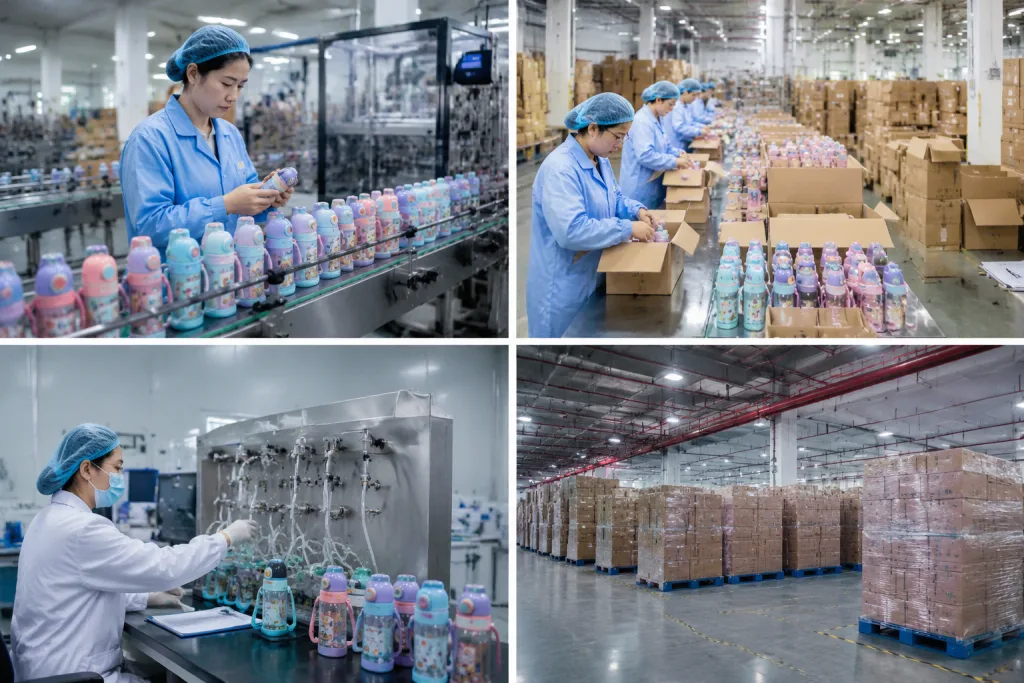
Samples are a start, not proof. A children water bottle manufacturer should show you what happens after sample approval. Ask about monthly output, line count, inspection points, and whether the factory handles lid assembly in-house or sends it out. On a Zhejiang line running 120,000 units a month, we still check cap torque with a dial torque meter. Capacity only matters if the factory keeps AQL targets and color match from the first pallet to the last.
Look for ISO 9001, BSCI, or equivalent social compliance if your buyer has vendor onboarding requirements. Ask whether they run AQL 2.5 for critical defects and AQL 4.0 for minor defects, and whether they do drop tests, seal tests, and odor checks on finished goods. QC pulled the sample after a 1 m drop test, and a 0.8 mm lid gap showed up fast. If the answer stays vague, you are probably talking to a trading layer, not a real children water bottle factory.
Here is the short checklist I would use:
- In-house or controlled mold maintenance
- Batch traceability for resin and color masterbatch
- Leak testing on sample pulls from each lot
- Carton drop testing for export packs
- Clear replacement policy for defective lids or seals
If you are comparing children water bottle suppliers, ask for factory photos, machine lists, and a process map. A children water bottle vendor may source from multiple plants, and that is fine if you know it. We run into trouble when the buyer flags a PO typo or a carton count mismatch only after shipment. Ask for the real producer early, before the first issue lands on your desk.
Match the bottle to the buyer channel
A school district does not buy the same bottle as a distributor or retail importer. For a district, we usually keep it plain: easy to wash, stable cap, and a look that works for 6-year-olds and 12-year-olds alike. A distributor wants more color picks, retail-ready cartons, and room for margin. If you are building a children water bottle wholesale program, do not overbuild it. One body, two lid choices, three colors, one logo position. That is the clean way to run it, and it keeps reorders from turning into a mess.
For a children water bottle promotional item, the math works when you start from a standard mold and one-color print. We have seen buyers push for full-wrap artwork on a low-budget giveaway, and the numbers do not hold. For retail, that same mold can take a better carton, a smoother surface, and a neater hang tag. A children water bottle customized for a district campaign may need the school name, grade-level color coding, or a safety note on the carton. Last month QC pulled a sample with a wrong grade color on the box. That one typo would have sent the wrong pack to three campuses.
After-sales is where channels split fast. Schools ask for replacement caps and silicone seals. Distributors watch carton cube, drop rate, and how many units break in transit. Brand owners care about repeatability and color match from batch to batch. The same custom kids bottle can serve all three channels, but only if the factory knows the job. A Chinese factory shipping to Europe and North America should pack to your SKU rules, not to whatever is easiest on the line. We run this kind of order every week, and the small details decide whether the buyer flags it or reorders it.
When you shortlist school water bottle manufacturers, keep the talk grounded: what is the unit price at 3,000 pcs, what is the pack-out count, which test reports ship with the cargo, and how fast can they repeat the order in Zhejiang, China if the first batch moves in 18 days? Ask for the carton size, too. A supplier who cannot give you a clear 12-day sample lead time and a clean packing list is not ready for school work. That is the wrong question to dodge.
Get a factory quote for your school bottle
Send your target age group, size, logo file, and annual volume. We will map the right spec, price, and lead time for your program.
Frequently asked questions
What is the best material for a school water bottle order?
For younger students, Tritan or PP is usually the most practical because it is light, clear, and easier to carry in a backpack. For older kids, 304 stainless steel makes sense if you want a more durable and premium feel. A common school spec is 350-500 ml with a PP lid and silicone seal. If you need a bulk kids bottle for daily classroom use, avoid heavy shapes and overcomplicated lids. Ask the factory for material declarations on the body, lid, straw, and gasket, not just the bottle shell.
What MOQ should I expect from school water bottle manufacturers?
A realistic MOQ for a custom kids water bottle is often 3,000 pcs per color or design. If you add a new mold, special lid, or multi-step decoration, the MOQ can rise to 5,000 pcs. For a repeat bulk school water bottle order, some Zhejiang, China factories may negotiate lower quantities, but the first order usually needs to cover setup and QC costs. If someone offers 500 pcs with full customization, check whether they are stock goods with a light logo only.
How long does a custom order usually take?
For a repeat production run, plan on 25-35 days after sample approval and deposit. New tooling, unusual caps, or multi-color prints can add 10-15 days. If you need children water bottle customized packaging, expect extra time for carton proofs and barcode checks. Shipping time is separate: sea freight to North America or Europe can add 20-40 days depending on port and season. A good children water bottle factory will give you a clear production calendar and update you if resin or accessories are delayed.
What compliance documents should I request?
For Europe, ask for REACH support and, when relevant, LFGB reports for food-contact parts. For North America, request FDA food-contact confirmation and any CPSIA-related paperwork if the bottle is sold as a children's product. If you are ordering from a children water bottle manufacturer in China, ask for a bill of materials, test reports for the body, lid, straw, and seal, plus batch traceability. If the bottle has print or coating, those surfaces should be documented too. A one-page declaration is not enough for most import teams.
Can I get one logo across school and retail channels?
Yes, but the decoration method should match the channel. For a children water bottle wholesale program, silkscreen printing is usually the lowest-cost option for a simple logo. For stainless steel, laser engraving is more durable and looks cleaner after repeated washing. If you need a custom logo kids bottle for both schools and distributors, keep the artwork simple and the color count low. That helps you reuse the same mold, same lid, and same carton structure without creating separate SKUs for every channel.