Key Takeaways
- For most school programs, 350-500 ml is the sweet spot for younger kids and 550-750 ml works better for older students.
- A practical MOQ is 500 pcs for stock shapes with custom print, while new molds usually start at 3,000-5,000 pcs.
- Expect 20-35 days lead time after sample approval from a well-run children water bottle factory in China.
- Ask for REACH, LFGB, CPSIA, and AQL 2.5 inspection data before you approve bulk kids water bottle production.
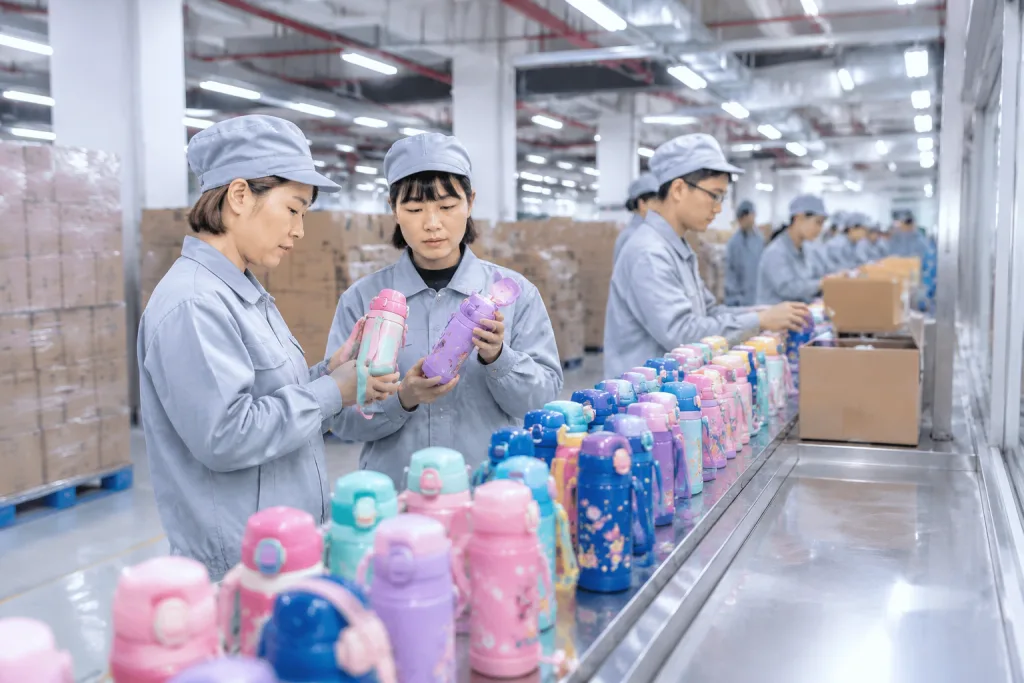
A school water bottle customized order is not about a logo. We run these jobs on the line every week, and the bottle has to survive 1.2 m drops, fit small hands, wash out fast, and clear import checks without a mess. QC pulled the sample after a drop test on the concrete floor, and that is where weak lids show up. If the spec is wrong, you get leaks, parent complaints, and replacement cost that wipes out the unit price saving.
If you source from China, especially Zhejiang, you will find plenty of children water bottle suppliers who can print a logo. Fewer can keep lid fit, odor, migration results, and carton packing under control at scale. The buyer says, "printing is enough," but that is the wrong question to ask. A serious children water bottle manufacturer should ship 300,000 units per month, quote a clear MOQ, and explain why one lid works for 6 to 8 year old students while another fits older kids better. We check that with calipers and a torque gauge, because a loose cap on a PO is how the whole order goes sideways.
Define the school use case first
Before you place a bulk school water bottle order, lock down who will carry it and how the bottle gets used. A kindergarten bottle is not a middle school bottle. Little kids need a lighter body, a one-hand open lid, and a shape that slips into small palms and backpack side pockets. Older students can take 550-750 ml and a firmer lid. We run this check at the line before tooling starts; if you skip it, you end up with a children water bottle bulk order that looks fine in photos and gets dumped at recess. That is the wrong question to ask.
For school programs, start with three checks: capacity, cleaning, and leak control. In most cases, 350-500 ml works for primary school use, while 550-750 ml fits sports days and longer school hours. A custom school water bottle also has to match lunchbox width, cup-holder dimensions, and the height limit of cubby storage. We measured a 248 mm bottle last week, and the buyer flagged it because it stood too tall in the locker. Too narrow, and it tips over. Too tall, and the teacher hears about it.
- Elementary: 350-500 ml, light body, straw or soft spout
- Middle school: 550-750 ml, wider opening, durable carry loop
- District procurement: one spec sheet, one artwork file, one packing standard
If you are buying from a children water bottle vendor, ask for samples filled with real water and shaken upside down for 60 seconds. QC pulled the sample on our bench, and that test caught a loose cap before it left the workshop. A glossy catalog will not show that. For more on product range and materials, see custom kids water bottle options.
Choose the right materials
Material choice is where a lot of bulk kids bottle projects go off track. For a school order, we look at age group, budget, and whether the bottle needs to stay light in a backpack. Tritan gives a clear body, strong impact resistance, and a cleaner pitch to parents. Food-grade PP is cheaper and lighter, so it works for giveaway runs and short-term campaigns. Stainless steel lasts longer, but it adds weight and cost. Glass is the wrong call for children's wholesale. We once saw a carton fail a drop test after a 1.2 m bench drop on the line, and that ended the debate.
My practical view: for elementary students, a PP body with a PP lid and silicone seal is usually the best price-to-performance mix. For district gift sets or higher-end retail, Tritan with a silicone straw is the cleaner upgrade. If the bottle has to survive a full school year, stainless steel with a 0.4-0.5 mm inner wall and a powder-coated outer finish holds up well, and the hand feel sells it. Keep the lid simple. A buyer once flagged a PO typo on the straw count, and the extra detachable parts turned that small mistake into a leakage issue at sampling. The math does not work when the cap has too many seals.
What I would avoid
Skip flip lids, tiny detachable parts, and soft pieces that stay wet. Mold loves trapped water. If a child cannot clean the bottle in under two minutes, parents stop using it, full stop. QC pulled the sample after a 30-second shake test and found water sitting in the hinge groove. That is the kind of detail that kills repeat orders. A children water bottle custom project should cut friction, not add clever bits that look good in a deck and fail in a backpack.
For a deeper look at material trade-offs, compare drinkware material choices before you lock the spec. We usually check that against a 24-hour leak test and a 2,000-piece MOQ before we sign off.
Check compliance before price
If you are importing children water bottle customized products into Europe or North America, compliance comes before price. We ask the supplier for test reports before tooling or artwork gets the green light. For the EU, you usually want REACH and food-contact compliance such as LFGB where relevant. For the US, ask for FDA food-contact suitability, CPSIA when it applies, and Prop 65 awareness for California shipments. If the bottle is sold for younger children, test the full unit, cap, spout, straw, and all.
Real buyers should also push on factory systems. A BSCI audit and ISO 9001 do not make a bottle safe by themselves, but they show the line has basic process control. On a good factory floor, QC pulls the sample from incoming 304 stainless or Tritan batches, checks a 0.2 mm print register, and logs line inspection at every station. A serious children water bottle factory should spell out incoming material checks, in-process checks, and the final inspection standard. AQL 2.5 for major defects and AQL 4.0 for minor defects is a common commercial approach for bulk children water bottle orders. This is the right question to ask before you chase a lower unit price.
Do not approve a school water bottle customized order until you have sample photos, test scope, and a defect standard in writing.
If you need a quality checklist, review factory quality controls before signing off on production.
Make the logo survive daily use
Branding on a custom logo kids bottle has to survive lunchroom abuse, dishwasher cycles, and backpack rub. The right decoration method depends on the body material. On PP or Tritan, silkscreen printing is usually the best buy for one- or two-color logos. On stainless steel, laser engraving holds up and does not peel. Pad printing works on curved areas, but it is weaker for school use over time. On our QC table, we check a sample after 100 washes, and the print still has to read clean. If you are choosing between methods, judge wear first. Price alone is the wrong question.
For children water bottle promotional orders, keep the artwork simple. A logo that is too small disappears; a logo too close to the grip gets scratched. I usually set a print zone of 40 x 25 mm to 60 x 35 mm for school use, depending on body shape. On the line, we mark that area with a steel ruler before first sample approval. If you need names or classroom numbers, variable data is possible, but it adds setup work. A custom children water bottle project with 500 school names is not hard, but it needs clean file control. We have seen one PO go sideways because the buyer mixed two name lists in one CSV.
For a process comparison, see silkscreen vs laser engraving. If you want school branding across multiple campuses, one artwork master and tight color standards will save you time. We run that with one Pantone target, one approval file, and one pack-out check at the carton stage. That is the clean way to ship it.
Understand MOQ and pricing
MOQ is where school buyers lose time. For a stock-shape children water bottle custom order with one-color pad printing, 500 pcs per design is the normal start. If you want a new mold, 3,000-5,000 pcs is the usual range, and a leak-proof lid with a custom strap buckle can push it higher. We run the line this way because the tooling cost has to be spread across the order. If a supplier offers 300 pcs on a fresh mold, the math usually does not work.
Price depends on the bottle body, lid, decoration, and packing. As a rough FOB guide, a simple PP bottle with one-color print may land around USD 1.10-1.90. A Tritan bottle with straw lid often sits around USD 2.20-4.80. Stainless steel school bottles usually fall around USD 4.50-8.50, depending on wall thickness and finish. On the line, we check lid torque with a small gauge before packing, because a loose cap turns into a return. If the quote looks too cheap, ask whether it includes the export carton, spare straw, and final polybag. We've seen that shortcut go sideways.
In Zhejiang, a children water bottle factory can usually ship samples in 5-7 days and finish mass production in 20-35 days after approval. That schedule works when the artwork is clean and the resin or 304 stainless is already on hand. QC pulled the sample, the buyer flagged a lid color mismatch, and we fixed it before the full run. If you need help with the pricing structure, start with MOQ and pricing basics.
Plan packaging and shipment
Packaging is not just a shipping detail. For school contracts, it drives breakage, shelf presentation, and labor cost. We shipped a 3,000-piece district order last season; the buyer wanted plain polybags, while the fundraising SKU needed a color box, barcode label, and hang tag. If your school water bottle customized program goes through ecommerce or a warehouse, lock the carton size to pallet specs and intake rules first. If Amazon is in the mix, FNSKU labels need to be on the PO before the line starts.
A practical children water bottle distributor setup should keep carton weight below 12 kg where possible and carton height under 40 cm for easier handling. On our packing bench, we keep a 5 kg scale and a tape measure next to the sealing machine; that catches a bad load before it leaves the line. For China-to-Europe or North America shipments, confirm drop-test targets, pallet stacking, and whether you need a moisture-barrier bag. During back-to-school season, a crushed lid costs more than the 20 cents you saved on the carton. The wrong question is, "Can we make the box cheaper?" A good children water bottle vendor also marks the outer carton with model number, quantity, and color code so receiving teams do not open every box.
Ask your supplier for packing photos, carton test results, and one master carton diagram before shipment leaves China. QC pulled the sample on a Tuesday and caught a 2 mm corner gap that would have turned into crush damage after two transfers. We have seen a PO typo on carton quantity become a warehouse claim later. That small check saves time where it matters, at the warehouse dock, not at the factory gate.
Get your school bottle spec reviewed
Send your capacity, logo, and target market. We will check MOQ, compliance, and packing before production starts.
Frequently asked questions
What is a realistic MOQ for a school water bottle customized order?
For a stock bottle with your logo, a realistic MOQ is usually 500 pcs per color or per design. If you want a new mold, expect 3,000 to 5,000 pcs because tooling, setup, and testing need to be spread across volume. Some children water bottle suppliers will quote lower, but check whether that price includes one print color, one packing method, and one export carton style. For district buyers, it is often smarter to order 1,000-2,000 pcs in one run and keep 10%-15% as buffer stock. That reduces repeat setup costs and helps you handle late enrollments or replacement needs without another production cycle in China.
Is Tritan, PP, or stainless steel better for a custom school water bottle?
For younger students, PP is usually the most practical because it is light, cost-effective, and easy to source at scale from a children water bottle factory. Tritan is the better upgrade if you want a clearer, more premium look and a stronger retail perception. Stainless steel is best when you need durability and a longer service life, but it adds weight and cost. For elementary school use, I would avoid glass. If the bottle is for a school district giveaway, PP or Tritan usually gives the best value. If you are selling to parents or specialty stores, stainless steel can support a higher retail price and a stronger brand story.
What compliance documents should a children water bottle manufacturer provide?
At minimum, ask for food-contact declarations and recent test reports that match your target market. For the EU, REACH is a must and LFGB is often expected for stronger food-contact reassurance. For the US, ask about FDA food-contact suitability, CPSIA where relevant, and Prop 65 awareness if you ship to California. If the factory is serious, it should also show ISO 9001 or BSCI audit status, plus an internal inspection standard such as AQL 2.5 for major defects and AQL 4.0 for minor defects. Do not accept generic certificates that are not linked to your exact material or model. The report should match the bottle body, lid, straw, and seal, not just one raw material sample.
How long does production take for bulk kids water bottle orders?
If the design is based on an existing mold and your artwork is approved, sample lead time is often 5-7 days. Mass production for a bulk kids bottle order usually takes 20-35 days, depending on quantity and season. If you need a new mold, add another 20-30 days for tooling and first samples. Shipping time is separate: sea freight from China to Europe or North America can take roughly 18-35 days port to port, plus customs and local delivery. If your school season is fixed, place the order early. A reliable children water bottle manufacturer in Zhejiang or wider China should be able to give you a dated production schedule before you pay the deposit.
Can I add student names or classroom numbers to a custom kids bottle?
Yes, but variable data printing needs cleaner file control than a normal logo job. For 500-2,000 pieces, the factory can usually print names, class numbers, or campus codes if you provide a spreadsheet with exact spelling and order. The more unique the data, the more careful the proofing must be. I recommend a 1-2% overrun for sorting and any misprint replacement, especially for school district orders. If you want each bottle personalized, keep the base design simple and use one print location. For stainless steel, laser engraving is ideal for names because it stays readable longer than ink. If you are working with a children water bottle vendor, ask for one pre-production proof sheet before mass printing starts.