Key Takeaways
- For ages 3-6, 350-400 ml is usually enough; for grades 1-5, 450-600 ml keeps weight down and reduces spills.
- A practical children water bottle factory in Zhejiang, China may offer 120,000 units/month, MOQ 3,000 pcs, and 25-35 day lead time.
- Budget PP bottles often land at USD 1.20-2.30 FOB, Tritan at USD 2.40-4.80, and insulated stainless at USD 4.80-9.50.
- Ask for AQL 2.5 inspection, REACH or FDA reports, plus 1.2 m drop and 24 hour inversion leak tests before you confirm bulk kids water bottle orders.
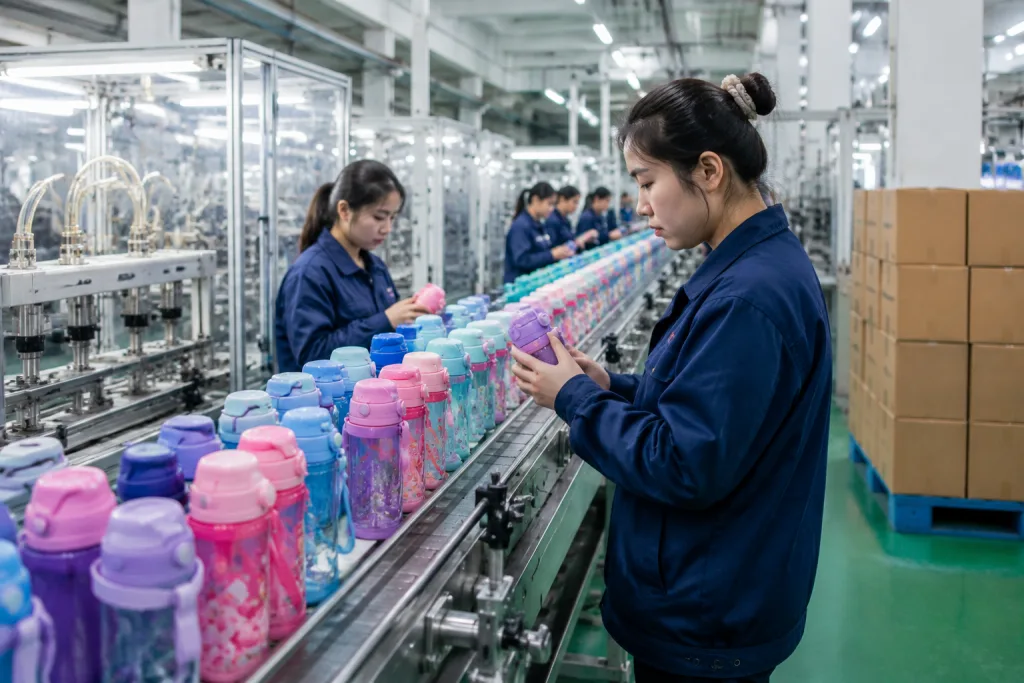
If you are buying for a school district, importer, or kids-product program, a school water bottle customizable has to do more than carry a logo. On our line, we check whether a 350 ml bottle fits a small hand, survives a 1.2 m drop test, passes food-contact testing, and stays leak-free in a backpack full of books and lunch boxes. The spec that wins is usually the one that gives steady quality at a clean landed cost, not the flashiest cap.
That is why buying a custom kids water bottle from a Zhejiang, China factory is a technical job first. Before price, you lock the material, lid, print method, and carton count. QC pulled a sample once with a 0.3 mm gap at the spout, and the buyer flagged it before we ran the full order. A real children water bottle factory will ask age group, drinking style, compliance market, and annual volume first. If they skip those questions, you are getting a generic quote, and the math does not work.
Start With Age And Use
Before you compare colors or print methods, lock down how the bottle will be used. A bulk school water bottle for kindergarten needs a different body shape than a bottle for middle school students, and we see that on the line every week. Younger kids usually need a lighter, shorter bottle with a soft straw or sip spout; older children can handle a wider mouth, a flip-top lid, or a simple screw cap if the school allows it. Get the age band wrong and the bottle looks fine on paper but fails in the classroom.
Capacity is the first number we check. For ages 3-6, 350-400 ml is enough. For grades 1-3, 450-500 ml is the sweet spot. For older primary students, 550-650 ml works better, especially for sports days. Keep the empty weight low. A clear Tritan bottle can stay under 180 g, while a stainless custom kids bottle may move closer to 260-320 g depending on insulation. That difference matters when you are selling children water bottle wholesale into school programs, and the buyer will flag it fast if the bottle feels heavy in a 6-year-old's backpack.
- Kindergarten: 350-400 ml, easy-grip body, straw lid, no loose small parts.
- Primary school: 450-550 ml, leak-resistant flip top, wider base for desk stability.
- Older kids: 550-650 ml, faster drinking flow, simple cleaning, backpack-friendly shape.
If you are a children water bottle distributor or a school buyer, ask the supplier for a sample in the exact age group you need. QC pulled the sample on our bench with a 6-year-old grip test and the result was clear: one mold does not fit every grade. A custom school water bottle that works for a first grader will not be the same bottle you should ship to 12-year-olds. Good children water bottle manufacturers in China usually suggest two or three body sizes, and that is the right move. We had a PO last quarter with a typo on the capacity line, and the buyer pushed back after the school checked the sample in person.
Pick Materials That Pass
Material choice is where most school water bottle customizable orders are won or lost. On our line, a 400 ml Tritan sample with a 1.5 mm wall keeps its shape after backpack abuse and still looks clean on a retail shelf. For a lower-cost bulk children water bottle, food-grade PP still works if the buyer accepts a simpler finish. For insulated use, 304 stainless is the base spec; 316 stainless only makes sense when the school needs more corrosion resistance and will pay for it. The math does not work if you try to cover every option at once.
Do not stop at BPA-free. A serious children water bottle supplier should hand over material declarations and test reports for the target market. For Europe, ask for REACH and LFGB. For North America, request FDA food-contact documentation and, where the bottle is for child-focused programs, confirm CPSIA-related requirements if they apply. If the bottle has printed graphics, the inks and coatings need to pass migration limits too. We once had a blue print fail after an alcohol wipe test, and the buyer flagged it fast. A pretty children water bottle customized with the wrong coating is a refund waiting to happen.
My rule: if the bottle cannot survive a 1.2 m drop, 24 hours inverted, and repeated wash cycles, it is not ready for school use.
Lid design matters as much as the body. Straw lids are easy for younger children, but they need clear cleaning instructions because the valve gives you one more leak point on the bench test. Flip-top lids are faster for classroom use. Screw caps are the cheapest, but they are easy to lose and a poor fit for a bulk school water bottle program. The wrong question is which lid costs less by 2 cents; the right one is which lid matches the age band and cleaning method your buyer actually runs. A good children water bottle manufacturer will give you lid options that fit that use, not a sales brochure answer.
Make Branding Work Harder
For school orders, branding does more than look nice. It identifies the bottle, supports resale, and keeps the set together after 20 weeks in a backpack. On our sample table, QC checks a 1.5 mm stroke before we release artwork. A custom logo kids bottle can run one color for a district fundraiser, two colors for a school brand, or student names for each class. Keep the art clean and the print panel generous. If the logo breaks into tiny lines, it will chip, scratch, or blur fast after daily use.
Each decoration method suits a different bottle body. Silk screen is the workhorse for flat or lightly curved plastic shells, and it stays cost-effective on 3,000-piece children water bottle wholesale runs. Pad printing handles small panels and curved lids well. Laser engraving is the better call on stainless steel because the mark does not peel. If you want a custom made kids bottle that feels more premium, go with a laser logo, matte powder coat, and a plain one-color outer box. A crowded print looks busy on shelf. We have seen that go sideways more than once.
- Best for school districts: one or two spot colors, a logo panel wide enough for a 35 mm name line, and a student name area.
- Best for importers: Pantone control, sample sign-off, and a 200-rub print test before mass run.
- Best for promotional use: a simple layout and low tooling cost on a custom school water bottle.
Ask the factory what changes cost after sampling. A late logo shift from 38 mm to 48 mm can mean a new screen, a recheck, and another 7 days on the line. A lot of children water bottle custom jobs get expensive because the buyer keeps revising the art after the proof is signed. We had one PO list the logo as "blue" while the file called for Pantone 300C. QC caught it before packing, but the buyer still lost a week. If you work with children water bottle vendors or children water bottle suppliers in China, lock the print file before mold approval. That is the right question to ask.
Compliance Beats Guesswork
For Europe and North America, compliance belongs in the RFQ, not in the last email before shipment. A children water bottle factory in China should tell you which reports cover the resin, the ink, the lid, and the full assembly. On our line, QC pulls 3 samples from every 5,000 pieces before packing, and that catches bad print or a loose cap fast. If the bottle is headed to a school district, a verbal promise is cheap. Paper wins. This is where a disciplined children water bottle manufacturer stands apart from a trading-only children water bottle vendor.
Ask for food-contact test reports for the body and lid, heavy metal limits for decoration, and migration testing for the finished product. For Europe, REACH and LFGB are the usual reference points. For the United States, FDA food-contact compliance is the floor most buyers expect, and child-focused orders often need CPSIA-related documents where they apply. If the bottle is insulated, confirm vacuum integrity and thermal claims with data, not sales talk. If it uses a straw, ask for the exact material in the straw and valve. A PO that says only “safe material” gets kicked back on our desk.
Quality control should sit in the purchase order too. AQL 2.5 for major defects and 4.0 for minor defects is a normal commercial standard for bulk children water bottle inspection. For school use, add a leak test, a drop test, and a fit check on every lid and seal. We run a 1.2 m drop test and a 30-second inverted leak test on sample units before release. If one SKU ships to Europe and North America, keep the compliance file aligned across every variant. A color code typo on the PO can split the file and stall customs.
Good buyers also ask where the factory sits. A children water bottle manufacturer in Zhejiang, China usually has faster access to raw materials, print subcontractors, and export logistics than a disconnected workshop inland. A lid mold tweak in Yiwu can take 2 days; from a far-off site, it can drag into 2 weeks. That does not guarantee quality. It does make repeat supply easier to run. If a school order needs 6,000 pieces before term starts, this is the question that matters.
MOQ, Price, And Lead Time
School buyers usually start with price, but a real children water bottle wholesale quote only makes sense once MOQ, lead time, and tooling are fixed. Price-first is the wrong question to ask. In our Hangzhou line, the pad printer runs about 120,000 units/month, MOQ sits at 3,000 pcs per design, samples take 5-7 days, and mass production lands in 25-35 days after sample approval. If you ask for rush packing or mixed cartons, the schedule moves. We ship it that way all the time. Get that timeline in writing before the PO.
For rough budgeting, a basic PP children water bottle promotional item usually sits around USD 1.20-2.30 FOB, a Tritan school bottle around USD 2.40-4.80 FOB, and a double-wall stainless bottle around USD 4.80-9.50 FOB depending on size, lid, and print count. One-color silk screen costs less than full-wrap graphics. A custom logo kids bottle with variable-data names costs more than a standard school logo because the print file changes bottle by bottle. QC pulled a sample last week with a 0.3 mm print shift, and the buyer flagged it before packing. Add a colored lid, matching straw, and retail box, and the math climbs fast.
Ask whether the MOQ is per color, per size, or per total order. Some children water bottle distributors mix SKUs, but many children water bottle suppliers still quote per mold and per artwork because the 2-cavity lid tool and the sleeve print both drive cost. If you are testing a new school program, start with 2 colors and one lid style rather than 5 SKUs. That keeps the first order clean and the sell-through data easier to read for the next PO. One buyer once typed "bule" instead of blue on a PO, and we caught it before the label run. The math does not work if you split everything five ways.
When buyers say they want a children water bottle custom project, they usually mean low cost, fast delivery, and strong branding at the same time. You can usually get two of those three. Be honest about the third one. On the line, a 360-degree wrap on a 6-color press takes more time than a simple front logo, and that is where the schedule bends. If FOB and MOQ matter more than the full wrap, say so early.
Packaging For School Programs
Packaging is where a lot of bulk kids bottle projects quietly lose margin. For school districts, we run master cartons, clean barcode labels, and low-waste packout. For retail, the job changes fast: printed boxes, hang tags, or FNSKU labels for Amazon FBA. A children water bottle distributor serving both channels should switch packout without touching the bottle spec. We had a 1 mm label shift once, and the cartons went straight to manual rework.
For school delivery, one bottle per inner bag or a plain box is usually enough. Add a short use-and-clean sheet if the lid has a straw or silicone valve. For retail, check carton strength, drop protection, and shelf-facing presentation. A custom school water bottle order should also lock down the spare part policy. We often see 2% spare straws, 2% spare gaskets, or 1 spare lid per carton. That is cheap insurance. This is the wrong place to save 0.03 USD per set, and the buyer will flag it later when parents call.
- Carton test: ask for drop, compression, and vibration testing on the master carton, not a hand squeeze in the office.
- Labeling: confirm SKU, barcode, country of origin, and lot code before the roll of labels hits the line.
- Traceability: keep batch records tied to the production date and material lot, so QC can pull the file fast if a cap issue shows up.
If you are buying from children water bottle manufacturers in China, especially in Zhejiang, put the packing standard into sample approval. Then the factory does not guess. On one 5,000-piece run, the buyer flagged a 3 mm carton gap and we changed the insert before mass packout. For a custom made kids bottle program, the small details decide the freight bill and the warehouse count: the right carton size cuts cubic space, the right insert protects the lid, and the right label keeps receiving from getting messy. Good packaging keeps a bulk school water bottle order from turning into a service problem after arrival.
Get a quote for your school bottle program
Send your target age group, capacity, logo file, and annual volume. We will spec the right custom kids water bottle for your market.
Frequently asked questions
What is the best material for a school water bottle customizable order?
For most school programs, Tritan is the easiest sell because it is light, clear, and durable. A 450-550 ml Tritan bottle usually weighs under 180 g and handles daily classroom use well. If you need a lower entry price, food-grade PP is common for bulk kids water bottle orders, especially in 350-400 ml sizes. For premium or older-student use, 304 stainless is the practical standard, while 316 stainless is only worth it when you need extra corrosion resistance. Always ask for food-contact reports, not just BPA-free claims, and match the lid to the age group.
What MOQ should I expect from a children water bottle manufacturer?
For a custom children water bottle, many factories in China quote MOQ 3,000 pcs per design, especially when you want custom color, logo, and packaging. Some simple children water bottle suppliers can start at 1,000 pcs if they already have the mold and you accept stock colors. If you ask for new tooling, the MOQ often rises to 5,000 pcs or more. A good factory in Zhejiang may send samples in 5-7 days and complete mass production in 25-35 days after approval. Always confirm whether MOQ is per color, per size, or per artwork version.
Can I personalize each custom kids bottle with student names?
Yes, but variable data adds cost and slows packing. For a school district order, name printing or label application is usually better than trying to change the mold. Expect an extra setup fee, often USD 35-80 for print file preparation, plus a small per-unit charge for each different name or class code. If you are doing 500-2,000 pieces, keep the base bottle the same and personalize only the outer label or card. That gives you a custom kids bottle without turning the project into a low-efficiency special run.
How do you test leak resistance on bulk school water bottle orders?
A proper leak check should include at least three parts: 24 hours inverted at room temperature, a 1.2 m drop test on the cap and body, and a fit check after opening and closing the lid multiple times. For insulated bottles, you should also confirm vacuum retention and thermal performance over several hours. If the bottle uses a straw, test the valve and straw connection separately. Ask the children water bottle factory for batch-level records, and if possible, inspect to AQL 2.5 for major defects. A school order should never leave the factory without a defined leak standard.
Do children water bottle suppliers in China handle Europe and North America compliance?
Good ones do, but you need to ask for the documents early. For Europe, request REACH and LFGB-related evidence where applicable. For North America, ask for FDA food-contact support and any child-product documentation relevant to your channel. A reliable children water bottle manufacturer should also work to ISO 9001 or similar internal controls and provide batch traceability. If your program is sold through distributors, keep the compliance file identical across the whole shipment. A factory in Zhejiang, China that can show test reports, inspection records, and carton labels will save you far more time than a cheaper quote with no paperwork.