Key Takeaways
- For most school programs, 350-500 ml is the safest size range, and MOQ is often 1,000 pcs per design.
- Tritan or 316 stainless is usually the best choice; confirm REACH, LFGB, and BPA-free declarations before order placement.
- A realistic factory lead time is 20-30 days after sample approval, plus 25-40 days by ocean freight from China.
- Ask for leak testing, drop testing, and AQL 2.5 inspection so your bulk school water bottle order does not fail at arrival.
When you place a school water bottle custom order for a district, retailer, or import line, you are not buying a plain bottle. You are buying something that has to hold up in backpacks, on lunch tables, in dishwashers, and under the eyes of parents and teachers who spot a leak fast. A 6-year-old needs a different cap, straw, and grip than a 12-year-old athlete. If you miss that, the cheap quote turns into complaints, reorders, and returns. QC pulled the sample off the line last week and ran a 1.2 m drop test on a 500 ml Tritan bottle; the lid stayed shut, which is the kind of result that matters more than a pretty catalog photo.
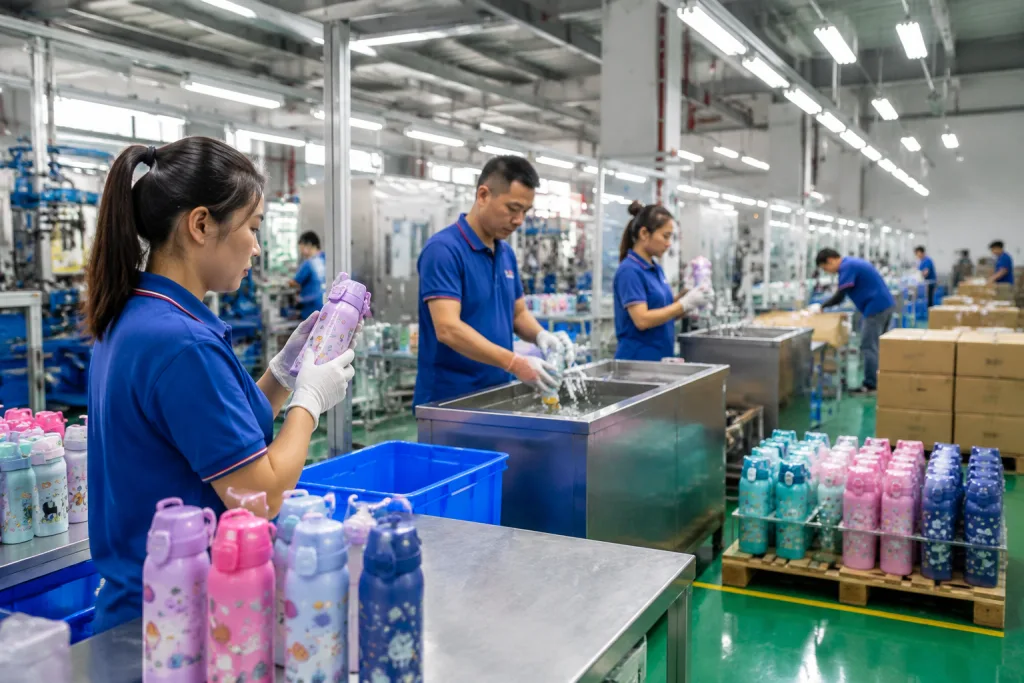
For buyers sourcing from China or Zhejiang, the job is to balance safety, use, and landed cost without turning the order into a mess of SKUs. A good children water bottle manufacturer should answer on material, MOQ, lead time, test standards, and spare parts without hand-waving. We run factories in Zhejiang that can output 600,000 units per month, but that number only helps if the bottle is easy to assemble, passes QC, and ships on schedule. One PO typo on cap color once cost a buyer a full week, so this is the wrong question to ask first: the math has to work before the artwork does.
Start With School Use, Not Catalog Specs
Most school buyers get the first call wrong at the capacity stage. They pick what looks good in a catalog, then the child cannot carry it, open it, or wash it without help. A school water bottle custom order should start with the age group, not the print. For elementary school, 350-500 ml is the right range. It stays light in a backpack and still covers a half-day schedule. For older students, 500-600 ml works better when the bottle also goes to PE or after-school training. On our line, QC pulled a 450 ml sample with a 62 g body weight, and that number made more sense than the photo did.
Think about the daily use case. Young children need one-hand operation, a lock that stays shut, and a lid that does not spray across the desk. Schools also care about name identification, because lost bottles turn into repeat orders and extra complaints. That is why many children water bottle custom programs add a writable name band, a clear ID window, or a wide panel for class labels. If you are planning a bulk kids bottle order, the spec has to work for carton packing and classroom handout, not just shelf display. The buyer flagged a typo on a PO once, and the missing class number cost us a full reprint run.
- Best capacity for ages 5-8: 350-400 ml
- Best capacity for ages 9-12: 450-600 ml
- Common school features: carry loop, straw lid, lock, and name plate
Do not overbuild the bottle. A thick wall and a heavy lid can make a custom school water bottle look tough, but if a child cannot lift it with one hand, the product fails in real use. The math does not work. We have seen a 320 g bottle get rejected by a school buyer after a 20-minute break test because the younger kids dropped it twice on the tile floor. Practical wins here, every time.
Pick Materials That Pass Real Tests
For a custom kids water bottle, material choice sets the tone for safety, weight, unit cost, and print adhesion. On our line, we check the body with a wall-thickness gauge before we quote. For school programs, Tritan copolyester is usually the cleanest pick for a clear body: it looks sharp, stays light in a school bag, and holds up to repeated washing better than cheap generic plastic. If you want metal, 304 stainless is acceptable, but 316 stainless gives better corrosion resistance and fits bottles that face salty sweat, daily dishwasher runs, or a long service life. A stainless body usually sits at 0.4-0.5 mm wall thickness; for plastic, ask for a measured thickness, not a vague claim of "thicker."
Material claims need paper behind them, not sales talk. We had a buyer flag a PO once because the resin code was missing. For Europe, expect REACH compliance and often LFGB for food-contact parts. For the United States, BPA-free is standard, and if the bottle includes small accessories or branded add-ons, check whether CPSIA or ASTM paperwork is needed for the final pack-out. A serious children water bottle supplier will send material data sheets, food-contact declarations, and test reports for the resin or steel grade, not just a catalog PDF.
If you are buying bulk children water bottle inventory for a school district, skip unknown recycled blends unless they are clearly tested and approved for food contact. We run into this pushback all the time: the buyer wants a lower price, then the audit file turns into a mess. In China, plenty of factories can offer recycled content, but use it only when your brand standard and regulatory file allow it. Saving $0.08 per unit sounds neat on paper. The math does not work if the batch fails an audit or lands you a parent complaint.
Practical rule: if the supplier cannot name the resin grade, wall thickness, and test standard in one email, keep searching. QC pulled the sample, checked the caliper, and that was the end of the argument.
Design The Lid Around Small Hands
Lid design is where a custom kids bottle either works on day one or gets ignored by Friday. Small hands need a cap they can open fast, and the lid still has to stay shut inside a school backpack. On the line, we run flip-top straw lids, push-button lids with a lock, and simple screw caps with a soft spout; those are the three styles buyers ask for most. Age matters, and so does the teacher's rule. A 5-year-old usually does better with a straw or soft spout, while older students can handle a sport lid if the lock does not pop open. QC pulled the sample after a 1.2 m drop test, and that is the kind of check that saves you from complaints later.
Do not let decoration drive the spec. That is the wrong question to ask. When you request a custom logo kids bottle, the print method has to match the lid and the way small hands hold it. Silk screen fits one or two solid colors and keeps unit cost down. Heat transfer gives more detail on a children water bottle customizable program. Laser engraving holds up on stainless, but it will not carry bright school branding. If you need a custom made kids bottle for a district launch, ask for print placement drawings. We have seen a buyer flag a PO because the logo sat 8 mm from the thumb rest and wore off in two weeks.
- Leak control: silicone ring plus tested lock mechanism
- School-friendly details: carry strap, name tag, wide mouth for ice
- Decoration rule: keep the logo away from grip zones
Replacement parts matter too. A children water bottle customized for schools should have spare lids or seals ready, because one lost cap can turn a usable bottle into scrap. We ship school orders in lots of 3,000 units, and one missing gasket can create 300 complaints if the district is strict. Good lid design cuts replacement cost, and that is the math that matters when you buy at scale.
Know Your MOQ And Real Unit Price
Price only makes sense when you put it next to MOQ, tooling, and packaging. On our line, a simple children water bottle wholesale order usually starts at 1,000 pcs per design if we use stock tooling and basic logo work. If you want a fully custom mold, the MOQ moves to 3,000-5,000 pcs, and a unique lid can push it higher. A children water bottle factory in Zhejiang that runs 600,000 units per month can still ask for a bigger first run on a new shape, because the 4-cavity mold setup and changeover time have to be spread across the order.
For FOB China pricing, a Tritan school bottle in the 350-500 ml range often sits around USD 1.35-2.20, depending on lid structure and print method. A 500 ml stainless custom school water bottle usually lands closer to USD 2.80-4.80. If a quote comes in far below that, check the carton spec, inserts, testing, and color matching. We run Pantone checks at the sample table before release, and a new lid or body tool can add USD 600-2,000; that is project cost, not a line item to ignore.
Lead time is where buyers get caught. A real first order usually needs 20-30 days after sample approval, plus 25-40 days for ocean freight from China to Europe or North America. If a seller promises a complex bulk school water bottle launch in 7 days, they are either shipping stock or cutting corners on production. QC pulled the sample on a 24-hour leak rack before we cleared mass production, and that is the kind of step you want listed in the timeline.
If you are comparing children water bottle suppliers, ask every factory for the same quote format: unit price, tooling, carton spec, test cost, and incoterm. This is the wrong question to ask if you only want the cheapest number. We once saw a PO typo swap 5,000 pcs to 500 pcs, and the whole price comparison went sideways in five minutes. Get the full sheet first, then the numbers can actually be compared.
Specify QC Before You Approve Samples
School buyers should never sign off on a sample because it looks clean on the table. We run the bottle through the same wear points it will see in school: body, lid, seal, strap, print, and carton. One scratched cap or loose gasket will turn into a buyer complaint fast. A good children water bottle manufacturer should walk you through that test plan without stalling.
Start with leak testing. Turn the bottle upside down and hold it for 10 minutes; if you see seepage at the lid or spout, stop there. Then ask for a drop test at 1.0-1.2 meters onto a hard floor, because kids do not treat a backpack gently. For production inspection, we usually see AQL 2.5 for major defects and 4.0 for minor defects. That is the right baseline for a children water bottle promotional program. Anything looser, and the math does not work.
Packaging gets blamed less than it should. If a children water bottle bulk carton ships with no divider, the line will show scuffs on day one, and print rub happens before the truck even leaves. Ask for inner trays, sleeve protection, or OPP bags when the finish is delicate. For school distribution, the carton should show quantity, color, and lot code in plain text. If the order goes to retail or Amazon-style fulfillment, you also need barcode placement, FNSKU labels, and master carton details. We’ve seen a PO typo on carton count turn into a week of rework, so this is the wrong question to skip.
Good QC is simple: if the supplier cannot explain how they test leaks, drops, and print abrasion, they are not ready for your order.
Choose A Factory That Can Scale
Call it a children water bottle factory, manufacturer, supplier, vendor, or distributor. The real question is simple: can they ship the same bottle on carton 1 and carton 500? A school order leaves no room for drift. We run resin by lot number, check lid fit with a 0.2 mm gauge, and lock print position before the line starts. In Zhejiang, plenty of plants can make a clean sample. The better ones can repeat that sample across 20,000 or 50,000 pieces without color shift, seal compression changes, or a logo that walks 2 mm. A pretty sample is not the job.
Ask for audit proof if you need it. BSCI or ISO 9001 does not promise perfection, but it shows the plant keeps records and checks. For Europe, ask for REACH or LFGB files tied to the exact model, not a generic PDF. On the line, QC pulled the sample and we caught a lid mark 1.5 mm off center. For North America, ask about tracking labels, carton traceability, and how the factory handles claims on a custom children water bottle order. If they also keep spare seals, replacement lids, and a reorder file with the same spec, they understand school business. If they shrug at that, the math does not work.
When you compare children water bottle manufacturers, watch how they answer technical questions. A solid team will talk about mold ownership, cavity count, assembly speed, and color tolerance. A weak team talks only about "best price." That is the wrong question to ask. For a bulk kids bottle program, you want a factory that can grow with you, not a middleman who vanishes after the deposit clears. We once saw a PO typo turn 3,000 pcs into 30,000 pcs, and that kind of mistake burns cash fast. Keep the RFQ narrow, ask for sample photos, and insist on a production schedule before you send any money.
Use this supplier checklist: material grade, MOQ, lead time, test report, carton spec, spare parts, and export terms. If one item is missing, keep asking.
Request a school bottle quote today
Send your age group, target MOQ, and logo file. We will match the right material, lid, and export packing for your market.
Frequently asked questions
What is the usual MOQ for a school water bottle custom order?
For a standard school water bottle custom project, the MOQ is often 1,000 pcs per color or per print setup if the factory uses existing tooling. If you want a new lid or fully custom mold, expect 3,000-5,000 pcs, and sometimes 10,000 pcs for a unique shape. For small pilot programs, some children water bottle suppliers will accept 500 pcs if you choose stock models and simple logo printing. Always ask whether the MOQ includes mixed colors, mixed lids, or mixed packaging, because those details change the real minimum.
Which material is best for a kids school bottle?
For most school use, Tritan is the best balance of weight, clarity, and durability for a children water bottle custom order. It is easy for kids to carry and works well with one-color or full-color branding. If you want a metal option, 316 stainless is a strong choice for long service life, but it is heavier and usually costs more. For either material, ask for food-contact documentation, BPA-free statements, and testing to REACH or LFGB if you are selling in Europe. A good target size is 350-500 ml for primary school.
Can you print names and logos on bulk kids bottle orders?
Yes. Most children water bottle customized programs can handle school names, district logos, mascots, and individual name fields. Silk screen is the lowest-cost option for one or two colors. Heat transfer works better for more detailed artwork. Laser engraving is durable on stainless but not ideal for colorful school branding. If you need a custom logo kids bottle for a district or fundraiser, ask the factory for artwork placement drawings and print tolerance. Typical MOQ for named printing is 500-1,000 pcs, depending on the model and the number of color changes.
How do I make sure the bottle will not leak in backpacks?
Leak prevention should be tested, not assumed. Ask the supplier to test the exact lid and seal combination you plan to order. A practical standard is a 10-minute inverted leak test, plus a drop test from about 1.0-1.2 meters. Also inspect the silicone ring, because a weak seal is the most common reason a children water bottle wholesale shipment gets complaints. If the cap has a lock, check that the lock holds during repeated opening and closing. For school use, request spare seals or spare lids in the same PO if the design is new.
How long does production and shipping take from China?
For a bulk school water bottle order, production usually takes 20-30 days after sample approval if the design is simple and materials are in stock. First orders with tooling or new printing can take 35-45 days before goods leave the port. Ocean freight from China to Europe or North America usually adds 25-40 days, depending on destination and season. If your schedule is tight, air freight can cut transit to roughly 5-8 days, but the landed cost rises sharply. When you source from Zhejiang, ask the factory to separate sample time, mass production time, and booking time in the quotation.