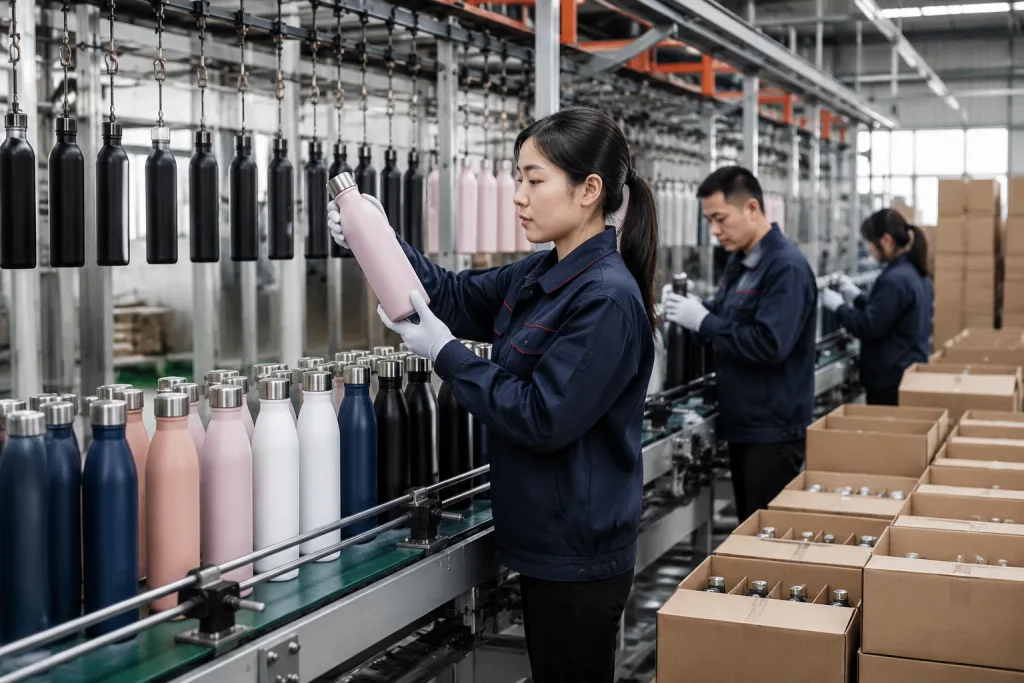
Key Takeaways
- A serious reusable water bottle supplier should state MOQ, FOB price, lead time, and inspection standard before sampling
- For stainless steel bottles, 304 inner steel and 201 or 304 outer steel are common; wall thickness usually runs 0.4-0.6 mm
- Expect 25-35 days for bulk production after sample approval on most custom drinkware orders
- Use AQL 2.5/4.0 inspection and request REACH, LFGB, or FDA documents based on your sales market
Choosing a reusable water bottle supplier is the wrong place to chase the prettiest catalog photo or the lowest FOB line. You are buying a product that carries your logo, touches drinks, clears customs, and may sit in an Amazon FBA warehouse for 90–180 days. One cheap mistake turns into 10,000 units nobody can sell; we have seen QC pull a random carton and find the lid gasket 0.6 mm too thin after the buyer approved only photos.
From our factory base in Zhejiang, China, we see 4 repeat problems every month: material specs that only say “stainless steel,” logo files sent as JPG instead of AI or PDF, lead times promised as 12 days when the line needs 18 days, and quotes that leave out tooling, carton, or inspection costs. If you are sourcing custom drinkware or custom canteen programs, lock the details before production starts. The math doesn’t work after welding, polishing, and powder coating have already started.
Start with the bottle spec
Before you compare quotes from canteen suppliers, lock the bottle spec in engineering language. “500 ml stainless bottle with logo” is a price trap, not a spec. A canteen manufacturer needs the fill capacity, steel grade, lid construction, coating finish, insulation target, inner packing, sales market compliance, and logo process before costing. Last month one buyer sent us that exact 6-word request; our quoting engineer had to send back 14 questions before the line could even check the right mold rack.
For vacuum stainless bottles, the common structure is 304 stainless steel inside and 201 or 304 stainless steel outside. For North American and European retail, we run 304 inside as the baseline. Wall thickness is often 0.4-0.6 mm. Too thin, it dents. Too thick, the freight math gets ugly fast, especially on 20,000-unit distributor canteen orders. QC pulled a 0.38 mm body sample from a trial run last quarter, and the buyer flagged side dents after a 1.2 m drop test.
Capacity changes more than the body height. A 350 ml kids bottle, 500 ml sports bottle, 750 ml canteen customized for outdoor brands, and 1,900 ml custom growler need different lid molds, handle strength, silicone sealing rings, and drop-test setups. If you want a canteen customizable for several retailers, this is where we push back: opening 5 body molds for one first order usually burns budget before sales data exists. Keep one body shape, then change Pantone color, laser logo, silicone sleeve, or 350 gsm carton artwork.
Ask your reusable water bottle supplier for a written quotation sheet with these lines: item number from the mold file, capacity tolerance in ml, material grade for inner and outer shell, net weight in grams, gross weight per export carton, carton size in cm, packing quantity, MOQ, sample fee, tooling fee, FOB port, production lead time, and payment term. At BottleForge Industrial in Zhejiang, China, our standard MOQ starts at 1,000 units per color for existing molds, and our monthly capacity is about 600,000 units across stainless bottles, tumblers, and growlers. Those numbers matter because capacity protects your delivery date; we’ve seen this go sideways when a PO typo changed “1,000 pcs” to “10,000 pcs” after sample approval.
Understand real MOQ and price
MOQ is not a punishment. It is the break-even point where we can buy material, change color, set up printing, run QC, and pack without burning labor. If a canteen factory says “any quantity is fine,” slow down. A 300-piece order usually means stock bottles, 2-3 available colors, hand-applied logo work, or a unit price padded enough to cover the mess. We’ve seen this go sideways when the buyer expected full custom, but QC pulled the sample and found the logo position was 4 mm off because it was jigged by hand.
For existing stainless steel bottle molds, a practical MOQ is 1,000 pieces per color. For powder coating in a private Pantone color, 2,000-3,000 pieces is more realistic because paint mixing and line cleaning waste material before the first saleable bottle comes off the line. We run about 8-12 kg of powder through the booth before the color stabilizes. For a fully customized canteen with new body tooling, lid tooling, or a special silicone boot, you may need 3,000-5,000 pieces to spread tooling cost properly. For plastic or Tritan-style canteen promotional programs, color MOQ depends heavily on resin purchase quantity; the resin supplier will not open a custom color lot for 500 pcs just because the PO says “urgent.”
FOB pricing also needs context. A simple 500 ml stainless single-wall bottle might land around USD 2.20-3.20 FOB China depending on finish and lid. A 500 ml vacuum bottle with powder coating and laser logo may run USD 4.20-6.50. A 1.9 L customized growler with handle lid can move into the USD 8.50-13.00 range. These are working ranges, not magic numbers. Steel price, exchange rate, packaging, and test requirements can move the final quote by 5-15%; last quarter one buyer flagged a USD 0.18 increase after we changed from 0.38 mm to 0.42 mm inner steel for drop-test performance.
When comparing canteen manufacturers, look for hidden items. Is the quote for individual white box or bulk pack? Is the logo included or charged separately? Are spare gaskets included? Are barcode labels, FNSKU labels, warning labels, or retail hang tags included? For distributor growler and distributor drinkware orders, packaging can add USD 0.20-0.80 per unit. A cheaper bottle with the wrong carton can still cost more after repacking in your warehouse; we once had a PO typo showing “master carton 24 pcs” while the buyer’s warehouse system required 12 pcs, and the math did not work after relabeling.
Choose logo and finish carefully
Brand owners spend 2-3 weeks arguing over bottle shape, then send the logo file at 6:40 p.m. before sample cut-off. Wrong order. Decoration changes MOQ, reject rate, unit price, and shelf feel. Last month QC pulled the sample because a 0.28 mm line in the icon filled in after powder coating. A solid reusable water bottle supplier should push back when artwork will not print cleanly. That is not being difficult; it is preventing 300 rejected pieces before mass production.
Laser engraving is clean and durable on powder-coated stainless steel. We run it for corporate logos and long distributor canteen programs where buyers want the same mark for 12 months, not one promo season. The catch is color. Laser removes coating or marks the steel, so full-color graphics are off the table. Silkscreen printing suits one- or two-color logos on smooth surfaces. It is cost-effective, usually USD 0.08-0.25 per position. Curved bottles and textured coatings still need a test run; our line checks logo stretch with a 3M tape pull after curing.
Heat transfer and water transfer handle larger, full-color artwork. They make sense for canteen promotional campaigns and retail gift sets with seasonal customized drinkware. The trade-off is process control. Adhesion, scratch resistance, and dishwasher claims need honest testing, not showroom talk. We have seen this go sideways when a buyer approved a glossy sample, then the carton copy promised dishwasher-safe decoration. If that claim goes on packaging, ask for tape test, cross-hatch test, and 30-cycle wash simulation; QC should record the peel area in mm, not just write “pass.”
Powder coating is the standard finish for mid-range and premium stainless bottles. Matte black, white, navy, and olive sell steadily in Europe and North America; we ship those colors almost every month. Gloss paint looks bright but shows cart scratches after one warehouse move. Rubber paint feels good in the hand, but poor coating chemistry can turn sticky after heat aging at 60°C. For a customizable growler or custom canteen line, we usually suggest 4-6 core colors first, then expand after 90 days of sales data. Launching 12 colors sounds bold. The math does not work when MOQ is 1,000 pcs per color and 3 colors sit in your warehouse.
Check compliance before production
Compliance is where first-time buyers lose 3 to 7 working days. A canteen supplier in China may show test reports, but match the report line by line against your material grade, surface coating code, lid resin, silicone parts, and sales market. A report for a 304 stainless bottle body does not cover a powder-coated bottle with a PP lid and a silicone straw; QC pulled one sample last month where the PO said “matte black,” but the report only covered unpainted steel. If you sell in the EU, ask for LFGB, REACH, and food contact declarations tied to that exact SKU. If you sell in the United States, FDA food-contact expectations and California Proposition 65 screening may apply.
For kids bottles, ask harder questions. Check CPSIA if the product is intended for children in the US, then review small parts, straw length, bite-valve pull force, and paint chemistry. We run a simple 30 N pull check on straw tips before sending samples, because one buyer flagged a loose silicone mouthpiece after their lab found it fit inside the small-parts cylinder. For Canada and the EU, confirm local distributor rules before mass production approval. Canteen distributors often say the supplier “has certificates,” but retailers ask for product-specific files with matching item number, color, material, and lid construction. General factory PDFs do not pass retail compliance desks.
Factory audits add another filter. BSCI, Sedex, ISO 9001, and similar systems do not guarantee a clean bottle shipment, but they show whether the canteen factory controls documents, training records, corrective actions, and incoming material checks. If you are a large canteen distributor or selling to national retail chains, audit status may be required before the first PO; we have seen a 20,000 pcs order sit for 12 days because the buyer asked for Sedex after artwork approval. Ask early. An audit cannot be created two days before shipment, and the math doesn't work once the line is already booked.
Write quality control into the order, not into a late-night email after the deposit. For most reusable bottle shipments, use AQL 2.5 for major defects and 4.0 for minor defects. Define critical defects as leakage, unsafe sharp edges, wrong material, odor, contamination, and incorrect capacity, with capacity checked by scale to the marked ml line rather than by eye. For vacuum bottles, test insulation by filling with 95°C water and checking temperature drop after 6 hours; our inspector records the start and finish readings with a probe thermometer. For leak testing, invert filled bottles for at least 30 minutes, and add random drop testing from 1.0 meter for retail packs. A practical supplier will accept these checks before taking your deposit.
Plan samples and lead time
Sampling is not for photos. It is the last low-cost gate before the line starts cutting cartons and printing bodies. A proper pre-production sample should match the approved 304 stainless grade, Pantone color, logo size in mm, lid set, silicone gasket, coating, and inner box. QC pulled one sample last month where the buyer approved the bottle body, then the PO showed a different flip lid code by one digit. If the sample uses a temporary lid or a close-enough color, mark the hang tag “reference only,” not “approved sample.” We have seen this go sideways after mass production, and the argument is never cheap.
For existing molds, plain samples usually ship in 3-7 days if stock is on the shelf. Custom logo samples need 7-12 days after artwork confirmation; laser engraving is faster than full-wrap powder coating because the jig setup is lighter. A new mold for a customized canteen or customizable growler takes 25-45 days depending on cavity count and shape risk. Bulk production for standard stainless bottles is commonly 25-35 days after deposit and sample approval. Before back-to-school orders and Q4 promotional campaigns, add 7-15 days of buffer. Our line once lost 2 days because a 0.6 mm gasket groove failed the leak test at 60°C.
Artwork files should be vector format: AI, EPS, or PDF with outlined fonts. Send Pantone codes and logo placement in millimeters, plus the max print area from the bottle drawing. “Put it in the middle” is the wrong instruction; middle of the body, middle of the printable window, and middle between seams can be 3 different points. For canteen custom work, request a digital mockup and a physical sample if the order is over USD 5,000. One DHL sample cost looks annoying on a PO, but the math does not work when the logo is 12 mm too high on 8,000 units.
Shipping planning matters too. Sea freight from Ningbo or Shanghai to Europe is often 30-40 days port to port, and to the US West Coast around 18-25 days depending on routing. Air freight can rescue an urgent launch, but it adds USD 1.50-4.00 per bottle, which can wipe out the margin on a promotional bottle. If your reusable water bottle supplier is in Zhejiang, China, Ningbo port is close; our trucks run from Hangzhou to the forwarder’s CFS in about 3 hours on a clean day. Port access helps. It does not replace a real production calendar.
Build a supplier scorecard
Do not award the order from one quote. Build a scorecard and use the same sheet for every canteen vendor, canteen manufacturer, and canteen factory you check. We normally score product fit, compliance readiness, MOQ, price transparency, sample quality, communication speed, production capacity, inspection process, and export experience, then give each item a weight out of 100 points. On our line, a powder-coated 750 ml bottle with 304 stainless needs a different score than a cheap PP lid giveaway bottle. If you sell to premium retailers, quality and compliance should beat a USD 0.15 price gap. The math doesn’t work after one failed AQL 2.5 inspection.
Communication is a factory metric. If a supplier needs three days to answer basic questions before deposit, they will not move faster when the shipment is stuck at 9 p.m. Ask direct questions: What is the current production queue? How many units per month can this line produce? What is the defect rate on powder coating? What is the standard spare gasket percentage? What happens if inspection fails? Last month QC pulled the sample after finding 4 scratched lids in 80 pcs, and the buyer flagged the reply time before the defect itself. A serious canteen supplier answers with numbers, not slogans.
For distributor drinkware and distributor growler programs, ask about repeat-order control. Can the supplier keep the same color standard for six months? Do they retain golden samples? Can they print batch codes on cartons? Can they support mixed SKUs in one container? We run color checks against the signed sample under a D65 light box, because “close enough” on matte navy becomes a chargeback when 3 SKUs sit on the same shelf. A canteen customizable for multiple accounts needs stable documentation, not flexible sales talk.
At BottleForge Industrial, we prefer buyers who send clear briefs and ask hard questions early. It saves both sides time. China has 200+ capable canteen vendors, but not every factory fits every project. A low-cost canteen promotional order for a 2-week event, a premium customized growler for outdoor retail, and a private-label sports bottle line need different risk controls, so this is the wrong question to ask: “Who has the biggest catalog?” Choose the reusable water bottle supplier that fits the order you are placing, not the one with the longest product list. We’ve seen that go sideways.
Send us your bottle spec and target price
We will review material, MOQ, decoration, compliance, and lead time before you commit to tooling or bulk production.
Frequently asked questions
What MOQ should I expect from a reusable water bottle supplier?
For existing stainless steel bottle molds, expect around 1,000 units per color as a normal starting MOQ. If you need a custom Pantone powder coating, 2,000-3,000 units is more realistic because the coating line has setup waste. For a fully custom canteen with new tooling, special lid, or unique silhouette, 3,000-5,000 units is common. Some canteen suppliers will offer 300-500 units, but usually only with stock colors, simple laser logos, and higher unit prices. Ask whether the MOQ is per color, per logo, or per total order. That detail changes the budget quickly when you have 4 colors and 2 logo versions.
How long does custom drinkware production usually take?
For standard customizable drinkware using existing molds, plan 7-12 days for logo samples and 25-35 days for bulk production after deposit and sample approval. If you need new mold tooling for a customized canteen or custom growler, add 25-45 days before production starts. Peak season can add another 7-15 days, especially before Q4 promotional orders. Shipping is separate: sea freight from China to Europe often takes 30-40 days port to port, while China to the US West Coast may be 18-25 days. For a retail launch, count backward from the required warehouse date, not the marketing launch date.
Which logo method is best for a custom canteen?
For durable, clean branding, laser engraving is usually the safest option on powder-coated stainless steel. It is excellent for corporate programs, outdoor brands, and repeat distributor canteen orders, but it is not full color. Silkscreen printing works well for simple 1-2 color logos and usually costs about USD 0.08-0.25 per position. Heat transfer is better for large full-color artwork, but it needs adhesion and scratch testing before approval. If the canteen customized order will claim dishwasher safety, ask for wash-cycle testing. A beautiful sample does not prove long-term decoration performance.
What certifications should canteen distributors request?
For EU sales, ask for LFGB or relevant food-contact testing, REACH screening, and a declaration of compliance covering the bottle body, lid, gasket, coating, and straw if included. For the US, request FDA food-contact support and consider California Proposition 65 testing depending on the product and sales channel. For children’s bottles, CPSIA may apply. Factory audits such as BSCI, Sedex, or ISO 9001 are useful when selling to larger retailers, but they do not replace product-specific test reports. Make sure the report matches the exact item, material, and finish you are buying, not just a similar bottle from last year.
How do I compare quotes from different canteen manufacturers?
Put every quote into the same format before comparing. Include item number, capacity, steel grade, wall thickness, lid material, coating, logo method, packing, carton size, MOQ, FOB port, sample fee, tooling fee, lead time, and payment term. A USD 4.60 bottle may be cheaper than a USD 4.30 bottle if it includes retail box, barcode labels, spare gaskets, and inspection support. Ask each canteen manufacturer to confirm whether the price is FOB Ningbo, FOB Shanghai, EXW, or delivered. Also check production capacity. A factory that can make 80,000 units per month is not the same as one that only assembles small mixed orders.