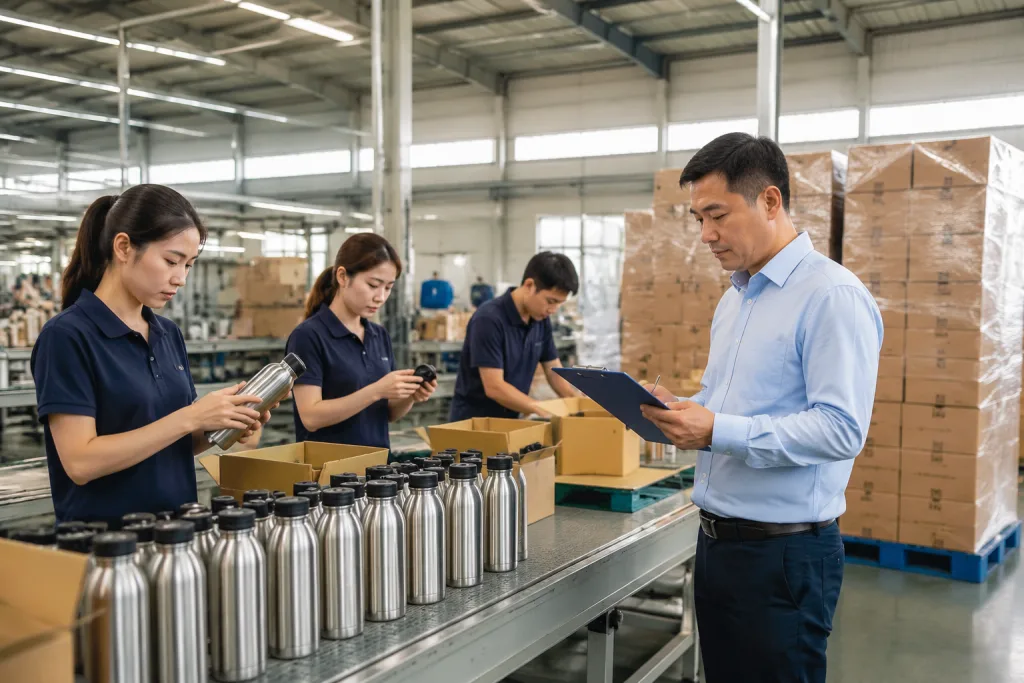
Key Takeaways
- Plan MOQ at 1,000-3,000 units per color for most custom stainless bottle programs
- FOB China pricing should be checked against wall thickness, lid tooling, coating, and carton spec
- AQL 2.5/4.0 inspection is more useful than a pretty pre-production sample alone
- Distributor margins improve when you standardize 2-3 bottle bodies and customize finishes, lids, and logos
If you are a reusable water bottle distributor, another catalog is not the fix. The fix is stock that passes a 24-hour inverted leak test, protects your 38-45% retail margin, and does not land 18 days after your promotion starts. Custom drinkware looks simple on a PDF, then QC pulls the sample and finds a 0.4 mm lid gap, thin powder coating on the shoulder, or cartons that crush at the bottom of a 12 kg stack.
BottleForge Industrial manufactures in Zhejiang, China for distributors, brand owners, and procurement teams that need repeatable supply. We usually quote MOQ from 1,000 units per color for stainless bottles, with normal production at 25-35 days after sample approval. The buyer flagged this last month: “Can we add three lid styles and keep the same ship date?” The math doesn't work. Good customization adds margin; bad customization slows the line and creates inspection arguments.
Start With The Sales Channel
A reusable water bottle distributor should start with the sales channel, not the nicest bottle render. We see this go sideways when a buyer approves a glossy 3D image, then asks why the carton count kills the landed cost. Outdoor retail, corporate promo, school contracts, and Amazon FBA each put pressure on a different line item. The difference shows up in a 12 pcs carton versus a 24 pcs carton, GS1 barcode placement within 2 mm, a 1.2 m drop-test result, and whether a flip lid or screw lid will survive repeat use.
For retail distribution, shelf presentation has to work harder: an individual color box with a clean dieline, a hang tag that does not tear at the punched hole, and a UPC sticker the scanner reads on the first pass. For canteen promotional orders, we run plain white boxes or bulk cartons when the buyer only cares about a clean logo and delivery before the event date. E-commerce is a warehouse problem. If one master carton goes over 18 kg, or the 5-ply board crushes at the corner after the clamp test, damage claims climb fast.
A distributor drinkware program also needs tight SKU planning. New buyers ask for 8 capacities, 12 colors, and 4 lid types on the first PO. The math does not work. It splits MOQ, slows inspection, and leaves you holding the odd colors after the black and navy sell through. Start with 2 bottle bodies and 3 colors; keep 1 proven lid until you have sell-through data. QC once pulled samples where the PO said “matte navy” but the artwork file said “navy gloss,” and that kind of typo burns 2 days before mass production even starts.
From our Zhejiang factory, the best distributor canteen programs use standard tooling and customize the parts customers notice. We run 304 stainless bodies from existing molds, then change the powder coat, laser logo size, silicone sleeve, lid color, retail box, or insert card. A 35 mm laser logo and a Pantone-matched lid can make the bottle feel custom without opening a new mold too early. That is usually the smarter spend.
Know The Factory Cost Drivers
FOB pricing is not one clean number you can compare line by line. A 500 ml stainless bottle at USD 2.40 and another at USD 2.95 may look close in a spreadsheet, but the cheap one might be 0.35 mm body steel, loose 2-start threads, thin powder coating, and a cap gasket that goes hard after 90 days. We see this in sample teardown with a digital caliper and thread gauge. As a canteen distributor, the wrong question is “who is cheaper?” Ask what the factory put inside the quote.
The main cost drivers sit in material grade, wall thickness, lid build, surface finish, logo method, packaging spec, and inspection level. For vacuum bottles, we run SUS304 inner and outer on standard orders; some programs move to SUS316 inner liner when the buyer sells into coastal or sports channels with more corrosion claims. Wall thickness often ranges from 0.35 mm to 0.50 mm depending on shape and capacity. Thinner steel cuts cost, yes. It also dents faster when a 12 kg export carton drops off the line table during packing.
Lids hide cost. A simple screw cap is cheap and stable, and QC can check torque fast with a hand torque tester. A flip lid with push button, straw, silicone vent, and carry handle may need 4-7 plastic and silicone parts, which means more molds, more assembly time, and more leak points. If you are buying from a canteen supplier, confirm whether the lid uses food-grade PP, Tritan, silicone, or TPE, and ask if the gasket can be replaced. Lid leak failure kills distributor accounts fast; we have seen buyers reject a full 3,000 pcs lot after QC pulled the sample and found seepage after a 30-minute upside-down test.
Decoration changes unit cost more than new buyers expect. One-color silkscreen may add USD 0.08-0.18 per unit, and the line needs a screen plate plus drying space, not just “print logo” on the PO. Laser engraving often adds USD 0.12-0.30 depending on logo size and position; a 65 mm tall logo on a tapered bottle runs slower than a small front mark. Full-wrap heat transfer or UV printing costs more, but it makes sense for customizable drinkware when the artwork sells the order. A practical canteen manufacturer should price these trade-offs before sending a low quote that goes sideways during production.
Choose Customization Without Chaos
Custom canteen options earn their place only when they move sell-through or protect margin. They become trouble when every buyer request turns into a new gasket, PMS color, or QC checklist. We run this split on the line: standard customization goes through the normal work order; engineered customization gets a drawing review, caliper check, and cost sign-off before we quote.
Standard customization covers logo application, powder coating color, lid color, sleeve printing, box artwork, barcode labels, and instruction sheets. These jobs usually stay inside existing fixtures, screens, and carton dielines, so the factory does not need new tooling. Engineered customization means changing bottle diameter, lid thread, cap structure, handle design, mouth opening, or vacuum body shape. That can require tooling fees from USD 800 to USD 8,000 per component, plus 20-35 days for mold sampling; last month QC pulled a 0.4 mm thread mismatch on a trial cap, and that tiny gap was enough to fail the leak rack.
If your customer wants a canteen customized for a campaign, the first question should be finish and packaging, not mold changes. A matte olive 750 ml bottle with laser logo, custom belly band, and kraft box can look fully custom to the buyer while using stock body, stock lid, and our existing 750 ml carton insert. This is the safer route for a 2,000-unit order. New tooling sounds attractive in a meeting, but the math doesn't work once you add sampling time, freight for approval samples, and one PO typo on “olive” versus “olive drab.”
For distributor growler or customizable growler programs, watch handle strength and cap sealing before artwork. A 64 oz growler carries more filled weight, so weak handles and thin caps fail faster; we have seen a handle crack after 500 lift cycles on a bad supplier sample. For customized growler orders, we normally recommend physical samples with water-fill carry testing and 24-hour upside-down leak checks before approving mass production. QC should test the sample your buyer approved, not a cleaner lab sample from another batch.
Good canteen manufacturers will push back when customization hurts reliability. That is not bad service. It is how you avoid shipping 3,000 beautiful bottles with a lid complaint rate above 5%. We have had buyers flag the pushback as “slow,” but a 15-minute gasket review at the torque tester beats sorting leaking caps after the container lands.
Set Realistic MOQ And Lead Time
MOQ follows the process sheet, not the factory’s mood. For stainless steel bottles from China, 1,000 units per color is a common practical MOQ for powder coating and logo work; below that, the powder booth still needs the same color-change cleanout and the same 2 laser logo fixtures. Some canteen vendors will accept 500 units, but the unit price can rise 12-25% because setup, coating loss, sample work, and carton printing are spread across fewer pieces. For fully customized canteen molds, MOQ often starts closer to 3,000-5,000 units, since a new lid mold or body tooling does not pay back on 800 pieces.
At BottleForge Industrial in Zhejiang, typical monthly drinkware capacity is about 450,000 units across stainless bottles, tumblers, kids bottles, and growlers. Capacity is not a magic shipping date. We run powder coating, silk screen, laser engraving, and final packing as separate steps, and one stuck lid injection slot can hold 20,000 bottles on the line. A normal repeat order with approved artwork takes 25-35 days. A new custom drinkware project with sample development usually needs 45-60 days from first artwork to shipment readiness, especially when QC pulled the sample for a 0.3 mm lid gap or a logo shifted 2 mm off center.
You also need to count time after production. Ocean freight to the US West Coast may take roughly 18-28 days port-to-port, while Europe often runs 30-40 days depending on routing and congestion. Air freight can save time but may add USD 1.20-3.50 per bottle, which destroys margin on low-price promotional orders. We had one buyer ask to air 12,000 promo bottles after approving artwork 9 days late; the math did not work, even before warehouse handling fees.
For seasonal distributor drinkware programs, work backward from the shelf date. If you need goods in a North American warehouse by May 1, final artwork should not be arriving in Hangzhou on March 25. Build in at least 7 days for sample review, 3-5 days for carton label confirmation, and a buffer for inspection rework. Small things eat days: a PO typo on color code “PMS Black C,” a missing suffocation warning on polybags, or AQL 2.5 finding scratches on 14 samples. The calendar is part of the product.
Check Compliance Before Deposits
Compliance feels boring until Ningbo customs holds 2,400 cartons, a retailer rejects the upload file, or your customer asks for documents 6 days before delivery. A reusable water bottle distributor should confirm required standards before paying the 30% deposit. For Europe, we usually check LFGB food contact testing, REACH for coatings/components, and packaging marks before the PO is released to the line. For North America, buyers often ask for FDA food contact basis, California Proposition 65 evaluation, CPSIA for kids products, or ASTM-related performance expectations by category. One buyer flagged a missing ink report after QC pulled the pre-shipment sample; the order waited 4 extra days while the lab matched the coating code.
Not every order needs every certificate. This is the wrong question to ask. A 304 stainless sports bottle for adults and a kids bottle with printed character artwork carry different risk. If a canteen vendor says “all certificates available” but cannot match reports to the exact steel grade, powder coating, silicone ring, and PP lid, treat it as a red flag. Test reports should be recent, readable, and tied to the product family. We check report numbers against the BOM; a 0.6 mm body with coating code BK-217 should not be covered by a random 2021 report for another lid set.
Factory social audits matter for larger accounts. BSCI, Sedex/SMETA, or ISO 9001 documentation may be requested by retailers and corporate buyers, especially when annual volume passes 50,000 pcs. These audits do not guarantee clean welds or perfect printing, but they make vendor onboarding faster. If your customer needs a nominated lab test, budget time and money before you promise the ship date. A full food contact and coating compliance package can take 7-12 working days and cost several hundred dollars depending on scope. We have seen this go sideways when a PO typo listed “LFGB+Prop 65” after the deposit, but the quotation only included FDA.
For customized drinkware with painted surfaces, ask whether the coating has passed cross-hatch adhesion, boiling water, alcohol rub, and dishwasher-related testing if you plan to claim dishwasher safe. Many bottles survive normal handwashing but fail aggressive dishwasher cycles. Do not print claims your supplier has not tested. On our line, QC cuts the coating with a 1 mm cross-hatch cutter and uses 3M tape before approval; if paint lifts around the logo edge, the math does not work for a dishwasher-safe claim.
Inspect More Than The Sample
A golden sample helps, but it is not quality control. It is usually built at a slower bench, often by a senior worker, with parts picked from the cleanest bin. The line is different. On a 10,000 pcs canteen run, QC pulled 125 pcs at mid-line last month and found color drift after the second powder-coating oven, 1.5 mm logo shift on 37 bottles, lid flash around the drinking spout, thread burrs, weak vacuum, small dents under the shoulder, and dust inside gift boxes. A serious canteen supplier should welcome inspection. If a factory acts offended, we’ve seen this go sideways.
For distributor orders, set the inspection criteria before the first sheet of 304 stainless is cut. AQL 2.5 for major defects and AQL 4.0 for minor defects is common for drinkware. Critical defects, such as sharp edges, leakage, wrong material, contamination, or unsafe odor, should be zero tolerance. We run the checklist with simple tools: a 500 ml measuring cylinder for capacity, 80°C water for leak testing, 3M tape for coating adhesion, a caliper for logo position tolerance, carton drop condition, barcode scan, and carton count. The wrong question is “does it look like the sample?” Ask what fails the carton.
Vacuum performance needs its own line item. For insulated bottles, the factory should test heat retention and vacuum failure, not just check the outside finish. One simple production check is filling bottles with hot water, then using temperature change or a surface heat detector to catch failed vacuum units after 3 minutes. On a 3,000 pcs batch, we normally ask the line to test at least 32 pcs before packing, then quarantine failed units in a red bin with a written count. A buyer does not need every machine setting, but you should ask how many pieces are tested per batch and who signs off when one fails.
Carton specification is quality too. A cheap carton can turn good bottles into dented returns. For export from China, we usually use 5-ply corrugated master cartons, edge protection for glossy paint, and inner polybags or dividers based on finish. If your order ships to Amazon FBA, FNSKU labels, carton weight limits, suffocation warnings, and carton dimensions must be correct. We once saw a PO typo list 21 kg per carton instead of 12 kg, and the buyer flagged it only after the warehouse rejected 48 cartons. Canteen distributors lose money not from product defects alone, but from handling problems caused by loose packaging instructions.
Build A Repeatable Supplier Program
The best distributor programs are not one-off bargains. They are repeatable systems. We track which 750 ml body reorders, which matte colors get repeat POs, which lid starts leaking after the drop test, and which 5-ply carton still looks clean after Ningbo-to-LA freight. Data beats supplier shopping. If you change canteen suppliers every quarter, QC pulled samples never match the last approved sample, and the buyer flags it before the goods even reach their warehouse.
A strong supplier relationship starts with clear specs. Send capacity, material, lid type, finish, logo file, packaging type, barcode requirements, target FOB price, market, compliance needs, and forecast quantity. Also send the small things: carton mark layout, UPC position in mm, insert card size, and whether the PO says “pantone Black 6C” or has a typo like “Black 6G.” If you only ask a canteen manufacturer for “best price,” this is the wrong question to ask. You invite thinner walls, loose gasket fit, and a lid the line has not run in 6 months. A structured RFQ lets good canteen suppliers quote cleanly, while weak ones expose the gaps by line two.
For repeat distributor canteen orders, lock 2-3 core models for 12 months. Keep the bodies stable. Refresh colors or artwork by season, not the whole bottle. We run better when the line has already set the same thread gauge, same powder coating rack, and same 24 pcs carton for the last 3 orders. Sampling cost drops, production workers know the tricky points, and QC can compare against a real golden sample instead of guessing. If you serve promotional buyers, keep one fast-turn canteen promotional model with a simple lid and 1-color logo option; 3,000 pcs MOQ is easier to move than a mixed-lid project with 9 SKUs. If you serve outdoor retail, keep a higher-spec insulated bottle or distributor growler with stronger packaging and tighter finish control, because dents on a $18 shelf item come back as chargebacks.
BottleForge Industrial is based in Hangzhou, Zhejiang, China, close to coating shops, packaging suppliers, and Ningbo/Shanghai port routes. That saves time when a replacement gasket, revised carton mark, or urgent pre-shipment inspection needs action today, not next week. We have seen this go sideways: one buyer approved the bottle but forgot the barcode label, then asked for 12,000 stickers after cartons were sealed. The math does not work if every fix happens after packing. You do not need a perfect supplier. You need a canteen factory that answers clearly, records the details, and fixes problems before they turn into customer chargebacks.
Send Your Bottle Spec For A Factory Quote
Share capacity, logo, target price, market, and quantity. We will return practical options, MOQ, lead time, and FOB China pricing.
Frequently asked questions
What MOQ should a reusable water bottle distributor expect?
For most stainless steel reusable bottle programs, expect 1,000 units per color for standard logo and powder coating orders. If you need custom molded lids, a new bottle shape, or a fully customized canteen body, MOQ usually rises to 3,000-5,000 units because tooling, setup, and component production need scale. Some factories in China will quote 300-500 units, but the FOB price may be 12-25% higher and color consistency can be harder to control. For first orders, we recommend choosing 2-3 colors on one proven model rather than spreading 1,000 units across too many SKUs.
How long does custom drinkware production take from China?
A repeat custom drinkware order with approved artwork normally takes 25-35 days for production after deposit and sample approval. A new canteen customizable project usually needs 45-60 days because you must add artwork proofing, pre-production sampling, packaging confirmation, and sometimes lab testing. Ocean freight adds another 18-40 days depending on destination port. If you need goods for a fixed campaign date, work backward and include a 7-10 day buffer for inspection or rework. Air freight is possible, but it can add USD 1.20-3.50 per bottle, which is often too expensive for distributor pricing.
Which logo method is best for distributor drinkware?
It depends on the finish, order volume, and retail positioning. Silkscreen is cost-effective for simple 1-2 color logos and may add about USD 0.08-0.18 per unit. Laser engraving is durable and clean on powder coated stainless steel, usually adding USD 0.12-0.30 depending on size. Heat transfer or UV printing works better for full-color graphics, but cost and defect risk are higher. For canteen promotional orders, silkscreen or laser is usually enough. For premium customized drinkware, laser plus a custom box often gives a better perceived value than complicated all-over printing.
How do I compare quotes from canteen manufacturers fairly?
Ask every canteen manufacturer to quote the same specification: capacity, SUS304 or SUS316 material, wall thickness, lid material, coating type, logo method, packaging, carton size, inspection level, and FOB port. A USD 0.25 price difference means little if one quote uses 0.35 mm steel and another uses 0.45 mm, or if one includes color box packaging and the other includes only bulk packing. Also confirm whether the quote includes pre-production sample cost, barcode labels, spare gaskets, and export carton marks. Fair comparison requires a written spec sheet, not screenshots of similar bottles.
Can one canteen vendor handle both bottles and growlers?
Yes, but verify capability by product type. A canteen vendor that makes 500 ml promotional bottles may not automatically be strong on 64 oz customized growler orders. Growlers need stronger handles, better cap sealing, and more careful carton protection because filled weight is higher. Ask for production photos, leak-test process, and recent export references for similar capacity items. For distributor growler programs, we suggest approving a physical sample, running a 24-hour upside-down leak test, and checking handle strength before mass production. If the vendor avoids those checks, choose another canteen supplier.