Key Takeaways
- For most stainless programs, realistic MOQ starts at 1,000-3,000 units per color and lead time is 25-40 days after artwork approval
- 304 stainless steel at 0.45-0.55 mm wall thickness is the normal safe baseline for retail-grade bottles
- Laser engraving lasts longer than silkscreen, but silkscreen is cheaper for large 1-3 color promotional orders
- B2B buyers should confirm LFGB, REACH, FDA, CA Prop 65, or ASTM needs before deposit, not after mass production
A reusable water bottle customizable program looks easy until 6 approvals land on the same desk: steel grade, lid tooling, logo method, carton marks, compliance files, and delivery date. For a retail brand, corporate promotion, or distributor catalog, the money usually gets burned before the line starts; last month QC pulled a pre-production sample where the PO said “matte black” but the artwork file said Pantone 426C.
From our Hangzhou, Zhejiang factory work, the strongest orders are not the fancy shapes. They are the orders with a locked capacity, target FOB price, logo area in mm, testing market, and packaging rules before we run samples. China can ship good custom drinkware at scale, but this is the wrong question to ask: “What is your best price?” The better question is whether the spec is tight enough that 3 suppliers would quote the same bottle.
Start With The Real Use Case
Before asking a canteen supplier for price, decide how the bottle will be used in the buyer's hand. A gym bottle is not a school canteen custom order with another logo. An outdoor custom growler is not an executive gift tumbler in a different box. We run different lids, wall thickness, coatings, carton protection, and compliance documents for each one. On our line, a 500 ml single-wall canteen body might use 0.45 mm stainless, while a 1.2 L vacuum growler needs a thicker shoulder and a cap seal checked with a torque meter.
If your customer sells through supermarkets or outdoor retail, ask for a finish that can take shelf rub, leak testing on every batch, and retail packaging that survives warehouse handling. QC pulled one sample last month after the color coating chipped at the bottom edge during a 76 cm carton drop test. For canteen promotional stock at a corporate event, a simpler carton and one-color logo can fit a USD 2.80-4.50 FOB Ningbo target. For Amazon or marketplace programs, the bottle also needs barcode placement, FNSKU labeling, drop resistance, and carton dimensions that stay within the buyer's inbound plan.
A practical RFQ should include capacity in ml or oz, material, lid style, insulation requirement, target market, expected annual volume, and decoration method. Better still, add MOQ by color and the ship window, such as 3,000 pcs total with 1,000 pcs per color and ETD Ningbo before May 18. Do not just write “reusable water bottle customizable, send best price.” This is the wrong question to ask. It invites the cheapest configuration, not the right one.
- Office gift: 500-750 ml, powder coating, laser logo, individual kraft box with a clean insert card and no barcode on the front panel.
- Sports retail: 750-1000 ml, carry handle, straw lid, abrasion-resistant coating tested by tape pull after printing.
- Distributor canteen: 500 ml and 750 ml shared body design, mixed colors, barcode stickers matched to the buyer's SKU sheet.
- Customizable growler: 1.2-1.9 L, vacuum insulation, wide mouth, stronger handle and cap seal checked before packing.
A serious canteen manufacturer in China should push back when your requested price and performance do not match. We have seen this go sideways: the PO said 304 stainless, the artwork file named 201 steel, and the buyer flagged it only after the pre-production sample arrived. That is not being difficult. It prevents claims later.
Materials And Construction Choices
For stainless reusable bottles, 304 stainless steel is the standard food-contact choice for both inner and outer walls. Some canteen vendors quote 201 stainless on the outer shell to shave off about USD 0.18-0.35 per piece on a 10,000 pcs PO, but the math doesn't work for premium retail or humid outdoor use. We have seen 201 outer shells come back with rust spots after a 24-hour salt spray check in our QC room. For a good customized canteen, specify 304 inner wall at minimum; for premium positioning, we run 304 on both inner and outer walls.
Wall thickness gets ignored too often. A 0.35 mm outer wall can look clean in a sample photo, then arrive with base dents after carton drop testing from 76 cm. For most 500-1000 ml bottles, 0.45-0.55 mm gives a steadier shell without making the bottle feel clumsy. For a customized growler or large canteen customizable model above 1.2 L, we usually push for stronger construction at the shoulder and base because QC pulled 7 dented samples from one thin-shell trial last year.
Vacuum insulation adds cost, but it gives the buyer something they can measure. A typical double-wall vacuum bottle should hold hot water above 60°C for about 6-12 hours depending on capacity, lid design, and test method. “Keeps hot all day” is the wrong claim to approve on artwork. Ask your canteen factory to write the test condition on the spec sheet, such as 95°C starting water temperature, 20°C room temperature, and result after 6 hours; we check this with a probe thermometer before packing pre-shipment samples.
Lids are where we see orders go sideways. PP is common for plastic lid parts, silicone is common for sealing rings, and Tritan may be used for clear flip or straw components, but each part still needs its own food-contact backup. For EU and North American buyers, confirm declarations for these parts as well as the stainless body. One buyer flagged a PO typo that listed “silicon ring” instead of “silicone ring,” and legal held the shipment for 3 days. A reusable water bottle customizable order is only as compliant as its weakest gasket, straw, or paint coating.
Decoration Methods That Actually Last
Your logo spec is not just a branding call. It changes unit cost, scrap rate, sample timing, and the complaint emails your sales team gets 45 days after delivery. For custom drinkware, we run silkscreen printing, laser engraving, heat transfer, water transfer, UV printing, embossing, and full-body powder coating with secondary decoration. Pick by use case. The wrong question is “which method looks best”; the better question is where the bottle will rub, wash, and get dropped. Last month QC pulled 32 bottles from a matte black run because the buyer placed a 28 mm logo right where the cup holder hits.
Silkscreen is usually the lowest-cost choice for 1-3 color logos on smooth bottle bodies. It fits canteen promotional campaigns, event orders, and basic distributor drinkware lines where the MOQ is 1,000 pcs and the buyer needs cartons moving fast. The risk is abrasion if the print sits where fingers, backpacks, or cup holders rub every day. We see this go sideways on soft-touch coating. A normal logo setup charge may run USD 40-80 per color, depending on artwork and factory policy; our screen room checks film alignment with a 0.2 mm registration mark before the line starts.
Laser engraving costs more per unit, often around USD 0.20-0.60 depending on logo size and order quantity, but it looks cleaner and survives harder use. Good choice for corporate gifts, premium canteen customized programs, and powder-coated bottles where the customer wants the stainless color to show through. Small text is the trap. If the logo has gradients or tiny text under 1.5 mm, simplify the artwork. On one 3,000 pcs order, the buyer flagged the slogan after sampling because the “e” filled in under the laser head; we widened the stroke gap by 0.3 mm and passed the second sample.
For full-color designs, heat transfer or UV printing can make sense, but sample approval needs to be tighter. Ask for a pre-production sample under real production conditions, not a clean digital mockup. Pantone matching on powder coating needs tolerance, usually Delta E under 2.0-3.0 if the project justifies formal color control. If your brand manual is strict, say it before the canteen vendor quotes, because controlled color matching adds lab dips, oven time, and money. We had one PO typo list “Pantone 186C” in the email and “168C” on the attachment; that mistake cost 12 days vs 18 days once the buyer reopened approval.
MOQ, Pricing, And Lead Time
MOQ is where buyer plans usually hit the wall. For existing molds with standard colors, canteen suppliers in Zhejiang or Jiangsu may open at 500-1,000 units, but that usually means stock powder colors, one lid type, and no special carton insert. We run into this on the line when the buyer asks for 4 lid colors inside a 500 pcs PO; the math doesn't work after coating changeover, lid sorting, and QC sampling. For cleaner pricing and fewer production stops, 1,000-3,000 units per color is the safer MOQ for a reusable water bottle customizable order.
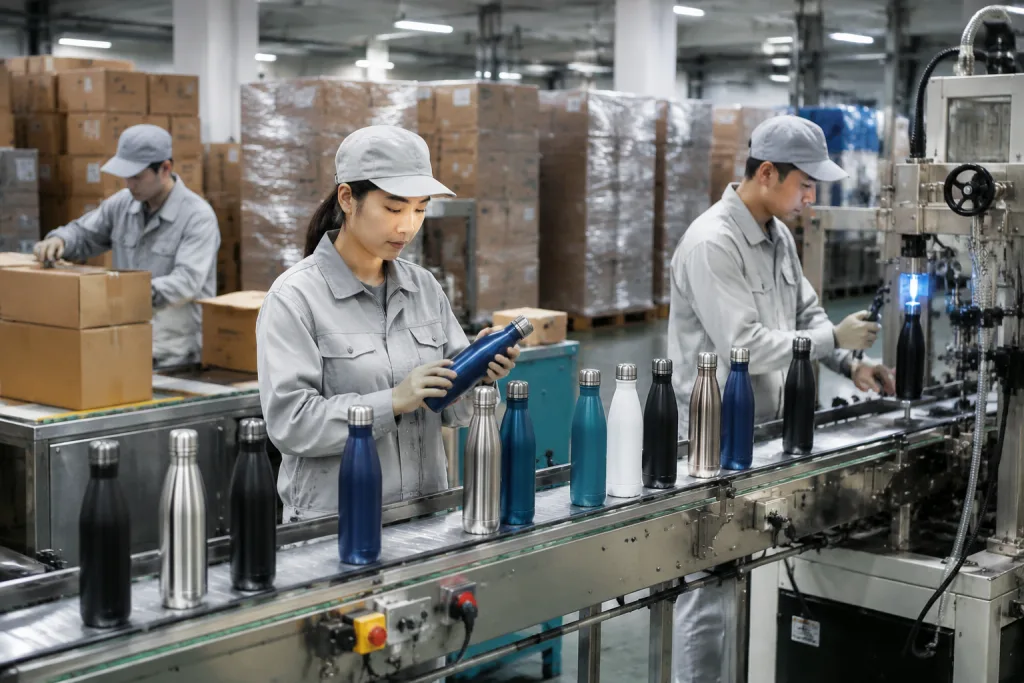
At BottleForge Industrial in Hangzhou, our monthly drinkware capacity is about 450,000 units across stainless bottles, tumblers, and growlers, with standard sample lead time of 7-10 days and mass production commonly 25-40 days after deposit and artwork approval. We usually need 12 days for a coated pre-production sample with laser marking versus 7 days for a plain stainless sample, because QC still checks the logo position with a 0.5 mm tolerance gauge before approval photos go out. During September-November, capacity tightens because North American and European promotional orders ship before holiday campaigns. Book earlier if you need vessel space before Q4.
FOB price depends on steel grade, capacity, lid structure, coating, logo method, packaging, and testing. A basic single-wall 750 ml stainless custom canteen may sit around USD 2.20-3.80 FOB. A double-wall vacuum bottle with powder coating and laser logo may run USD 4.80-8.50 FOB. A heavy customized growler can move from USD 9.00 to above USD 18.00 depending on capacity and lid hardware. Last month QC pulled a 64 oz growler sample where the handle screw added 38 g of stainless hardware, so the buyer's target price missed by USD 0.42 before carton cost.
Be careful with quotes that are 12-18% below the market without a clear reason. The saving often comes from thinner steel, cheaper paint, loose vacuum rejection, weak cartons, or skipped compliance tests. We have seen this go sideways: one distributor pushed for USD 0.25 off, then the buyer flagged 3% dented units after warehouse drop handling because the carton was changed from 5-ply to 3-ply. For distributor canteen programs, that USD 0.25 saving disappears fast.
Ask your canteen manufacturer to quote the same specification in writing: material, thickness in mm, lid material, logo size, packing method, test requirement, MOQ, payment terms, and Incoterm.
Compliance For Europe And North America
Compliance is not decoration paperwork. It decides whether your order can be sold, promoted, or imported without trouble. For Europe, buyers commonly ask for LFGB food-contact testing, EU 1935/2004, REACH for chemical substances, and sometimes BSCI or Sedex audit information for social compliance. For the United States, FDA food-contact expectations, CA Prop 65, CPSIA for child-related products, and ASTM standards apply by bottle type and user age. We run this check before tooling artwork; last month one buyer flagged a missing CA Prop 65 line on the PO, and it cost 2 days before the sample room could release the printed bottle.
If you are buying a kids bottle, do not treat it like a normal adult bottle. That is the wrong question to ask. A kids bottle needs small parts review, bite valve safety, BPA-free documentation, and tougher drop testing, often 1.2 m onto a steel plate for the lid corner and base. For a sports bottle with a straw lid, test the straw, silicone, PP lid, and coating as separate contact points where needed. A canteen factory should provide material declarations, but third-party testing must match your exact production materials, not a similar item from last year. QC pulled one 350 ml kids sample in Hangzhou because the silicone bite valve lot number did not match the SGS submission sheet.
AQL inspection is part of risk control. For most B2B custom drinkware orders, we suggest AQL Level II with critical defects at 0, major defects at 2.5, and minor defects at 4.0. Critical defects include leakage, sharp edges, contamination, or unsafe assembly. Major defects include wrong logo, serious dents, poor coating adhesion, or failed vacuum performance. Minor defects cover small cosmetic marks inside agreed limits, such as a 0.3 mm paint speck below the base rim. We ship by carton count, not hope; the line uses a vacuum tester and a 24-hour water leak rack before final inspection.
Do not wait until the goods are finished to ask for test reports. If your retailer requires reports dated within 12 months, or under its own lab account, state that in the PO. China factories can support testing, but rushed lab work after production can delay shipment by 7-14 days. We have seen this go sideways: 3,000 finished bottles sat in our packing area because the buyer wrote “FDA needed” but forgot to name the lab account, so the booking moved from 12 days to 18 days.
Packaging And Logistics Details
Packaging looks simple until the buyer starts deducting charges. For customizable drinkware, we usually run one unit in a polybag or tissue wrap, then a white box or kraft box, then a master carton. That works for wholesale. Retail buyers often ask for printed color boxes, hang tags, care manuals, UPC labels, carton side marks, and pallet specs. For Amazon orders, QC pulled the sample and checked FNSKU labels, suffocation warnings on the polybag, and carton weight against warehouse limits.
On a 750 ml vacuum bottle, a normal master carton usually holds 24 units and lands around 10-14 kg, depending on the box spec and divider. Push it to 48 units and the math gets ugly fast. One buyer wanted to save freight that way; we told him dent claims would eat the savings. For powder-coated bottles, we add cardboard dividers or switch to individual boxes when the route includes two or three warehouse transfers.
FOB Ningbo and FOB Shanghai are the two common terms we quote for Zhejiang production. Ningbo usually fits Hangzhou-area factories better, while Shanghai can work if your forwarder is consolidating mixed cargo. If you sell into a canteen distributor network, keep carton sizes steady across SKUs. A 2 mm difference in carton width sounds small, but it slows palletizing and messes with pick flow on the line.
For LCL shipments, ask for stronger cartons, moisture protection, and shipping marks on at least two sides. For DDP air shipments, check dimensional weight before you book, because a bottle carton fills space fast. We once saw a sample carton jump 11% in chargeable volume after the outer box changed by just a few millimeters. The buyer flagged it late; the forwarder invoice did not leave much room to argue.
How To Vet The Supplier
A canteen supplier is not qualified just because the catalog shows 300 SKUs. We see trading companies, small factories, and hybrid exporters using the same Hero bottle photos down to the reflection on the lid. Fine. Just ask who controls the line. Who owns the assembly benches, the vacuum tester set at 0.08 MPa, the powder coating partner, and the fiber laser for logo work? If they dodge that, the catalog size means nothing.
For a reusable water bottle customizable project, ask for production photos from the last 30 days, audit documents if they have them, and one sample with your real logo, not a blank bottle with a sticker. QC should pull the sample from a running batch, measure the mouth diameter with a digital caliper, and check the logo position in mm. If you are placing more than USD 20,000 in one PO, a video factory tour or third-party audit is reasonable. A professional canteen manufacturer can talk about defect history. We all have it. Anyone claiming zero defects is selling you a story.
Compare canteen manufacturers by response quality, not only unit price. A good export sales engineer asks about destination market, retail channel, required tests, lid function, carton drop requirements, and barcode placement before quoting. The weak supplier replies in 8 minutes with a low price and no questions. We have seen this go sideways when the buyer later flags an EU food-contact test or asks why the straw lid leaks at 45 degrees.
Payment terms are usually 30% deposit and 70% before shipment for first orders. For repeat distributor growler or distributor canteen programs, better terms can be negotiated after 3 stable shipments or 12 months of clean payment history. Keep golden samples, signed artwork, carton layout, and inspection criteria in one approval folder. Simple habit. On one PO, the buyer typed “matte balck” and QC caught the color mismatch only because the approved carton mockup showed matte black.
The right China partner will not say yes to every request. They will tell you when a custom canteen handle needs tooling, when a Pantone color adds 5 to 7 sample days, and when your target FOB price sits below safe 304 stainless material cost. This is the wrong question to ask: “Can you match the cheapest quote?” Ask whether the math works after coating loss, logo setup, leak testing, and AQL 2.5 inspection. Honest pushback beats a pretty quotation.
Send Your Bottle Specification For A Factory Quote
Share capacity, logo, market, MOQ, and packaging needs. Our Zhejiang team will reply with practical options, FOB pricing, and lead time.
Frequently asked questions
What MOQ should I expect for a reusable water bottle customizable order?
For existing stainless bottle molds, a practical MOQ is usually 1,000 units per design and 1,000-3,000 units per color if you need custom powder coating. Some canteen suppliers may accept 500 units for stock colors with a simple logo, but the unit price will be higher and color options may be limited. For a fully custom canteen with new lid tooling or special body shape, expect tooling fees and MOQ from 5,000-10,000 units. If you are a distributor testing a new SKU, start with an existing mold, standard lid, and laser or silkscreen logo. That keeps risk lower while you validate sell-through.
How long does production take after I approve the sample?
For most customized drinkware using existing molds, sample production takes 7-10 days after artwork confirmation. Mass production normally takes 25-40 days after deposit and signed pre-production sample approval. Add 5-7 days if you need custom Pantone powder coating, and add 7-14 days if third-party compliance testing must be completed before shipment. Sea freight to Europe or North America can add 25-45 days depending on port and season. If your campaign has a fixed event date, share it at the RFQ stage so the canteen factory can judge whether the schedule is realistic.
Which logo method is best for a canteen promotional order?
For canteen promotional orders, silkscreen printing is usually the best cost-performance choice when the logo is 1-3 solid colors and the order is above 1,000 units. It is fast, clean, and cost-effective. Laser engraving is better when you want a premium look or stronger wear resistance, especially on powder-coated stainless bottles. For full-color artwork, heat transfer or UV printing may work, but you should approve a physical sample because color and edge sharpness can vary. If the bottle will be used daily in bags, gyms, or vehicles, avoid placing large printed logos on heavy contact areas.
Can I mix bottle colors in one wholesale order?
Yes, but it depends on the coating schedule and MOQ per color. A canteen manufacturer may accept mixed standard stock colors at 300-500 units per color if total order quantity reaches 1,000-2,000 units. For custom Pantone coating, most factories prefer 1,000-3,000 units per color because powder changeover creates waste and setup time. Mixed colors also require tighter carton marking and inventory control. If you are a canteen distributor building a catalog, choose 3-4 core colors first instead of 10 slow-moving colors. That improves price, reduces stock risk, and makes repeat orders easier.
What should I check before paying the deposit?
Before deposit, confirm the full specification: capacity, dimensions, 304 stainless grade, wall thickness, lid material, logo method, logo size, Pantone colors, packaging, carton quantity, Incoterm, lead time, and required compliance tests. Ask for a written quotation and artwork proof, not only chat messages. For orders above USD 10,000, approve a physical sample or at least a production-equivalent sample with the same coating and logo method. Also confirm AQL inspection standard, payment terms, and whether the supplier is a factory, trading company, or hybrid exporter. Clear approval files prevent most reusable bottle disputes.