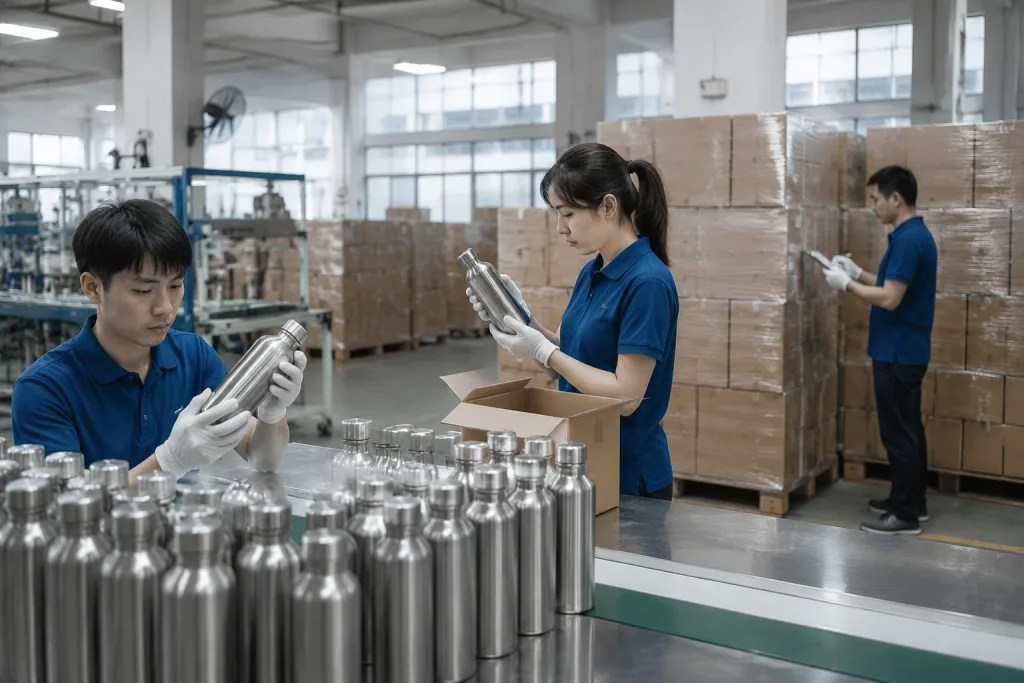
Key Takeaways
- A practical promotional bottle MOQ starts at 500-1,000 units for stock shapes and 3,000+ units for custom molds
- 304 stainless steel at 0.4-0.5 mm wall thickness is the normal baseline for mid-market promotional drinkware
- Logo method affects cost: laser engraving is usually USD 0.20-0.45 per unit, while full-wrap print needs higher setup control
- Plan 25-35 days for standard production after artwork approval, plus 3-7 days for inspection and export handling
A refillable water bottle promotional program looks simple until the PO lands. Then the buyer flags the missing logo setup fee, the 58 × 42 × 46 cm master carton fails FBA, QC pulled the sample for chipped powder coating after a 1.2 m drop test, or the factory cannot hit the approved Pantone color within ΔE 1.5.
No magic needed. You need a sourcing brief that says 304 stainless or plastic, a realistic MOQ such as 1,000 pcs instead of 200 pcs, and a canteen manufacturer willing to push back before the line starts. From our Hangzhou, Zhejiang office, we run into the same 4 problems every month: blurry AI artwork with 0.3 mm logo strokes, 0.4 mm steel quoted as “premium,” inspection booked 1 day before loading, and buyers comparing FOB China pricing against landed distributor drinkware costs. The math doesn’t work.
Start with the buying use case
Before asking a canteen supplier for a quote, pin down where the bottle will be used. Wrong question, otherwise. A university welcome-pack bottle is not built like an outdoor retail bottle; the line will change the body size, lid seal, coating thickness, export carton, and test plan before we even talk price. Last month QC pulled a 750 ml sample because the buyer wanted a carabiner lid for a school order, but the cap made the bottle 18 mm too tall for their gift box.
For most refillable water bottle promotional orders, buyers choose 500 ml, 600 ml, 750 ml, or 1,000 ml. Europe usually stays with 500-750 ml because commuter bags and bike cages are tight; we check this with a 74 mm cage gauge on the sample bench. North America accepts 32 oz and 40 oz sizes more easily, especially for sports orders and distributor growler programs. If you are buying for resale, do not guess. Ask your sales channel which size already sells, because we have seen 1,000 ml bottles sit in cartons when the buyer’s shelf was built for 600 ml.
There are three common product lanes, but the math is not equal. Stock-shape bottles with logo decoration move fastest and usually start at 500 or 1,000 units per color; we run these on existing jigs, so sampling is cleaner. Semi-custom drinkware covers special coating, lid color, packaging, or an accessory kit, and MOQ is usually 1,000-3,000 units because the coating line and carton supplier both need batch volume. A canteen customized by mold, cap structure, body contour, or proprietary handle is a development project, often 5,000-10,000 units after tooling, and the first T1 sample can expose small issues like a 0.3 mm parting-line step on the shoulder.
Be honest about the buying stage. If you are a canteen distributor testing a new SKU, starting with a custom mold is usually the wrong move. Use a proven stock bottle, put the budget into a clean logo and retail-ready packaging, then shoot proper photos; we ship plenty of repeat orders this way. If you are a brand owner protecting a retail line, a custom canteen or customizable growler can justify the tooling cost because it makes copycat pricing harder. One buyer once flagged a PO typo that changed “matte black” to “metal black,” and that kind of small miss gets expensive once tooling and coating chips are approved.
Choose materials without pretending
Most B2B buyers write “high quality stainless steel” on the RFQ. That line is too soft. A canteen factory should quote the steel grade, wall thickness, vacuum structure, coating type, and test standard on the PI, not bury it in chat. For stainless promotional bottles, 304 stainless steel is the normal food-contact choice for the inner wall. We run 201 stainless steel on some outside shells when the target price is tight, but the inner wall should be written as 304 and backed by a material certificate. QC pulled one sample last month where the PO said “SS bottle” and the buyer later expected full 304 inside and outside. That went sideways.
For vacuum insulated bottles, 0.4-0.5 mm stainless wall thickness is common in mid-market programs. Go thinner for an ultra-light bottle and the dent complaints start after the first carton drop. Use thicker steel and the bottle feels better, but the freight math gets worse fast. A 750 ml double-wall bottle normally weighs around 330-450 g depending on lid and body shape; our line checks this with a 0.1 g digital scale before sealing the golden sample. If a quote is 12% cheaper than the other two, ask for unit weight and steel gauge before you celebrate.
Plastic bottles still work for refillable water bottle promotional campaigns, especially Tritan, PP, or PE sports bottles. For Europe, check REACH and food-contact requirements. For the United States, ask about FDA food-contact compliance and, where relevant, California Proposition 65 documentation. For children’s products, ASTM and CPSIA concerns apply. A kids bottle is not just a smaller adult bottle. We once had a buyer flag a 6 mm straw because their retail tester called it a choking concern, so confirm mouthpiece size, cap torque, and age grading before tooling.
Glass bottles look clean and sustainable, but breakage risk and carton design decide whether the order survives shipping. A glass canteen promotional order needs silicone sleeve thickness, drop test expectations, and inner carton protection fixed before mass production. We ship glass with egg-crate dividers or molded pulp trays depending on the MOQ and bottle diameter; a 2 mm loose fit in the inner box can show up as cracked shoulders after a 1.2 m drop test. For a custom growler or customized growler, stainless steel usually handles transport and outdoor use better than glass unless the sales channel specifically wants glass.
China can manufacture all these material lanes well, but only if the specification is written. “Eco-friendly” is the wrong word to put on a purchase order by itself. Recycled stainless content, BPA-free plastic, FSC paper packaging, and plastic-free inserts are specifications. We prefer seeing them listed line by line on the PO, because one typo like “BPA” instead of “BPA-free” can slow artwork approval by 3 days and make the buyer nervous for no good reason.
Understand logo and finish costs
Decoration is where the budget moves fast. A plain bottle body might sit at USD 3.20 FOB Ningbo, then logo, coating, packaging, and QC can add another USD 0.50-1.50 per unit. We run this every week, and the wrong question is asking for one clean unit price with no decoration breakdown. That usually turns into a surprise after sample approval.
Laser engraving stays sharp and holds up well on stainless steel or powder-coated bottles. For a simple logo, it usually adds USD 0.20-0.45 per unit based on size and placement. Silk screen printing is cheaper for one or two colors on a flat panel, often USD 0.08-0.25 per color per position, but the line needs proper curing and adhesion checks. Heat transfer and water transfer work for full-wrap artwork, though the setup is fussier and the defect rate is easier to blow up if the buyer pushes a rushed PO.
Powder coating is the finish we use on a lot of custom drinkware orders. Ask for coating thickness, cross-hatch adhesion test, and dishwasher guidance up front. A 0.3 mm spec gap can change the result. Most promotional bottles end up hand-wash only, and if someone says otherwise without testing, we’ve seen that go sideways in customer complaints. If the campaign needs dishwasher-safe performance, say it at quotation stage and expect fewer color choices or a higher price.
For a canteen custom by color, lid, and logo, keep the artwork practical. Skip reverse text below 0.5 mm line width. Don’t run a logo across a curved shoulder unless you accept distortion on the line. If Pantone matching is part of the brief, ask for a tolerance sample, not a promise of lab-grade perfection on every batch. On powder coat, a close visual match under standard light is the right target.
Private label packaging matters too. A plain white box may add USD 0.12-0.25. A printed kraft box may add USD 0.25-0.60, depending on paper weight and MOQ. Retail color boxes cost more, especially under 3,000 units. QC pulled a sample last month with a box typo on the carton mark, and that is why we insist on line-item pricing instead of one vague package number from the supplier.
Set realistic MOQ and pricing
MOQ is not a punishment. It is the math behind the line: coating line setup takes one wash-down, logo tooling needs a screen or laser fixture, carton printing has a plate charge, and components have their own supplier MOQ. On our Zhejiang partner lines, a stock stainless bottle with one logo normally starts at 500 units per SKU if the color is available. A custom coating color usually starts at 1,000 units because the powder room will not open a 20 kg color batch for 200 pcs. Printed retail packaging often starts at 1,000-3,000 units. New mold development is rarely sensible below 5,000 units. We have seen this go sideways when a buyer asks for 300 pcs across 6 colors; the math does not work.
For reference, a 500 ml single-wall stainless bottle may quote around USD 1.80-3.20 FOB China depending on cap and finish. A 750 ml double-wall vacuum bottle may sit around USD 4.20-7.50. A larger insulated custom growler can range from USD 8.50-18.00 depending on capacity, handle, lid, and surface treatment. QC pulled one matte-black sample last month with a 0.6 mm paint chip near the base, and that finish cost more because we had to add one extra coating check. These are working ranges, not fixed prices, so you can catch quotes that look padded or too cheap to survive production.
Distributors ask for tiered prices. Fair request. A canteen manufacturer should be able to quote 500, 1,000, 3,000, and 5,000 units, with the price break tied to a real cost point. Sometimes the jump from 500 to 1,000 units saves only USD 0.15. Sometimes it saves USD 0.80 because carton printing, coating, or lid MOQ finally lines up with supplier terms. Ask for the reason, not just the number. If the sales sheet only says “better price at 3,000” and nobody can explain the carton size or lid MOQ, push back.
Our typical production capacity across selected drinkware lines is 300,000-500,000 units per month, but that does not mean every urgent order fits. Peak season before Q4 fills coating and assembly slots fast; last September we had 18 days of coating bookings before one new PO could even enter the line. Standard lead time is 25-35 days after deposit and artwork approval for stock molds. Customizable drinkware with special packaging or lab testing should be planned at 40-55 days. One typo on a PO, such as “Pantone 186C” written as “186U,” can burn 2 days before the sample room signs off.
Low MOQ works for a test order. It is not a forecast. If you expect stable color, stable lid supply, and repeat pricing, send the 3-month call-off plan before QC seals the pre-production sample.
Control compliance and inspection
Promotional buyers often leave compliance until the goods are already on the water. Bad habit. For Europe, confirm LFGB food-contact testing before we cut steel, then check REACH on powder coating, silicone seals, and any plastic straw parts. For North America, get the food-contact file, Prop 65 wording, and CPSIA or ASTM position clear by user age. If the bottle is for adults only, write “adult promotional use” on the PO and the packaging brief; we once had a buyer flag this after carton artwork was already plated.
Factory audits matter too. BSCI, Sedex, ISO 9001, and similar documents do not promise perfect bottles, but they show whether the canteen factory runs basic document control, incoming material checks, and worker-hour records. For a large corporate promotion, audit status can decide whether procurement releases the order. A canteen vendor that cannot send a factory profile, line photos from the assembly table, and a QC flow chart should not be your first choice for 10,000 units. We ask for those before quoting firm lead time.
Use AQL inspection, not a quick look at 20 cartons near the door. For drinkware, a common final random inspection level is General Inspection Level II with AQL 2.5 for major defects and 4.0 for minor defects, though stricter programs use 1.5 for majors. Major defects include leakage under a 30-minute inverted test, vacuum failure after hot-water filling, logo shift over 2 mm, sharp rim edges, cracked lids, or wrong material. Minor defects include small coating specks under 0.5 mm, light scratches outside the logo area, or carton printing issues within the signed limit sample.
Vacuum bottles need functional testing. Ask for leak testing, vacuum thermal retention testing, lid torque checks, and coating adhesion checks with 3M tape or a cross-cut tester. A basic heat retention check usually records water temperature after 6 or 12 hours under controlled conditions. The math does not work if one supplier starts at 95°C and another starts at 88°C, so compare results only when starting temperature, room temperature, fill level, and cap condition match.
If you work with canteen suppliers in China, put inspection timing into the schedule from day one. Final inspection after goods are fully packed usually needs 1-2 days for booking and 1 day on site; QC pulled the sample only after carton sealing, not while lids are still in bins. If problems are found, rework can add 3-10 days, with leakage fixes often closer to 5 days because the line must reopen cartons and retest. That is still cheaper than finding 600 leaking bottles in your warehouse in Germany, Canada, or the United States.
Plan shipping and distributor handling
FOB pricing is the first line on the cost sheet, not the landed cost. A refillable water bottle promotional order eats container space fast. For a 750 ml stainless bottle in an individual box, we usually pack 24 pieces per master carton; one recent carton measured 50 x 38 x 32 cm and came in at 10-13 kg on our floor scale. Air freight kills the margin on bulky bottles. We’ve seen a buyer approve a USD 1.42 FOB bottle, then push back when the air quote added USD 1.18 per piece. For non-urgent distributor drinkware orders, sea freight or rail-to-Europe planning usually makes the math work.
If you sell on Amazon or another marketplace, packaging needs to be locked before the line starts packing. FNSKU labels, carton drop tests, suffocation warnings for polybags, and master carton weight limits should sit in the packing instruction, not in a late WhatsApp message. Don’t ask the factory to “handle FBA” unless you send the routing guide. We can apply labels and carton marks; your account-specific rules are still yours. Last month QC pulled the sample carton because the FNSKU was 3 mm too close to the box edge, and repacking 1,200 boxes cost more time than anyone liked.
For canteen distributors, mixed cartons and barcode control cause trouble more often than bottle quality. If you buy four colors, decide early: single-color carton or mixed-color carton. Single-color cartons are cleaner for warehouse picking. Mixed cartons suit retail starter packs, but the packing table needs a color ratio sheet, or errors creep in by lunch shift. If you need EAN, UPC, or SKU stickers, send the approved label file and a placement drawing; “put it near the barcode” is the wrong instruction. We once caught a PO typo where navy was listed as “naby,” and the buyer flagged it after carton marks were already printed.
Shipping terms need plain wording. FOB Ningbo or FOB Shanghai is common from Zhejiang and nearby production areas, and we ship both lanes every week. EXW can look cheaper, but it moves local trucking, export handling, and customs paperwork to you or your forwarder. DDP works for small buyers if duties, VAT, insurance, and delivery appointments are written into the quotation. For serious B2B programs, FOB plus your own forwarder gives better control; we’ve seen DDP go sideways when a delivery warehouse refused a 9 a.m. appointment because the booking email used the wrong reference number.
A distributor canteen program also needs spare parts planning. Lids, straws, gaskets, and handles are the parts customers lose first. Ordering 1-3% spare lids or gaskets with the main shipment is cheap insurance; on our assembly bench, silicone gaskets are counted in 100-piece bags, so adding 300 spares to a 10,000-piece order is easy before sealing cartons. After shipment, it becomes a small headache with a courier bill.
Write a purchase brief factories use
A clear RFQ usually saves more than hard price pushing. Send canteen manufacturers a brief the costing desk and production line can price without chasing 6 follow-up emails. List capacity, material, insulation type, lid type, body color, logo method, artwork size, packaging, testing, target market, quantity tiers, delivery term, and required shipment date. If you have a target FOB price, share it. We run the BOM in grams, check carton CBM, then see whether the cap, coating, and logo process fit the number. A serious canteen supplier can suggest the closest workable construction instead of guessing.
For example, “750 ml double-wall 304 stainless bottle, powder coated matte black, one-position laser logo 35 x 45 mm, individual kraft box, 1,000/3,000/5,000 pcs, FOB Ningbo, Europe market, LFGB required, delivery by August 20” is a useful request. “Please quote best promotional bottle” is not. The second one lands in sales chat, not costing. Last month a buyer wrote “mate black” on the PO, and QC pulled the sample because the artwork file said matte black but the carton mark did not match.
Ask for pre-production samples. A digital mockup is not enough. For logo orders, one physical sample can confirm engraving depth, print position, coating color, cap fit, and packaging. Sample lead time is usually 5-10 days for stock molds with standard logo work, 12-18 days if custom coating or new components are involved. Approved samples should be signed, photographed, and kept as the inspection reference. We tape the approved bottle beside the QC table, then measure logo position with a 0.5 mm ruler during the first-line check.
Do not overload the first order. If you are testing a canteen promotional range, start with two colors and one lid structure. Add colors after sales data proves demand. Every extra color adds coating control, inventory complexity, and replacement risk. This is where the math doesn't work for small runs: 500 pcs split across 5 colors gives the coating line 100 pcs per color, and one shade drift can eat the margin. Customizable canteen programs work best when the base platform is stable and the options plug in cleanly.
BottleForge Industrial works from Hangzhou, Zhejiang, with production partners across China that handle stainless bottles, sports bottles, glass bottles, growlers, and packaging. We are practical about what factories can and cannot do. If your budget does not fit a fully customized canteen, we will say so and quote a stock option that can ship on time. We ship from Ningbo or Shanghai most weeks, and if a buyer flags a 7-day promo deadline with 3,000 pcs and new tooling, we tell them early instead of pretending the line can bend physics.
Send your bottle brief for a practical factory quote
Share quantity, target market, logo, packaging, and deadline. We will quote realistic options from Zhejiang and China production lines.
Frequently asked questions
What is the best MOQ for a first refillable water bottle promotional order?
For a first order, 500-1,000 units is the sensible range if you use an existing bottle shape and standard factory colors. Below 500 units, setup costs for logo, cartons, and production handling make the unit price unattractive. For custom coating, expect 1,000 units per color. For printed retail boxes, many suppliers prefer 1,000-3,000 units because paper mills and box factories also have MOQ. If you need a new mold, do not plan below 5,000 units unless the product has strong retail margin. A distributor canteen test should prove demand before locking money into tooling.
How much should I budget for a customized stainless bottle?
A practical FOB China budget for a 750 ml double-wall stainless bottle is usually USD 4.20-7.50 with standard lid, powder coating, and one logo. Laser engraving may add USD 0.20-0.45 per unit. A printed kraft box may add USD 0.25-0.60. A more complex customized canteen with special lid, carry handle, silicone base, or full-wrap artwork can move above USD 8.00. Freight, duty, VAT, inspection, and domestic delivery are not included in FOB pricing. If a quote is 25-35% lower than the market range, check steel thickness, vacuum performance, and packaging before approving.
Which logo method is safest for promotional drinkware?
Laser engraving is usually the safest for stainless steel promotional bottles because it does not peel and handles transport well. It works best for simple logos, names, and one-color brand marks. Silk screen printing is cost-effective for one or two colors, but adhesion depends on surface prep and curing. Heat transfer or full-wrap print is better for complex artwork, yet defect risk is higher on curved bodies. For corporate campaigns, we usually recommend laser engraving on powder-coated stainless steel, then a physical pre-production sample. If color accuracy is critical, request Pantone-matched print and accept a signed tolerance standard.
Can one canteen manufacturer handle bottles, growlers, and packaging?
Some canteen manufacturers can coordinate stainless bottles, sports bottles, custom growler projects, and packaging, but not every factory makes every item in-house. In China, many strong suppliers specialize by process: stainless vacuum forming, plastic injection, glass forming, coating, or packaging. A good canteen vendor should be transparent about what is produced internally and what is subcontracted. That matters for quality control and responsibility. For a distributor growler or customizable growler program, ask who makes the lid, who applies coating, and who packs final cartons. One accountable export partner is useful, but you still need clear inspection standards.
What documents should I request before mass production?
Ask for a proforma invoice, production specification sheet, artwork proof, packaging layout, factory profile, material declaration, and relevant test reports for your market. For Europe, LFGB and REACH may be needed depending on material and coating. For the United States, food-contact compliance and Prop 65 review may apply. If your buyer requires social compliance, request BSCI, Sedex, or audit documentation before placing the deposit. Also confirm AQL inspection criteria in writing: many buyers use AQL 2.5 for major defects and 4.0 for minor defects. These documents should be agreed before production, not requested after cartons are sealed.