Key Takeaways
- A practical distributor MOQ starts around 1,000-3,000 units per SKU for color and logo control
- 304 stainless steel, Tritan, borosilicate glass, and PP each create different testing and price issues
- AQL 2.5/4.0 inspection and pre-shipment leak testing should be written into the PO
- FOB China lead time is usually 30-45 days after artwork approval and deposit
Refillable water bottle distributors usually hit the same cost trap: the customer approves a clean bottle render, then the real bill shows up in landed cost, carton size, compliance testing, artwork rework, and missed ship dates. Pretty picture. Bad RFQ. Before we open a mold or run a Pantone match under the D65 light box, we need to know if the factory can hold color within ΔE 1.5, keep lids leakproof after a 24-hour upside-down test, pass REACH or FDA testing, and repeat the same powder coat on the next 3,000-piece reorder.
From our factory base in Hangzhou, Zhejiang, we see buyers lose 10 to 14 days when they treat custom drinkware like a catalog SKU. This is the wrong question to ask: “What is your best price?” A canteen customizable for a campus program, a customized growler for retail, and a promotional sports bottle for an event do not run on the same line settings, carton drop-test plan, or artwork file rules. Last month QC pulled the sample because the PO said matte black, but the AI file called out PMS Black 6C gloss. China can make these bottles well, but your RFQ needs specs tight enough for production, not just sourcing.
Start With The Selling Channel
Ask where the bottle will sell before you ask a canteen manufacturer for a quote. A distributor order for corporate gifting runs on different rules than a retail program, school district tender, Amazon FBA launch, or outdoor specialty account. The wrong channel brief changes the bottle structure, packing method, AQL 2.5 inspection points, and test documents; last month QC pulled 12 samples because the PO said “retail box” while the artwork file showed bulk-pack dividers.
For retail, we run stronger shelf boxes, EAN barcode labels, tighter Pantone control, and a master carton that can take courier-style mixed handling. Think 5-layer K=K carton, under 18 kg gross weight, with corner crush checked by the packing line. For promotional programs, the buyer often accepts bulk cartons if the logo is clean and the event date is protected. Amazon FBA is a different animal: carton weight, drop-test packing, FNSKU labels, suffocation warnings, and scannable outer cartons beat a shiny gift box every time.
If you are a refillable water bottle distributor, be direct about the use case when you brief the canteen supplier. Asking for “the cheapest bottle” is the wrong question to ask. A 500 ml single-wall aluminum canteen promotional item can hit a low price, but our line will still see small dents if the wall is only 0.5 mm and the cartons get stacked 6 layers high. A 32 oz double-wall stainless custom canteen costs more, but it makes sense for outdoor, gym, and employee wellness programs because the buyer is paying for insulation, hand feel, and fewer after-sales complaints.
At BottleForge Industrial in Zhejiang, our monthly capacity is about 600,000 drinkware units across stainless bottles, travel tumblers, sports bottles, and growlers. Big number. The schedule still moves by 304 stainless coil arrival, powder-coating color, lid tooling, silk-screen jig setup, and packing complexity. We have seen this go sideways when a buyer needed 20,000 units before a September retail reset but sent the final logo file on July 18; the math does not work. If you need that program on shelf, tell the canteen factory in March, not July.
Choose Materials Without Guesswork
Material is where distributor canteen orders slip fast. Buyers ask for the lowest price, then stack on a hot fill spec, a drop test, and a logo finish that the cheap build cannot hold. We start by checking what the end user actually does with the bottle, not what looks good on a quote. Last week QC pulled a sample because the lid torque was off by 0.8 N·m on the test line.
304 stainless steel is the standard workhorse for reusable bottles and custom growler programs. On vacuum bottles, we usually run 0.4-0.5 mm for the inner and outer shells, and that range keeps the line stable. 316 stainless steel fits the inner wall when the buyer wants stronger corrosion resistance, but the math does not work for every program and the cost jump is real. One PO typo on a wall spec can turn into a full recheck.
Tritan works well for clear sports bottles when impact resistance and BPA-free claims matter. It needs a tighter cap structure because the body flexes more than steel. Borosilicate glass gives a clean premium look, but we budget for silicone sleeves, thicker inner trays, and breakage control at pack-out. PP and PE stay on lids, straws, handles, and inner stoppers, where they make sense. The buyer flagged one glass set because the carton drop result was weak by 10 cm.
If you need a canteen customized for EU or North American buyers, ask for material declarations before sampling. For Europe, REACH and LFGB testing may be requested. For the US, FDA food-contact compliance and California Proposition 65 review are common. For kids bottles, buyers may ask about CPSIA, ASTM-related packaging checks, and small-part risk. A serious canteen vendor in China should expect all of this, and this is the wrong question to skip.
Do not mix too many materials unless the order size supports it. A stainless body, PP lid, silicone gasket, and powder coating is a clean build. Add a bamboo cap, copper plating, printed sleeve, straw set, and gift box, and the line turns messy fast. We have seen that go sideways on a 5,000-piece order when the packing list and sample bag did not match.
MOQ, Price, And Lead Time
Most canteen distributors open with 3 numbers: MOQ, unit price, and ship date. Fair question. It is also the wrong question to ask first if the spec is still loose. We quote a 750 ml single-wall 304 stainless bottle with one-color silkscreen on a stock body nothing like a 1 L vacuum insulated bottle with powder coating, laser engraving, carry handle, and retail box; last month QC pulled the sample because the buyer’s PO said “matte black,” while the Pantone file showed 426C.
For distributor drinkware programs, realistic MOQ ranges are usually:
- 500 units for a stock shape with a simple logo, when the model and color are sitting in our Hangzhou sample room already
- 1,000-3,000 units for custom color, laser logo, or silkscreen logo on a standard mold; we run a 3M tape test after coating before packing
- 5,000-10,000 units for a new lid color, private packaging, or a multi-SKU retail set with separate carton marks
- 20,000 units or more for new mold development or exclusive structural changes, because the CNC tooling and trial shots need their own schedule
FOB Ningbo or FOB Shanghai pricing for standard stainless vacuum bottles often lands around USD 3.20-7.80 depending on order volume, coating, lid design, and packaging. Customizable growler projects are heavier; a 64 oz vacuum growler can sit in the USD 8.50-16.00 FOB range before duty and freight. Plastic sports bottles price lower on paper, but the math doesn't work if the cap leaks at AQL 2.5 inspection or the lab asks for a different food-contact report.
Lead time from China is normally 7-12 days for pre-production samples after artwork confirmation, then 30-45 days for mass production after deposit and sample approval. Peak season can add 10-20 days, especially when powder coating lines are full before back-to-school and holiday programs. We ship FOB Ningbo and FOB Shanghai often, but a factory completion date is not the same as customer delivery date; count ocean freight, customs, inland trucking, and inspection delays if your customer needs stock in a European warehouse by a fixed promotion date.
Logo Methods That Actually Hold
Custom drinkware gets judged at the logo first. A bottle can pass leak testing and still get rejected if the mark rubs off after 20 dishwash cycles. The right method depends on the surface, MOQ, artwork detail, and washing claim. We had a buyer flag 3 cartons last June because the bottle worked fine, but the slogan printed 2 mm too low.
Laser engraving is the safest choice on stainless steel when the buyer wants a clean, permanent mark. We run it often for corporate programs and premium customized canteen orders above 500 pcs. It adds no ink, so color stays with the exposed metal or the contrast against the coating. On powder coating, the laser strips the top layer and shows the stainless base; it looks crisp only when the coating thickness holds around 60 to 80 microns across the body.
Silkscreen printing keeps cost down for one or two solid colors on straight bodies and mild curves. Ink matters. Curing matters too. Cheap ink fails the 3M tape test fast, and we have seen dishwashing claims go sideways after 10 cycles when the oven temperature was set 8°C low. Heat transfer and water transfer handle full-color artwork better, but plate setup and reject sorting cost more. UV printing works for small batches and complex graphics, though QC should pull coated-steel samples for cross-hatch adhesion before bulk packing.
For canteen custom work, ask for a logo layout sheet with print size, position tolerance, Pantone reference, and front-facing direction. Plus or minus 1.5 mm is reasonable for a lot of bottle bodies; asking for zero movement on a curved surface is the wrong question to ask. If you order customized drinkware for 12 branches or franchise customers, keep the logo size consistent across SKUs where the diameter allows it. It cuts setup mistakes, and it stops the usual inspection argument when one PO says 42 mm and the artwork file says 45 mm.
One opinion from the line: do not wrap tiny legal text around a tapered bottle unless you accept distortion. It looks clever on a PDF and ugly in production. QC pulled a sample last month where 5 pt text stretched near the shoulder, and the buyer rejected the photo before we even packed the first carton.
Quality Control Before Shipment
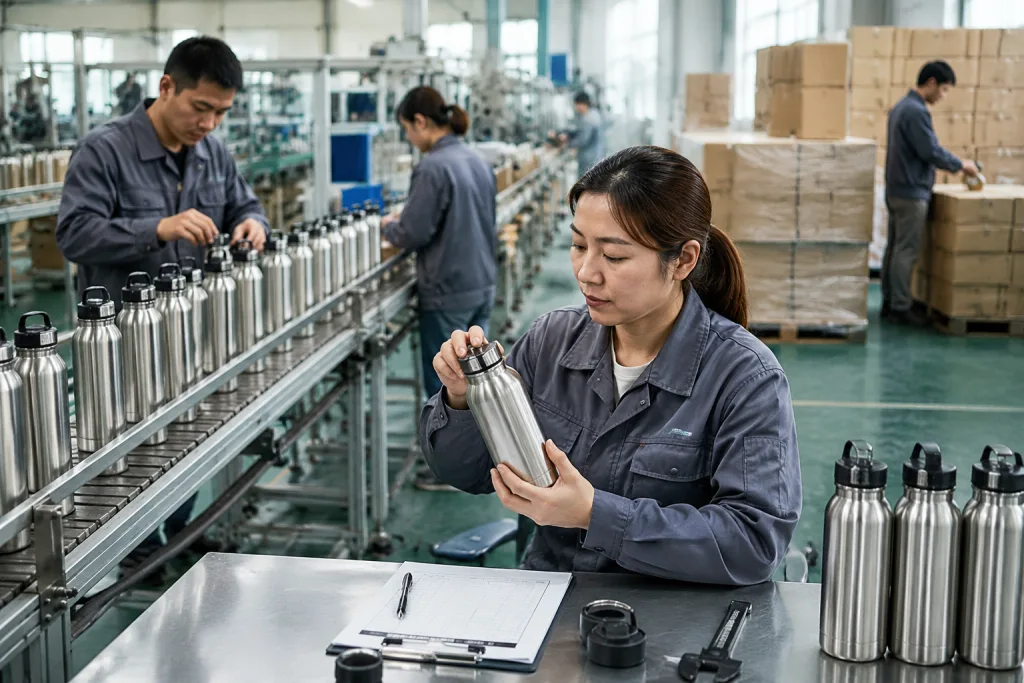
A solid canteen supplier does not wait for final inspection to catch trouble. We run checks from incoming 304 steel to welding, vacuum test, coating, assembly, and packing. If the PO says nothing, the factory will fill in the blanks, and that is where disputes start.
For stainless vacuum bottles, the usual checks cover vacuum performance, wall thickness, weld seams, lid fit, gasket position, odor, coating adhesion, print adhesion, leak resistance, capacity, and carton drop resistance. On the line, QC pulled the sample with a 3M tape test and a hot-water hold check after assembly. For powder coating, cross-hatch adhesion and alcohol rub testing are standard; for logos, 3M tape testing is the floor, not the finish line.
For third-party inspection, a lot of buyers use AQL General Inspection Level II with Critical 0, Major 2.5, Minor 4.0. That sets the defect limit, nothing more. You still need a clear major-defect list. A leaking lid, wrong logo color, exposed rust, missing gasket, cracked cap, or unreadable barcode is a hard reject, not a cosmetic issue. We have seen buyers lose a claim because the PO said “normal defects” and the inspector had no room to call it out.
Ask the canteen manufacturers for inline photos, carton marks, and a pre-shipment inspection booking window. If you need BSCI, ISO 9001, Sedex, or other audit documents, ask before deposit, not after production starts. A PO typo on the buyer name or carton count can slow release at the warehouse, and a trading company’s supplier list is not the same thing as a verified production site in Zhejiang.
Packaging And Distributor Logistics
Packaging is not decoration. It decides freight damage, warehouse handling, retail shelf condition, and chargebacks. Refillable water bottle distributors should lock packaging before artwork approval, because one color box can move a carton from 0.048 CBM to 0.061 CBM and change the pallet count. We check this on the packing table with a tape measure, not from a PDF.
Bulk packing fits most promo orders over 3,000 pcs: one bottle in a polybag or tissue wrap, egg-crate dividers between bodies, then a 5-ply export carton. Retail packing usually means color boxes, kraft boxes, window boxes, belly bands, hang tags, instruction sheets, and barcode labels, so we price the labor by station instead of guessing. E-commerce packing is tougher. A single bottle dropped through parcel sorting takes more abuse than a palletized B2B carton; QC pulled one sample last season with a dented lid after a 76 cm drop test.
Carton strength matters. A common export carton might use K=K or A=B flute depending on weight and route. For heavy distributor growler orders, we run fewer units per carton, even when the buyer pushes back on freight count. The math does not work if the carton hits 22 kg and the handles tear during unloading. We prefer keeping master cartons near 18-20 kg; once they go over that, the line sees more crushed corners and warehouse staff start dragging instead of lifting.
If you ship to 3 distributor warehouses, confirm carton marks by destination before mass packing. If you ship to Amazon, confirm FNSKU placement, carton label size, polybag warnings, and master carton limits before the first carton is sealed. Small detail, big mess. Relabeling 8,000 units after inspection is not a small fix; we have seen it burn three days, and one PO even had “FNSKU” typed as “FNSK” on the label file, which the buyer flagged during pre-shipment photos.
For sustainable drinkware positioning, kraft boxes, recycled paper inserts, and reduced plastic work well when the structure still protects the bottle. Do not cut protection so hard that breakage rises from 0.5 percent to 4 percent. We tested one no-polybag pack with a white powder-coated bottle, and the divider rubbed black marks onto 14 pieces in a 200 pcs pilot run. Sustainability claims need to survive the truck, the port, and the distributor warehouse, not just the sales deck.
How To Brief A Factory
A vague RFQ gives you vague pricing. We see it every week. If you want a canteen factory to quote cleanly, send the same detail you would ask from your own buyer: capacity in ml, steel grade and wall thickness, insulation claim, lid structure, Pantone or coating code, logo size and method, box style, sales market, test standard, quantity by SKU, ship date, and Incoterm. Our merchandiser once had to rework a quote because the PO said “blue” but the approved swatch was Pantone 2965C.
Use plain numbers. Instead of saying “premium bottle,” write “750 ml double-wall 304 stainless, 0.5 mm outer wall, powder coated black, laser logo 45 x 22 mm, leakproof screw lid, 24 hours cold claim, individual kraft box, FOB Ningbo, 3,000 units.” QC can pull a sample against that. The caliper, vacuum tester, and logo positioning jig all have something clear to check.
If you are comparing canteen suppliers, lock the spec before you compare prices. One vendor may quote 0.4 mm steel, another 0.5 mm. One may include a 350 gsm retail box, another may pack 24 pcs into a bulk export carton. One may quote FOB China, another EXW. The cheapest line on a spreadsheet often hides a missing FDA test, thinner coating, weak 5-layer carton, or a production slot 18 days out instead of 12 days. The math doesn't work if the quote is missing half the job.
For a new distributor relationship, start with a standard mold unless your customer needs exclusivity. Standard molds cut tooling cost, keep sampling around 7-10 days, and make reorders easier because the line already has fixtures for that body. Once monthly volume proves itself, talk about a private lid, shoulder profile, or custom growler handle. Tooling for a new plastic lid can start around USD 2,000-6,000; full bottle structural tooling can go much higher. We've seen this go sideways when a buyer spends on tooling before the first 1,000 pcs retail test sells through.
The best custom drinkware projects are not complicated. They are specific. When your brief is clear, a reliable canteen vendor in Zhejiang can protect cost, quality, and timeline without turning every 1 mm tolerance or carton mark into an argument. We ship cleaner when the brief is clean.
Send Your Bottle Spec For A Factory Quote
Share capacity, quantity, logo, packaging, and target market. We will reply with practical MOQ, FOB pricing, sampling time, and compliance notes.
Frequently asked questions
What MOQ should refillable water bottle distributors expect?
For standard shapes with a simple logo, 500 units may be possible if the color is already in stock. For normal distributor drinkware programs, 1,000-3,000 units per SKU is a better planning number because it supports custom color, stable logo setup, and efficient packing. If you need a new lid color, retail box, printed insert, or mixed carton plan, expect 5,000 units or more. New mold projects usually need 20,000 units or a tooling charge. Be careful when a canteen supplier offers very low MOQ for a highly customized canteen; the unit price may be high, the color control may be weak, or the factory may be using leftover inventory.
How long does a custom drinkware order take from China?
A normal timeline is 7-12 days for artwork proof and pre-production sample, then 30-45 days for mass production after deposit and signed sample approval. Add 3-7 days for inspection, booking, and container loading. Ocean freight to North America or Europe can add 25-45 days depending on port and season. Air freight is faster but often too expensive for stainless bottles because the cartons are bulky. If your customized growler or canteen promotional order has a fixed event date, work backward from warehouse arrival, not factory finish date. Peak season before summer and Q4 can add 10-20 days.
Which certification documents should I ask a canteen manufacturer for?
For food-contact drinkware, ask for material declarations and recent test reports for the target market. EU buyers often request REACH, LFGB, and sometimes specific migration testing. US buyers commonly ask for FDA food-contact compliance and Proposition 65 review. For children’s products, CPSIA and small-parts risk should be considered. Factory-side documents may include ISO 9001, BSCI, Sedex, or social audit reports, depending on your customer. Do not accept a generic certificate without checking product scope, test date, tested material, and applicant name. A stainless bottle report does not automatically cover a plastic straw, silicone gasket, bamboo cap, or printed coating.
Should I use laser engraving or printing for customized drinkware?
Use laser engraving when durability and a premium look matter more than full color. It is strong for stainless steel bottles, custom canteen orders, and corporate gifting. Use silkscreen printing for clear one-color or two-color logos when you need lower cost at 1,000 units or more. Use heat transfer, water transfer, or UV printing for full-color designs, gradients, or retail graphics, but require adhesion testing before mass production. For powder-coated bottles, ask for a pre-production sample and check logo contrast under normal lighting. Also confirm logo tolerance, usually around plus or minus 1.5 mm on curved bodies.
How do I compare quotes from different canteen vendors fairly?
Put every canteen vendor on the same specification sheet. Include capacity, material grade, wall thickness if known, lid type, coating, logo method, packaging, carton quantity, testing, Incoterm, payment terms, and delivery date. A USD 0.40 price gap may come from real differences: thinner steel, no retail box, weaker carton, cheaper coating, or EXW instead of FOB. Ask each canteen manufacturer to state exclusions clearly. Also compare sample quality, response speed, document quality, and whether they can explain defects honestly. For refillable water bottle distributors, the cheapest supplier is rarely cheapest after delays, rework, chargebacks, and customer complaints.