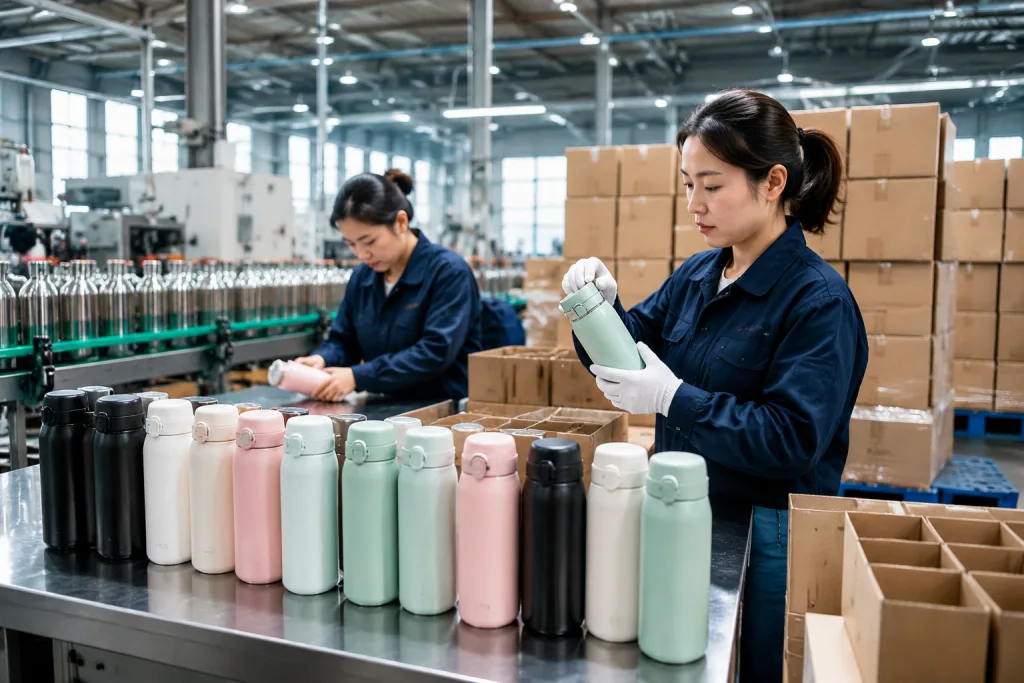
Key Takeaways
- A practical MOQ for custom thermos orders is usually 1,000-3,000 units per color and 3,000-5,000 units for new powder coating colors.
- 304 stainless steel at 0.45-0.55 mm inner wall thickness is a common baseline for retail-grade vacuum bottles.
- Normal lead time from Zhejiang, China is 35-50 days after deposit and artwork approval, excluding ocean freight.
- Use AQL 2.5 for major defects and AQL 4.0 for minor defects on wholesale stainless thermos inspections.
If you purchase vacuum bottle wholesale for an outdoor retail line or a promotional thermos campaign, price is only one line on the risk sheet. We have seen 6,000 pcs look clean in the carton, then QC pulled the sample and found 2 lids leaking at the silicone ring, heat retention dropping after 3 months, REACH files missing, or the shipment landing 12 days late for a spring launch.
On our thermos floor in Hangzhou, Zhejiang, buyers still ask first for the catalog photo. Wrong question. We run the line by steel grade, vacuum yield, lid tooling fit, coating adhesion after cross-cut tape test, 1.2 m carton drop result, and logo tolerance within ±0.5 mm; skip those checks and the math doesn't work, even when China gives you a sharp bulk thermos price.
Start with the bottle use case
A hiking retailer and a low-cost conference giveaway should not share the same spec sheet, even if both get sold as a custom thermos. This is the wrong question to ask: “What is your cheapest 500 ml bottle?” For outdoor retail, we run tighter checks on heat retention, lid torque, coating adhesion, and carton strength. QC pulled one trail-bottle sample last month after the flip lid squeaked at 6 kgf·cm on the torque meter. For an event thermos, a lighter body or simpler lid can pass if the delivery date is fixed and the logo color matches the buyer’s Pantone chip.
Before asking a thermos supplier for a quote, write the use case in numbers. Capacity: 500 ml, 750 ml, or 1,000 ml. Mouth diameter: 45 mm for drinking, 55-60 mm for ice cubes, or wider for food-style use. Target heat retention: 60°C after 12 hours for a 500 ml bottle tested from 95°C water is a reasonable retail claim. Body finish: powder coating, spray painting, stainless polish, or silicone boot. Carton drop requirement: 76 cm on 1 corner, 3 edges, and 6 faces is a common export test reference. We write these items on the sample card beside the caliper reading, because a 2 mm mouth change can turn a clean quotation into three rounds of revised drawings.
For a distributor thermos program, I would not start with 12 SKUs. Start with 2 capacities and 3 colors, then build the line after sell-through data. We’ve seen this go sideways: the buyer flagged slow replenishment after choosing 9 lids, 4 coatings, and a matte gold logo that needed two print passes. If you are a thermos vendor supplying promotional brands, keep one reliable 500 ml and one 750 ml mold available with stable lid inventory. That beats chasing 20 fashionable shapes that you cannot replenish in 45 days.
At BottleForge Industrial in Zhejiang, our monthly stainless vacuum bottle output is about 420,000 units across standard and customized thermos programs. Our usual MOQ is 1,000 units per stocked color, 3,000 units per custom color, and 5,000 units when a new lid color or silicone component must be produced. Those numbers matter because they decide whether your quote is based on real production or wishful sampling. We had one PO arrive with “mat black” instead of “matte black,” and the line stopped for 18 minutes while sales, PMC, and the spray room confirmed the coating code.
Specify steel, vacuum, and insulation
Most buyer problems start with loose material wording. “Stainless steel” is not a spec. On a retail program or thermos bulk order, write 304 stainless steel for the inner wall on the PO, then choose 201 or 304 for the outer wall. We run plenty of balanced bottles with a 304 inner wall at 0.45-0.55 mm and a 201 outer wall at 0.45-0.50 mm, checked by micrometer before drawing. If the brand sells into a premium channel, coastal market, or a buyer already flagged rust complaints last season, use 304 inside and outside. The extra cost is easier to defend than a return pallet.
For a factory thermos, vacuum quality is harder to check than steel grade. The line should include vacuum pumping, copper brazing or laser sealing based on the body design, then heat-retention screening before packing. We usually fill samples with hot water, hold them for 6 hours, and reject bottles with abnormal outer-wall temperature; QC pulled a sample last month that looked perfect but warmed the infrared gun to 38°C on the side wall. Bad sign. A weak vacuum still photographs well, then fails when your customer leaves coffee in a cold truck overnight.
Do not accept insulation claims without test conditions. “Keeps hot 24 hours” is the wrong question to ask unless the supplier states starting water temperature, room temperature, bottle capacity, fill level, and final temperature. A 1,000 ml bottle usually beats a 350 ml bottle because the surface area works against the smaller size. For a 750 ml manufacturer thermos, a solid benchmark is 70°C or higher after 6 hours and 55-60°C after 12 hours under controlled indoor testing at about 20°C room temperature. We write that into the spec sheet, not just the quotation.
Check every part touching liquid. Lids should use food-contact PP, Tritan, or stainless components where the structure needs it. Gaskets should be food-grade silicone, usually 50-60 Shore A hardness depending on lid structure; we measure this with a Shore A durometer because soft rings can leak after 3,000 open-close cycles. For Europe, ask your thermos manufacturer for LFGB or EU food contact documentation when needed, plus REACH for coatings. For North America, FDA food-contact compliance and, for kids or youth items, CPSIA and applicable ASTM review can matter. One typo on a PO, like “silicon” instead of “silicone,” has caused more arguments than it should.
Choose customization that survives use
A customizable thermos can look sharp in a mockup and still look tired after 30 dishwashing cycles or 7 days rolling around in a backpack. We see this on the line when QC pulled the sample after a 500 g denim-rub test: the logo passed on one finish and smeared on another. Match the logo method to the finish and to the buyer channel. Laser engraving holds up on 304 stainless and powder coating, but it gives a tone-on-tone mark, not full color. Silk screen printing works for simple one-color or two-color logos on smooth coating, with lower setup cost at 1,000 pcs MOQ. Heat transfer is better for gradients and retail artwork, but adhesion testing decides whether the math works. UV printing fits short runs and detailed graphics, but abrasion resistance depends on ink brand and curing time under the UV lamp.
If you are buying thermos custom for outdoor retailers, I usually recommend laser engraving or a proper silk screen logo on powder coating. The buyer flagged this last season: “Nice logo, but will it survive rental gear?” Fair question. For a promotional thermos campaign where the artwork sells the bottle, heat transfer or UV may earn the extra cost. Ask for a 3M tape test, cross-hatch adhesion test with a 1 mm cutter, and alcohol rub test before mass production. For powder coating, a 1.5-2.0 mil coating thickness is common, but this is the wrong question to ask if the oven curve is unstable. We run the curing oven log by batch because 12 minutes at the wrong temperature can fail faster than 18 minutes in spec.
Color matching needs discipline. A Pantone reference on paper will not look identical on curved stainless steel under warehouse lighting, and we have seen this go sideways when a PO said “beige” while the approved chip was closer to sand gray. Approve a physical color chip or pre-production sample, not just a PDF. For a customized thermos program with 3 colors, approve each color separately. White shows pinholes fast. Matte black hides small shade drift but shows rub marks. Sand beige changes under LED inspection lamps, so we check it at the packing table and again near the dock door before we ship.
Packaging is part of customization too. Outdoor retailers often need barcode labels with 38 mm placement tolerance, hang tags tied through the lid loop, recycled kraft boxes with crush-test notes, and carton markings by SKU. Promotional brands may need individual gift boxes, then master cartons sorted by event location so the warehouse team does not open 60 cartons to re-sort them. If you sell through marketplaces, FNSKU labels and carton weight under 15 kg can reduce receiving problems. A good thermos suppliers quote should include logo, packaging, labeling, and export carton specs in one line, not as surprises after deposit; we have seen buyers push back hard when a “free box” turns into a 0.42 USD add-on after artwork approval.
Understand wholesale pricing and MOQ
If you purchase vacuum bottle wholesale, chasing the lowest unit price is the wrong question to ask. We quote a 500 ml stainless vacuum bottle around USD 3.20-4.80 FOB Ningbo or Shanghai for standard construction, depending on steel grade, lid build, coating process, logo method, packaging spec, and order quantity. A 750 ml bottle often lands around USD 4.10-6.20 FOB. Premium lids, handle caps, silicone boots, full 304 construction, or retail packaging add USD 0.20-1.20 per unit. Last month QC pulled a 500 ml sample at 286 g on the bench scale; the buyer compared it with a 241 g quote from another factory. Same photo. Different bottle.
MOQ is not a sales trick. It comes from coating line setup, logo fixture setup, carton printing plates, component injection runs, and stainless steel sheet purchasing. A standard supplier thermos model in a stocked color can often run at 1,000 units. A thermos customizable order with new Pantone powder coating is more realistic at 3,000 units, because the line needs one powder change, one color card approval, and at least 2 cartons of sprayed samples before mass production. New mold development for a special lid or body shape usually starts at USD 3,000-12,000 tooling cost, depending on complexity, and 45-70 days for mold and validation. We’ve seen this go sideways when a PO says “matte black” but the buyer meant Pantone Black 6 C.
Be careful with quotes packed with hidden assumptions. A thermos manufacturer may quote low based on 201 outer steel, thin wall, basic lid, plain white box, and no third-party testing. That works for some giveaways. It does not work for a retailer expecting returns under 1%. Ask each manufacturers thermos candidate to quote against the same specification sheet: capacity in ml, body steel such as 304 stainless, lid material with gasket type, coating thickness in μm, logo size in mm, box type, carton quantity, test requirement, Incoterm, and payment term. If the supplier cannot tell you wall thickness with a digital caliper, the math doesn't work.
For distributors thermos programs, ask for tier pricing at 1,000, 3,000, 5,000, and 10,000 units. You will see where production efficiency starts. In China, price drops usually matter when component MOQ or coating batch efficiency improves, not because you push harder in email. A serious thermos factory can explain why 3,000 units costs less than 1,000 units: fewer powder changes, better carton printing cost, and less downtime on the line. A weak supplier says “best price” and waits. We run into this weekly.
Control quality before shipment
Plan quality control before the deposit leaves your account. For a bulk thermos order, we run a written quality standard and a buyer-approved inspection checklist, not a few photos in WeChat. Set checkpoints for capacity tolerance, weight tolerance, lid fit, leakage, vacuum performance, coating defects, logo position, barcode scan, carton drop result, and packing count; for a 500 ml bottle, buyers often set capacity at ±5% and logo shift within 1.5 mm. For appearance, define the viewing rule: 30-40 cm under normal light, no magnifying glass. QC pulled one matte-black sample last month with 6 tiny powder dots, all invisible at arm’s length, and the buyer still flagged it because the PO never said what “acceptable” meant.
AQL inspection is the normal tool for export drinkware. For most wholesale orders, use AQL 2.5 for major defects and AQL 4.0 for minor defects. Critical defects such as leakage, sharp edges, foreign material inside the bottle, or wrong food-contact material need zero tolerance. No debate there. If you ship to outdoor retailers with strict vendor manuals, set tighter limits or run 100% leak testing on the line; for a 12,000 pcs order, the math works better than paying for a return pallet in Hamburg.
Leakage testing needs its own line on the checklist. A practical factory method is simple: fill each bottle or sampled bottles, invert them, shake for 10-15 seconds, then check the lid thread and silicone gasket with dry tissue. For straw lids or flip lids, match the real use angle; a bottle lying sideways in a backpack is not the same as a cup tilted 45 degrees on a desk. Some lids are spill-resistant, not fully leakproof. Say that on the color box and user card, because we’ve seen this go sideways when Amazon customers treat a sip lid like a screw cap.
Pre-shipment inspection should start when at least 80% of goods are packed and 100% of goods are produced. If you need lab testing for REACH, LFGB, FDA food contact, or coating heavy metals, do not wait until vessel booking week. Lab testing can take 5-10 working days, and in Q4 we plan 12 days vs 18 days if the lab is stacked with toys and cookware jobs. In Zhejiang, China, we normally reserve 3-5 days between final inspection and container loading, because QC may find a wrong EAN label, a carton mark typo from the PO, or 2 cartons with loose dividers that need repacking before the container truck arrives.
Plan logistics and reorder timing
Lead time and freight timing are where purchase plans get tight. We run a normal custom thermos order at our Hangzhou, Zhejiang facility in 35-50 days after the deposit is received and the approved AI artwork matches the signed sample. Add 3-7 days for domestic trucking to Ningbo or Shanghai, export customs clearance, and port handling; last month QC pulled 24 bottles from a 3,000 pcs lot because the carton mark showed “750ML” while the PO said “750 ml.” Ocean freight to the US West Coast is about 18-25 days on water. Europe is often 30-40 days on water depending on port and routing. Inland delivery still needs a buffer.
If your launch date is fixed, work backward from the shelf date, not from the day you want to place the PO. For a May retail shelf date in Germany or the United States, approve the production sample by late February or early March. For a promotional event, air freight is the wrong backup plan to assume unless the margin is already checked. The math often fails: air shipping a 750 ml stainless vacuum bottle can cost more than the bottle because a master carton might be 58 x 39 x 31 cm, with bulky volume weight against a low unit value.
FOB is still the cleanest term for experienced importers. FOB Ningbo or FOB Shanghai lets your forwarder control consolidation, cargo insurance, and final delivery, which matters when 2 suppliers share one 40HQ. If you are new to importing, DDP feels easier, but compare the full landed cost and confirm who carries customs responsibility when HS code questions come up. For Amazon-style channels, carton labels need the right ship-to code, FNSKU labels must scan at 300 dpi, polybags need the suffocation warning if used, and carton size limits must be confirmed before packing. We have seen this go sideways after the line packed 86 cartons and the buyer flagged the missing FNSKU.
Reorder planning matters as much as the first order. If your distributor thermos line sells through in 8 weeks but production plus freight takes 10-12 weeks, you will stock out. Ask your thermos suppliers to hold critical components such as lids and silicone gaskets when you have a rolling forecast; for standard color bodies, we can sometimes reserve 1,000 pcs blanks before logo printing. A reliable thermos vendor should name the bottleneck. We should not pretend every reorder can ship in 20 days when the lid mold is already booked on the line.
Vet the supplier behind the quote
A low quote from a thermos supplier means nothing if the factory cannot repeat it on 3,000 or 30,000 pcs. First ask who is actually making the bottle: trading company, manufacturer thermos factory, or a hybrid team using partner workshops. Any of these can work. The risk starts when the sales rep cannot say which line forms the 304 stainless body, which room handles powder coating, which mold injects the lid, and who signs the final AQL 2.5 report. We run into this often; one quote looked sharp until QC pulled the sample and found the body height was 2.8 mm off the drawing.
For outdoor retailers and promotional brands, supplier audits are not paperwork for the file. BSCI, Sedex, ISO 9001, and quality system records show whether the factory is used to written SOPs, batch records, and buyer checks. If your customer needs social compliance, confirm the audit status before you pay for samples. We have seen factories make 12 good samples and still miss a buyer audit window by 18 days because their overtime records were not clean. That delay kills launch dates.
Ask for production photos, QC flow, sample retention policy, and defect handling process. A serious thermos manufacturers partner keeps golden samples and signed pre-production samples for each order, usually locked in the sample cabinet with the PO number taped on the box. They should record logo position in mm, coating batch, carton artwork version, and gasket material lot. When a repeat order has a leaking lid or shade drift, those records let the line correct fast instead of arguing by email for 6 days.
Communication style is another filter. If you ask about wall thickness, AQL, or REACH and only get “no problem,” keep pushing. Good suppliers thermos teams answer with numbers, photos, and limits: 0.45 mm inner wall, 0.50 mm outer wall, 24-hour hot water test, real carton drop results. They will also push back when the math does not work, such as 500 units in 6 custom colors with full-color retail packaging at the same price as a 10,000-unit run. We have seen this go sideways.
For a first order, keep the scope tight: one proven body, one lid, two colors, one logo method, and one carton standard. That is enough to test the factory without turning the PO into a rescue project. After the factory proves delivery, expand into more thermos customized options. On our floor, a clean first run might be 1,000 pcs with laser logo, 12 kg master cartons, and a signed carton mark sheet; the buyer flagged one typo on a PO last month, and catching it before printing saved 86 cartons from rework.
Send your thermos spec for a factory quote
Share capacity, logo, quantity, market, and target delivery date. We will reply with MOQ, FOB pricing, lead time, and practical options.
Frequently asked questions
What MOQ should I expect when I purchase vacuum bottle wholesale?
For standard stainless vacuum bottles, expect 1,000 units per stocked color as a realistic starting MOQ. If you need a custom Pantone powder coating, 3,000 units per color is more practical because coating setup and material loss are real costs. For new lid colors, silicone boots, or molded accessories, MOQ often moves to 5,000 units. A new body or lid mold may require USD 3,000-12,000 in tooling and 45-70 days before mass production. If a supplier offers 300 units with full customization at a very low price, check whether they are using stock bodies, digital logo only, and generic packaging.
Is 304 stainless steel necessary for a custom thermos?
For the inner wall, yes, 304 stainless steel is the normal baseline for a safe, retail-grade custom thermos. For the outer wall, 201 stainless can be acceptable on many wholesale programs if corrosion exposure is low and coating is good. A stronger specification is 304 inner and 304 outer, especially for outdoor retailers, coastal markets, or premium positioning. Typical wall thickness is 0.45-0.55 mm, depending on capacity and body shape. Ask your thermos manufacturer to state steel grade on the proforma invoice and keep material records. If you need EU or North American compliance, pair the steel spec with food-contact documentation for lids, coatings, and silicone gaskets.
How long does a customized thermos order take from China?
A normal customized thermos order from Zhejiang, China takes about 35-50 days after deposit, artwork approval, and production sample approval. Add 5-10 working days if you need third-party lab testing for REACH, LFGB, FDA food contact, or coating heavy metals. Ocean freight then adds roughly 18-25 days to the US West Coast and 30-40 days to many European ports, plus inland trucking. Air freight is possible for urgent promotional thermos orders, but it can add USD 2-5 per unit or more depending on bottle size and carton volume. For fixed launches, approve samples at least 10-12 weeks before the required warehouse date.
Which logo method is best for outdoor retail bottles?
For outdoor retail, laser engraving and durable silk screen printing are usually the safest choices. Laser engraving is excellent on powder coating or stainless steel because it does not peel, but it is not full color. Silk screen is cost-effective for 1-2 color logos and can look sharp if the bottle surface is consistent. Heat transfer and UV printing are better for complex artwork, but you should require adhesion, abrasion, and alcohol rub testing. For a thermos promotional order, visual impact may matter more than long-term abrasion resistance. For a retailer, I would rather have a simpler logo that survives backpack use than a full-color print that scratches in 2 weeks.
How do I compare quotes from different thermos suppliers?
Compare quotes only after every thermos supplier prices the same specification. List capacity, steel grade, wall thickness, lid material, gasket material, coating type, logo size, packaging, carton quantity, test requirements, MOQ, lead time, and Incoterm such as FOB Ningbo or FOB Shanghai. A USD 0.40 price difference may come from a thinner outer wall, cheaper lid, no retail box, or weaker coating. Ask for tier pricing at 1,000, 3,000, 5,000, and 10,000 units. Also ask what is included: pre-production sample, barcode labels, carton marks, inspection support, and spare parts. The best thermos factory quote is not always the lowest; it is the one you can verify before shipment.