Key Takeaways
- For PP bottles, realistic MOQ is usually 3,000-5,000 units per color, with custom mold projects starting near 10,000 units.
- Food-contact PP should be tested against EU LFGB or FDA requirements, and pigments should be checked for REACH where applicable.
- A stable wholesale drinkware quote must define resin grade, wall thickness, cap material, gasket, print method, carton spec, and FOB port.
- Normal lead time from Zhejiang or nearby China production hubs is 25-40 days after sample approval and deposit.
If you plan to purchase polypropylene bottle wholesale, supplier search is the easy part. The harder work is locking the PP resin grade, checking 1.2 mm wall thickness at the shoulder, testing cap torque on a digital torque gauge, and confirming carton burst strength before you approve 5,000 or 50,000 units. PP bottles look simple on a sample table. They are not. A small change in mold venting or lid gasket depth can turn a clean reorder into 300 photos of leaking bottles from your customer service team.
From our factory base in Hangzhou, Zhejiang, we see buyers compare PP bottles with stainless steel orders, Tritan retail programs, glass gift sets, and bulk canteen tenders with 12-color assortments. China has capacity, but two quotes at USD 0.42 can hide different resin sources, different AQL 2.5 habits, and different export paperwork discipline. We’ve seen this go sideways when a buyer chased the lowest price and QC pulled samples with black specks near the injection gate. The sourcing brief has to make the line accountable.
Start With The Right PP Spec
If you purchase polypropylene bottle wholesale, don’t start with a catalog photo and a target price. Start with the performance spec. PP works well for food containers because it is light, impact-resistant, and handles heat better than 5 common low-cost plastics we get quoted against. For drink bottles, we run body wall thickness from 1.2 mm to 2.0 mm, based on volume, shape, squeeze feel, drop risk, and whether the bottle gets thrown into a sports bag with keys and a wet towel. QC checks this with a digital thickness gauge at the shoulder, waist, and base. Small detail, big difference.
Ask the supplier to write the material clearly on the PI: virgin PP, recycled PP, or a blend. For export drinkware wholesale, virgin food-contact PP is the safer default. Post-consumer recycled content looks good in a sales deck, but for direct beverage contact the paperwork gets heavier and color drift shows up fast. We’ve seen a 3,000 pcs blue order shift half a Pantone shade between injection batches, and the buyer flagged it before packing. If you are selling into the EU, ask for LFGB or EU 10/2011 food-contact support. For North America, ask for FDA food-contact compliance. If the bottle is for children, discuss ASTM F963 and CPSIA requirements early, even if your product is not a toy.
Caps kill cheap projects. A PP body with a low-grade PE lid, thin silicone gasket, or loose thread tolerance will leak during carton drop testing, even when the bottle itself looks fine. Define the cap material, gasket hardness, thread turns, and whether the bottle must pass a 180-degree leak test for 24 hours. We usually ask the line to fill 12 samples, invert them on kraft paper, then QC pulls the sample again after one shift. For a promotional giveaway, that may pass. For retail, gym, or outdoor use, add a 1.0 m drop test on a filled bottle and discuss dishwasher cycles. PP can handle heat better than PET, but the decoration and lid parts may fail first.
Don’t let the phrase best wholesale drink bottle distract you. It is the wrong question to ask. The right bottle matches the sales channel. A school bottle, a canteen wholesale program, and a gym bottle do not need the same mold, lid, or testing budget; we’ve seen this go sideways when a buyer tried to use one 600 ml mold for 4 channels just to save one tooling charge.
Match Product Type To Channel
Polypropylene bottles make sense when the buyer needs a light, cheap, repeat-order item. We run these mostly for school campaigns, race kits, gym giveaways, and value retail; a 600 ml PP bottle is usually around 58-72 g before packing, so carton weight stays friendly. The line uses existing injection molds for most caps, and QC checks mouth diameter with a digital caliper before leak testing. The mistake we see 6 or 7 times a month is buyers putting PP bottles in the same drinkware bulk basket as stainless tumblers, bulk growler items, aluminum canteens, and small alcohol flasks. Same category name, different sourcing math.
If the program is plain hydration, PP is usually the lower-cost route. A 600-750 ml PP sports bottle made with an existing mold can land at a lower FOB cost than stainless steel, and tooling can be skipped if the logo area fits within the current print jig. Fast too. We have shipped repeat PP bottle orders in 12 days, while a custom stainless tumbler with powder coating and laser logo often needs 18-25 days. If the brief mentions hot coffee, beer, or insulation, PP is the wrong question to ask. Beer tumbler wholesale or beer tumbler bulk projects usually need stainless steel double-wall bodies and, in some cases, powder coating. Beer growler wholesale and beer growler bulk programs need pressure checks, cap sealing tests, and often stainless steel or glass instead of PP.
Canteens sit in the gray area. A bulk canteen or wholesale canteen order might be PP, PE, aluminum, or stainless steel, depending on the shelf price and user. If you send canteen bulk wording to a China factory, spell out whether you mean a military-style bottle with a shoulder strap, a kids lunch canteen, or a normal water bottle with a screw cap. We once had a PO say “canteen bottle 500 ml” while the artwork showed a kids bottle with a straw lid; the buyer flagged it only after we sent the 3D mold drawing. The same problem hits growler wholesale and wholesale growler requests. Some buyers say growler for any large bottle. Brewery buyers mean a beer growler in bulk, with sealing and cleaning demands. Those are not interchangeable.
Alcohol flask wholesale and alcohol flask bulk belong in another lane. An alcohol flask in bulk is normally stainless steel, with welded seams, internal electropolishing, and a cap thread that cannot feel gritty when QC twists it by hand. We pulled one sample last season where the weld line inside the neck caught a cotton swab, and that batch did not ship. Do not force one supplier quote sheet to cover PP bottles, alcohol flask wholesale bulk, beer growler wholesale bulk, and beer tumbler wholesale bulk unless the supplier has separate lines and inspection records for each category. One factory can trade 200 items. Only some factories can make them properly.
Understand MOQ And Price Drivers
For existing PP bottle molds in Zhejiang, we usually quote a workable MOQ at 3,000 to 5,000 units per color. Custom PMS color, custom lid, or new mold pushes the order to 10,000 units or more. At BottleForge Industrial, typical monthly drinkware capacity across plastic and stainless categories is about 420,000 units, but that does not erase color-change loss, mold booking, or print setup time. The wrong question is “Can you accept 2,000 units?” A buyer ordering 2,000 units in six colors can tie up the injection line for half a day, while 12,000 units in one color runs cleaner with one resin change and one QC color card check under the light box.
FOB pricing for a basic 600-750 ml PP bottle may range from about USD 0.55 to USD 1.35 depending on resin, gram weight, lid structure, decoration, packaging, and inspection level. A thicker body, flip lid, silicone loop, matte texture, or individual color box can add USD 0.08 to USD 0.45 per unit. Tooling for a new PP bottle mold may range from USD 3,000 to USD 12,000 for a simple project, and more if you need multiple cavities, complex cap parts, or tight cosmetic requirements. We weigh the first 20 shots on a 0.1 g scale; if the body moves from 78 g to 92 g, the resin math changes fast.
Decoration drives price. One-color silkscreen is cheap and holds up well on straight cylindrical shapes. Multi-color printing, heat transfer, IML labels, and full-wrap artwork cost more because artwork registration has to be controlled, not guessed from a PDF screenshot. Laser engraving is usually the wrong pick for PP; we run it more often on stainless steel wholesale drinkware. If you want drinkware bulk products across PP, stainless, and glass, split the decoration plan by material. We have seen this go sideways when a PO says “same logo on all items,” then QC pulled the PP sample and the 0.25 mm fine line had already filled in during pad printing.
Packaging matters more than buyers expect. A master carton that passes local wholesale drinkware handling can fail export handling after two truck transfers and one wet container floor. For North America and Europe, we normally recommend 5-ply export cartons for heavier mixed drinkware wholesale orders, edge-crush strength around 32 ECT or better, and a carton drop test based on gross weight. If you sell online, ask about FNSKU labeling, suffocation warnings for polybags, and carton dimension control before confirming the proforma invoice. Last month the buyer flagged a PO typo: 54 × 42 × 38 cm became 45 × 42 × 38 cm, and the pallet plan lost 18 cartons.
Build A Quote Sheet That Works
A solid RFQ forces the factory to quote the bottle you plan to buy. A weak one says, “please quote 750 ml PP bottle with logo.” We see this 6-8 times a month, and it creates five drawings, five material assumptions, and five prices that cannot sit in the same comparison sheet. Put the basics in one line: volume, resin grade, target bottle weight, wall thickness in mm, lid type, gasket material, color code, logo size, print method, inner packing, carton quantity, test standard, AQL level, Incoterm, destination market, and yearly forecast. The line needs numbers. Our costing clerk cannot price “thick wall”; she needs something like 1.2 mm body wall and 78-85 g body weight before she opens the mold-cost file.
Use wording the line can quote against. Example: 750 ml bottle, virgin food-contact PP body, approximate body weight 78-85 g, screw cap with food-grade silicone gasket, 1-color silkscreen logo 60 x 35 mm, individual OPP bag, 50 pcs per export carton, AQL 2.5 major and 4.0 minor, FOB Ningbo, EU retail market. That is enough for a Zhejiang factory to send a serious quotation, not a bait price. The wrong question is “what is your cheapest 750 ml PP bottle?” QC pulled one sample last quarter where the buyer expected silicone, but the PO only said “gasket,” so the first quote used TPE and the sample failed the buyer’s smell check.
If you are consolidating other products, split them into separate tabs. Use one tab for purchase polypropylene bottle wholesale, one for canteen wholesale, one for beer tumbler in bulk, one for beer growler wholesale, and one for alcohol flask wholesale if needed. We run costing by process, not by catalog mood: injection PP bottles, stainless tumblers, and vacuum growlers sit on different lines with different scrap rates. This also blocks a common trading-office trick, where one blended answer hides which items are made in-house and which ones are subcontracted 40 km away in Yongkang.
Define the commercial assumptions before anyone talks price. State whether your target is FOB Ningbo, FOB Shanghai, EXW Zhejiang, or DDP to your warehouse. FOB is cleaner for experienced importers because it separates factory cost from freight swings; DDP works for a small first order, but the math gets messy once cartons pass 3-4 CBM. Ask for carton dimensions, gross weight, HS code suggestion, and declared material details. For PP bottles, HS classification and duty treatment can change by market and product design, so send the spec sheet to your broker instead of relying only on the supplier. We have seen this go sideways when a PO typo listed “PC bottle” instead of “PP bottle,” and the buyer flagged it only after the forwarder prepared the export docs.
Control Samples Before Production
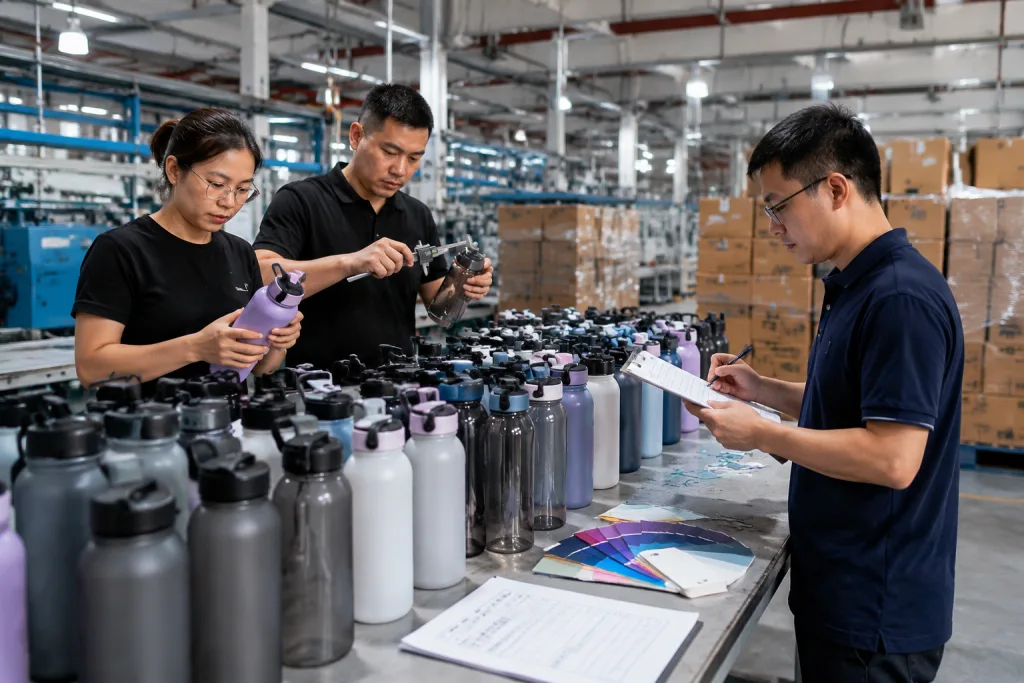
Samples are not souvenirs. They are the contract reference for mass production. Before you approve a PP bottle sample, put it on a 0.1 g digital scale, measure total height and body diameter with calipers, check fill volume with a graduated jug, twist the cap by hand, then leave it filled and upside down for 12 hours. If the bottle has a flip lid, open and close it at least 200 times. If the product targets sports, schools, or outdoor retail, we run a filled drop test from 1.0 m onto plywood or concrete. Photos hide problems. QC pulled one sample last month where the bottle looked fine, but the hinge pin walked out after 73 flips.
Color approval needs discipline. PP color can shift between resin batches, especially for translucent colors. Approve against a physical PMS chip or a signed master sample, not a screen image from a laptop. For brand owners, this is where 2 approval rounds become 4. The factory can produce a lab dip or color chip in 5-7 days, but comments like “make it more premium” add another cycle because the line has no measurable target. Give us PMS 5425C, a tolerance, or a signed bottle. The buyer flagged this exact issue on a PO where “smokey blue” was typed as “smoky blue,” and purchasing lost 6 days confirming the shade.
For logo approval, request a pre-production sample using the actual decoration method. A digital mockup is not enough. For silkscreen, check ink adhesion with a 3M 600 tape pull, rub the print 50 times with a wet cloth, and soak the printed area in 60°C water if the bottle will be washed often. If your project includes drinkware wholesale sets with mixed materials, do not expect one Pantone ink to match across PP bottle bodies, stainless powder-coated tumblers, and glass cups with baked decals. It will not. We have seen this go sideways when the PP passed, then the stainless logo looked 1 shade duller under warehouse LED lights.
Keep one golden sample with you and one sealed at the factory. Sign or photograph the details that matter: gram weight and fill line, logo position in mm from the base, cap structure, inner bag style, and carton mark. For orders above 20,000 units, we recommend a pilot run or first-article inspection before full production. It costs time. The math still works because catching a loose cap on 300 pilot pieces is cheaper than opening a full container and finding every bottle feels slightly wrong.
Inspect With Practical AQL Rules
Inspection should follow the failure risk, not the carton value. For most PP bottle wholesale orders, we run ANSI/ASQ Z1.4 or ISO 2859-1 sampling with AQL 2.5 for major defects and 4.0 for minor defects. Critical defects stay at 0. Major defects mean leakage, cracked body, sharp plastic flash, wrong material, wrong logo, color mismatch beyond the signed PP chip, or export packaging that collapses in a 10 kg carton drop check. Minor defects are small cosmetic marks, print offset inside the approved mm tolerance, or light flow lines that do not change use. QC pulled 125 pcs last month and found 7 sharp flashes around the drinking spout; that is not “appearance.” That is a reject.
Ask the inspector to run functional checks, not just count scratches. Fill 20-32 pieces from the sample lot, invert them for at least 30 minutes, and check leakage on dry kraft paper so even a slow cap weep shows. Test cap fit across different cavities if the mold has multiple cavities; cavity No. 4 is where we usually see thread drag first. Measure bottle weight on at least 10 pieces with a 0.1 g digital scale. If your approved sample is 82 g and mass production averages 70 g, the supplier saved resin and changed performance. The math does not work. Treat it as a serious issue, not a minor variation.
For compliance, documents are not enough, but you still need them in the file before shipment booking. Request food-contact test reports that match the material family and destination market. If the supplier provides an old report from a different bottle, ask whether the same resin, pigment, and additive package is used, then match the resin lot code on the bag in the injection area. For EU buyers, REACH concerns can apply to pigments, coatings, inks, and packaging components. For US buyers, California Proposition 65 may matter depending on your retail channel. BSCI, Sedex, or ISO 9001 audits do not prove food-contact safety, but they do show something about process control and labor management. We have seen this go sideways when a PO says “clear blue” but the lab report covers only natural PP.
If you are shipping mixed containers with wholesale growler, beer tumbler wholesale, or alcohol flask wholesale bulk items, inspect by category. A stainless flask weld issue needs a water pressure or seam check; a PP bottle leak issue needs cap torque, thread fit, and inversion testing. One generic “bulk drinkware passed” report is not enough for a serious procurement file. We ship mixed 40HQ loads often, and the buyer flagged it once because the inspector used the same checklist for a 304 stainless flask and a 650 ml PP sports bottle.
Plan Lead Time And Reorders
For an existing PP bottle mold, we quote 25-40 days after deposit and sample approval. Custom Pantone color matching or a new logo setup usually adds 7-15 days; our color room checks the chip under a D65 light box before we release it to the injection line. New mold work adds 25-45 days before mass production, depending on cavity count and how many correction rounds the buyer accepts after the T1 sample. In Q3 peak season in Zhejiang and other China drinkware hubs, book earlier. We may still have injection machines open, but pad printing screens, cap assembly tables, and AQL 2.5 inspection slots become the choke point.
For first orders, keep the program simple. One or two colors, one logo method, and standard packaging will teach you more than a launch with six SKUs and three carton marks. We have seen this go sideways: the buyer flagged a 2 mm logo shift on SKU 5, and the whole shipment waited while the line reworked bottles that were already polybagged. Once the product sells, add canteen bulk variations, growler bulk products, or beer tumbler wholesale bulk sets under the same brand story. Do not force every possible item into the first purchase order. The math doesn't work.
Reorder planning needs to cover resin batch control and color repeatability. Ask how long the supplier keeps the approved color formula, mold maintenance record, and logo screen; if they cannot show a file name or sample tag, push back. At BottleForge Industrial in Hangzhou, Zhejiang, we keep signed production references for repeat programs, usually one sealed bottle, one carton label, and the approved Pantone note in the job folder. QC pulled a repeat sample last month where the cap torque was 0.3 N·m off the reference. One reorder mismatch can damage a distributor relationship faster than a late sample.
If annual demand is predictable, share a 6-month forecast. You do not need to place all purchase orders at once, but a rolling forecast helps us reserve mold time, resin, and packaging before the warehouse gets tight. For importers handling wholesale drinkware or drinkware bulk across several retail accounts, this cuts emergency air freight; we have had buyers ask for 18 cartons by air after a PO typo put the ship date 12 days later than their promo plan. Air shipping low-value PP bottles rarely makes sense because freight can exceed the product cost. Plan ocean freight early, confirm carton cube, and protect the margin before the order leaves China.
Send Your PP Bottle RFQ For Factory Review
Share volume, market, logo, packaging, and target FOB price. We will flag cost risks before you commit to tooling or mass production.
Frequently asked questions
What MOQ should I expect when I purchase polypropylene bottle wholesale?
For an existing mold, expect 3,000-5,000 units per color as a normal MOQ from a China factory. If you need a custom PMS color, some suppliers will accept 3,000 units but charge a color setup fee or resin loss fee. For a new mold, 10,000 units is a more realistic starting point, and tooling may cost USD 3,000-12,000 depending on the bottle and cap design. Very small orders such as 500 units are usually handled from stock, with limited color and logo choices. If your target is retail consistency, avoid stock-mix orders unless you can accept shade variation and packaging differences.
Is PP safe for food-contact drink bottles in Europe and North America?
PP can be safe for food-contact drink bottles, but you need documentation tied to the actual resin, pigment, and additive system used in production. For Europe, ask for EU 10/2011 or LFGB support where relevant, plus REACH consideration for inks and colorants. For the United States, ask for FDA food-contact compliance information and check California Proposition 65 if your channel requires it. Do not accept a random test report for a different plastic bottle. The report should match PP material and, ideally, the same product family. For kids products, discuss CPSIA and ASTM F963 early because testing scope and cost can change the project.
How much does a custom logo add to PP bottle wholesale pricing?
A simple one-color silkscreen logo may add about USD 0.03-0.08 per unit, depending on logo size, order quantity, and bottle shape. Two-color printing, full-wrap heat transfer, or more complex artwork can add USD 0.10-0.35 per unit. Setup charges may apply for screens, films, or fixtures, often USD 30-120 per color or position. Curved or textured PP surfaces are harder to print cleanly than flat panels, so ask for a pre-production sample with the real method. If you are comparing wholesale drinkware quotes, make sure every supplier includes the same logo size, color count, and packaging.
Can one supplier handle PP bottles, canteens, growlers, tumblers, and flasks?
One supplier may coordinate all those items, but that does not mean one factory makes them all. PP bottles, wholesale canteen programs, beer growler wholesale, beer tumbler in bulk, and alcohol flask wholesale require different materials, equipment, and inspection standards. PP uses injection or blow molding; stainless flasks need welding and polishing; insulated tumblers need vacuum performance control. If you want one export contact for convenience, ask which products are made in-house and which are subcontracted. For each category, request separate samples, test reports, AQL checklists, and lead times. This keeps a mixed bulk drinkware order from hiding weak items.
What is the normal lead time from sample approval to shipment?
For existing PP bottle molds, 25-40 days after sample approval and deposit is normal. Add 5-10 days for color matching, 7-14 days for printed pre-production samples, and 25-45 days if new tooling is required. Peak season can add another 7-15 days, especially before major retail delivery windows. Sea freight to Europe or North America then adds several weeks depending on port and routing. If you need FNSKU labels, retail cartons, or pallet requirements, confirm those before production starts. Changing packaging after the bottles are finished can delay shipment and create repacking costs.