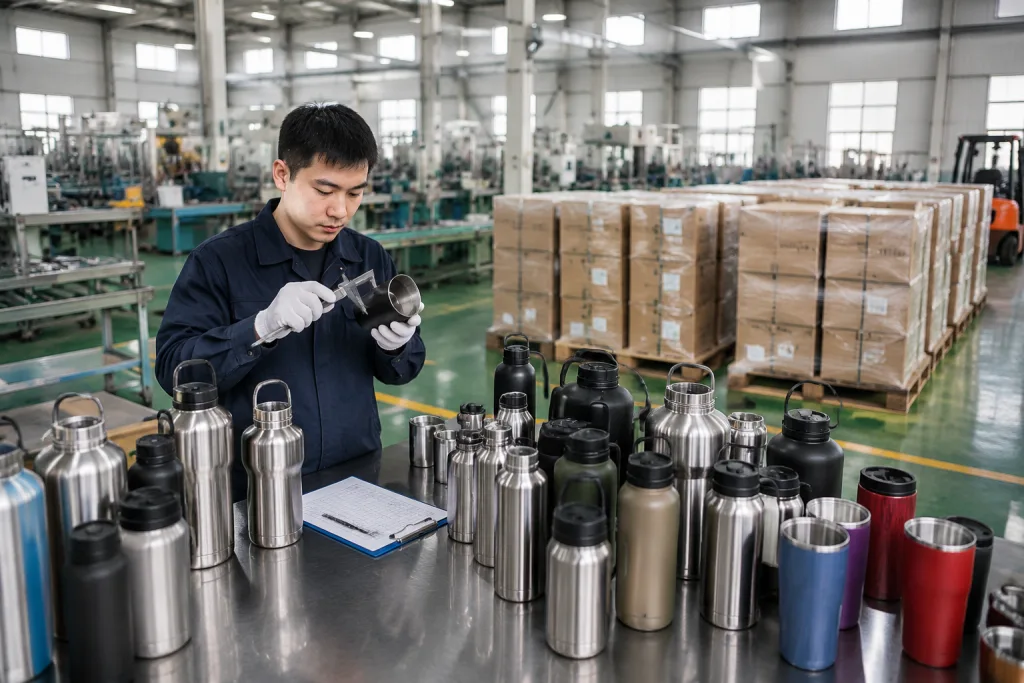
Key Takeaways
- Expect 1,000-3,000 units MOQ per SKU for most custom wholesale drinkware programs
- FOB China prices only make sense after you lock material grade, capacity, finish, and packaging
- Use AQL 2.5/4.0 inspection for appearance, leak testing, function, and carton checks
- Lead time is usually 30-45 days after deposit and artwork approval, not after first email
If you need to purchase drinkware wholesale, finding a supplier is the easy part. The harder job is locking the spec: 304 stainless body, lid tolerance within 0.3 mm, print that survives tape-test, and a carton that does not collapse after 18 kg stacking. We’ve seen this go sideways. One buyer chased a USD 0.12 lower quote, then QC pulled the sample and found the inner wall was 0.36 mm instead of the agreed 0.42 mm.
From Zhejiang, China, we see the same sourcing mistakes about 20 times a month: buyers compare FOB prices without checking wall thickness, approve artwork before adhesion testing, or order drinkware bulk before confirming retail box and FBA carton dimensions. The math doesn’t work if Amazon rejects the carton. BottleForge Industrial runs 600,000 units/month across stainless bottles, travel tumblers, wholesale canteen programs, beer growler bulk orders, and private-label flask lines, with a practical MOQ from 1,000 units per SKU. On our line, the caliper and 3M tape test usually catch problems before the buyer’s inspector does.
Start With The Product Use
Before asking for a price list, pin down what the cup has to survive in the buyer’s hand. A stainless sports bottle for a 120-store gym chain is not the same build as a beer tumbler wholesale program for outdoor retail. An alcohol flask wholesale bulk order for a gift distributor is different again. We run different steel thickness, lid tooling, powder coating, leak-test pressure, and packaging. Last month QC pulled the sample after 30 minutes upside down because the buyer’s PO said “push lid,” but the artwork file showed a screw cap.
For stainless vacuum bottles and tumblers, most serious wholesale drinkware projects use 304 stainless steel for the inner wall and either 304 or 201 for the outer wall, depending on price target. A common wall thickness is 0.4-0.5 mm per shell. For a bulk canteen or wholesale canteen project intended for hiking, I would not chase the lowest shell weight. The math doesn’t work. We’ve seen 0.38 mm outer shells pass the quote stage and then come back with dent complaints after a 1.2 m drop test on the line.
Capacity changes cost faster than 8 out of 10 new buyers expect. A 20 oz tumbler and a 40 oz travel tumbler are not priced in a straight line. Larger products need more steel, larger molds, bigger cartons, and higher ocean freight per unit; our carton team often has to move from 5-layer to stronger 7-layer cartons once the gross weight passes 15 kg. A 64 oz bulk growler or beer growler in bulk order needs extra attention to handle welding, cap sealing, and carton compression because the filled product is heavy.
If you are building the best wholesale drink bottle for a retail launch, define the use case first: gym hydration with a straw lid, camping bottles that take drops, office coffee with sip lids, brewery merchandise with laser logo, school bottles with name labels, corporate gifts in color boxes, or supermarket shelf stock with barcode placement. Then request the quote by material, capacity, lid type, coating, logo method, packaging, and test requirements. This is how you get comparable pricing instead of five random numbers from five factories in China. We ship cleaner when the RFQ includes a target MOQ, carton drop standard, and whether AQL 2.5 inspection is required.
Understand MOQ And Price Breaks
MOQ is not a trick number. We set it from coating setup, logo fixture setup, carton printing, accessory purchasing, and how many changeovers the line can take in one shift. At our Zhejiang facility, the normal MOQ is 1,000 units per SKU for standard models with one logo position; our laser fixture plate takes about 35 minutes to reset when the logo size changes. For custom colors, custom lids, or retail packaging, 3,000 units is more realistic. For a new mold, you should budget 5,000-10,000 units for the first production run.
Drinkware wholesale pricing moves with the specification. As a rough FOB Ningbo or FOB Shanghai reference, a basic single-wall stainless bottle may land around USD 1.80-2.80 at 3,000 units. A double-wall vacuum bottle may run USD 3.20-6.50. A powder-coated travel tumbler with slider lid may sit around USD 4.20-7.80. A 64 oz wholesale growler usually costs more, often USD 8.50-14.00 depending on cap structure, handle, finish, and wall thickness; QC pulled one growler sample last month because the body wall measured 0.46 mm against a 0.50 mm spec.
The lower price break often appears at 3,000, 5,000, and 10,000 units. Still, chasing the lowest unit price is the wrong question to ask if your sales forecast is unproven. Inventory sitting in a 3PL warehouse for 14 months costs more than paying USD 0.25 extra per unit on the first order. We have seen this go sideways: one buyer booked 10,000 units, then flagged slow sell-through after only 1,860 units shipped out of the warehouse. For brand owners, a mixed container of bulk drinkware styles beats one oversized SKU bet.
For canteen bulk, growler bulk, beer tumbler in bulk, or alcohol flask in bulk programs, ask the supplier to separate mold cost, sample cost, product cost, packaging cost, and inland freight. A clean quote sheet should show assumptions such as logo method, carton size, pcs per master carton, and whether the 17 kg carton weight is acceptable for your warehouse. This makes negotiation cleaner. A one-line price with no assumptions is not a professional quote; it is a future dispute waiting to happen, and we have had buyers push back over a PO typo that changed “matte black” to “gloss black.”
Choose Materials And Compliance Early
Lock the material sheet before artwork starts, not after a 30-minute sales call. For North America and Europe, ask for food-contact reports by part: cup body, lid, gasket, straw, coating. A nice render means nothing when QC pulls the pre-production sample and the silicone ring has no report attached. Stainless drinkware normally requires FDA food-contact compliance for the US, LFGB or EU food-contact testing for parts of Europe, and sometimes REACH checks for coatings, silicone, plastic lids, or painted surfaces. If the product is for children, ASTM F963, CPSIA, EN 71, or related requirements may apply depending on market and design. We’ve seen this go sideways when a PO says “kids tumbler” on line 3 but the buyer only approved adult-use testing.
Stainless steel grade matters. 304 is the standard inner-wall material for drink contact, and we check it with an XRF gun when the buyer asks for traceability photos. 316 works for premium positioning or marine-use claims, but the math often does not work for normal water, coffee, tea, or beer use; on a 5,000 pcs order, it can push the quote out of the target range fast. 201 stainless on the outer wall can reduce cost, but do not dress it up in loose retail copy. If your listing says “304 stainless steel” without saying “304 inner wall,” a distributor may read that as the whole body being 304. We had one buyer flag this exact wording after packaging plates were already made.
For lids, Tritan and PP do not behave the same under heat, and silicone gaskets are usually where small failures start. AS looks clear but cracks more easily in drop tests; bamboo-style decorative parts also need their own coating or glue review. A lid that passes a room-temperature leak test on the bench may fail after 95°C coffee exposure or 20 dishwasher cycles. We run the sample upside down for 30 minutes, then check the gasket groove with a 0.02 mm feeler gauge if leakage shows near the sip hole. For beer growler wholesale bulk orders, cap seal performance is the product. Test pressure retention and odor transfer before approving mass production.
Coating needs early decisions too. Powder coating is common for wholesale drinkware because it gives better grip and hides fingerprints, but adhesion depends on sandblasting depth, degreasing, and curing time; our line usually checks cure with a cross-hatch tape test before packing. UV printing gives colorful branding, while laser engraving lasts longer but cannot match full-color logos. For alcohol flask bulk orders, mirror polish looks good in photos but scratches in cartons, especially when dividers are thin 250 g cardboard. This is the wrong question to ask: “Which finish looks best?” Ask which complaint you prefer to manage: higher cost, limited branding, or scratched goods after distribution.
Logo And Packaging Decisions
Custom decoration is where 7 out of 10 wholesale drink bottle projects lose time. Lock the logo method before the purchase order, because artwork size, color count, and placement change both unit price and schedule; we have seen a 35 mm logo become 42 mm after approval and push sampling from 5 days to 9 days. Laser engraving stays clean on 304 stainless steel, so we run it often for corporate gifts and alcohol flask wholesale orders. Silkscreen works when the logo is one or two colors and the buyer accepts a simple Pantone match. Heat transfer and UV printing are better for full-color artwork, but QC pulled the sample twice last month for weak adhesion after a 3M tape test and 500-cycle rub test.
For a drinkware bulk order, ask for a pre-production sample with the exact logo, color, lid, and packaging. No shortcuts. A blank sample proves shape and function, not your final product. If you are ordering beer tumbler wholesale bulk for a brewery, the logo finish is often the part the customer pays for; approving from a digital mockup only is the wrong question to ask. We had one buyer flag a 2 mm logo shift near the cup seam after the line had already packed 1,200 pcs, and the math does not work once cartons are sealed.
Packaging needs the same discipline. A plain white box works for distributor inventory, but retail shelves need barcode placement, warning text, country-of-origin marking, and carton labeling checked against the PO. Amazon-style fulfillment often asks for FNSKU labels, drop-test-ready master cartons, and carton dimensions that stay away from oversize fees. A 24-piece master carton is efficient for 12 oz and 16 oz tumblers; a 12-piece carton is safer for 40 oz bottles or beer growler bulk shipments because the gross weight can pass 18 kg fast. We have seen this go sideways when a buyer typed “made in Chian” on the artwork file and nobody checked the bottom sticker before mass printing.
Ask for carton specs in centimeters, gross weight, net weight, units per carton, and pallet loading estimate. Also confirm whether the supplier quotes FOB, EXW, CIF, or DDP. FOB China is the cleanest starting point for experienced importers because it keeps factory pricing separate from freight and duty. From Zhejiang to Ningbo port, we usually cost inland freight by truck type and carton CBM; a 6.8 m truck loaded at our Hangzhou dock is not priced the same as 3 pallets sent by LTL. Put it in the costing sheet before the buyer asks why 12 days of production became 18 days with relabeling and port cutoff pressure.
Quality Control Before Shipment
A serious purchase drinkware wholesale order needs inspection points, not hope. Define the quality standard before deposit, while the sample is still on the QC table with the caliper, color card, and leak-test basin. For standard bulk drinkware, we run incoming material checks, first-piece approval, in-line inspection at 20-30% completion, and final random inspection when 100% is produced and at least 80% packed. For most export orders, AQL 2.5 major and 4.0 minor is a practical baseline.
Major defects are the ones that stop shipment: leaking lids, vacuum failure, sharp edges, severe dents, wrong logo color, poor coating adhesion, contaminated interior, mismatched parts, or incorrect capacity. Minor defects are smaller findings such as 1-2 tiny dust spots, light print offset under 0.5 mm, small carton scuffs, or color shade variation inside the approved tolerance. Write it on the PO. If the standard is only discussed on WhatsApp, we have seen this go sideways when QC pulled the sample and the buyer flagged the same bottle as reject while the line called it acceptable.
For vacuum bottles and tumblers, test insulation with hot water over 4-6 hours and record the starting temperature, not just “keeps hot.” For leak checks, invert and shake the sample like a customer carrying it in a gym bag; 30 seconds is enough to expose a bad silicone ring. For wholesale growler and beer growler wholesale programs, test cap torque, gasket seating, and odor retention. For canteen wholesale projects, check strap strength, cap thread fit, and drop resistance if the product is marketed for outdoor use.
Do not skip carton testing. A good bottle in a weak carton becomes a damaged delivery. We ship heavier products in 5-ply export cartons, especially growler wholesale or beer growler in bulk shipments, and QC checks inner box fit, divider strength, and master carton compression before sealing the pallet. The math does not work if your distributor receives 6% dented units because the carton was underbuilt; that “cheap” unit price disappears fast after credit notes and replacement freight.
Lead Time And Payment Reality
Lead time starts after deposit, artwork approval, and final specification confirmation. Not after the first quotation. For standard wholesale drinkware from China, 30-45 days is normal after approval; on our line, that means the BOM is locked, carton marks are checked, and the logo file is sitting in the laser room folder, not still floating in WhatsApp. Before summer promotions or Q4 retail programs, 50-60 days is safer. Custom tooling can add 25-40 days before mass production starts, especially when the buyer changes a lid radius by 1.5 mm after the first mold drawing.
A typical payment term for new buyers is 30% deposit and 70% balance before shipment, often after inspection approval. Some larger distributors negotiate 20/80 or credit terms after several successful orders, but first orders usually do not start with open account. If a supplier accepts loose terms on a small first order, ask why. This is the wrong question to ignore. Good factories in Zhejiang are not short of work during peak season; last April we had 6 buyers fighting for the same powder-coating slot, and QC pulled the sample only after the balance payment screenshot matched the PI number.
Sample timing also matters. A stock sample can ship in 3-5 days. A custom logo sample usually needs 7-12 days after artwork confirmation, and that clock starts when the AI or CDR file is clean enough for the laser jig, not when someone sends a low-res JPG. A new color sample may take 10-15 days because powder coating or painting needs line scheduling. International courier transit adds 3-7 days depending on destination and customs handling; we have seen a 2 kg DHL sample sit 4 days because the PO showed “mug” while the invoice said “stainless tumbler.”
Freight planning should be done before production finishes. Stainless drinkware is bulky. A 40 ft high cube container may hold 45,000-70,000 small bottles, but far fewer large tumblers or bulk growler units. Air freight is rarely sensible for heavy drinkware except urgent samples or small launch quantities. The math doesn't work on a 900 ml tumbler at 18 kg per master carton. If your sales date is fixed, work backward from final delivery through labeling, warehouse receiving, customs clearance, sailing date, port cutoff, production finish date, and inspection date; the buyer flagged this once after cartons passed AQL 2.5 but missed a retailer routing label by 12 mm.
How To Compare Suppliers
Start with the wrong question and the sourcing file gets messy fast. “Who is cheapest?” is the wrong question to ask. Ask, “Who understood the product?” A solid factory or trading partner should ask about market, capacity, material grade, lid fit, logo method, retail packaging, compliance, delivery term, and target price. If they quote alcohol flask wholesale, beer tumbler bulk, canteen bulk, and glass bottle jobs from one PDF catalog without asking for mouth diameter, logo size in mm, or carton drop-test requirements, be careful. We see this on RFQs every week.
Ask for business license details, factory audit status such as BSCI or Sedex if your retailers require it, production photos, inspection process, and recent export markets. ISO 9001 certification helps, but it is not a shield. A factory can hold ISO paperwork and still pack a weak carton if the PO says “standard packing” with no 5-ply spec or gross weight limit. QC pulled a sample last month where the carton tape split at 17 kg. The practical question is simple: can they control your exact SKU repeatedly?
Check the communication. Good export sales engineers answer with numbers: MOQ 1,000 units, sample 10 days, production 40 days, 0.5 mm wall, 304 inner, 5-ply carton, AQL 2.5/4.0, FOB Ningbo. Weak suppliers answer with “high quality, best price, fast delivery.” That line does not help you manage risk. We run into fewer problems when the supplier confirms things like 78 mm cup height tolerance, laser logo position, and whether the lid gasket passed hot-water testing at 95°C.
For a first order, choose a supplier that can handle one tight project well, not a supplier claiming they can make every drinkware item on the same line. If your program includes wholesale canteen, beer growler wholesale, alcohol flask bulk, and travel tumblers, evaluate each product family separately. The right China supplier will push back when the design needs adjustment, such as a powder coating color that needs 3,000 units MOQ or a lid mold that adds 12 days to sampling. That honesty saves money, even when the first quote is not the lowest.
Send Your Wholesale Drinkware Specification For Review
Share capacity, material, logo, packaging, MOQ, and target market. We will return a practical FOB quote and sourcing risk notes.
Frequently asked questions
What MOQ should I expect when I purchase drinkware wholesale?
For standard stainless bottles, tumblers, canteens, and flasks, expect 1,000 units per SKU as a realistic starting MOQ. If you need custom powder coating, custom lid colors, retail boxes, or a special accessory set, 3,000 units is more common. New molds usually need 5,000-10,000 units to make tooling and production setup worthwhile. Some suppliers will accept 300-500 units, but the unit price can rise 25-60% and customization options become limited. If you are testing a new brand, start with one or two SKUs at 1,000-2,000 units rather than spreading budget across too many colors.
How much does wholesale drinkware from China usually cost?
FOB China pricing varies by material, capacity, finish, lid, and packaging. As a rough reference, a single-wall stainless bottle may cost USD 1.80-2.80 at 3,000 units. A double-wall vacuum bottle often runs USD 3.20-6.50. Travel tumblers with powder coating and slider lids can be USD 4.20-7.80. A 64 oz bulk growler or beer growler wholesale product may cost USD 8.50-14.00. Alcohol flask wholesale prices can be lower, but gift box packaging and polishing quality change the number quickly. Always compare quotes with the same wall thickness, steel grade, logo method, and carton spec.
What is the normal production lead time for bulk drinkware?
For standard bulk drinkware with custom logo, plan on 30-45 days after deposit, artwork approval, and sample confirmation. During peak seasons, especially before summer campaigns or Q4 retail shipments, 50-60 days is safer. Custom color sampling can add 10-15 days, while new tooling may add 25-40 days before mass production begins. Ocean freight from China to North America or Europe can add another 25-45 days depending on port pair and congestion. If your launch date is fixed, approve artwork early and book inspection before the goods are fully packed.
Should I use laser engraving, silkscreen, or UV printing?
Use laser engraving when durability matters and a single-color metal mark is acceptable. It works well for stainless bottles, alcohol flask bulk programs, and corporate gifts. Silkscreen is usually cheaper for simple logos, especially at 1,000-5,000 units, but it has color and shape limits. UV printing is better for full-color branding on drinkware wholesale programs, but you should test adhesion with tape, scratch, and dishwasher-style exposure if your claim allows washing. For premium retail, approve a physical pre-production sample. A digital mockup is not enough to judge logo size, color, or coating contrast.
What quality checks should I require before shipment?
Use final random inspection with AQL 2.5 for major defects and 4.0 for minor defects as a baseline. Check capacity, weight, wall finish, logo placement, color, lid fit, leak resistance, odor, insulation performance, barcode accuracy, and carton strength. For beer growler in bulk orders, test gasket sealing and cap torque. For canteen wholesale products, check strap strength and thread engagement. For alcohol flask wholesale bulk, inspect polish marks, welding, and cap leakage carefully. Require inspection after 100% production and at least 80% packing, so the inspector can verify both product and export carton quality.