Key Takeaways
- A realistic custom MOQ starts at 1,000 pcs per color, while stock-logo orders can start near 300 pcs
- FOB pricing for common stainless bottles usually ranges from USD 2.20 to USD 6.80 depending on size and finish
- Plan 30-45 days for normal production after artwork and pre-production sample approval
- Use AQL 2.5/4.0 inspection and confirm REACH, LFGB, FDA, or ASTM requirements before deposit
Buying drink bottles wholesale is not hard. Picking the spec before the deposit is where orders get expensive. A 500 ml bottle in 201 stainless steel, 304 stainless steel, Tritan, glass, or aluminum will change the unit cost, lab test items, lead time, carton CBM, and the type of complaints your customer sends back. Last month QC pulled a 500 ml sample with a 0.35 mm wall that passed the quote sheet but dented after a 1.2 m drop test. The math doesn't work if the bottle looks cheap on the PI and fails in the store.
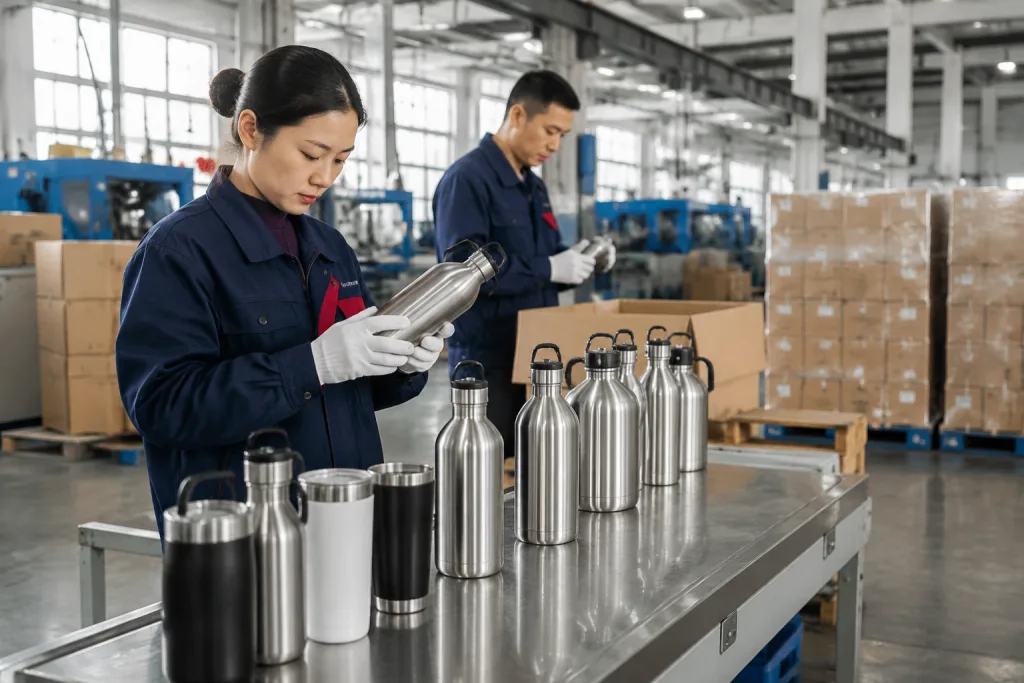
We manufacture in Hangzhou, Zhejiang, and we ship bulk drinkware for retail shelves, promotion orders, hotel programs, outdoor brands, and Amazon FBA cartons. China is still efficient when the buyer locks the working details early: MOQ, lid fit, coating adhesion, logo method, AQL inspection, and FOB Ningbo or FOB Shanghai. On our line, a loose lid tolerance of 0.3 mm is enough for the buyer to flag leakage after the pre-shipment sample, and that one small gap can turn a 30-day order into 42 days after rework.
Start With The Real Use Case
Before you ask for a quotation, decide what the bottle must survive. A procurement manager buying wholesale drinkware for a supermarket promotion carries different risk than a brand owner launching a premium outdoor line. The same 750 ml shape can pass a catalog review and still fail on the line if the wall is 0.38 mm instead of 0.45 mm, the lid thread feels loose after 200 twists, or the coating chips during a 3M tape test.
For retail, we look first at shelf face, barcode location, carton print, and repeat supply. For promotional drinkware bulk orders, the buyer usually pushes us on logo charge, delivery date, and AQL 2.5 defect control. For outdoor or camping ranges, we often see bulk canteen, canteen wholesale, bulk growler, and beer tumbler bulk options on the same RFQ. Fine. Quote them separately. A single-wall canteen, a vacuum growler, and a powder-coated tumbler do not share the same welding jig, polishing wheel, leak test, or packing method, and we have seen this go sideways when a buyer tries to force one target price across all 3.
Capacity changes how the item sells. In North America, 20 oz, 32 oz, and 40 oz move well for sports and travel shelves. In Europe, 500 ml, 750 ml, and 1 L are easier for retailers to price and display. A beer growler wholesale program often starts at 64 oz, while an alcohol flask wholesale item may be 6 oz or 8 oz and brings a different compliance discussion. If you sell through distributors, keep the line tight: two capacities, three colors, one lid system. The buyer may ask for 18 SKUs on the first PO, but the math often does not work once each color needs a separate inner box, carton mark, and spare lid count.
At BottleForge Industrial in Zhejiang, our monthly drinkware capacity is about 480,000 units across stainless bottles, tumblers, growlers, and flasks. That number only matters when your forecast is real. A trial order of 1,000 pcs should prove packaging, customer feedback, and sell-through before you ask a China factory to block the line for 50,000 pcs; last quarter QC pulled 32 samples from a first run because the PO had “mat black” instead of “matte black,” and nobody wants that argument during final inspection.
Understand Materials Before Pricing
Material shortcuts cause most sourcing claims we see. If you purchase drink bottle wholesale and compare only unit price, this is the wrong question to ask; two quotes can look the same on a spreadsheet and still be different bottles on the line. Stainless steel bottles are quoted in 201, 304, or 316 grades. For most drinkware wholesale programs, 304 stainless steel is the practical baseline for food-contact surfaces, and our PMI gun checks incoming coil before blanking. 316 gives stronger corrosion resistance, but on a normal water bottle the math often does not work unless the buyer has saltwater, sports nutrition, or acidic beverage use in the brief.
Ask for wall thickness early. Many stainless bottles use 0.4 mm to 0.5 mm sheet, while heavier growlers may use 0.5 mm to 0.6 mm depending on structure. We run calipers on cut shells because a 0.35 mm body can pass a photo review and still dent after one carton drop. Thinner steel saves money, but it dents faster and feels light in hand. For plastic bottles, Tritan is common for reusable clear bottles because it is BPA-free and has better impact resistance than lower-grade plastics. Glass bottles need sleeve design and drop-test expectations, not just a clean render; QC pulled 32 samples last month where the silicone sleeve edge sat 1.5 mm too low.
If your category includes wholesale canteen, growler wholesale, beer growler in bulk, or alcohol flask in bulk, confirm the inside finish. Poor electropolishing or rough seams can trap odor and trigger returns. We have seen this go sideways when a buyer approved the outside polish but skipped an inside weld photo; 18 cartons came back with a metallic smell complaint. For vacuum-insulated items, ask for temperature performance in hours and the test method. A serious supplier should tell you whether they test with 95°C water, room temperature at 20°C, and a 6-hour or 12-hour measurement point, not just write “keeps hot long time” on the PI.
Coating is not decoration only. Powder coating normally costs more than spray paint but gives better grip and abrasion resistance. UV printing works well for full-color logos, though curved and textured surfaces need a jig check before mass printing. Laser engraving is durable but gives only the metal-under-coating look. On one 3,000 pcs launch order, the buyer flagged a 2 mm logo shift after pre-production sampling, and fixing the fixture took 2 days vs 12 days of repainting finished stock. If you are chasing the best wholesale drink bottle for a brand launch, lock material and finish before target price. Otherwise, the supplier will quietly downgrade the item to hit your number.
MOQ, Tooling, And Unit Price
MOQ is not a punishment. It is where the line stops losing money. On a standard BottleForge model in Zhejiang, we run a stock bottle with a one-color logo from 300 pcs per design because the screen plate, ink setup, carton labels, and AQL 2.5 check still fit inside one shift. For custom color powder coating, expect 1,000 pcs per color; the spray booth needs color change cleaning, and QC pulled samples last month for a 0.3 mm coating build-up near the shoulder. For a new mold, custom lid, or special body shape, 3,000 to 5,000 pcs is more realistic.
Typical FOB China pricing moves fast, but these ranges work for first budgeting: a basic single-wall stainless bottle may be USD 1.60 to USD 3.20; a 500 ml vacuum bottle may be USD 2.80 to USD 5.20; a 40 oz travel tumbler may be USD 4.80 to USD 8.50; a 64 oz wholesale growler may be USD 6.50 to USD 12.00. Alcohol flask wholesale bulk orders can be lower per unit, often USD 0.90 to USD 2.40, because the body is simpler, but a rigid gift box can add USD 0.35 to USD 0.80 before you even talk about outer carton strength. We ship enough of these to say this plainly: the cheap unit price is not always the cheap landed price.
Do not ask for “your best price” without a spec sheet. This is the wrong question to ask. Send capacity, material grade, finish, logo method, packaging, test requirement, order quantity, and shipping term; one buyer once sent “500ml black bottle” and forgot the PO said matte on page 1 but glossy on page 3. If you need canteen bulk, drinkware bulk, beer tumbler wholesale bulk, and growler bulk quotes for one campaign, separate them line by line with target qty and packing. Mixed quotations hide cost drivers, and we have seen this go sideways during final artwork approval.
Tooling needs a hard look before anyone promises a launch date. A simple logo mold or silicone part may cost USD 80 to USD 300. A custom plastic lid mold can cost USD 1,500 to USD 6,000 depending on sliders, thread detail, and whether the lid needs a leak test jig on the bench. Stainless body tooling can be higher. If the supplier says tooling is free on a small custom project, the math does not work; the cost is buried in the unit price or the design is not truly custom. For brand owners, paying tooling can be smart when it protects shape consistency and keeps repeat orders out of argument.
Logo And Packaging Choices
Logo choice starts with the bottle surface and where the buyer plans to sell it. Silkscreen is the low-cost workhorse for 1 or 2 solid colors on smooth PP, Tritan, or painted stainless; on our line we check it with 3M tape after curing. Laser engraving lasts best on powder-coated 304 stainless steel, so we run it often for corporate gift orders and outdoor bottles. UV printing is better for gradients or full-color mascot artwork, but curved bodies need a jig test first, usually 5 pcs, because a 2 mm drift is easy to spot near the shoulder. Heat transfer gives more coverage. The math doesn't work unless adhesion passes a hot-water soak and a fingernail scratch test.
For wholesale drinkware sold through retail, packaging is where buyers often miss the cost. A plain white box may cost USD 0.08 to USD 0.18. A printed color box can cost USD 0.18 to USD 0.55 depending on paper weight, surface finish, and order quantity. Insert cards with 157 gsm paper, hang tags with cotton string, retail sleeves with barcode space, and master carton printing look small on the quote, but at 10,000 pcs those pennies turn into a real PO line. We had one buyer flag a USD 420 carton-printing add-on after the PI was signed. For online sales, carton strength beats glossy artwork; we usually run 5-layer K=K cartons for heavier bottles. For Amazon FBA, check FNSKU labels, suffocation warnings for polybags, carton weight under 22.5 kg, and drop-tested packaging before mass packing starts.
Packaging for beer growler wholesale bulk or beer tumbler in bulk has to protect lids and handles, not just the bottle body. QC pulled a growler sample last month with a cap dent from a loose divider, and the buyer said it looked returned. Fair point. A scratched handle makes the whole item feel used. For alcohol flask bulk projects, gift boxes and funnel accessories are common, but each funnel, ribbon pull, and foam slot becomes another inspection point. Ask your supplier to photograph the full packing stack: unit box with barcode, inner carton if used, master carton with shipping marks, and pallet plan with carton count.
Artwork approval should be treated like production control, not a quick email reply. Send vector files in AI, EPS, or PDF. Confirm logo size in millimeters, Pantone color, distance from the bottle base, and whether the logo crosses a curve or seam. We mark placement with a steel ruler and a 0.5 mm pencil line before sample printing; if the PO says 65 mm but the artwork says 60 mm, the buyer flagged it later. A pre-production sample usually takes 7 to 10 days after artwork confirmation. Approve it in writing, because that sample becomes the reference for production and AQL inspection.
Compliance And Inspection Basics
Compliance starts with the destination market and the material touching the drink. For Europe, buyers usually ask for LFGB, REACH, and food-contact declarations under EU 1935/2004; last month our QC desk checked 14 EU files and 3 were missing the lid gasket material line. For the United States, FDA food-contact compliance is the normal baseline, while children’s bottles bring CPSIA and ASTM into the discussion. Kids’ bottles are not normal promo bottles. This is the wrong question to ask if the team only says, “Is the cup FDA?” Small parts, coatings, straw hardness, warning labels, and polybag text all need checking before we run the line.
A responsible China supplier should provide recent test reports for the same material family, but check the report date, applicant name, test item, and standard line by line. We use a red pen on the PDF printout because one typo in the PO, “PP lid” written as “PE lid,” has caused a buyer to reject documents 6 days before shipment. A report for a stainless tumbler does not cover a painted plastic lid. A report for clear Tritan does not cover a colored silicone sleeve. For alcohol flask wholesale orders, confirm the inner surface is food-contact safe and test any coating or plating that touches the mouth area.
Factory audits also matter. BSCI, Sedex, ISO 9001, or Walmart-type audits are not magic shields, but they show whether the factory has basic management systems, signed training records, and a calibration sticker on the torque tester. For distributors supplying large retailers, audit availability can decide whether a quote is usable. We have seen this go sideways when a buyer asked for Sedex after packing 18,000 units; the math did not work because the audit slot was 12 days out and the vessel cut-off was in 5 days. If you need a specific audit, say it before sampling. Do not wait until the order is ready to ship.
Use third-party inspection when the order value justifies it. A typical pre-shipment inspection under AQL 2.5 for major defects and 4.0 for minor defects costs less than one pallet of unsellable goods. Inspection should check capacity with a measuring cylinder, empty weight on a 0.1 g scale, coating adhesion, logo position in mm, leakage, vacuum performance, barcode readability, carton drop condition, and quantity. For vacuum bottles, we recommend 100% vacuum testing during production plus random final testing; on our line, QC pulled 32 samples from a 3,000 pcs batch after the water bath station flagged 2 weak units. That is why a cheap quote can cost more later: skipped process control rarely appears on the proforma invoice.
Lead Time And Shipping Terms
For a normal OEM run, we quote 30 to 45 days after the deposit lands and the pre-production sample is signed off. Stock bottles with a one-color logo can ship in 12 to 20 days if the blank inventory is real; last month QC pulled 300 pcs from rack B-17 before we promised that date. New molds, matched Pantone colors, retail boxes, or mixed drinkware wholesale assortments push the line closer to 60 days. Chinese New Year adds 3 to 5 weeks, and the bottleneck is often not our welding line but coating, lid injection, or carton suppliers around Zhejiang and nearby provinces.
FOB Ningbo and FOB Shanghai are the two terms we run most from our Hangzhou factory. Ningbo works well for full-container loads out of Zhejiang, especially when the trucker can load 28 cbm before 4 p.m. cut-off at the warehouse. Shanghai makes sense when your forwarder is consolidating with other suppliers or your buyer file already uses a Shanghai route. EXW looks cheaper on the PI, but the math doesn't work if you then pay local pickup, export declaration, and port handling one by one. CIF is easy on paper, but destination charges can bite. For a first import order, FOB with your own forwarder is usually the cleanest setup.
Air freight is for samples, urgent replenishment, or small orders with enough margin to absorb the freight. It is the wrong question to ask for 40 oz tumblers or wholesale growler programs; the volumetric weight kills the quote before the product cost even matters. Sea freight suits bulk drinkware, but carton size changes the landed cost fast. A 500 ml bottle may pack 24 pcs per carton; a 40 oz tumbler may pack 12 pcs; a 64 oz beer growler bulk order may need thicker dividers and larger protective cartons. Ask for carton size, gross weight, net weight, and units per pallet before you lock your landed cost. We measure cartons with a tape at packing, not from a guessed Excel sheet.
Payment terms decide who carries the risk. For new buyers, 30% deposit and 70% balance before shipment is standard. After 3 or 4 clean orders, larger repeat customers may negotiate better terms, especially if their PO data is consistent and artwork files do not change after sample approval. We have seen this go sideways when a PO had one typo in the lid color code and nobody caught it until the 5,000 pcs inspection. If a supplier offers loose payment on the first order, check whether they are a trading company moving stock instead of the factory. That is not always a problem, but you need to know who controls quality and the shipping date.
How To Brief A Factory
A clean RFQ saves 2 to 4 working days before we even open the mold room schedule. Do not send one photo and ask, “best price?” Send a buyer-grade brief: bottle type and capacity in ml; body material such as 304 stainless; single-wall or vacuum insulation target; Pantone color; logo process with print size in mm; inner box or bulk pack; FDA or LFGB test need; order quantity and split by color; delivery date; sales market; Incoterm. We enter this into our ERP line by line, and one missing cap material can stop costing for half a day. If you need canteen wholesale, beer tumbler wholesale, and wholesale growler options, put each product on a separate tab with its own MOQ and packing notes.
Our preferred flow is simple: confirm stock model or custom design, price from written specs, cut the sample, approve artwork and packaging, receive deposit, start the line, inspect, collect balance, ship. No drama. Skipping sample approval may save 7 days, but we have seen it go sideways when QC pulled a pre-production bottle and found the silicone gasket 0.3 mm thinner than the approved drawing. For a repeat order with the same lid, color, carton, and logo file, we can move faster. First orders need tighter control.
Give the target price early, but do not make it the only filter. If your retail math needs a USD 3.20 FOB bottle, say that number. The right supplier can change the lid structure, reduce capacity from 750 ml to 650 ml, switch to a stock powder-coat color, or simplify the gift box without touching food-contact safety. The wrong supplier just says yes and drops the wall thickness from 0.50 mm to 0.42 mm. The math does not work. Ask what changed to hit the price, then ask for the weight in grams and a cross-section photo.
Brand owners should keep one approved golden sample in the office and one sealed at the factory. Procurement managers should keep the spec sheet, test reports, approved sample photos, carton marks, and inspection checklist in the same folder, with file names that match the PO number. We had a buyer flag a carton mark typo at final inspection because the PO said “Matte Black” but the artwork folder said “Matt Black.” Small mistake, 186 cartons held. When you purchase drink bottle wholesale from China, control comes from clear documents, not luck, translation, or a salesperson’s memory.
Send Your Bottle Spec For A Factory Quote
Share capacity, material, logo, packaging, quantity, and market. We will return a practical FOB quote with MOQ and lead time.
Frequently asked questions
What is the normal MOQ when I purchase drink bottle wholesale?
For standard models, 300 pcs can be workable if you accept stock colors and a simple one-position logo. For custom powder coating, 1,000 pcs per color is a more realistic MOQ. New lids, custom molds, or private shapes usually start from 3,000 to 5,000 pcs because tooling, material ordering, and line setup cost more. If you need a mixed order with canteen bulk, beer tumbler bulk, and growler wholesale items, each product may have its own MOQ. Do not assume 1,000 pcs total can be split into 10 colors and 5 models. That usually creates high cost and unstable quality.
How do I compare FOB prices from different China suppliers?
Compare only after the specification is identical. Confirm capacity, steel grade, wall thickness, lid material, coating, logo method, packaging, test standard, carton quantity, and Incoterm. A USD 3.60 FOB quote and a USD 4.20 FOB quote may not be comparable if one uses 201 stainless steel, thinner material, or plain bulk packing. Ask for net weight and carton size too, because freight affects landed cost. For drinkware wholesale projects, a 5% cheaper unit price can disappear if the carton is oversized or the defect rate is higher. Use a written spec sheet, not catalog descriptions.
Can I order alcohol flask wholesale or beer growler bulk with my logo?
Yes, but the best logo method depends on the surface. Stainless alcohol flask wholesale orders usually use laser engraving, silkscreen, or embossing if tooling is justified. Beer growler wholesale bulk orders often use laser engraving on powder coating or silkscreen on smooth stainless. MOQ can start around 500 pcs for simple logo flasks and 1,000 pcs for custom-color growlers. If the item is sold with alcohol-related branding, check local retail rules and age-related marketing restrictions in your destination market. Also confirm food-contact testing for the inner surface and any mouth-contact coating.
How long should I allow from sample to shipment?
A normal timeline is 7 to 10 days for a pre-production sample, 2 to 3 days for approval and deposit paperwork, then 30 to 45 days for production. Add 3 to 7 days for final inspection, balance payment, and port delivery. Sea freight to Europe or North America may add 25 to 45 days depending on port pair and season. For custom drinkware bulk orders near Chinese New Year, add another 3 to 5 weeks. If you have a fixed retail launch date, work backward and include buffer for packaging revisions or failed sample details.
What inspection standard should I use for wholesale drinkware?
For most wholesale drinkware orders, use AQL 2.5 for major defects and AQL 4.0 for minor defects. Critical defects, such as sharp edges, contamination, unsafe parts, or severe leakage, should be set at 0. Inspection should include appearance, logo position, coating adhesion, lid fit, leakage, capacity, weight, barcode scan, carton drop condition, and packaging count. For vacuum-insulated bottles, require factory 100% vacuum testing plus random temperature retention checks during final inspection. For kids bottles, add ASTM or CPSIA-related checks where applicable. Share the checklist before production, not on inspection day.