Key Takeaways
- Plan 3,000 units per color as a realistic MOQ for most custom protein shaker programs
- Confirm resin grade, lid seal design, and AQL level before paying tooling or deposit
- FOB Ningbo or Shanghai pricing usually changes 6–12% based on decoration and packaging
- Sample approval should cover leak test, logo durability, carton drop test, and barcode scan
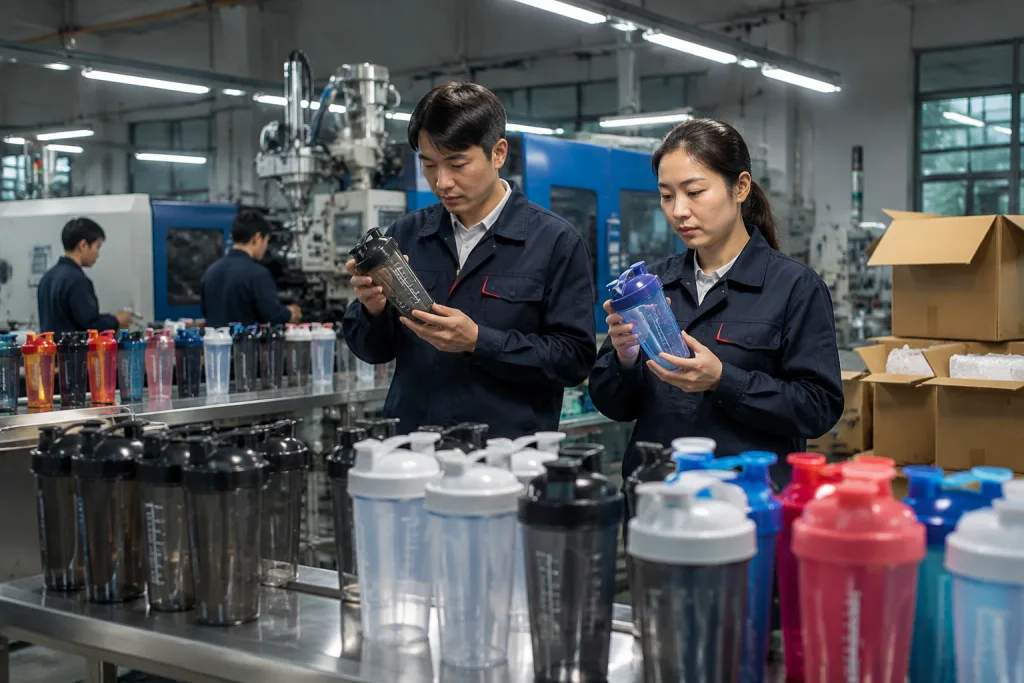
Choosing a protein shaker vendor is the wrong place to chase the lowest unit price. We check lid torque with a handheld torque meter, run upside-down leak tests for 30 minutes, and still see buyers push back hardest when a $0.03 gasket change protects a full carton. You need leak resistance, safe materials, clean decoration, carton strength, barcode accuracy, and a factory that answers emails after the deposit is paid. If the lid thread strips or the mixing ball rusts, your brand takes the hit before anyone asks about the shipment date.
BottleForge Industrial manufactures custom drinkware in Hangzhou, Zhejiang, China for distributors and fitness brands with retail shelf requirements. Our typical shaker MOQ starts at 3,000 units per color, with sample lead time of 7–12 days and mass production around 30–45 days after approval. On the line, QC pulled one recent pre-production sample because the barcode sticker was 4 mm off the flat panel and scanned poorly under warehouse light. Small miss. Big headache. If you are new to sourcing from China, the details below are where we see 8 out of 10 avoidable problems start.
Start with the shaker use case
A good protein shaker vendor should ask how the bottle will be used before quoting. A 500 ml gym shaker for powder samples is not the same build as a 900 ml retail shaker with a carry loop, internal mixing grid, and color box. If the supplier sends a price list in 10 minutes, the math is off. You are likely getting a catalog body with a logo pad-printed on the side, not a controlled B2B program; last month QC pulled a pre-production sample where the buyer’s PO said “matte black,” but the artwork file said Pantone 426C gloss.
For fitness brands, we run most orders in 500 ml, 600 ml, 700 ml, and 900 ml. Wall thickness on PP shaker bodies is commonly 1.2–1.8 mm. Tritan bodies may be 1.5–2.2 mm depending on shape and drop-test target. The lid deserves the argument. Most rejects we see are not on the cup body; they show up around thread fit, flip caps, silicone plugs, and hinge fatigue after the line tests the cap with a torque meter and 20 open-close cycles.
Decide early whether the shaker belongs inside a wider custom drinkware range. About 6 of 10 fitness buyers we quote start with shakers, then ask for a custom canteen or sports bottle for the next launch; custom growler requests usually come from outdoor or wellness channels. If you are a distributor drinkware buyer, matching lid colors, logo position, carton specs, and master case dimensions across SKUs cuts warehouse mistakes. We have seen this go sideways when one 700 ml shaker carton was 3 cm taller than the sports bottle carton, and the buyer flagged it after the pallet plan failed.
In Zhejiang, we see two buyer types. One wants the cheapest promotional shaker for a 30-day campaign. The other wants a reusable SKU that can pass repeat retail orders. Both are valid. They should not use the same mold, cap structure, or inspection standard; for repeat retail, we normally set AQL 2.5 on major defects and check lid leakage with 50 filled samples before the master cartons leave Hangzhou.
Materials and compliance matter early
Lock the material before artwork. We run protein shakers mostly in food-grade PP, PE, Tritan, or stainless steel for insulated cups. PP keeps the piece price down and survives a normal drop test better than buyers expect; our line checks wall thickness with a 0.01 mm caliper before mold trial sign-off. Tritan looks cleaner on shelf, especially in clear 600 ml and 700 ml bodies. Stainless steel lifts the gift value, but the math changes fast: higher weight, slower pad printing setup, and more rejects around coated curves.
For Europe, ask for LFGB or EU food contact documents where required, plus REACH screening for coatings and printed parts. For North America, FDA food-contact suitability and California Proposition 65 review depend on the sales channel. If the shaker goes into children’s fitness kits or youth sports clubs, ASTM and CPSIA questions can show up late. Don’t wait until cartons are taped. We had one buyer flag certificates 2 days before vessel closing, and QC had already pulled the packed sample from a 38-carton lot.
A responsible canteen manufacturer or canteen supplier should separate raw material claims from finished product test reports. Resin supplier papers are useful, but they do not prove the finished lid, silicone gasket, ink, and color masterbatch pass. This is where projects go sideways. For a new customized drinkware project, budget USD 350–900 for third-party testing if your retailer or distributor needs formal reports; SGS or TÜV will usually ask for 3–5 finished samples, not loose resin pellets.
Be careful with recycled claims. Some buyers ask for PCR plastic to support a sustainable line, but food-contact approval, color drift, and odor control are the hard parts. For shaker cups, we usually recommend verified virgin PP or Tritan unless your program has the budget and timeline to validate recycled content properly. The buyer may like the story, but the math doesn’t work if MOQ is 3,000 pcs and the lab needs 12 days while your ship date allows 18 days total. China has strong material supply chains; the factory still needs written requirements on the PO, not a WhatsApp note after the mold is cut.
MOQ, price, and real cost drivers
For a standard protein shaker vendor quote, we usually run MOQ at 3,000 units per color on stock molds. If the buyer wants Pantone color matching, molded logos, or retail packaging with inserts, the line normally needs 5,000–10,000 units to keep setup waste under control. New private molds are a different bill: USD 4,000–18,000 tooling, tied to body shape, lid structure, and cavity count. On our last 700ml shaker mold review, the mold shop flagged a 0.3 mm lid-thread adjustment before T1 sampling.
For FOB China pricing, a basic PP shaker with one-color silkscreen may land around USD 1.15–2.20 at 5,000 units. Tritan models are often USD 2.40–4.80. Stainless insulated shakers can run USD 5.50–9.50, mainly from capacity, steel grade, copper coating, lid type, and packaging. Not a promise. We have seen one buyer push back over a USD 0.06 carton change, then accept it after QC pulled a drop-test sample and the old carton split on the corner.
The common price drivers are not mysterious:
- Material: PP is cheaper than Tritan; 304 stainless steel costs more than 201 steel, but for drinkware the cheaper choice is often the wrong question to ask.
- Decoration: one-color silkscreen is cheaper than full-wrap heat transfer or laser engraving on two positions, especially when we need a jig change between front logo and side scale marks.
- Packaging: bulk polybag can be under a few cents, while a printed retail box with insert card and EAN/FNSKU labels adds printing plates, hand packing, and more carton CBM.
- Inspection: tighter AQL, extra leak testing, and carton drop testing add labor; we run 100% lid leak checks on some gym-chain orders because one loose flip cap can turn into 200 claim emails.
If you are a canteen distributor or distributor canteen buyer, ask for pricing at 3,000 units for market testing, 5,000 units for normal production, and 10,000 units for scale. The spread shows whether the factory understands real batch economics. We have seen this go sideways when a PO typo changed “matte black” to “black,” so our merchandiser now checks color chips against the PI before mass production. At BottleForge in Hangzhou, Zhejiang, our drinkware capacity is about 480,000 units per month across shaker, bottle, tumbler, and canteen customized lines.
Customization options that actually hold up
Customization has to survive dirty hands, dishwashing, and 8-carton drops during warehouse sorting. A logo can look clean on the golden sample and still fail after 300 rubs with our RCA abrasion tester; QC pulled one shaker last March where the black print started silvering at the edge after 6 dishwasher cycles. Not good. For protein shakers, we run silkscreen printing and heat transfer for most plastic bodies, pad printing for lids with ribs, in-mold labeling for bigger programs, and laser engraving on stainless steel mixing balls or steel sleeves.
Silkscreen works best for simple logos, with minimum line width around 0.2–0.3 mm depending on the body curve and how much the cup flexes under the jig. Heat transfer handles gradients and full-color branding, but cheap film plus weak curing is where the math doesn't work; we set the tunnel at 145°C for one PP shaker job, then the buyer flagged peeling near the 38 mm thumb groove. Laser engraving is excellent for stainless steel but wrong for most plastic surfaces. If your brand color is strict, send Pantone codes and accept a realistic tolerance, usually Delta E under 2.0–3.0 for premium projects.
For canteen promotional programs, buyers usually push for lower cost and fast delivery; 5,000 pcs one-color print on a stock body is the clean answer when the event date is fixed. For canteen customizable retail lines, we control body color and lid color first, then lock packaging artwork, barcode placement, and carton marks in the PO. Small stuff bites. We once saw a PO typo change a carton side mark from “24 pcs” to “42 pcs,” and the buyer’s 3PL held 186 cartons for relabeling. A custom canteen or customizable growler with weak carton labeling can cause as much trouble as bad print.
Before mass production, approve a physical pre-production sample, not just a rendering. Check grip feel and cap snap force with the actual lid mold, then verify logo alignment, powder residue cleaning, dishwasher claims, and fit in your target cup holder or retail shelf. We use a 0.5 mm feeler gauge on some flip caps because a loose seal looks fine on video and leaks in a gym bag. If the product will be sold online, request one packed sample and photograph it exactly as the consumer receives it, including the polybag, manual, and outer carton label.
Factory checks before deposit
A serious canteen factory or protein shaker vendor should show more than clean product photos. Ask for a 6-page factory profile, the business license name in Chinese, 3 recent export records, the equipment list, QC flow chart, and current social compliance status if your customer asks for it. On our side, buyers often ask to see laser-welding machines, injection machines by tonnage, and the packing line capacity per shift. BSCI, Sedex, ISO 9001, or retailer audits may not be mandatory for every order, but they tell you whether the factory can handle repeat B2B supply without guessing every step.
Verify who makes the goods. Some canteen vendors are trading companies with useful sourcing channels, and that is fine when they say it clearly. The problem is a hidden supply chain. We have seen this go sideways when a buyer approved one 304 stainless sample, then bulk came from a second workshop with a 0.3 mm thinner wall. If you need stable Pantone color, repeated mold access, and QC that answers for defects, the real canteen manufacturer must be named before deposit.
For a first order, use written checkpoints:
- Confirmed quotation with Incoterms, usually FOB Ningbo, FOB Shanghai, or EXW factory, plus carton size and estimated CBM.
- Approved artwork file with logo size in mm and print position, not just a WhatsApp screenshot.
- Material and compliance requirements listed on the proforma invoice, including any FDA, LFGB, or food-contact test request.
- Pre-production sample approval before bulk production, with QC pulling the sample from the line instead of the sales desk.
- Final inspection to AQL 2.5 major / 4.0 minor unless your retailer requires stricter, with defect photos tied to carton numbers.
China sourcing works when the buyer controls documents early. It fails when key details sit in chat messages. Put the spec into one sheet, mark the revision, and make the factory sign back the same file. Small thing, big trouble saver. Last month we caught a PO typo that changed 700 ml to 750 ml before mold opening; after deposit, that mistake would have cost 12 days and a new sample fee.
Quality control for shaker orders
Protein shakers need functional QC, not just a quick look under the packing table light. For a 5,000-unit order, we ask the buyer to lock the leak test method, odor limit, lid opening force in N, thread feel, cap hinge life, color tolerance, and print adhesion before the mold trial; otherwise the line argues about “acceptable” after 37 cartons are already sealed. ANSI/ASQ Z1.4 sampling is a fair base, with AQL 2.5 for major defects and 4.0 for minor defects. Critical defects should be zero. No debate there.
Our normal QC flow is incoming resin check with a moisture meter, first-piece inspection, patrol checks every 30 minutes, 100% visual screening on decorated bodies, random leak testing, and final carton inspection with a digital scale. For leak testing, an inverted water test for 2–4 hours catches bad gaskets and warped lids, but this is the wrong question to ask on a new lid design; we still run pressure or shake simulation because a shaker fails in a gym bag, not on a quiet shelf. Flip caps should be opened and closed at least 300–500 cycles during validation, and QC pulled the sample if the hinge turns white at the pin.
Packaging QC sits inside product quality. If you sell through marketplaces or retail distribution, FNSKU, EAN, UPC, carton marks, suffocation warning, and country-of-origin labels must match the customer file; last year a buyer flagged one PO typo where “Made in China” was missing from the inner polybag artwork. One wrong barcode can block a shipment at a fulfillment center. For distributor growler or distributor drinkware programs, mixed cartons go sideways fast unless the packing list is checked line by line against the carton mark and SKU count.
Do not accept “we inspected already” as proof. Ask for photos, the inspection report, a defect list, and packed carton dimensions measured in cm, not guessed from the carton supplier’s quote sheet. For higher-value customized growler or stainless shaker orders, a third-party inspection costing USD 250–400 per man-day is cheap insurance; the math works better than reworking 5 pallets after the buyer’s warehouse rejects them.
Lead time and shipping decisions
Shaker delays usually start before the line runs: artwork sits unapproved, Pantone chips do not match the cap resin, the buyer changes the color box, or the PO says “FDA” while the test file asks for LFGB. For stock mold protein shakers, we quote 7–12 days for sample, 3–5 days for buyer approval, 30–45 days for mass production, and 3–10 days for booking plus factory-to-port handling. Sea freight to Europe or North America then adds 25–45 days depending on route and season. QC pulled one sample last month because the logo was 2 mm too close to the measuring scale. That small miss cost 4 days.
If goods must land before a campaign date, work backward from the delivery day. Do not start with “production is 30 days.” That is the wrong question to ask. A canteen supplier may mean 30 days on the injection and assembly line, not test lab time, pre-production sample courier, inspection booking, customs clearance, or trucking to your 3PL. For Amazon-style shipments, we also run FNSKU labeling, carton weight checks, and pallet specs; one buyer flagged a 16.8 kg master carton because their warehouse limit was 15 kg. For retail, printed packaging approval can take 5–9 extra days if the barcode, warning text, or color proof gets revised.
Air freight can save a launch, but the math often does not work. A 700 ml shaker is bulky, so you pay for volume weight, not just product weight. In peak season, air freight can cost more than the shaker itself. We have seen this go sideways when a buyer tries to air 80 cartons after missing the vessel cut-off. A cleaner plan is to approve the first colorway early, ship a small urgent batch by air if needed, and move the balance by sea. For repeat canteen distributors and canteen manufacturers, a 60-day rolling forecast is still the cheapest logistics tool we have.
BottleForge usually quotes FOB China first because it keeps product cost clean and makes freight charges easier to compare. We can support DDP discussion for experienced buyers, but FOB gives better control if you already have a forwarder. We ship from Ningbo or Shanghai depending on vessel space, and the booking sheet must match the PO exactly; a typo in “matte black” versus “matt black” once delayed SI confirmation by 1 day. Whether you source a customized canteen, customizable drinkware set, or protein shaker line, treat the calendar as a cost item from the first RFQ.
Send your shaker spec before you request price
Share capacity, material, logo method, MOQ target, packaging, and destination port. We will return a practical FOB quote and timeline.
Frequently asked questions
What MOQ should I expect from a protein shaker vendor?
For most stock-mold protein shakers, expect 3,000 units per color as a practical MOQ. Some simple promotional models can start at 1,000–2,000 units if you accept existing colors and one-position printing, but pricing is usually weaker. For custom color matching, retail packaging, or molded logos, 5,000 units is more realistic. If you need a new lid or body mold, plan for 5,000–10,000 units plus tooling. A serious China factory should quote price breaks at 3,000, 5,000, and 10,000 units so you can see the cost curve clearly.
How do I know if a canteen supplier can also handle shakers?
Ask for production photos, mold list, QC records, and recent export cases for both shaker cups and canteen customized products. A canteen supplier may be strong in stainless bottles but weak in plastic lid engineering. For protein shakers, lid sealing, thread fit, and odor control matter more than basic bottle forming. Request 3 packed samples: one shaker, one custom canteen, and one similar custom drinkware item. Test leak resistance, print adhesion, and carton strength. If the supplier cannot explain AQL, material grade, and lead time in numbers, treat the order as higher risk.
What is the normal lead time for customized drinkware from China?
For stock molds with custom logo, sample time is usually 7–12 days after artwork confirmation. Mass production is commonly 30–45 days after sample approval and deposit. More complex customized drinkware, including custom growler or stainless insulated shaker projects, may need 45–60 days, especially if color matching, retail box printing, or third-party testing is required. Add 25–45 days for sea freight to Europe or North America. If your launch date is fixed, approve artwork and packaging at least 90 days before the required warehouse arrival date.
Which decoration method is best for protein shaker branding?
For simple logos, one- or two-color silkscreen printing is usually the best balance of cost and durability. For full-color artwork, heat transfer or in-mold labeling may be better, but MOQ and setup cost increase. For stainless steel shaker bodies or customized growler products, laser engraving gives a clean permanent mark, though it cannot reproduce every brand color. Always request a physical decorated sample and perform tape testing, rub testing, and dishwasher checks if you plan to make dishwasher-safe claims. Logo approval should include size in mm, Pantone code, and exact position.
Can one vendor supply protein shakers, canteens, and growlers together?
Yes, but you should qualify the vendor by product category, not by catalog size. A capable canteen vendor may supply shakers, custom canteen items, customizable canteen lines, and distributor growler programs through one controlled factory network. The benefit is consistent packaging, carton marks, QC reporting, and shipping consolidation. The risk is assuming all items use the same production process. Plastic shakers, stainless canteens, and glass bottles require different inspections. Ask for one combined specification sheet and separate AQL checkpoints for each SKU. For mixed orders, keep carton labels and packing lists very precise.