Key Takeaways
- A practical OEM shaker MOQ starts at 3,000 pcs per color, with new mold projects usually above 10,000 pcs
- Food-contact PP, PE, Tritan, and stainless steel parts need different test plans for EU and North America
- Leakage control depends more on lid thread tolerance and gasket design than on the cup body alone
- FOB China unit pricing should include packaging, logo method, inspection standard, and spare part policy
If you are sourcing a protein shaker for a supplement brand, gym chain, or distributor drinkware program, finding 20 factories is easy. The hard part is checking whether the protein shaker oem manufacturer can hold a 0.15 mm lid tolerance, stop cap leakage, control PP odor, and repeat the same resin batch on reorder instead of quietly switching material on the line.
From our factory base in Zhejiang, China, we see the same buyer problem 6 or 7 times a month: nice 3D renders, thin specifications, then quotes that do not match. A 700 ml shaker at USD 1.18 and another at USD 1.55 can look close in a PDF, but the math changes once QC pulls the sample and checks 1.6 mm wall thickness, PP grade, 30-minute upside-down leak test, 5-layer carton strength, and AQL terms.
Start With The Use Case
A protein shaker is not just a plastic bottle with a ball inside. The user shakes 35 g of powder, drops it in a gym bag, opens the flip cap with wet hands, then leaves milk residue inside for 8 hours. That beats up the lid, thread, gasket, and printed logo harder than a 5,000 pcs canteen giveaway. We have had QC pull samples after a 1.2 m drop test because the hinge pin showed white stress marks.
Before you ask any protein shaker oem manufacturer for a quote, define the sales channel. A supplement brand selling through retail needs shelf-ready packaging, barcode control, and a brand finish that does not look cheap under store lighting. A gym chain usually pushes back on cracked lids, reorder speed, and whether the cap survives 2 opens per day for 6 months. A canteen distributor or distributor drinkware buyer often asks for mixed models, color assortments, and carton labels that match its WMS; we once had a PO typo “matte balck” hold 18 cartons at pre-shipment check.
Capacity is the next decision. The common range is 500 ml, 600 ml, 700 ml, and 800 ml. For North America, 24 oz and 28 oz markings are common. For Europe, ml scale markings are more useful. If you want both, confirm whether the mold has raised measurement marks or whether the scale is printed. Raised marks add tooling cost but do not rub off. Printed marks cost less, but we run abrasion testing with 3M tape and 500 rubs before we trust them on repeat orders.
Then choose the mixing system. Stainless wire balls are cheap and familiar, usually USD 0.04-0.08 each FOB China depending on gauge. Plastic grids cut noise, but the ribs need tighter molding or they warp by 0.5 mm and jam inside the cup. Spring agitators mix well, yet they add assembly checks on the line. If your buyer expects a premium customized drinkware feel, choosing the cheapest ball and complaining about rattling is the wrong question to ask; the math does not work.
Materials Decide Your Risk
Most shaker cups we run use PP for the body, then PE or PP for the lid, flip cap, and mixing grid. Food-grade PP keeps the quote sensible, cuts cup weight by about 18-25 g versus Tritan on a 700 ml shaker, and survives normal dishwasher cycles if the buyer does not push 90°C drying. Tritan gives a clearer shelf look and a heavier hand feel, but resin cost usually adds USD 0.18-0.35 per cup at 5,000 pcs, and scuff marks show fast on glossy transparent bodies. Stainless steel is a different job. The line moves from injection molding to metal forming, laser welding or seamless body sourcing, powder coating, and sometimes vacuum insulation; QC pulled one matte black sample last month because the coating chipped at the 8 mm bottom radius after a 3M tape test.
Do not accept lazy wording like "food grade plastic" on a proforma invoice. That is the wrong question to ask. Ask for the resin family, virgin or recycled content, and the exact test the supplier will stand behind on paper. For EU sales, buyers often request LFGB or EU 10/2011 food contact migration, plus REACH for restricted substances. For the US, FDA food-contact compliance and California Proposition 65 screening may be requested by retailers. For children's or youth gym programs, ASTM-related checks may also enter the discussion. We have seen a PO typo say "PP lid, PET body" when the artwork file clearly called for PP; the buyer flagged it during pre-production, not after shipment, which saved 12 days of arguing versus an 18-day remake.
A responsible canteen manufacturer in Zhejiang should separate resin batches, keep injection records, and retain color masterbatch samples. In our China production files, we normally keep golden samples, approved Pantone references, and mass production resin lot records for at least 24 months. Boring paperwork saves reorders. We label each resin bag with lot number and machine date before it reaches the Haitian injection press, because one mixed masterbatch drum can turn a navy blue shaker purple under store lighting. We have seen this go sideways when a supplier changed from a 2% to 3% color dosing ratio without telling the buyer.
Wall thickness matters more than most buyers expect. For a PP shaker body, 1.2-1.6 mm is common depending on design and capacity. Thinner walls shave cost, but the math doesn't work if the cup deforms during hot filling, high-temperature washing, or a tight carton stack in transit. On a 10,000 pcs protein shaker order, we usually check 20 bodies with a digital caliper at the rim, waist, and bottom push-up before approving mass production. For stainless options, 0.4-0.5 mm inner and outer wall gauge is common for vacuum drinkware, while single-wall shakers may use heavier gauge to prevent denting.
Tooling And Logo Choices
OEM work starts at the mold rack. If we run an existing mold, the line opens faster and MOQ stays lower. For a standard 700 ml PP shaker, a realistic MOQ is 3,000 pcs per color with logo, and lead time is often 25-35 days after artwork approval. If you need a fully custom cup shape, new lid structure, or proprietary mixing insert, expect tooling cost from USD 3,000 to USD 15,000 depending on cavity count and complexity. A 4-cavity injection mold costs more on day one, but the math works once the order moves past 30,000 pcs because cycle time and unit labor drop.
Branding method should follow the shelf price, not the buyer’s first sketch. Silk screen printing is the workhorse for one- to three-color logos, and our screen room usually checks film output with a 0.1 mm line gauge before making the plate. Heat transfer handles larger graphics with gradients. In-mold labeling gives a cleaner retail look, but it needs higher volume and artwork files that do not change after sampling. Laser engraving belongs on stainless steel parts, not standard PP bodies. A canteen customized project with a 35 mm logo can be simple; a full-wrap fitness supplement design needs pre-production samples because curves stretch letters near the grip ribs.
Ask where the logo tolerance sits. This is the wrong question to leave open. For example, a 60 mm wide logo centered opposite the measurement scale should have a placement tolerance such as ±2 mm. Without that number, your inspection team has no fair standard, and QC pulled the sample last month for a logo that looked “off” but had no agreed limit on the PO. For color, do not rely only on screen photos. Use Pantone C or U codes and approve a physical sample. On translucent plastics, the same Pantone masterbatch can look different at 1.2 mm and 1.6 mm wall thickness.
If you are also sourcing custom canteen, customizable growler, or distributor growler items in the same program, do not force one logo process across every product. PP shakers, stainless canteens, and powder-coated growlers need separate decoration plans because ink adhesion, curing temperature, and surface roughness are not the same. We’ve seen this go sideways when a buyer copied the shaker logo spec onto a powder-coated growler and the tape test failed after 24 hours. A practical canteen factory will tell you when one method is wrong, even if it means a slightly higher unit price.
Leak Testing Is Not Optional
Leakage complaints kill repeat orders faster than a 1-2 ΔE color miss. For protein shakers, we check the screw thread, flip cap, drinking spout, gasket groove, plus any side storage compartment with a 0.20 mm feeler gauge and a torque cap tester. The cup body is not the usual culprit. A lid with shallow thread bite can pass a quick sink-fill check, then leak after whey powder dries in the thread or the user shakes warm liquid in the gym bag. We have seen this go sideways.
For production control, write the test method before the PO is stamped. A basic factory test should fill the shaker to 80% capacity, close the lid, invert for 30 seconds, then hand-shake 20 times; QC pulled the sample, not the line leader’s favorite cup. For higher-risk orders, we run air pressure testing at the fixture or vacuum-assisted checks on samples from each production lot. If the shaker has a snap cap, test cap fatigue. A cap opened and closed 500 times should still hold securely for normal retail-grade products. Premium projects may specify 1,000 cycles, but the math does not work if the buyer also asks for 7-day mass production and zero test allowance.
AQL belongs in the purchase order. Spell it out. B2B buyers commonly use AQL 2.5 for major defects and 4.0 for minor defects, with critical defects at 0. Leakage is normally a major or critical defect depending on the contract, so do not leave it for a WhatsApp argument after the goods are packed. For a 20,000 pcs order, an inspection may pull 315 pcs under general inspection level II; if the PO says “leakage acceptable within reason,” the buyer flagged it too late.
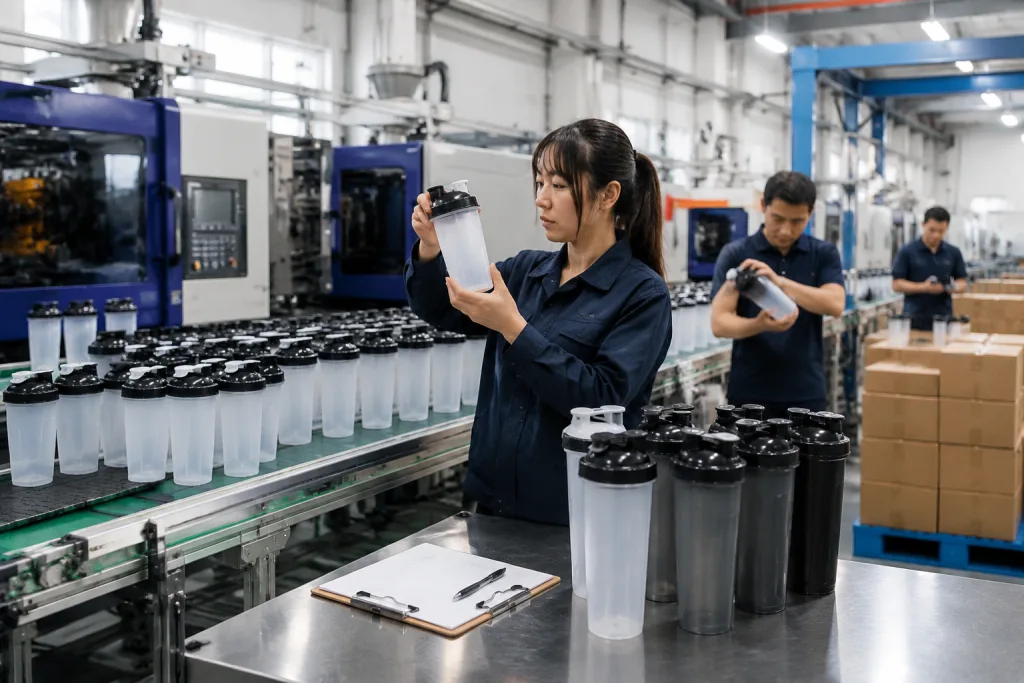
At BottleForge Industrial in Zhejiang, China, a typical shaker line can output around 180,000-220,000 units per month depending on decoration load. That volume means nothing if the factory does not stop the line when lid shrinkage changes by 0.3 mm after cooling. We run first-piece checks with calipers at the molding machine and recheck lids after assembly, because finished product photos do not show thread engagement. A reliable canteen vendor or shaker factory should show process checks, scrap records, and the moment QC stopped the line.
Pricing Needs A Clean Basis
Shaker quotes get messy when the basis is loose. One factory may quote USD 1.05 FOB Ningbo for a plain 600 ml PP cup with no print, while another sends USD 1.38 with two-color logo, 304 stainless mixing ball, individual kraft box, and a 5-layer carton we run through a 76 cm drop test. The math doesn't work if those sit in the same comparison table. Ask every canteen supplier or protein shaker oem manufacturer to quote from the same spec sheet: capacity line, lid mold, logo position in mm, packing method, carton gross weight, and test standard.
For reference, a standard PP shaker with one-color logo and polybag may sit roughly around USD 0.95-1.45 FOB China at 5,000-20,000 pcs, depending on capacity, lid complexity, resin grade, and decoration area. Tritan versions can move into the USD 1.80-3.20 range. Stainless steel single-wall shakers often start higher, and double-wall vacuum shaker styles can exceed USD 5.00 before premium packaging. These are working ranges, not promises, because resin and exchange rates move. Last month our purchasing team saw PP resin move twice in 12 days, and the buyer flagged a USD 0.04 jump after sample approval. Painful, but real.
Packaging hides cost fast. A simple OPP bag may cost under USD 0.03. A printed color box can add USD 0.12-0.35, and the box dieline alone needs a 3 mm bleed or the artwork guy will kick it back. For Amazon or retailer fulfillment, spell out FNSKU labels, carton labels, suffocation warnings, master carton drop-test strength, and barcode scanning requirements. A distributor canteen order going into a warehouse may need pallet height limits plus mixed SKU carton marks, not generic “export carton” wording. Put those requirements in the RFQ, not after mass production; we've seen this go sideways when a PO typo said “white box” and the buyer expected printed retail packaging.
Payment terms change risk. Common terms are 30% deposit and 70% balance before shipment. For mature buyers, some suppliers may discuss balance after inspection or against copy bill of lading. If you are dealing with new canteen vendors, pushing only on payment terms is the wrong question to ask. Push harder on signed golden sample approval, AQL 2.5 inspection rights, and whether the factory can replace defective lids or gaskets within a defined spare part percentage, such as 1% free spare lids for large programs. QC pulled the sample once for a 0.6 mm gasket mismatch; that tiny gap leaked after 20 shakes.
Factory Audit And Compliance
A clean showroom proves almost nothing. If your shaker order goes into retail, supplement distribution, or a promotion where the brand lawyer will read every file, ask for factory audits before you pay the deposit. BSCI, Sedex, ISO 9001, and retailer-specific audits are normal requests; we see about 6 audit-file checks a month from EU and US buyers. Not every canteen manufacturers group holds the full set, and trading companies sometimes send certificates from a brother factory 40 km away. Check the audited entity name against the production address, the business license, and the export invoice. QC pulled one file last year where the BSCI report named a Yiwu gift plant, while the PO said Hangzhou production site.
For food-contact products, the test report must match the real material, color, and product category. A three-year-old report for a clear PP lunch box does not cover a black PP shaker lid with a 52 mm silicone gasket. Wrong question to ask: “Do you have FDA?” Ask which part was tested, which color, which lab, and which standard. If the lid has multiple parts, review the gasket, cap, body, and printing ink as separate risk points instead of treating the lid as one item. For customized canteen and customized growler projects, coating adhesion and metal migration can add test items; we run 304 stainless samples through a wall-thickness check with a digital caliper before sending them to the lab.
Check factory capacity with numbers, not promises. If a canteen factory says it can ship 100,000 pcs in 15 days during peak season, ask how many injection machines are blocked for your SKU, how many printing lines are open, and whether assembly is manual or semi-automatic. In Zhejiang, an experienced plant can scale molding fast; decoration is where we have seen this go sideways. A four-color wrap print can slow the project more than molding, especially when the buyer flags a 1.5 mm logo shift on the golden sample. On our line, 8 injection machines may finish bodies in 12 days, while pad printing and lid assembly push the real ship date to 18 days.
Pre-shipment inspection earns its fee. Use your own QC company if the order is large or the buyer is strict. Send the inspection checklist before production, not after the cartons are taped. Include material, capacity, weight, logo placement, lid fit, leakage test, barcode scan, carton drop condition, and packing count, with tolerances where they matter; for example, 600 ml capacity, ±5 g body weight, and 50 pcs per master carton. Good canteen suppliers will accept a clear checklist. Weak suppliers push back because the math does not work once AQL 2.5 defects, loose lids, and 1.2 m carton drop failures are written into the file.
Reorders And Distributor Programs
The first order proves the product. The second order proves the supplier. If you are a canteen distributor, distributor canteen buyer, or brand owner building a repeat fitness line, reorder control beats chasing USD 0.03 off the first PO. We keep one approved sample set in the sales room and one sealed set beside the injection line, with the Pantone chip, 0.35 mm logo tolerance, carton mark, and assembly photo packed in the same file. Put resin, logo, carton, and assembly standards in one locked version file, not 6 email threads. We have seen this go sideways after a buyer changed “matte black” to “black” on the reorder PO.
For distributor drinkware programs, control the SKU count early. A canteen customizable catalog with 12 colors looks strong in a deck, but each color adds MOQ pressure, stock risk, and forecast noise. If the factory MOQ is 3,000 pcs per color and you launch 8 colors, you have a 24,000 pcs starting commitment before safety stock. The math doesn't work for every distributor. A cleaner launch uses 3 core colors, one seasonal color, and shared packaging, so the line can run fewer resin purges and QC can compare shade with one light box standard. The same logic applies to customizable canteen and customizable drinkware ranges.
Spare parts get missed until complaints start. Lids crack, gaskets get lost, and shaker balls disappear after 30 gym bags. If your retail channel can sell or supply replacement lids, you cut returns and keep the product in use. Ask whether the protein shaker oem manufacturer can keep lid molds available and supply replacement parts at 500-1,000 pcs per color. QC pulled a sample last month where the spare gasket was 0.4 mm loose, enough to leak during a 45-second shake test. For stainless custom growler and customized growler programs, replacement caps matter more because the bottle body outlasts the lid.
Protect your design files and mold ownership terms before you send final artwork. If you pay for exclusive tooling, write down who owns the mold, where it is stored, whether it can be moved, and whether the factory can use it for other canteen distributors. A good China supplier will discuss this directly and mark the mold shelf with your item code, not just “customer mold.” If the answer is vague, assume the mold is not exclusive. We ship OEM parts, so I would rather have this argument at quotation stage than after a competitor shows the same lid at a trade fair.
Send Your Shaker Specification Before You Quote
Share capacity, material, logo, MOQ, and target market. We will check manufacturability and return a practical FOB China quotation.
Frequently asked questions
What MOQ should I expect from a protein shaker OEM manufacturer?
For an existing mold with a one-color logo, a practical MOQ is usually 3,000 pcs per color. Some factories quote 1,000 pcs, but the unit price and setup cost usually make it unattractive for B2B buyers. For a custom color with matched lid and cup, 3,000-5,000 pcs is more realistic because resin mixing and injection setup create waste. For new tooling, expect at least 10,000 pcs for the first production run, sometimes 20,000 pcs if the mold has several parts or the factory needs to recover engineering time.
How long does a custom protein shaker order take?
For an existing mold, allow 7-10 days for artwork, color sampling, and pre-production samples, then 25-35 days for mass production after approval. If packaging is complex, add 5-7 days. New mold development usually needs 30-45 days for design, tooling, and trial samples before mass production starts. Sea freight to Europe or North America can add 25-45 days depending on port and season. If your launch date is fixed, work backward at least 90 days from the required warehouse arrival date.
Which material is best for a shaker cup?
PP is the most common choice because it is light, cost-effective, and suitable for food-contact use when the correct grade is selected. Tritan is better when you need a clear, premium look, but it costs more and needs careful scratch handling. Stainless steel is stronger and more premium, but it raises the unit price and changes the production process. For most supplement and gym programs, PP at 1.2-1.6 mm wall thickness is a sensible starting point. Ask for EU 10/2011, LFGB, or FDA-related documentation depending on your market.
Can I combine protein shakers with custom canteen or growler orders?
Yes, but do not assume the same MOQ, logo method, or lead time applies. A PP shaker may use injection molding and silk screen printing, while a stainless custom canteen or customizable growler may use forming, welding, polishing, powder coating, and laser engraving. You can combine shipping under one FOB China shipment, but production schedules may differ by 10-20 days. For distributor growler and shaker programs, align carton sizes, barcode labels, and pallet requirements early so your warehouse receives one clean shipment instead of mixed packing problems.
What should be on my shaker RFQ sheet?
Include capacity, material, wall thickness target, lid structure, mixing system, Pantone color, logo size, logo method, packaging, test standard, MOQ, delivery term, and inspection standard. Add market requirements such as REACH, LFGB, FDA food-contact, Prop 65, BSCI, or Amazon FNSKU labeling if relevant. State whether leakage is critical defect 0 under AQL and define the test method, such as 80% fill, 30-second inversion, and 20 shakes. A clear RFQ lets canteen suppliers quote the same product instead of guessing their way to a low price.