Key Takeaways
- A practical first MOQ is 3,000 units per color for PP shakers and 1,000 units for stainless steel models
- Ask for lid leak testing, BPA-free documentation, LFGB or FDA food-contact reports, and AQL inspection terms before deposit
- Normal lead time from Zhejiang is 25-35 days after sample approval for repeat shaker orders
- Logo cost usually ranges from USD 0.04-0.18 per unit for screen printing, laser, or heat-transfer branding
If you are comparing protein shaker manufacturers, finding a factory is the easy part. The real filter is whether the line can hold a 0.20 mm gasket gap, keep your logo edges clean after 500 tape-test pulls, pass EU or US testing, and ship on a fixed launch date instead of “around mid-month.” We run into this weekly: QC pulled a lid sample last month where the silicone ring sat proud by 0.35 mm, and that small miss was enough to leak during a 30-second inversion test.
From our Hangzhou, Zhejiang base, we see buyers mix up fitness shakers, canteen custom programs, and general custom drinkware projects. Same suppliers, yes. Same PP, Tritan, 304 stainless, cartons, inserts, and barcode rules. But the risk points are not the same. A shaker lid leaking at 3% of units is not a “minor defect”; the math doesn't work when a 20,000 pcs order turns into 600 complaints, chargebacks, returns, and distributor pushback in China, Europe, and North America. We've seen this go sideways when the buyer flagged wet master cartons at pre-shipment inspection, and the root cause was one lid thread being 0.4 mm shallow.
What makes shaker sourcing different
A protein shaker looks simple until QC pulls it apart on the bench. The usual leak comes from 2 places: the lid thread after PP shrinkage, or the flip cap seal after 24 hours in a wet backpack test. Then you still have volume markings that must stay readable after dishwasher claims, a mixing ball or grid that cannot rattle loose, and sometimes a powder box that needs its own thread gauge check. We run go/no-go gauges on the lid, check silicone seal height with a caliper, and still see buyers flag a 0.3 mm mismatch on the first T1 sample. A normal canteen factory can make a water bottle. A gym shaker gets worse treatment.
For plastic shakers, buyers usually choose PP, Tritan, or PE based on channel, not just price. PP works for promotional runs, especially 3,000-10,000 pcs with simple silk print. Tritan gives better clarity and impact resistance, but the mold polish and resin cost push the quote up fast. Stainless steel shakers, usually 304 inside with 201 or 304 outside, sit closer to travel tumbler production and need vacuum testing if insulated. Wall thickness on stainless bodies is often 0.4-0.5 mm; going to 0.35 mm saves cents, but the math doesn't work when retail cartons arrive with dent complaints.
Separate the project type before asking for quotes. This is the wrong question to ask: “What is your shaker price?” A basic gym shaker might use one-color PP, a stock lid, and bulk packing; a retail shaker may need powder coating, laser logo, barcode sticker, and an insert card checked against the PO artwork file. Gift-set shakers add powder boxes or accessories, so the carton size and assembly labor change again. A USD 1.10 FOB Ningbo PP shaker at 5,000 units cannot be compared fairly with a USD 4.80 stainless shaker using powder coating, laser logo, and custom insert card.
Protein shaker manufacturers in China often sit inside broader custom drinkware factories. That helps if you also buy custom canteen, custom growler, or customizable drinkware lines from the same supplier, because one export team can combine the booking and keep carton marks consistent. It gets risky when the supplier treats the shaker like another bottle and skips lid torque checks, drop testing, or seal compression review. We've seen this go sideways: the buyer approved the body color, then QC found 18 leaking lids in a 125 pcs AQL pull because nobody tested the flip cap after carton compression.
Factory capability questions to ask
Before you talk decoration, ask boring production questions. They show more than a glossy catalog. A serious protein shaker manufacturer should answer monthly output, mold count, resin source, assembly method, and inspection standard from its production board, not after a 48-hour “checking with factory” delay. At BottleForge Industrial in Zhejiang, typical drinkware capacity is 450,000 units/month across stainless bottles, tumblers, canteens, and shaker-related programs, with shaker MOQ starting at 3,000 units per color for stocked molds. On the line, we track cavity count and daily output beside the injection machines, and QC pulled one lid sample last week because the thread gauge showed a 0.18 mm drift.
Ask whether the factory owns the molds or buys semi-finished bodies from another canteen supplier. Trading is not automatically bad, but you need transparency. If your canteen vendor cannot control the lid mold, it cannot fix a leaking thread fast. This is where we have seen programs go sideways: the buyer flagged “leak proof” on the PO, but the lid came from a second workshop and nobody owned the fix. If your canteen suppliers outsource spray coating, ask for the coating line name, curing temperature, tape-test method, and who signs the inspection sheet after the 3M adhesion pull.
- Tooling: confirm existing mold, private mold, or shared mold; ask for cavity count, mold age, and whether your color is blocked by another buyer’s restricted option.
- Materials: check food-grade PP and Tritan resin invoices, 304 stainless steel thickness, silicone seal hardness, and BPA-free declarations tied to the actual batch.
- Testing: require leak test pressure or fill-and-invert time, 1.0 m drop test surface, dishwasher guidance, odor check after 24 hours closed, and heavy-metal testing for coated parts.
- Compliance: match LFGB for Germany-focused buyers, FDA food-contact for the US, REACH for coatings and packaging, and California Prop 65 review if relevant.
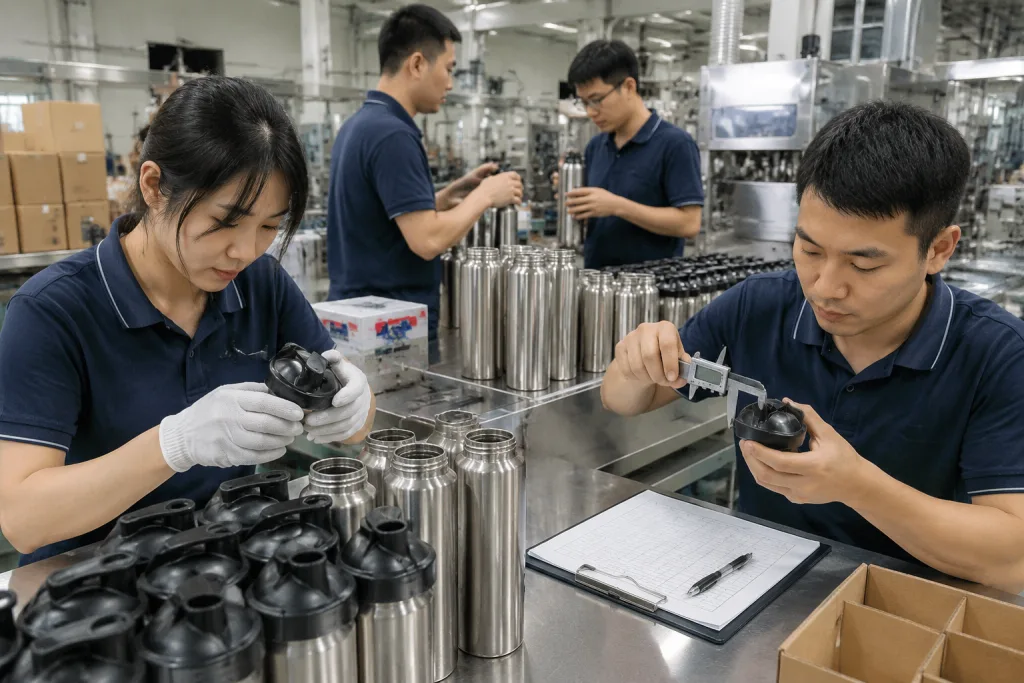
Ask for actual production photos from the last 30 days, not only showroom images. Simple request. A canteen manufacturer with clean assembly tables, labeled semi-finished goods, and calibrated leak-test stations is usually easier to work with than a cheaper canteen factory that cannot show process control. We run leak testers with a dated calibration sticker; if a supplier sends only angled beauty shots and no fixture, scale, carton mark, or AQL 2.5 inspection table, the math does not work for export orders.
MOQ, pricing, and tooling reality
MOQ trouble usually starts before we even quote. For a stock plastic shaker mold in China, 3,000 units per color is a workable MOQ; our injection line can run that without wasting too much PP resin during color changeover. Some canteen vendors will accept 1,000 units, but the unit price often rises 12-25%, and Pantone matching gets messy because a 25 kg resin batch is too small to tune cleanly. Stainless steel shaker MOQ can be 1,000 units per design when using an existing body and lid system. The wrong question is “Can you do 500 pcs?” The better question is “What price and color risk do I take below the normal run?”
For rough FOB pricing, basic 600-700 ml PP shakers often sit around USD 0.95-1.60 at 5,000-10,000 units, depending on lid complexity, ball or grid, logo method, and carton spec. Tritan can push the price to USD 2.20-3.50. Stainless steel single-wall shakers may be USD 3.20-5.20, while insulated versions can reach USD 5.80-8.50. We’ve seen buyers send back a quote because another factory was USD 0.18 cheaper, then QC pulled the sample and found a loose flip cap at 2.5 mm gap. These are not promises. They are guardrails so you can spot quotes that are padded or priced so low the math doesn’t work.
Private mold tooling is where buyers under-budget. A new shaker cup mold plus lid and cap can cost USD 6,000-18,000 for a relatively standard design, and that is before extra EDM work if the grip texture is deep. More complex locking lids, powder compartments, or textured grips can move above USD 25,000. Tooling time is normally 25-45 days before the first T1 sample; after that, expect at least one fitting round if the lid seal or thread start is off by 0.3 mm. If your launch is eight weeks away, choose a stock mold and customize color, logo, packaging, or accessories instead. We’ve seen this go sideways when a buyer approved tooling after a PO typo listed “700 ml” while the drawing showed 600 ml.
Decoration is usually cheaper than structural customization. Screen printing may cost USD 0.04-0.08 per color per position, and the line will check registration with a simple film ruler before mass run. Laser engraving on stainless is often USD 0.08-0.18. Heat transfer or full-wrap designs cost more but look better for retail because the logo area is larger and the edge finish is cleaner. For a canteen promotional program, simple logo work is fine. For distributor drinkware going into retail, spend the extra few cents on tighter print registration and stronger export cartons; a 9 kg master carton with weak corners gets flagged fast after a drop test.
Compliance and inspection are not optional
Protein shakers touch food, protein powder, and warm water, so compliance cannot sit in a folder until shipment week. For European buyers, we normally push LFGB food-contact testing, especially for Germany and retail accounts that reject EN-only paperwork. REACH still matters for powder coating, UV ink, silicone straps, hang tags, and printed cartons; QC once pulled a lid strap because the soft-touch coating did not match the tested BOM. For North America, buyers ask for FDA food-contact support, BPA-free statements, and Prop 65 review. If the shaker is sold for kids or packed with odd accessories like a pill box or mixing fork, expect ASTM and CPSIA questions too.
“Same material as last order” is not proof. This is the wrong question to ask. Ask for a test report that shows the material, item description, report date, lab name, and every tested component, then match it against the PO and final artwork file. On a 20,000 pcs customized drinkware order, we run pre-production samples using the final resin color, final logo ink, and final silicone seal; a caliper check on the seal lip should still land within the approved mm tolerance. A clear sample from one resin lot does not prove a blue retail unit with a black printed logo will pass.
For inspection, put AQL terms in the purchase order, not in a WeChat message after packing starts. A common setup is AQL 2.5 for major defects and 4.0 for minor defects, with critical defects at 0. Leaking lids, cracked bodies, sharp edges, wrong material, and unreadable volume marks belong under major or critical depending on the sales channel; we have seen this go sideways when a buyer called blurred 600 ml marks “minor” and the gym chain rejected 36 cartons. For shakers, we usually recommend pulling at least 80-125 units for functional leak checks on medium-sized orders, using warm water, a torque check on the lid, and 30 seconds of upside-down shaking on the inspection table.
Cheap inspection is still cheaper than airfreighting replacements after a distributor canteen launch fails.
If your canteen distributors sell across several countries, keep documents organized by SKU. One shared PDF buried in an email thread will not hold up when a retailer asks for proof six months after delivery, especially if the PO has one typo in the color code and the carton mark says “BLK” instead of “BLACK.” We ship document packs by SKU, report number, and production lot; boring work, but it saves 2 days vs 12 days of back-and-forth when customs or a retail compliance desk asks for the file.
Custom branding and packaging choices
Branding is where 7 out of 10 new buyers burn budget in the wrong place. You do not need a new body shape to build a strong customized canteen or shaker program. Start with the surface finish, color, logo wear, and packaging, because those are the first things your customer handles. We run 600 ml matte black shaker samples on the line every month; crisp white measurement marks and a clean kraft box beat a fancy custom mold with weak printing almost every time.
For plastic shakers, direct screen printing keeps the unit cost under control, but curved walls and textured grips punish small artwork. If your logo has text under 1.5 mm, QC will pull the sample and flag broken letters after the first print pass. In-mold labeling works for large programs, but the math does not work at 3,000 pcs because tooling and film setup eat the savings. For stainless steel, laser engraving holds up well for distributor growler, customized growler, and shaker lines where buyers want a premium look. Powder coating should pass cross-hatch adhesion testing, commonly 3M tape after 100-grid cuts, before you approve mass production.
Packaging depends on the sales channel. Amazon-style units need FNSKU labels, mailer boxes that survive a 1.2 m drop test, and carton dimensions that do not waste freight. Retail buyers ask for color boxes, barcode labels, warning text, and care instructions in 2 to 5 languages; last month a buyer flagged a PO typo where “dishwasher safe” appeared on a hand-wash-only lid. A canteen promotional order may only need bulk cartons and polybags, but check plastic bag suffocation warnings for the US and EU before the cartons close.
If you are building a wider customizable canteen or customizable growler range, keep the branding system locked across SKUs. Same Pantone. Same logo size logic. Same care card style. We ship 12-SKU distributor drinkware programs with one artwork control sheet, and it cuts proofing from 18 days to about 12 days when the buyer does not change fonts midstream. Without that discipline, the range looks like five unrelated factory samples, not a product family.
How to qualify a China supplier
Supplier qualification is not complicated. It just needs discipline. Start by confirming who is quoting: factory, export office, or trading company. A direct canteen manufacturer in Zhejiang or another China production hub should show business license details, workshop photos, audit reports, and a clear production flow from injection molding to packing. Ask for BSCI, Sedex, ISO 9001, or retailer-specific audits before sampling, not after your customer signs off the design. We had one buyer push this check until the PO stage; QC pulled the first sample, then the audit gap killed 12 days.
Make the RFQ specific. Send capacity in ml or oz, material, lid style, color count, logo method, packaging, testing requirements, target market, and order quantity with the first email. “Best price for custom drinkware” is the wrong question to ask. A proper RFQ for a 700 ml PP shaker, one Pantone body color, two-color logo, mixing ball, color box, 5,000 units, FOB Ningbo, LFGB testing gives protein shaker manufacturers something real to cost. On our line, changing from single-color pad print to two-color screen print adds a second fixture setup and about 0.18 USD per unit at this quantity.
Compare communication quality, not just unit price. Does the canteen supplier flag risks, or only say yes? A useful factory will tell you if your artwork has 0.25 mm lines that will fill in during screen printing, if the silicone seal color can migrate, or if your requested ship date sits too close to Golden Week. We run into this often: the buyer flagged a logo blur on a black lid, but the artwork was built for paper, not curved plastic. Honest pushback saves money.
Place a controlled first order. Do not launch ten SKUs with a new canteen vendor. Start with one or two SKUs, set AQL, approve pre-production samples, and book inspection. For a first 5,000-unit shaker run, we prefer one PP body color, one lid mold, and one packing method so the line can prove repeatability before assortment work starts. Once the supplier proves stable, expand into canteen customized programs, distributor canteen assortments, custom growler projects, or broader customizable drinkware lines.
Send your shaker RFQ before tooling decisions
Share quantity, material, logo, packaging, and target market. We will reply with practical MOQ, FOB pricing, and sampling options from Zhejiang.
Frequently asked questions
What MOQ should I expect from protein shaker manufacturers?
For stock plastic shaker molds, a realistic MOQ is 3,000 units per color. Some China factories accept 1,000-2,000 units, but expect a higher unit price, fewer color choices, or a surcharge for resin setup. Stainless steel shaker projects can start around 1,000 units per design if you use an existing body and lid. Private molds are different: you may need 10,000 units or more to make tooling cost sensible. If you are a canteen distributor testing a new market, start with a stock mold and customize logo, color, and packaging before paying for new tooling.
How long does production take after sample approval?
For repeat orders using existing molds, normal production is 25-35 days after sample approval and deposit. Add 5-10 days if you need custom color matching, complex packaging, or third-party testing. New tooling usually adds 25-45 days before the first mold trial sample, and another 7-14 days for adjustments. Shipping from Zhejiang through Ningbo or Shanghai to Europe often takes 30-40 days by sea, while US West Coast routes are commonly 18-25 days. Do not count factory lead time and ocean transit as the same schedule line.
Which material is best for a protein shaker?
PP is the most common choice for budget and promotional shakers because it is light, food-safe when properly sourced, and cost-effective. Tritan gives better clarity and impact resistance, but it costs more and may not fit every canteen promotional budget. Stainless steel is better for premium retail and gym accessory programs, especially if you want powder coating or laser branding. For any material, ask for BPA-free documentation and market-specific food-contact reports. The best material depends on your price point, target country, dishwasher claim, logo method, and whether the shaker is sold alone or inside a gift set.
Can one supplier handle shakers, canteens, and growlers?
Yes, if the supplier is a real custom drinkware factory with separate process control for plastic molding, stainless forming, coating, and assembly. Many buyers prefer one canteen supplier for shakers, custom canteen products, and custom growler programs because artwork, cartons, testing, and export documents stay consistent. The risk is assuming every factory is equally strong across all categories. Ask for recent production photos and order references for each product type. A supplier good at stainless distributor growler orders may still need extra checking on plastic shaker lid sealing and measurement mark printing.
What quality standard should I put in the purchase order?
Use written AQL terms instead of general wording like “good quality.” A common inspection level is AQL 2.5 for major defects and 4.0 for minor defects, with critical defects at 0. Define leaking, cracked body, wrong material, sharp edge, missing seal, unreadable logo, and wrong barcode as rejectable issues. For protein shakers, include functional leak testing and cap open-close checks. Also state approved sample, Pantone color tolerance, packaging layout, carton strength, and required test reports. This protects both sides because the canteen manufacturer knows exactly what will be checked before shipment.